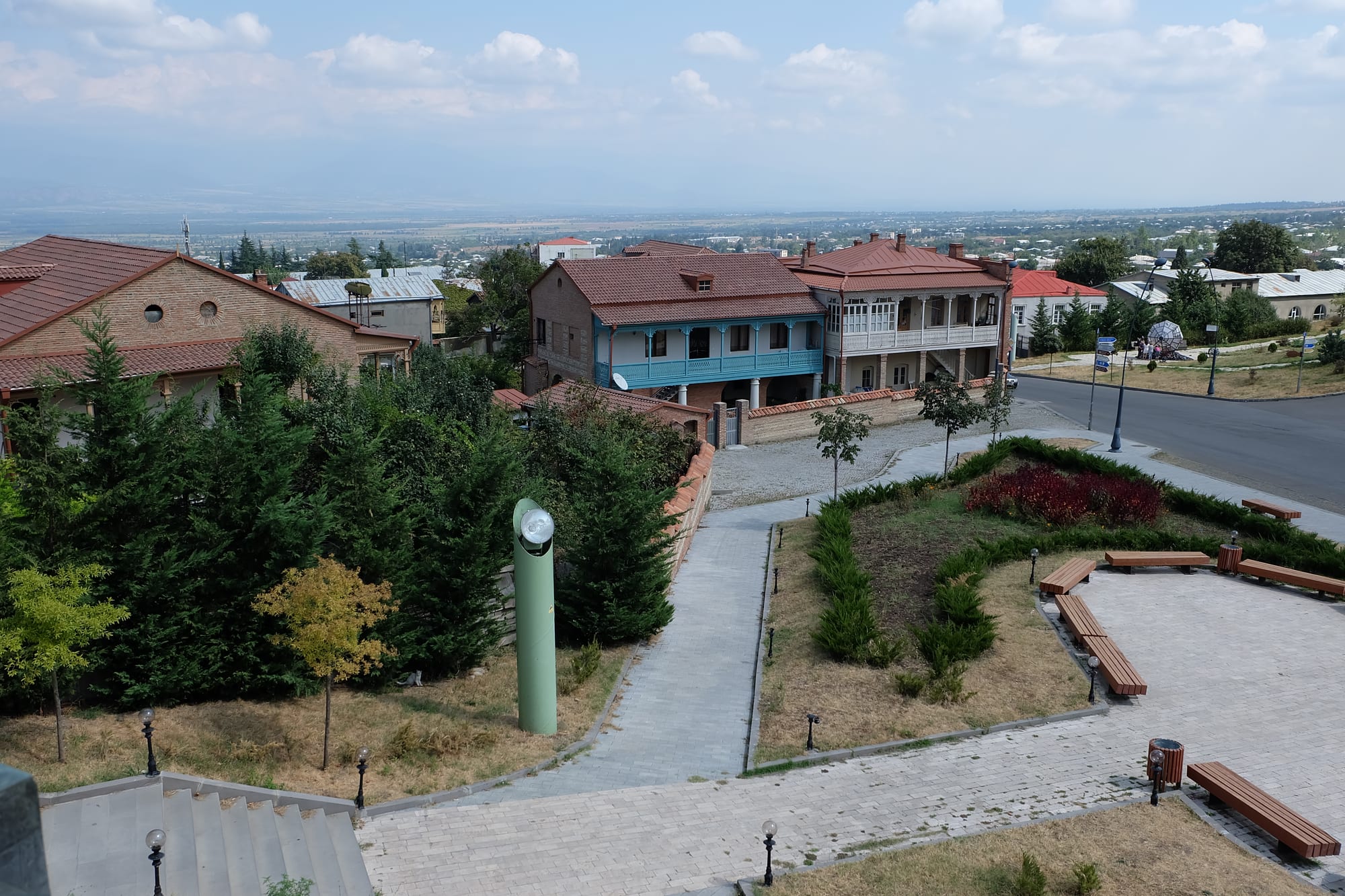
Red-roofed houses with wooden balconies on a slope in Telavi, with paths and benches in front and a wide hazy valley behind

Tbilisi, Kakheti & the East, Georgia

Telavi

Houses below the Batonis Tsikhe fortress in Telavi, looking out over the Alazani valley. (shankar s. / Wikimedia Commons · CC BY 2.0)

The main town of Kakheti in eastern Georgia, set on the slopes of the Gombori range above the Alazani valley with the Greater Caucasus on the skyline. It was the capital of the Kakhetian kingdom and the seat of King Erekle II, whose fortified palace still stands in the centre, and it remains the market and administrative town of Georgia's principal wine region.

Neighbourhoods

  • The town centre
    • First-time visitors
    • Historic district
    • Close to public transport

    The few blocks around Erekle II Avenue and the fortress walls, with the equestrian statue of the king, the museum, banks, cafés and the main bus stand. Most hotels and guesthouses are within a short walk, and the streets slope steadily downhill towards the valley.

    Open in Maps
  • Nadikvari
    • Views
    • Quiet
    • Walks

    The park and the streets along the ridge just west of the centre, laid out on a terrace above the valley with a viewpoint looking north to the Caucasus. It is the town's evening promenade, and several guesthouses sit on the quiet lanes behind it.

    Open in Maps
  • The market quarter
    • Local life
    • Best for food
    • Budget stays

    The lower streets around the covered and open market, busiest in the morning with produce, cheese, bread and household stalls. It is plain and workaday, close to the minibus stands, and gives the clearest view of how the town lives.

    Open in Maps
  • Kurdghelauri and the valley edge
    • Quiet and residential
    • Vineyards

    The suburb and villages spreading north-east of the town towards the valley floor, with houses in walled gardens, family vineyards and a scattering of larger guesthouses. Rooms here are cheaper and quieter, but a taxi or a long walk is needed for the centre.

    Open in Maps

Things to do

In the town

  • Batonis Tsikhelandmark

    The walled royal residence in the centre, built in the seventeenth century for the kings of Kakheti and later the home of King Erekle II, with two court chapels, bathhouses and a museum inside the rampart.

    Open in Maps
  • Telavi Historical Museummuseum

    The regional museum inside the fortress grounds, holding Kakhetian archaeology, weapons, church objects and paintings, alongside the restored royal apartments.

    Open in Maps
  • Statue of Erekle IIlandmark

    The equestrian monument to the eighteenth-century king who ruled from Telavi, standing on the terrace beside the fortress walls above the valley.

    Open in Maps
  • The Telavi plane treelandmark

    A vast oriental plane in the centre of town, reckoned at about 900 years old and some eleven metres around the trunk, a local landmark with benches beneath it.

    Open in Maps
  • Nadikvari Parkpark

    A small hillside park on the ridge west of the centre, with a lookout terrace facing the Alazani valley and the wall of the Greater Caucasus.

    Open in Maps

Monasteries and churches nearby

  • Alaverdi Monasterylandmark

    An eleventh-century cathedral rising above the vineyards about 15 kilometres north-west, for centuries the tallest church in Georgia, with a working monastic winery.

    Open in Maps
  • Ikalto Monasterylandmark

    A monastery in cypress woods a few kilometres west of the town, site of a medieval academy where winemaking was taught alongside theology and philosophy, and where the poet Shota Rustaveli is said to have studied.

    Open in Maps
  • Old Shuamtalandmark

    Three small early churches in forest on the Gombori road above the town, the oldest a fifth-century basilica.

    Open in Maps
  • New Shuamtalandmark

    A sixteenth-century convent founded by a Kakhetian queen, standing in woodland a short way beyond Old Shuamta.

    Open in Maps

Wine country around the town

  • Tsinandali Estateattraction

    The house, garden and historic cellar of the Chavchavadze family, where European and Georgian winemaking traditions were combined in the nineteenth century.

    Open in Maps
  • Gremilandmark

    The church and citadel of the sixteenth-century capital of Kakheti, razed by the army of Shah Abbas I of Persia in 1615 and standing alone on a hill in the valley.

    Open in Maps
  • Nekresilandmark

    A monastery founded in the sixth century, on a wooded slope above the north side of the valley, with wide views over the plain.

    Open in Maps
  • Kvareliattraction

    A wine town below the mountains, at the centre of the vineyards that produce Kindzmarauli, the semi-sweet red of the valley.

    Open in Maps

Seasonal events

  • RtveliSeptember to October

    The grape harvest, when the whole region picks and presses; guesthouses and wineries around Telavi invite visitors to join the work and the meals that follow.

  • AlaverdobaSeptember

    An old harvest feast centred on Alaverdi Monastery north of the town, now marked with a church service and a gathering of pilgrims and traders.

  • Tsinandali FestivalEarly autumn

    A festival of classical music held at the Tsinandali estate outside the town, on the grounds of the Chavchavadze house since 2019.

Eat and drink

Long-standing places and food districts in Telavi. Hours, ratings and directions come from your maps app, always current.

Kakhetian classics

  • Restaurants of the town centreneighborhood

    The streets around Erekle II Avenue hold most of the town's restaurants, serving mtsvadi grilled over vine cuttings, chakapuli, khinkali and Kakhetian wine by the jug.

    Open in Maps
  • Guesthouse suprasrestaurant

    Family guesthouses in and around the town cook dinner for their guests and pour their own wine, often at a shared table with toasts led by the host.

    Open in Maps

Markets and cellars

  • Telavi marketmarket

    The town's daily market, strongest in the morning, with vegetables, herbs, cheese, spices, churchkhela and hot bread from tone ovens nearby.

    Open in Maps
  • Wine cellars around Telavineighborhood

    Family marani cellars and larger wineries in the surrounding villages pour Saperavi, Rkatsiteli and amber wines made in buried qvevri, usually with bread and cheese.

    Open in Maps

Experience Telavi

History

Telavi appears in the records from the tenth century, when an Arab geographer listed it among the towns of the Caucasus, and from then until the twelfth century it was the capital of the kingdom of Kakheti. After the collapse of united Georgia the Kakhetian capital was at Gremi, sacked by Shah Abbas's army in 1615, and then returned to Telavi, which became the royal seat in the seventeenth century. The fortified residence of Batonis Tsikhe in the centre of town dates from that period.

The town's best-known figure is Erekle II, born here in 1720, who ruled Kakheti and then the united kingdom of Kartli-Kakheti for most of the eighteenth century. He rebuilt the palace, fortified towns across the region, including Sighnaghi, and in 1783 signed the Treaty of Georgievsk placing his kingdom under Russian protection — protection that did not arrive when a Persian army marched on Tbilisi in 1795. He died in Telavi in 1798, and his equestrian statue stands beside the fortress.

Under Russian rule the town became a district centre and a market for the wine and grain of the Alazani valley, with Armenian and Jewish trading families alongside Georgians. The Soviet period brought wine factories, workshops and blocks of flats on the edges. Independence and the collapse of the state wine monopoly hit the region hard in the 1990s, and the Russian embargo on Georgian wine from 2006 forced producers to seek new markets. Since then family wineries, restored estates and visitors have gradually rebuilt the town's fortunes.

Culture & Customs

Telavi is the centre of a region whose identity is built around wine. Households keep a marani, a cellar with qvevri buried to the neck, in which grapes ferment on their skins in a method inscribed by UNESCO as intangible cultural heritage. The rtveli harvest in September and October organises the year, and the churches, cellars and vineyards around the town are the setting for most of its public life.

The supra is taken seriously here. A tamada leads the toasts in order — peace, the homeland, the dead, family, guests — and each is answered by the table, often with polyphonic singing, another UNESCO-listed Georgian tradition. Kakhetians have a reputation across the country for open-handedness and for saying what they think, and a visitor who accepts an invitation to a cellar should expect to stay for a meal.

Religious life is strong, centred on Alaverdi Monastery north of the town, whose September feast of Alaverdoba is an old harvest gathering that draws people from across the region, and on the monasteries of Ikalto and Shuamta in the hills. Ikalto's medieval academy, linked by tradition to the poet Shota Rustaveli, gives the district a place in Georgian literary memory. More recently the Tsinandali estate outside town has added an international classical music festival to the autumn calendar, and craft traditions — the potting of qvevri, felt and carpet weaving — continue in the villages.

Daily Life

About 17,000 people live in Telavi, making it the largest town in Kakheti and the administrative centre of the municipality, with a hospital, courts, a state university and the schools and offices that the valley's villages depend on. The population has fallen since Soviet times, and many households have relatives working in Tbilisi or abroad.

The regional economy is agricultural above all. Grapes dominate, with wineries ranging from cellars selling a few hundred bottles to substantial commercial producers, and the town also handles grain, fruit, walnuts, sunflowers and livestock from the plain. Tourism has grown steadily, bringing guesthouses, restaurants and drivers, although most visitors treat Telavi as a base rather than a destination and Sighnaghi takes a larger share of them.

The day begins early: the market is busiest soon after dawn, offices and shops open mid-morning, and the heat of a summer afternoon empties the streets until evening, when families walk in Nadikvari Park and along the avenue. Weekends and harvest weeks pull people out to village houses and cellars. Low wages, seasonal work, the state of rural roads and the price that wineries pay for grapes are the recurring subjects of conversation.

Food

Telavi eats the cooking of Kakheti, meatier and less herb-heavy than that of western Georgia. Mtsvadi — pork or lamb skewered and grilled over dried vine cuttings — is the centrepiece of a feast, served with raw onion and pomegranate seeds. Chakapuli, lamb or veal stewed with tarragon, spring onions and sour green plums, belongs to spring; chanakhi, lamb baked in a clay pot with aubergine and tomato, to colder months; and khinkali, pleated dumplings of spiced meat and broth, are eaten all year in plain dining rooms around the centre.

The table opens with vegetable and walnut dishes: pkhali of spinach, beetroot or cabbage ground with walnuts, garlic and coriander; badrijani nigvzit, fried aubergine rolled around walnut paste; lobio, beans stewed with herbs and eaten with cornbread; and sheep's or cow's cheese from the valley. Shotis puri, the canoe-shaped loaf slapped onto the wall of a clay tone oven, is bought hot from bakeries through the day, and in autumn churchkhela — walnuts threaded on string and dipped in thickened grape juice — hangs in every market stall.

Wine is the region's reason for being known abroad. Saperavi, a dark-fleshed red grape, and the white Rkatsiteli are the mainstays, and the appellations of the surrounding villages — Tsinandali, Mukuzani, Napareuli, Vazisubani and the semi-sweet red Kindzmarauli from Kvareli — come from vineyards within a short drive. Amber wine, white grapes fermented on their skins in qvevri, is the traditional Kakhetian style, and chacha, a spirit distilled from the pressings, closes a meal.

Planning tools

Budget

Telavi is a working town rather than a resort, and it is cheaper than Sighnaghi or Tbilisi for both rooms and meals. Guesthouses often include dinner with house wine. Tastings at family cellars cost very little, while the larger estate wineries charge more, and the main extra cost is a car or driver to reach cellars and monasteries scattered around the valley.

Daily Budget Midrange
USD 70–130 (good guesthouse or hotel, restaurant dinners with wine, a driver for a day around the wine country)
Daily Budget Shoestring
USD 30–50 (guesthouse room or hostel bed, market food and bakeries, marshrutkas from Tbilisi and around the valley)

Rooms are hardest to find and dearest during the September and October harvest; village cellars are usually far better value than estate tasting rooms.

Best Time to Visit

May and June are green and clear, with snow still on the Caucasus behind the valley. September and October bring the harvest, warm days and the busiest, most sociable weeks of the year. July and August are hot on the valley floor. Winter is cold, quiet and cheap, with the mountains often under cloud.

Suggested Number of Days

A day covers the town itself, which is small. Three or four days suit the wine villages, monasteries and valley roads around it, which are spread out and slow to reach. Harvest season and long lunches both stretch a stay.

First Visit
1–2 days
With Surroundings
3–4 days

Transportation

The centre is walked in twenty minutes, and it is downhill from the fortress to the market. Marshrutkas and shared taxis leave the central stands for Tbilisi, Sighnaghi, Kvareli and the valley villages, though services thin out in the afternoon. Taxis are cheap and are the usual way to reach wineries, and some visitors hire a car or a driver for the day.

Check the return time of the last minibus before setting out for a village, and arrange a driver through a guesthouse for a day of tastings.

Airport & Station Connections

Telavi lies about 90 kilometres east of Tbilisi, some two hours by road over the Gombori pass or rather longer by the lower route through Sagarejo. Marshrutkas run through the day from Tbilisi's Ortachala and Isani stands, and shared taxis cover the same route. Sighnaghi is about an hour away across the valley, and the nearest airport is Tbilisi International.

Walkability

The town is compact and walkable, but it is built on a slope, so the return from the market to the fortress is a steady climb. Pavements are uneven in places and poorly lit at night. The monasteries and wineries outside town are too far to walk, apart from Ikalto, which is a long walk on a road with little shade.

Safety

Telavi is quiet and crime against visitors is uncommon. The everyday hazards are traffic on narrow streets and the winding Gombori pass road, uneven pavements and stray dogs; summer heat is strong on the valley floor and afternoon thunderstorms are common.

Do not drive after tastings — use a hired driver or taxi — and take care on the pass road in rain, fog or snow. Check current official travel advice before travelling.

Climate

A moderate continental climate in a sheltered valley, drier than western Georgia. Spring and autumn are mild, with most rain in late spring and thunderstorms in summer; the mountains to the north keep snow into early summer.

Summer
hot, with July and August days commonly around 30–33°C and warm evenings
Winter
cold but not severe, with January days around 0–5°C, some snow and frequent frost at night

Local Customs

Kakhetian hospitality is emphatic, and a visit to a family cellar usually becomes a meal with toasts led by a tamada, answered by the whole table; wine is drunk down at a toast rather than sipped, and beer is not used for toasts. Churches and monasteries expect modest dress, with shoulders and knees covered and a headscarf and skirt for women, generally lent at the entrance.

Tipping is not obligatory but rounding up is usual; ask before photographing people at work in cellars or vineyards, and avoid photographing services inside churches.

Common Payment Methods

The currency is the Georgian lari. Hotels, larger restaurants and estate wineries take cards, and there are ATMs in the centre, but the market, family cellars, small guesthouses and minibuses want cash, so carry small notes.