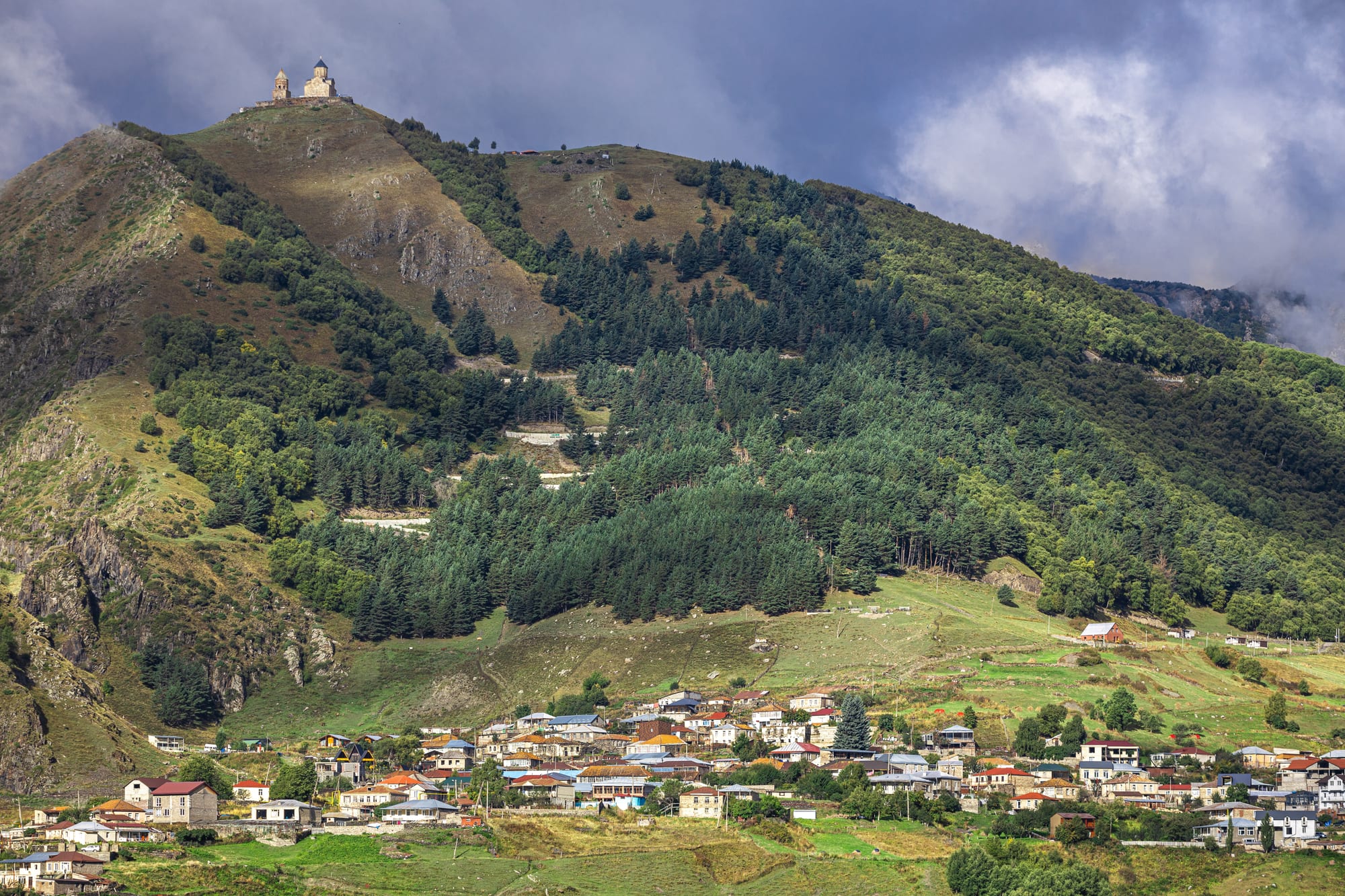
Metal-roofed village houses on a green valley floor below a steep wooded ridge, with a small stone church standing on the summit

Tbilisi, Kakheti & the East, Georgia

Stepantsminda

Stepantsminda below the ridge carrying Gergeti Trinity Church, in the Greater Caucasus. (Supanut Arunoprayote / Wikimedia Commons · CC BY 4.0)

A mountain village in the Greater Caucasus of northern Georgia, on the Georgian Military Highway at about 1,740 metres. Long known as Kazbegi, it sits in the valley of the Tergi river beneath the glaciers of Mount Kazbek, with the medieval Gergeti Trinity Church on the ridge above. Herding and the road built it; walking and climbing now sustain it.

Neighbourhoods

  • The village centre
    • First-time visitors
    • Close to transport
    • Best for food

    The few streets around the main square on the highway, where marshrutkas and shared taxis stop and where the shops, bakery, small restaurants and most guesthouses are. Everything is within a ten-minute walk, and the church on the ridge is in view from almost every corner.

    Open in Maps
  • Gergeti
    • Views
    • Walks
    • Quiet

    The village across the Tergi river, joined to the centre by a bridge, from which the steep path and the rough road climb to the Trinity church. It is quieter than the centre, has guesthouses with long views, and lies closest to the start of the walks.

    Open in Maps
  • The upper slopes above the highway
    • Views
    • Hotels

    Houses and newer hotels on the eastern hillside above the main road, built to face Mount Kazbek and the church. The climb up is steep, but the outlook is the widest in the village.

    Open in Maps
  • Sno and the side valleys
    • Quiet
    • Hiking
    • Local life

    Small farming settlements a short drive south and east, at the mouths of the Sno and Snostskali valleys, with a medieval tower, stone sculptures beside the road and tracks leading on towards Juta. Guesthouses here are simple and the hamlets very quiet.

    Open in Maps

Things to do

Landmarks and viewpoints

  • Gergeti Trinity Churchlandmark

    A medieval stone church with a separate bell tower on a ridge at 2,170 metres above the village, reached on foot in two to three hours or by rough road.

    Open in Maps
  • Mount Kazbekviewpoint

    A dormant stratovolcano of 5,054 metres just south of the border with Russia, the highest mountain in eastern Georgia, carrying glaciers on several flanks and tied in legend to the chaining of Amirani, the Georgian Prometheus.

    Open in Maps
  • Georgian Military Highwaylandmark

    The historic road over the Caucasus between Tbilisi and Vladikavkaz, which passes through the village and gave it its importance.

    Open in Maps

Walks and mountain trips

  • Dariali Gorgelandmark

    The narrow rock defile of the Tergi north of the village, the ancient gateway through the Caucasus and the site of the road crossing into Russia.

    Open in Maps
  • Gveleti Waterfallstrail

    Two waterfalls in a side valley off the Dariali road, the lower one reached by a short walk from the parking area, the upper by a rougher path.

    Open in Maps
  • Jutatrail

    A high hamlet at around 2,200 metres up the Snostskali valley, a common base for the walk towards the Chaukhi massif and its jagged rock towers.

    Open in Maps
  • Truso Valleytrail

    A broad valley west of the highway with ruined defensive towers and villages left largely empty by the conflicts of the 1990s and 2008; it lies in a border zone where a checkpoint asks walkers for identity documents.

    Open in Maps
  • Sno Fortresslandmark

    A medieval tower on a rock above the village of Sno, a short drive up the side valley from Stepantsminda.

    Open in Maps

Along the highway

  • Gudauriattraction

    The country's best-known ski resort, on the high plateau by the Jvari Pass at about 2,200 metres and some 30 kilometres away by road, with a season from December to April and paragliding in summer.

    Open in Maps
  • Russia–Georgia Friendship Monumentviewpoint

    A curved concrete terrace of 1983 lined with a mosaic mural, standing above the Devil's Valley on the pass road south of the village.

    Open in Maps
  • Ananurilandmark

    A fortified complex of churches and towers on the Aragvi, seat of the dukes of Aragvi and a guard post on the old road south of the mountains.

    Open in Maps

Eat and drink

Long-standing places and food districts in Stepantsminda. Hours, ratings and directions come from your maps app, always current.

Mountain cooking

  • Guesthouse tablesrestaurant

    Family guesthouses serve the local repertoire — khinkali, lamb and potato stews, bean lobio, sheep's and cow's cheese and homemade bread — usually as a set dinner.

    Open in Maps
  • Khinkali houses by the squarerestaurant

    Small restaurants around the central square serve khinkali by the dozen, a mountain dish in origin, along with soups and grilled meat for walkers coming off the hill.

    Open in Maps

Shops and supplies

  • Village shops and bakerymarket

    General shops and a bakery on and just off the main road sell bread, cheese, dried fruit, churchkhela and provisions for the trails; there is no large supermarket.

    Open in Maps

Experience Stepantsminda

History

The settlement grew where the Tergi valley widens below Mount Kazbek, in the district of Khevi, whose Mokhevian people held the route through the mountains. Their duty was to guard the pass, and the ruined towers and hilltop shrines in the side valleys date from the centuries when raids came through the Dariali gorge, the narrow defile fortified in ancient times and known as the Caucasian Gates. Gergeti Trinity Church was built on the ridge above in the Middle Ages, far enough from the road to serve as a refuge in times of invasion.

The Russian Empire cut the Georgian Military Highway through the mountains in the first half of the nineteenth century, and the village became a staging post on it, with a post station where travellers changed horses. Pushkin, Lermontov and Alexandre Dumas all passed this way and wrote about the gorge and the mountain. The village was then called Stepantsminda, after a monk named Stephan, and in 1925 it was officially renamed Kazbegi, after the local family of that name whose best-known member was the writer Alexander Kazbegi, who came home from study in Tbilisi and Russia to work as a shepherd before writing stories of Khevi life.

Soviet rule brought a road, a museum and a population that lived from herding, the highway and the mineral springs of the district. The frontier closed and reopened as relations with Russia changed, and the nearby crossing at Dariali carries heavy lorry traffic when open. In 2006 the village recovered its original name of Stepantsminda, although both names remain in use. In recent decades walking, climbing and new hotels have reshaped its economy.

Culture & Customs

Khevi keeps a distinct mountain identity within Georgia. The Mokhevians speak a dialect of Georgian and preserve customs from before Christianity alongside their Orthodox faith: khati shrines on hills and rocks, sacred groves and sites tended by a khevisberi, an elder who leads prayers and sacrifices at community feasts. Some shrines are closed to women or to strangers, and villagers are quiet rather than secretive about them.

The year is marked by church feasts that double as community gatherings, with sheep and cattle slaughtered, beer brewed for the occasion and wrestling and horse racing in some villages. Guests are received with formality: a table is laid, a toastmaster leads, and the first toasts are for peace and for the dead. Refusal to eat or drink at all is taken as a slight, though moderation is understood.

The literary image of the region comes from Alexander Kazbegi, whose nineteenth- century stories about Khevi shepherds and clan honour are taught in Georgian schools, and from Russian Romantic writers who described the Dariali gorge as the edge of the known world. The mountain itself carries the older legend of Amirani, the hero chained to a Caucasian peak for defying the gods, a tale close to the Greek story of Prometheus. Traditional felt-making, woollen knitting and cheese-making continue in the households of the valley.

Daily Life

Rather more than a thousand people live in Stepantsminda, about half the population of the municipality, with the rest spread through its villages — Gergeti across the river, Sno, Achkhoti, Sioni and the scattered hamlets of the side valleys. It is the administrative centre of Kazbegi Municipality, with the school, clinic, police station and shops that the surrounding settlements rely on.

Livelihoods come from three sources: livestock, mainly sheep and cattle moved between valley pastures and high summer grazing; the highway, with its lorry traffic to and from the Russian border, its drivers, mechanics and cafés; and tourism, which has grown quickly, turning many houses into guesthouses and drawing seasonal workers from Tbilisi. The natural mineral springs of the district are a further local resource.

Life follows the seasons rather than the clock. Summer is short and busy, with haymaking, herding and a stream of visitors; winter is long, and snow can close roads for days, leaving the village on its own. Young people leave for Tbilisi for work and study, and the population is older than the national average. Electricity supply, the state of side roads, the pressure of new building on a small village and the unpredictable border trade are all everyday concerns.

Food

Mountain food here is plain, warming and based on what the pastures give. Khinkali, the pleated dumplings of spiced meat and broth now eaten across Georgia, are credited to the mountain peoples of this region and are the dish most visitors eat; they are held by the knot, bitten at the side and drunk from. Meat is usually lamb or beef, stewed with potatoes and herbs or grilled as mtsvadi over wood.

Dairy is central. Sheep's and cow's milk cheeses, fresh and salted, appear at every meal, and are folded into khachapuri, into boiled dough with butter, and into mountain versions of khinkali and dumplings. Wild herbs, mushrooms and berries from the slopes are gathered in summer, and jams and pickles are made for the winter. Bread is baked at home or bought from the village bakery, and hot soups — bean lobio or a sour chikhirtma — appear at the end of a cold day.

Kakheti's wine reaches the village by lorry rather than growing here: this is too high for vines, and the local strong drink is chacha, a clear spirit distilled from grape pressings, poured at toasts. Home-brewed barley beer, ludi, has a long history in the Caucasus mountain districts and is still made for village feasts. Mineral water from springs in the region is drunk everywhere, and tea with mountain herbs is the ordinary drink of a guesthouse evening.

Planning tools

Budget

Sleeping and eating here are cheap by European standards, though prices rise in July and August when rooms are scarce. Guesthouses are the usual choice and often include dinner and breakfast. The real costs are transport — a shared taxi or a hired 4x4 for Juta, Truso or the church road — and any hire of a guide or equipment for the high mountains.

Daily Budget Midrange
USD 70–130 (comfortable hotel or good guesthouse, restaurant meals, a hired 4x4 or driver for the side valleys)
Daily Budget Shoestring
USD 30–50 (guesthouse room or hostel bed, guesthouse meals, marshrutka from Tbilisi, walking rather than driving)

Book rooms ahead for August and for weekends; carry enough cash for a hired jeep, as drivers rarely take cards.

Best Time to Visit

June to September is the walking season, when the passes are clear, the meadows are in flower and the higher valleys can be reached. May and October are quieter, cooler and often wet, with snow possible on the tops. Winter brings deep snow, short days and the risk of the Jvari Pass closing, but also the nearby skiing at Gudauri.

Suggested Number of Days

One or two days are enough for the village and the church on the ridge above it. Three or four allow the side valleys and longer walks, which need whole days. Weather is the main variable: cloud can hide the mountain for days at a time, so spare time is worth having.

First Visit
1–2 days
With Surroundings
3–4 days

Transportation

The village is small enough to walk. Marshrutkas and shared taxis run along the highway to and from Tbilisi, and local drivers wait near the square with 4x4 vehicles for the rough roads up to Gergeti, Juta, Truso and the Gveleti falls. There is no local bus service, and hitching a lift is common among walkers.

Agree the price and the waiting time with a jeep driver before setting out, and check with a guesthouse whether a track is passable before hiring one.

Airport & Station Connections

Stepantsminda lies about 155 kilometres north of Tbilisi on the Georgian Military Highway, usually three to four hours by road over the Jvari Pass. Marshrutkas leave Tbilisi's Didube station through the day, and shared taxis and tours cover the same route. The Russian border at Dariali is a few kilometres further north, and there is no railway or airport nearby.

Walkability

The village itself is easily walked, though the streets are steep, often unpaved and can be muddy or icy. Beyond it, distances are mountain distances: the climb to Gergeti Trinity Church gains about 400 metres and takes two to three hours up, and the valleys beyond need a full day or a vehicle.

Safety

The village is safe, and crime against visitors is rare. The hazards are those of high mountains: sudden weather changes, exposure, altitude on the higher routes, rockfall, unbridged stream crossings, livestock guard dogs on the pastures, and winter avalanche danger and road closures on the Jvari Pass. The Russian frontier lies a short way north and is not a place to wander.

Leave word at the guesthouse before a long walk, carry warm and waterproof layers even in August, keep off the glaciers of Mount Kazbek without a guide and proper equipment, and stay well clear of the border. Check current official travel advice before travelling.

Climate

An alpine climate at about 1,740 metres, far colder than the lowlands. Weather changes quickly, cloud often fills the valley in the afternoon, and the mountain may be hidden for days before clearing at dawn.

Summer
cool and changeable, with July and August days usually around 20°C and nights that fall close to 10°C or below
Winter
cold and snowy, with January days usually between -10°C and 0°C, heavy snowfall and hard frosts at night

Local Customs

This is Khevi, home of the Mokhevian mountain people, whose traditions mix Orthodox Christianity with much older shrine customs; hilltop shrines and crosses should be treated with respect and some are not open to women or to outsiders. Modest dress is expected at Gergeti Trinity Church, with shoulders and knees covered and a headscarf and skirt for women, usually lent at the door. Hospitality is strong and refusing a toast outright is awkward.

Ask before photographing people, houses or shrines, close gates on the pastures, and do not fly a drone near the church, the border or livestock.

Common Payment Methods

The currency is the Georgian lari. Hotels and some restaurants take cards and there are a couple of ATMs in the village, but guesthouses, jeep drivers, small shops and marshrutkas generally want cash, and machines can be empty in high season, so bring lari from Tbilisi.