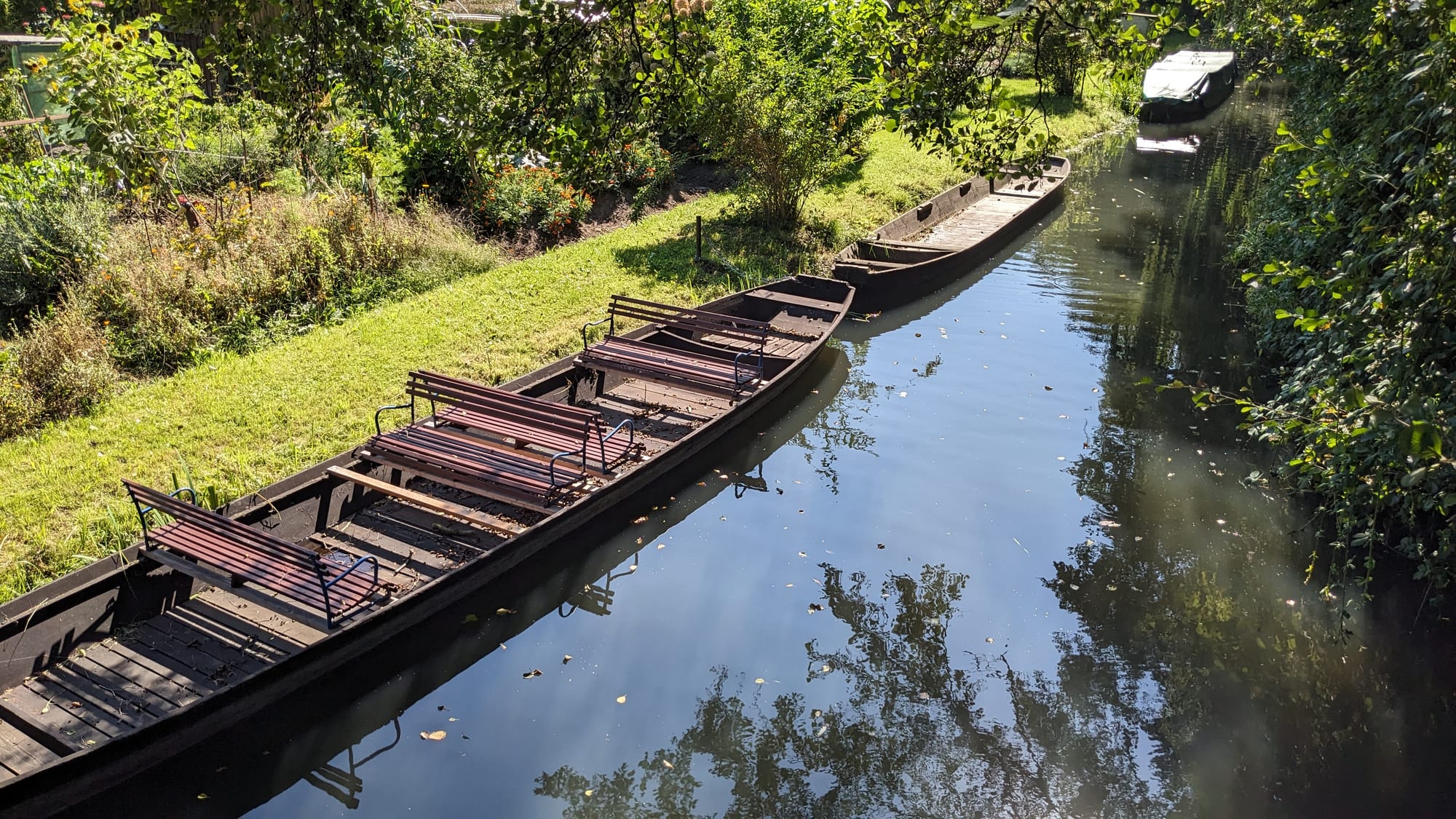
Long flat-bottomed wooden punts with benches moored along a grassy bank of a still, tree-shaded canal in Lübbenau

Berlin & Brandenburg, Germany

Lübbenau

Traditional Spreewald punts moored on a canal in Lübbenau. (TricksterWildcat / Wikimedia Commons · CC BY-SA 4.0)

A small town in Lower Lusatia on the edge of the Spreewald, where the Spree divides into a maze of canals through wet woodland. Known as the gateway to the Spreewald, it grew on vegetables and gherkins, became a lignite power town under East Germany, and now lives largely on the punts and canoes that carry visitors to the canal villages of Lehde and Leipe.

Neighbourhoods

  • Old town and the harbour
    • First-time visitors
    • Boat trips
    • Historic district

    The small historic centre around the Nikolaikirche and the 18th-century gatehouse, a short walk from the Großer Spreewaldhafen, the main landing stage where the punts set off. The castle park with its orangery lies at the edge of the old town.

    Open in Maps
  • Lehde and Leipe
    • Canal villages
    • Quiet
    • Nature

    Two villages within the town's boundaries where branches of the Spree take the place of streets, with farmhouses, gardens and wooden footbridges along the water. Lehde is the classic destination of a punt trip and holds an open-air museum.

    Open in Maps
  • Neustadt
    • Local life
    • East German history

    The residential new town built from 1958 onwards in prefabricated blocks for the workers of the power station and the lignite mines. Partly demolished since 2002 as the population fell, it holds the town's shopping centre and much of its housing.

    Open in Maps

Things to do

On the water

  • Großer Spreewaldhafentransit hub

    The main boat harbour on the Spree, rebuilt in 1999 and 2005, where the traditional punts leave for trips through the canals.

    Open in Maps
  • Lehdeneighborhood

    The canal village just east of the town where the waterways are the streets, the usual goal of a punt trip or a walk along the towpaths.

    Open in Maps
  • Spree Forestpark

    The inland delta of the Spree, a UNESCO biosphere reserve since 1991, with more than 200 small canals totalling some 1,300 kilometres, explored by punt, canoe or kayak.

    Open in Maps

Museums and the old town

  • Freilandmuseum Lehdemuseum

    An open-air museum opened in 1957 in Lehde, with three farmsteads typical of the region moved to the site.

    Open in Maps
  • Spreewaldmuseummuseum

    The local museum, now housed in the gatehouse of 1780 in the old town, with exhibitions on the history of the Spreewald gherkin and on Sorbian costume.

    Open in Maps
  • Nikolaikirchelandmark

    The church of St Nicholas in the old town, where services were once also held in Lower Sorbian.

    Open in Maps
  • Castle park and orangerypark

    The landscaped park around the castle of 1817–20, with the orangery added in 1820 and ponds at its eastern end.

    Open in Maps

Short trips from the town

  • Lübbenneighborhood

    The neighbouring Spreewald town and district capital, between the Upper and Lower Spreewald, another starting point for boat trips.

    Open in Maps
  • Lusatian Lake Districtpark

    A chain of artificial lakes being created by flooding decommissioned lignite opencast mines across southern Brandenburg and northern Saxony.

    Open in Maps

Seasonal events

  • Easter egg fairbefore Easter

    The Lübbenauer Ostereiermesse, held at the Spreewaldmuseum, where decorated Sorbian Easter eggs are shown and sold.

  • Spreewald- und Schützenfestfirst weekend of July

    The town's annual festival, with a Kahnkorso, a parade of decorated punts on the water.

Eat and drink

Long-standing places and food districts in Lübbenau. Hours, ratings and directions come from your maps app, always current.

Lübbenau classics

  • Spreewald gherkinsmarket

    The protected local pickled cucumbers, sold from stalls and shops around the harbour as mustard gherkins, dill pickles and other varieties.

    Open in Maps

Food districts

  • Harbour and old townneighborhood

    Restaurants, cafés and snack stalls cluster around the boat harbour and the old town streets leading to it.

    Open in Maps

Experience Lübbenau

History

Archaeological finds from the Stone Age show early settlement in the area, and the Lower Sorbian name, Lubnjow, can be traced to the personal name Lubin, a short form of Lubomir, meaning 'the peace-loving'. The castle is first recorded in 1301 and the town in 1315. Lübbenau was a lordship town, ruled by a series of noble families until Elisabeth zu Lynar acquired it in 1621; the counts of Lynar then held it until the end of the Second World War, when the family was expropriated after Wilhelm Graf zu Lynar's part in the 20 July 1944 plot against Hitler. The gatehouse in the old town was completed in 1780, and the present castle was built in 1817–20.

The town lived on its waterlogged land. By the 18th and 19th centuries its farmers were shipping gherkins, onions and horseradish to Berlin, Dresden and Leipzig, and the harbour was a loading point for vegetables. Tourism began in 1882, when the local teacher Paul Fahlisch started offering organised punt trips and advertised them in the cities; he also helped found the Spreewaldmuseum.

Under East Germany the town was transformed. The Lübbenau lignite power station, in its day the largest steam power station in Europe, and the opencast mines nearby brought workers from across the country, and the population rose from about 5,600 in 1946 to about 22,000 by 1976, housed in a new town of prefabricated blocks. Pollution was severe, and studies found lung and blood disease among residents. The power station closed in 1996 and was demolished by 2010; some 1,300 flats in the new town were pulled down between 2002 and 2014, while the Spreewald became a UNESCO biosphere reserve in 1991 and tourism took over as the town's main business.

Culture & Customs

Lübbenau lies in Lower Lusatia and in the official settlement area of the Sorbs, or Wends, a Slavic minority; the town's full name is bilingual, Lübbenau/Spreewald and Lubnjow/Błota. Services in Lower Sorbian were held in the town church until 1867, and a count in 1884 found about 150 Sorbs among some 3,800 inhabitants. Sorbian tradition survives in festive costume, in the decorated eggs shown and sold at the Easter egg fair, and in the villages around the town.

The punt, or Kahn, is the town's symbol. Long flat-bottomed boats, poled along by a ferryman standing at the stern, were the working boats of a landscape where canals take the place of roads, and they now carry visitors to Lehde and beyond. The writer Theodor Fontane took a boat trip from the old loading point at the harbour, and the town still sees itself as the 'gateway to the Spreewald'. The festival on the first weekend of July ends with a parade of decorated punts on the water.

Since 2006 the old town has belonged to Brandenburg's association of towns with historic centres, and the Spreewaldmuseum keeps the region's story, from Sorbian dress to the gherkin trade.

Daily Life

Lübbenau is a small town whose population has fallen since its East German peak of about 22,000 in 1976, as many residents left after the last mine and the power station closed in 1996. The town area is large and mostly meadow and farmland, taking in villages such as Lehde, Leipe, Boblitz, Ragow and Zerkwitz, several of them inside the biosphere reserve. Most residents live either in the old town and its surrounding streets or in the Neustadt, where the remaining prefabricated blocks have been partly renovated.

Tourism is now the main industry: boatmen, guesthouses, restaurants and the gherkin trade depend on the summer season. Gherkins have long been part of the local economy, and they are still grown and pickled across the Spreewald. The lakes south of the town have been created by flooding the old lignite pits, part of a wider effort to give the former mining country a new future.

The rhythm follows the seasons. From spring to autumn the harbour is busy from morning, punts leave in a steady stream, and the canal paths fill with walkers and cyclists; in winter the town is quiet. Regional trains connect it with Berlin.

Food

The Spreewald gherkin is the town's emblem: a pickled cucumber from the region protected by the European Union as a Protected Geographical Indication. Lübbenau has long been its main trading centre, and stalls around the harbour and along the canals sell it in many forms, from mustard gherkins (Senfgurken) to spiced dill pickles (Gewürzgurken). Fermentation in large barrels once took several weeks; today most gherkins are ready for sale after a day of processing. The Spreewaldmuseum has an exhibition on their history, and a long-distance cycle route, the Gurkenradweg, links gherkin sites across the Spreewald.

Horseradish and onions were grown and exported alongside the gherkins, and both still turn up in local cooking. Quark with linseed oil, eaten with potatoes boiled in their skins, is a traditional dish of Lusatia and especially the Spreewald, and Plinse, a name borrowed from Sorbian, are round pancakes, in Lusatia often made with buttermilk. Restaurants around the harbour serve Spreewald dishes alongside fish and game.

Planning tools

Budget

Lübbenau is cheaper than Berlin or Potsdam, with modest guesthouse prices, though rooms near the water fill up in summer. The main extra cost is the boat: a punt trip or canoe hire is the reason most people come.

Daily Budget Midrange
USD 120–220 (guesthouse, restaurant meals, a longer punt trip or canoe hire, museum tickets)
Daily Budget Shoestring
USD 60–100 (hostel or campsite, gherkins and snack-stall food, a shared punt trip, regional train)

A Deutschlandticket covers the regional trains from Berlin; walking or cycling the towpaths to Lehde costs nothing.

Best Time to Visit

April to October, the season for the punts, with summer the busiest time and the first weekend of July bringing the town festival and its parade of boats. Late spring and early autumn are quieter on the water. Winter is cold and still, with fewer boats running.

Suggested Number of Days

Many visitors come for a single day from Berlin. Two or three days allows time to paddle further into the Spreewald by canoe, cycle its paths and see the neighbouring towns at a slower pace.

First Visit
1 day
With Surroundings
2–3 days

Transportation

The old town, the harbour and the castle park are close together, and Lehde is reached on foot along the towpaths, by bicycle or by boat. Punts leave from the harbour with a ferryman who poles the boat along, and canoes and kayaks can be hired to paddle the canals independently.

English-speaking boatmen are most easily found at the main harbour; for paddling alone, take a map of the waterways, as the channels are easy to confuse.

Airport & Station Connections

Lübbenau is about 80 kilometres south-east of Berlin. Regional trains on the Berlin–Görlitz line, opened through the town in 1866, stop at Lübbenau station. By car the town lies just off the A13 motorway.

Walkability

The old town and the harbour are compact and flat, a walk of a few minutes from each other and from the station's side of town. Paths along the canals lead to Lehde through meadows and woodland, and the area is well suited to cycling.

Safety

Germany is a safe country with low levels of violent crime. In and around Lübbenau the hazards are rural: ticks in the woods and long grass, unsupervised swimming, and the risk of capsizing or getting lost when paddling the canals alone.

Check for ticks after walks in the woods, swim only at designated spots, and give way to the working punts when paddling. Check current official travel advice before travelling.

Climate

Temperate, with influences of both the continental climate to the east and the Atlantic to the west. The average annual temperature is about 9°C.

Summer
warm, with July averaging about 19°C across day and night
Winter
cold, with January averaging just below freezing at about −1°C

Local Customs

Lübbenau lies in the official settlement area of the Sorbs, a Slavic minority, and signs are in German and Lower Sorbian. Manners are those of rural Brandenburg: polite, reserved and punctual. Service is included in restaurant prices, and tips, including for the boatman, are a matter of rounding up.

Respect private gardens and landing stages along the canals, and keep to marked paths in the biosphere reserve.

Common Payment Methods

The currency is the euro. Larger restaurants and shops take cards, but boat trips, snack stalls and small guesthouses may want cash, so it is wise to carry some. There are ATMs in the town centre.