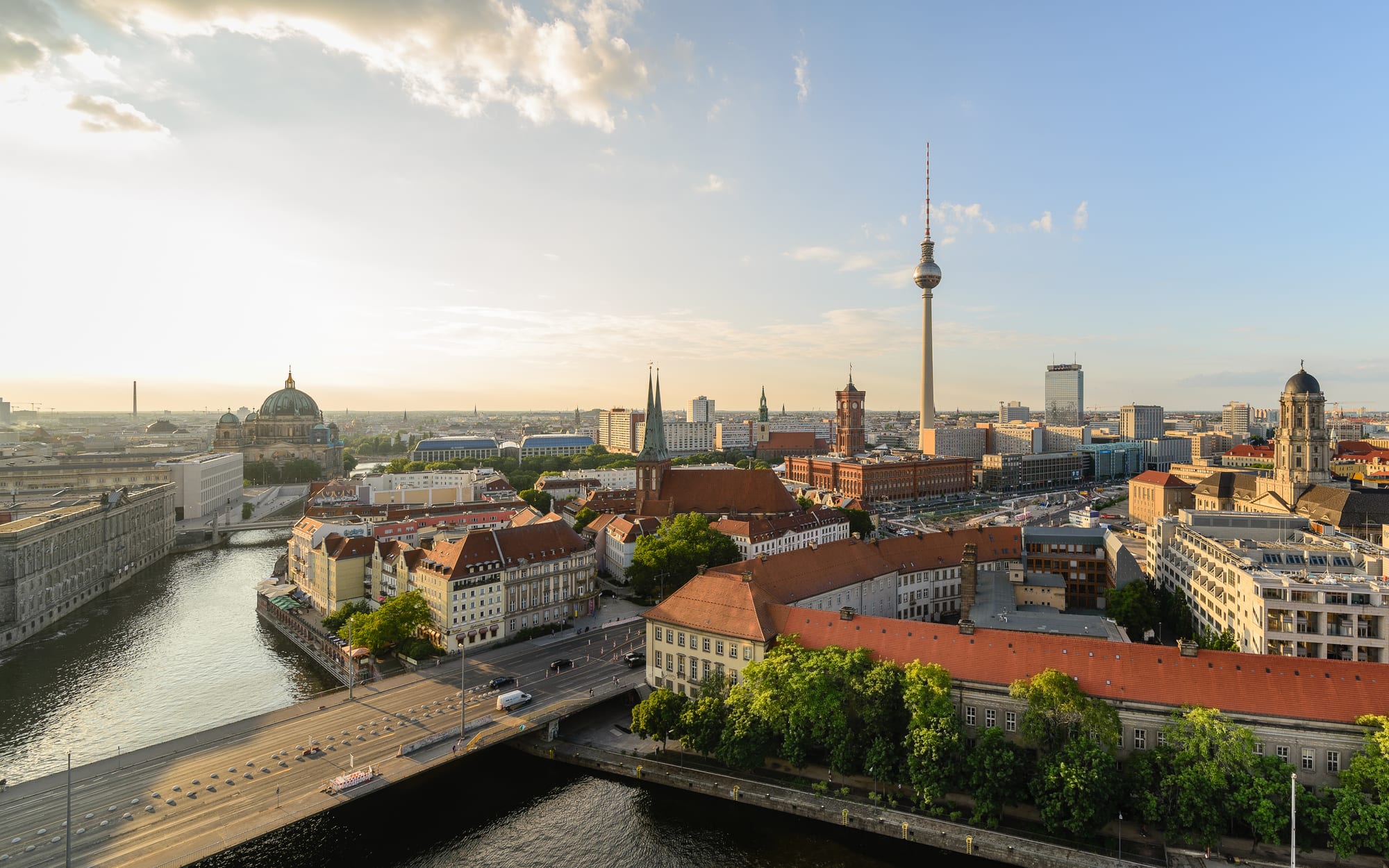
The Spree curving past red-roofed buildings in central Berlin, with the cathedral dome, Rotes Rathaus and TV tower

Berlin & Brandenburg, Germany

Berlin

Central Berlin seen from Fischerinsel, with the Berlin Cathedral, the Rotes Rathaus and the Fernsehturm. (ArildV / Wikimedia Commons · CC BY-SA 4.0)

Germany's capital and largest city, on the Spree in the middle of Brandenburg — the Prussian and imperial seat that was bombed, divided by the Wall for twenty-eight years and reunited in 1990. Today it is a sprawling, green city of about 3.9 million registered inhabitants, known for its museums and memorials, its clubs and its strongly local neighbourhoods.

Neighbourhoods

  • Mitte
    • First-time visitors
    • Museums
    • Close to public transport

    The historic centre and the heart of the former East Berlin, running from the Brandenburg Gate and Unter den Linden to Museum Island and Alexanderplatz. Government buildings, the big museums and the TV tower are here, along with the courtyards and galleries of the old Scheunenviertel.

    Open in Maps
  • Kreuzberg
    • Best for food
    • Nightlife
    • Street art

    A former West Berlin district once hemmed in by the Wall on three sides, long home to Turkish families, squatters and the punk scene. Canal-side cafés, market halls, Turkish bakeries, bars and clubs fill its streets, and the mood is loud, mixed and informal.

    Open in Maps
  • Friedrichshain
    • Nightlife
    • Young travellers

    An East Berlin district across the Oberbaum Bridge from Kreuzberg, with the East Side Gallery along the Spree, the socialist boulevard of Karl-Marx-Allee and a dense cluster of bars and clubs around Boxhagener Platz and the old railway yards.

    Open in Maps
  • Prenzlauer Berg
    • Cafés
    • Quiet and residential
    • Sunday flea market

    Rows of restored 19th-century tenements with balconies, tree-lined squares, cafés and playgrounds, much changed since the 1990s from a run-down East Berlin district into one of the city's most sought-after. The Mauerpark and its Sunday flea market are on its western edge.

    Open in Maps
  • Charlottenburg
    • Shopping
    • Classic West Berlin
    • Palaces

    The old centre of West Berlin, with the Kurfürstendamm's shops, the bomb-damaged tower of the Kaiser Wilhelm Memorial Church, Charlottenburg Palace and quiet streets of grand apartment blocks, cafés and Asian restaurants around Savignyplatz and Kantstraße.

    Open in Maps
  • Neukölln
    • Local life
    • Bars
    • Middle Eastern food

    A working-class district south of Kreuzberg, home to large Arab and Turkish communities and, since the 2000s, to many young newcomers. Sonnenallee's bakeries and grills, small bars in the side streets and the open runways of Tempelhofer Feld next door set its tone.

    Open in Maps
  • Schöneberg
    • LGBTQ+ history
    • Quiet and residential

    A residential district of West Berlin whose streets around Nollendorfplatz have been the centre of the city's gay life since the 1920s. Its town hall is where John F. Kennedy gave his 'Ich bin ein Berliner' speech, and the KaDeWe department store stands on its northern edge.

    Open in Maps

Things to do

Famous landmarks

  • Brandenburg Gatelandmark

    The neoclassical gate of 1791 at the head of Unter den Linden, which stood on the border between East and West Berlin and since reunification has been seen as a symbol of European unity and peace.

    Open in Maps
  • Reichstag buildinglandmark

    The seat of the Bundestag since 1999, redesigned by Norman Foster, with a walk-in glass dome above the plenary chamber and a 360-degree view of the city.

    Open in Maps
  • Fernsehturmviewpoint

    The 368-metre East German television tower on Alexanderplatz, among the tallest structures in the European Union, with a viewing floor and a slowly revolving restaurant in its sphere.

    Open in Maps
  • Gendarmenmarktlandmark

    A square framed by the French and German churches and Schinkel's Konzerthaus, rebuilt after the war, and the setting of one of the city's best-known Advent markets.

    Open in Maps
  • Charlottenburg Palacelandmark

    A Baroque palace of the Prussian royal family, among the largest palaces in the world, badly damaged in the Second World War and since reconstructed, with a large formal garden behind it.

    Open in Maps

The Wall and the 20th century

  • Berlin Wall Memorialattraction

    The central memorial to the divided city on Bernauer Straße, where a 60-metre section of the former border is kept, with a documentation centre, an observation tower and the Chapel of Reconciliation.

    Open in Maps
  • East Side Galleryattraction

    An open-air gallery of murals painted directly onto one of the last surviving sections of the Wall, running along the Spree in Friedrichshain.

    Open in Maps
  • Memorial to the Murdered Jews of Europelandmark

    Peter Eisenman's field of 2,711 concrete slabs on a sloping site south of the Brandenburg Gate, with an underground information centre on the victims of the Holocaust.

    Open in Maps
  • Topography of Terrormuseum

    A documentation centre opened in 2010 on the site of the Gestapo and SS headquarters, beside a surviving stretch of the Wall.

    Open in Maps
  • Checkpoint Charlieattraction

    The best-known crossing point between East and West Berlin, scene of the tank stand-off of 1961, now marked by a copy of the guard house on Friedrichstraße.

    Open in Maps

Museums

  • Museum Islandmuseum

    The northern part of the Spree island in Mitte, holding five museums and listed as a UNESCO World Heritage Site.

    Open in Maps
  • Neues Museummuseum

    The Museum Island building that holds the Egyptian collection, including the bust of Nefertiti, restored from 1999 to 2009 by David Chipperfield after war damage and decades of decay.

    Open in Maps
  • Jewish Museum Berlinmuseum

    Daniel Libeskind's zigzag building in Kreuzberg, opened in 2001, the largest Jewish museum in Europe.

    Open in Maps
  • Humboldt Forummuseum

    The rebuilt Berlin Palace beside Museum Island, opened digitally in 2020 and in stages to the public from 2021 to 2022, housing the city's ethnological and Asian art collections.

    Open in Maps
  • Neue Nationalgaleriemuseum

    Mies van der Rohe's glass and steel gallery of 20th-century art at the Kulturforum, reopened in 2021 after a renovation by David Chipperfield.

    Open in Maps

Parks and open spaces

  • Tiergartenpark

    The great inner-city park beside the Brandenburg Gate, a former hunting ground of the electors of Brandenburg, with the Victory Column on the Großer Stern.

    Open in Maps
  • Tempelhofer Feldpark

    The airfield of Tempelhof Airport, closed in 2008 and opened as a park in 2010, with its old runways open to the public.

    Open in Maps
  • Mauerparkpark

    A park on part of the former death strip between Prenzlauer Berg and Gesundbrunnen, crowded on Sundays for its flea market and open-air karaoke.

    Open in Maps

Music and nights out

  • Berliner Philharmonieattraction

    Hans Scharoun's tent-like concert hall at the Kulturforum, home of the Berlin Philharmonic, one of the world's leading orchestras.

    Open in Maps
  • Berghainattraction

    A techno club in a former power station near Ostbahnhof, famous for its long weekend nights and its unpredictable door policy.

    Open in Maps

Short trips from the city

  • Sachsenhausen concentration camp memorialmuseum

    The memorial and museum at Oranienburg, just north of the city, on the site of a Nazi concentration camp that the Soviets later used as a special camp.

    Open in Maps
  • Potsdamneighborhood

    Brandenburg's capital on the city's south-western edge, with the palaces and park of Sanssouci, reached by S-Bahn or regional train.

    Open in Maps

Seasonal events

  • BerlinaleFebruary

    One of the world's leading film festivals, with around half a million admissions, which makes it the largest publicly attended film festival in the world.

  • Karneval der KulturenPentecost weekend, May or June

    A multi-ethnic street festival and parade through Kreuzberg celebrating the city's many communities.

  • Berlin Pride (Christopher Street Day)July

    One of Europe's largest Pride marches, recalling a city whose gay and lesbian life was unusually visible as early as the 1920s.

  • Berlin Marathonlate September

    A flat, fast big-city marathon on whose course the marathon world record has been broken thirteen times.

Eat and drink

Long-standing places and food districts in Berlin. Hours, ratings and directions come from your maps app, always current.

Berlin classics

  • Konnopke's Imbissrestaurant

    A long-established Currywurst stand under the elevated U-Bahn at Eberswalder Straße in Prenzlauer Berg, one of the city's best-known places for the sliced sausage in curry ketchup.

    Open in Maps
  • Curry 36restaurant

    A well-known Currywurst stand opposite Mehringdamm U-Bahn station in Kreuzberg.

    Open in Maps
  • KaDeWe food hallmarket

    The food floor of the Kaufhaus des Westens, the second-largest department store in Europe, with delicatessen counters and bars in the heart of old West Berlin.

    Open in Maps

Food districts and markets

  • Markthalle Neunmarket

    A 19th-century market hall in Kreuzberg, one of the city's historic covered markets, now known for its food stalls and street-food evenings.

    Open in Maps
  • Sonnenalleeneighborhood

    Neukölln's main street, lined with Arab and Turkish bakeries, grills, sweet shops and falafel counters.

    Open in Maps
  • Kantstraßeneighborhood

    A street in Charlottenburg known for its many Asian restaurants, near the cafés of Savignyplatz.

    Open in Maps

Experience Berlin

History

Berlin grew from two trading settlements on either bank of the Spree, Cölln and Berlin, at the crossing of two old trade routes; 1237 is taken as the city's founding date. It became the seat of the margraves and electors of Brandenburg, then capital of the Kingdom of Prussia from 1701. Between 1700 and 1750 its population nearly quadrupled, from about 30,000 to 113,000, and in the age of the Enlightenment it became a centre of science, art and philosophy.

In 1871 Berlin became capital of the new German Empire, and industrialisation in the Gründerzeit drew workers in their hundreds of thousands into tenement districts around the old centre. The Greater Berlin Act of 1920 absorbed dozens of surrounding towns and villages, and in the 1920s Berlin was the third-largest city in the world, famous for its theatre, cabaret and open gay and lesbian life. The Nazis ruled Germany from here after 1933, and the Second World War left much of the centre in ruins.

After 1945 the city was divided into four sectors. The Soviet blockade of the western sectors in 1948 was broken by the airlift, and in 1961 East Germany built the Wall around West Berlin, with a tank stand-off at Checkpoint Charlie soon after. The Wall fell on 9 November 1989. Reunited Berlin became the capital again, and the following decades brought huge building projects — Potsdamer Platz, the Hauptbahnhof in 2006, the rebuilt palace of the Humboldt Forum and, after years of delays, Berlin Brandenburg Airport in 2020.

Culture & Customs

Few cities have so many cultural institutions. Berlin has several opera houses, the Berlin Philharmonic, one of the world's leading orchestras, and the museums of Museum Island and the Kulturforum, alongside a large independent theatre and dance scene in venues such as the Hebbel am Ufer in Kreuzberg. The Berlinale is the largest publicly attended film festival in the world.

The city's other reputation is for its nights. After the Wall fell, squatters and artists occupied empty buildings in the old East and turned them into clubs and bars, and techno became Berlin's sound; clubs such as Tresor and Berghain are known worldwide. Kreuzberg's SO36 was a centre of punk in the 1970s and 80s, and the city's gay and lesbian scene, unusually visible as early as the 1920s, celebrates with Christopher Street Day and the Lesbian and Gay City Festival in Schöneberg. The Karneval der Kulturen parade at Pentecost reflects a population drawn from all over the world.

Berliners are known for their Schnauze, a direct, dry and quick-witted manner, and many feel more loyal to their own Kiez than to the city as a whole. Most belong to no church. Football divides loyalties between Hertha in the west and Union in the east, the marathon each September is one of the world's fastest, and summer life moves outdoors to the parks, the lakes and the canal banks.

Daily Life

At the end of 2024 Berlin had about 3.9 million registered inhabitants, the largest population of any city proper in the European Union, and its urban area had more than 4.6 million in 2021. The city is divided into twelve boroughs and 96 neighbourhoods. Berlin has the largest Turkish community outside Turkey, at least 180,000 people, alongside large Polish, Syrian and Russian-speaking communities, and in 2022 it became the main destination in Germany for refugees from Ukraine.

The economy is built on services rather than industry: government and the embassies, universities and research institutes, media, technology start-ups, health care and tourism. Berlin's growth has outpaced the national rate in every year since 2013, yet unemployment rose again to an annual average of about 10 per cent in 2025, and around a fifth of residents are at risk of poverty. A similar share of households spend at least 40 per cent of their income on rent.

Most Berliners rent flats in tenement blocks or in the large post-war estates of the outer east and west, and many cycle or use the S-Bahn and U-Bahn rather than drive. The day starts later than in much of Germany: weekend brunch runs into the afternoon, the Späti corner shops stay open late, the trains run all night at weekends, and Sunday, when most shops close, belongs to the parks, flea markets and lakes.

Food

Berlin's own food is street food. The Currywurst — sliced pork sausage with curry ketchup — was invented in 1949 by Herta Heuwer at a stand in Charlottenburg and caught on with the construction workers rebuilding the city; tens of millions are eaten in Berlin every year. The modern fast-food Döner kebab sandwich evolved here in the 1970s among Turkish immigrants, and falafel is sold in many kebab shops. Buletten, the local meat patties, and Eisbein, cured and boiled ham hock, are the old pub dishes, and the jam doughnut that the rest of Germany calls a Berliner is known in Berlin as a Pfannkuchen.

Beyond those, the city eats from everywhere. Neukölln's Sonnenallee is lined with Arab bakeries and grills, Kantstraße in Charlottenburg is known for its Asian restaurants, and Vietnamese, Thai, Korean, Indian, Italian and Greek kitchens are found across the city. Berlin is also known for its vegetarian and vegan cooking and for its food markets and pop-up street-food events, and in the 2021 Michelin Guide it had more starred restaurants than any other German city. Historic market halls such as Markthalle Neun in Kreuzberg have been revived for food stalls.

Berliner Weisse is the city's own beer, a cloudy, sour wheat beer of about 3.5 per cent, often served in a bowl-shaped glass with a shot of raspberry or woodruff syrup. By the late 19th century it was the most popular drink in Berlin, made by up to fifty breweries; by the late 20th century only two in the city still produced it.

Planning tools

Budget

Berlin is cheaper than Munich, Hamburg or Frankfurt, though hotel prices have risen in recent years and climb further during the Berlinale, the marathon and the big trade fairs. Street food, bakeries and the corner Späti keep everyday eating cheap, and public transport day tickets cover most sightseeing.

Daily Budget Midrange
USD 150–260 (mid-range hotel, restaurant dinners, museum tickets, public transport)
Daily Budget Shoestring
USD 65–110 (hostel bed, Currywurst, Döner and bakery food, a day ticket for the S-Bahn and U-Bahn)

Many of the most important sights — the Brandenburg Gate, the Wall Memorial, the East Side Gallery, the Holocaust memorial, Tempelhofer Feld — cost nothing, and the Reichstag dome is free with advance registration.

Best Time to Visit

May to September, when the parks, lakes, beer gardens and open-air festivals are at their best and the evenings are long. September brings the marathon and clear, cooler days. Winter is dark and cold, but the Berlinale in February and the Advent markets give it a purpose, and the museums are quieter.

Suggested Number of Days

Three or four days covers a first visit to a city this large and spread out. Allow five to seven to add day trips into the surrounding countryside. Museum-heavy visits and nightlife both stretch the number.

First Visit
3–4 days
With Surroundings
5–7 days

Transportation

The S-Bahn, U-Bahn, trams and buses form one network divided into fare zones A, B and C; most of the city lies in zones A and B, while the airport and Potsdam are in zone C. Trains run all night at weekends and night buses fill the gaps on weekdays. The city is flat and cycling is fast, with many bike lanes.

Buy an ABC ticket for the airport or Potsdam — an AB ticket is not valid there — validate paper tickets before boarding, and never walk in the bike lanes.

Airport & Station Connections

Berlin Brandenburg Airport (BER) is at Schönefeld, just outside the city's south-eastern border; the Airport Express reaches the Hauptbahnhof in about 23 minutes, and S-Bahn and regional trains also serve the airport station. The Hauptbahnhof is the main rail hub, with ICE trains to Hamburg and Munich, the fastest reaching Munich in under four hours.

Walkability

Individual districts are pleasant on foot — Mitte between the Brandenburg Gate and Alexanderplatz, Kreuzberg's canal, Prenzlauer Berg's squares — but the city is very large and its sights are scattered, so most visitors combine walking with the S-Bahn, U-Bahn or a bicycle. Streets are flat and wide.

Safety

Germany is a safe country with low levels of violent crime. In Berlin, pickpocketing in busy stations and on crowded trains and trams is the main risk, and cyclists move fast through their lanes. Demonstrations are frequent and usually peaceful.

Keep phones and bags close on public transport and in the nightlife districts, watch for distraction tricks at ticket machines, and stay out of cycle lanes. Check current official travel advice before travelling.

Climate

Temperate and fairly continental, with warm summers, cold grey winters and rain spread through the year. The city can be several degrees warmer than the surrounding countryside.

Summer
warm and sometimes humid, with average highs of 22–25°C and lows of 12–14°C
Winter
cold, with average highs around 3°C and lows of −2 to 0°C

Local Customs

Berliners are known for their blunt, quick-witted manner, the Berliner Schnauze, which is meant as directness rather than rudeness. Service is included in prices and tips are modest, usually a matter of rounding up. Dress is casual almost everywhere, including the theatre. Many residents identify first with their Kiez, their home neighbourhood. Most shops close on Sundays.

Wait for the green man at crossings, keep out of bike lanes, and do not take photographs inside clubs, where it is generally forbidden.

Common Payment Methods

The currency is the euro. Cards and contactless payment are widely accepted, but some bakeries, Spätis, bars and small restaurants still take cash only, so it is worth carrying some. ATMs are easy to find; buses accept cash for tickets.