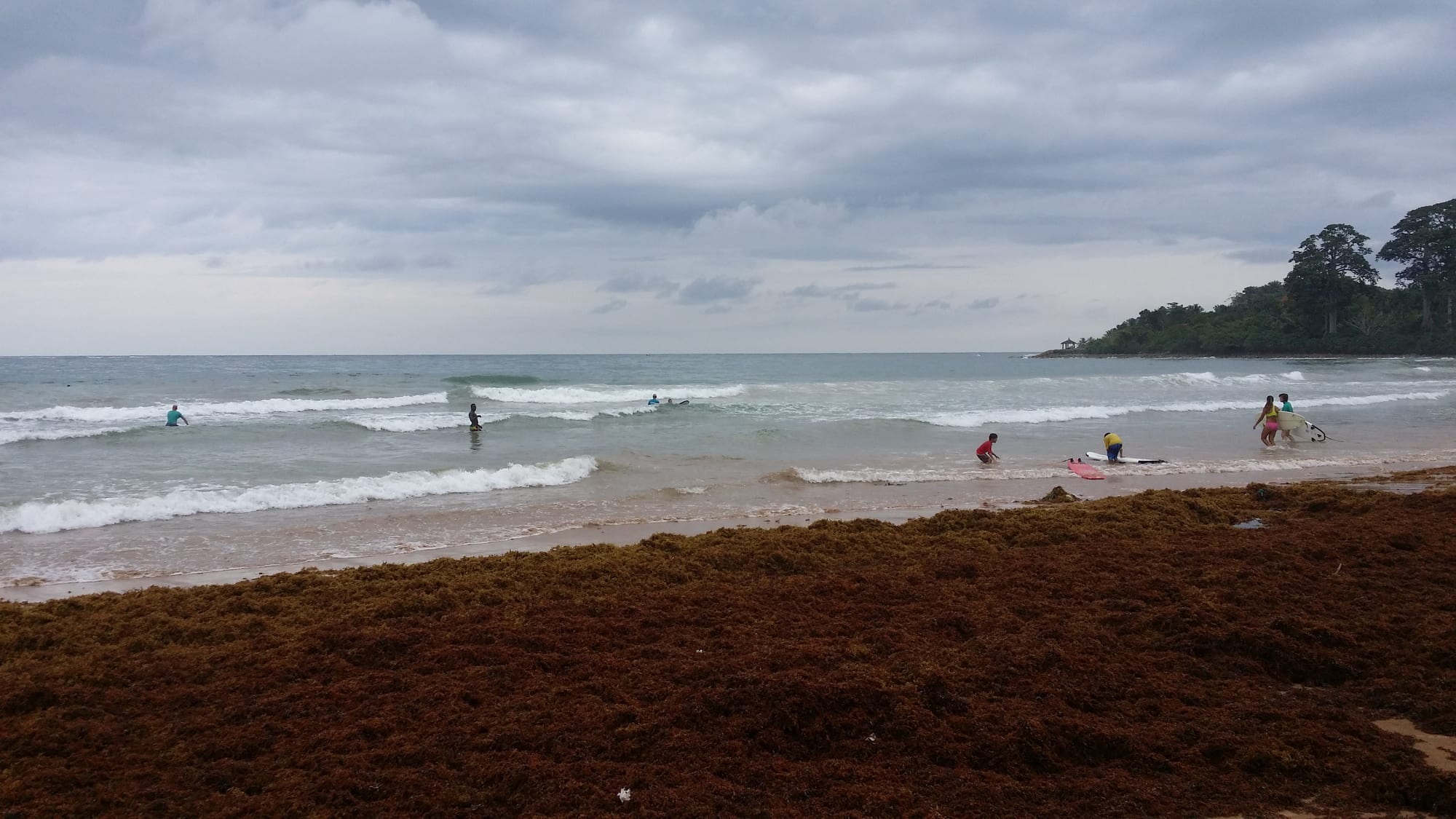
Small surf breaking on a sandy bay with a few bathers and boards in the shallows, a wooded headland to the right and banked brown seaweed in the foreground

Accra & the Coast, Ghana

Busua

The bay at Busua on Ghana's western coast, with its wooded headland beyond. (Tom Lubbe / Wikimedia Commons · CC BY-SA 3.0)

A fishing village on a curved bay in Ghana's Western Region, on the Ahanta coast west of Takoradi. Its sheltered beach and steady break made it the country's best-known surfing spot, and guesthouses now stand along the sand beside the canoes. The old fort town of Dixcove lies over the headland to the west.

Neighbourhoods

  • The beach strip
    • Beaches
    • First-time visitors
    • Surfing

    The line of guesthouses, small restaurants and board-hire shacks set back from the sand along the bay. Everything a visitor needs stands within a few hundred metres, and the day runs between the water, the shade and the food.

    Open in Maps
  • The village
    • Local life
    • Quiet and residential

    The lanes behind the beach where most people live, with the school, the chapel, provision stalls and the canoes pulled up at the eastern end of the bay. Quiet, close-knit and busiest when the boats come in.

    Open in Maps
  • Dixcove
    • Historic district
    • Harbour life

    A fishing town in a deep natural inlet over the headland west of Busua, with Fort Metal Cross above the harbour and a crowded waterfront of boats, fish smokers and traders. Reached on foot over the hill or by road.

    Open in Maps

Things to do

The bay and the shore

  • Busua beachbeach

    A curved bay of firm sand with a gentle, consistent break at its western end, used for learning to surf, and with fishing canoes drawn up at the other end.

    Open in Maps
  • The fishing landingattraction

    The end of the beach where crews launch and return, mend nets and sell the catch straight from the canoes.

    Open in Maps

Forts and old towns

  • Fort Metal Crosslandmark

    Originally Fort Dixcove, an English fort on the promontory above Dixcove harbour, used in the gold trade and later as a slave prison, listed by UNESCO in 1979 with Ghana's other forts and now leased and kept as a visitor site.

    Open in Maps
  • Butreattraction

    A village at a river mouth east of Busua where the Dutch signed the 1656 treaty of Butre with the Ahanta; the ruins of Fort Batenstein stand on the hill above it.

    Open in Maps
  • Akwidaaattraction

    A fishing village further west with long beaches and the ruins of Fort Dorothea, the smaller of the two forts of the Brandenburger Gold Coast, listed by UNESCO in 1979 with Ghana's other forts.

    Open in Maps

Short trips along the coast

  • Cape Three Pointsviewpoint

    The southernmost point of Ghana, a headland whose working lighthouse was completed in 1925 to replace a British one of 1875.

    Open in Maps
  • Takoradiattraction

    The port half of the twin city of Sekondi-Takoradi, about 30 km east, with Ghana's first deep-water harbour, the Market Circle and the region's banks and transport.

    Open in Maps
  • Nzulezoattraction

    A village of stilt houses and walkways built over Lake Tadane in the far west, reached by canoe through a creek and marsh.

    Open in Maps

Seasonal events

  • KundumHarvest season

    The harvest festival of the Ahanta and Nzema peoples, held town by town along the western coast and lasting four weeks in each, with drumming, dancing and a durbar of chiefs.

  • Christmas and New YearDecember and January

    The village fills with Ghanaian families and returning diaspora visitors, and the beach sees its biggest crowds and music of the year.

Eat and drink

Long-standing places and food districts in Busua. Hours, ratings and directions come from your maps app, always current.

Busua classics

  • Grilled fish on the beachrestaurant

    Whatever the canoes have landed — tilapia, snapper, barracuda, lobster in season — grilled over charcoal and served with banku, rice or chips and pepper sauce.

    Open in Maps
  • The village chop barsrestaurant

    Small kitchens behind the beach serving fufu in palm-nut or light soup, kenkey with fried fish and jollof rice at local prices.

    Open in Maps
  • Dixcove harbour food stallsmarket

    Fried fish, kenkey, roasted plantain and koose sold along the waterfront where the catch is landed and smoked.

    Open in Maps

Drinks

  • Palm wine and coconut sellersmarket

    Palm wine tapped in the villages inland is sold fresh by the calabash, and green coconuts are cut open on the beach for their water.

    Open in Maps

Experience Busua

History

The bay belongs to the Ahanta, one of the Akan-speaking peoples of the western coast, whose small states traded gold and salt long before Europeans reached the shore. From the late fifteenth century Portuguese, Dutch, English, Swedish and Brandenburger traders worked this stretch of coast, and the deep inlet at Dixcove — the harbour the English called Dick's Cove — became one of its busiest anchorages. The English fort above it, first called Fort Dixcove and later Fort Metal Cross, was built for the gold trade and was later used as a slave prison.

East of Busua, at the mouth of the Butre river, the Dutch built Fort Batenstein and in 1656 signed a treaty with the Ahanta that placed the area under Dutch protection; signed on 27 August 1656, it stayed in force until the Dutch sold their Gold Coast possessions to Britain in 1872. The Ahanta rose against Dutch authority in 1837, and their king Badu Bonsu II was executed the following year and his head taken to the Netherlands, from where it was returned for burial in 2009.

Busua itself stayed a fishing village through the colonial period and the first decades of independence, with a small beach hotel on the bay. Its reputation changed in the 2000s, when Ghanaian and foreign surfers found the reliable, gentle break at the western end of the bay and board hire, lessons and small guesthouses grew up along the sand. The offshore oil found off the Western Region, which from about 2010 made Takoradi an oil city, left the village itself much as it was, and fishing and visitors now support it in roughly equal measure.

Culture & Customs

Busua is an Ahanta village, and the Ahanta language, chieftaincy and stool traditions are its framework. The paramount and divisional chiefs still settle disputes and lead ceremonies, and the asafo companies of the coast take part in funerals and festivals. Kundum, the harvest festival shared with the Nzema further west, moves from town to town along the coast at harvest time and lasts four weeks in each, with drumming, masked dancing and a durbar at which chiefs receive their people.

Fishing shapes the calendar as much as the church does. A weekly rest day keeps the canoes ashore, and the sea has its own observances and prohibitions. Christianity is dominant, with chapels and all-night services, and funerals fill the weekends here as everywhere in southern Ghana, with matching cloth, canopies and brass bands.

The surf scene has added something unusual for a Ghanaian village: a small, mixed community of local and visiting surfers, skateboarding sessions for children in the evenings, and a steady trickle of long-staying visitors who become familiar faces. Relations between the village and the beach businesses are generally easy but the gap in money is obvious, and visitors who greet people, learn a few words of Ahanta or Fante and ask before taking photographs are treated very differently from those who do not.

Daily Life

A few thousand people live in Busua, and the village has no large employer. Men crew the canoes that launch from the eastern end of the bay, often at night; women buy the catch, smoke it in clay ovens and carry it to the markets at Agona Junction and Takoradi. Others work land inland, growing cassava, plantain and coconut, or tap palm wine.

Tourism is the second economy: guesthouses, cooks, board hire, guides for the headland walk and boat trips, and the building trade that serves them. It is seasonal, strongest from December to March, and much of the money passes through a small number of hands. Young people leave for Takoradi, where the port and the oil industry pay better, and remittances come back the other way.

Days start before dawn on the water and in the kitchens, the middle of the day is spent out of the sun, and evenings bring football on the sand, music from the beach bars and the smell of charcoal. Electricity and water supply are erratic, the road down from the junction is rough in the rains, and the recurring worries are falling fish catches, coastal erosion and the sargassum weed that washes ashore in some years and fouls the nets and the beach.

Food

The bay eats fish, and it eats it fresh. Tilapia, snapper, cassava fish, barracuda and, in season, lobster and crab are grilled over charcoal or fried, and come with banku, the sour maize-and-cassava dough, or with rice, chips or kenkey, and always with a ground pepper sauce of chilli, onion and tomato. Shito, the dark chilli and dried-fish paste, is on every table.

The village kitchens cook the standard food of the southern Ghanaian coast: fufu pounded from cassava and plantain, served in light soup, groundnut soup or abenkwan, the palm-nut soup; jollof and waakye rice; red red, the bean stew with fried plantain; and nkontomire, the cocoyam-leaf stew, spooned over boiled yam or plantain. Smoked fish from the ovens behind the beach goes into most of the soups.

Coconut palms line the shore and green coconuts are cut open for their water; palm wine is tapped inland and sold fresh, with akpeteshie, the distilled spirit, poured at ceremonies. Sobolo, the hibiscus drink, ginger juice and bottled lager fill the beach bars, and the Western Region's own crop, cocoa, is turned into chocolate sold in Takoradi and Accra.

Planning tools

Budget

Busua is cheap by Ghanaian beach standards, though rooms on the sand cost more than rooms in the village and rise sharply over Christmas and Easter. Food is inexpensive, and the main extras are board hire, a lesson, and a taxi for trips along the coast.

Daily Budget Midrange
USD 60–130 (beachfront room, grilled fish dinners, board hire and a hired taxi for the coast)
Daily Budget Shoestring
USD 25–45 (simple guesthouse, chop-bar meals, shared taxis and tro-tros)

Cash is brought from Takoradi or Agona Junction, since the village has little in the way of banking.

Best Time to Visit

November to March is dry, sunny and the busiest stretch, with the Christmas and New Year weeks the fullest of all. The surf is generally larger between about June and September, which is also the wettest and quietest time. Drifts of sargassum seaweed can cover the sand in some months.

Suggested Number of Days

Two days are enough for the bay, the walk over the headland and the fort. Three or four allow the other Ahanta villages, the cape to the west and the stilt village further along the coast. Longer stays are common for anyone learning to surf.

First Visit
2 days
With Surroundings
3–4 days

Transportation

The village is walked. Shared taxis run the few kilometres up to the main road at Agona Junction, where tro-tros pass for Takoradi and the west, and a taxi can be chartered for the day to reach the cape, Butre or Akwidaa. A footpath over the headland links Busua and Dixcove in about half an hour.

Fares are agreed before setting off, and the last shared transport of the day leaves well before dark.

Airport & Station Connections

Busua lies about 30 km west of Takoradi, which has domestic flights from Accra and is the road hub for the Western Region. Most people come by tro-tro or coach to Agona Junction on the main coast road and take a shared taxi down to the village; Accra is about 250 km east, five to six hours by road.

Walkability

Everything in the village is within a short walk, and the beach itself is the main street. The path over the headland to Dixcove is a steep, unmarked half-hour walk that most people do with a local guide, and the road round is longer. Sand, heat and unlit lanes at night are the limitations.

Safety

The village is quiet and crime is uncommon, though theft from open rooms and unattended belongings on the sand happens. The Atlantic is the real hazard: currents and rip tides are strong along this coast and there are no lifeguards. Malaria is present, the sun is fierce, and the headland path is best not walked alone after dark.

Swim only where locals advise and never alone, use app-based or registered taxis in Accra at night, and hire official castle guides at the ticket office. Surf instructors are asked about the day's currents before going in, and valuables are best locked away rather than left on the beach. Check current official travel advice before travelling.

Climate

The Western Region is the wettest part of Ghana, hot and humid all year with rainforest inland. The long rains fall from about April to July, with a second wet spell in September and October, and the sea breeze keeps the coast a little cooler than the interior.

Summer
the long rains, about April to July: 24–30°C, humid, with heavy downpours and bigger surf
Winter
the dry season, about November to March: 24–32°C, sunny and less humid

Local Customs

This is an Ahanta fishing village with its own chief, and a weekly rest day traditionally keeps the canoes ashore. Swimwear belongs on the beach and not in the village lanes. Children often ask visitors for money or gifts, and giving to schools or projects rather than individuals is the local preference.

Permission is asked before photographing people, canoes or ceremonies, greetings are exchanged with the right hand before any request, and modest dress is expected away from the sand.

Common Payment Methods

The currency is the Ghanaian cedi, and the village runs on cash and mobile money. Cards are of little use, and the nearest reliable ATMs are at Agona Junction and in Takoradi, so enough cash for a stay is best brought in.