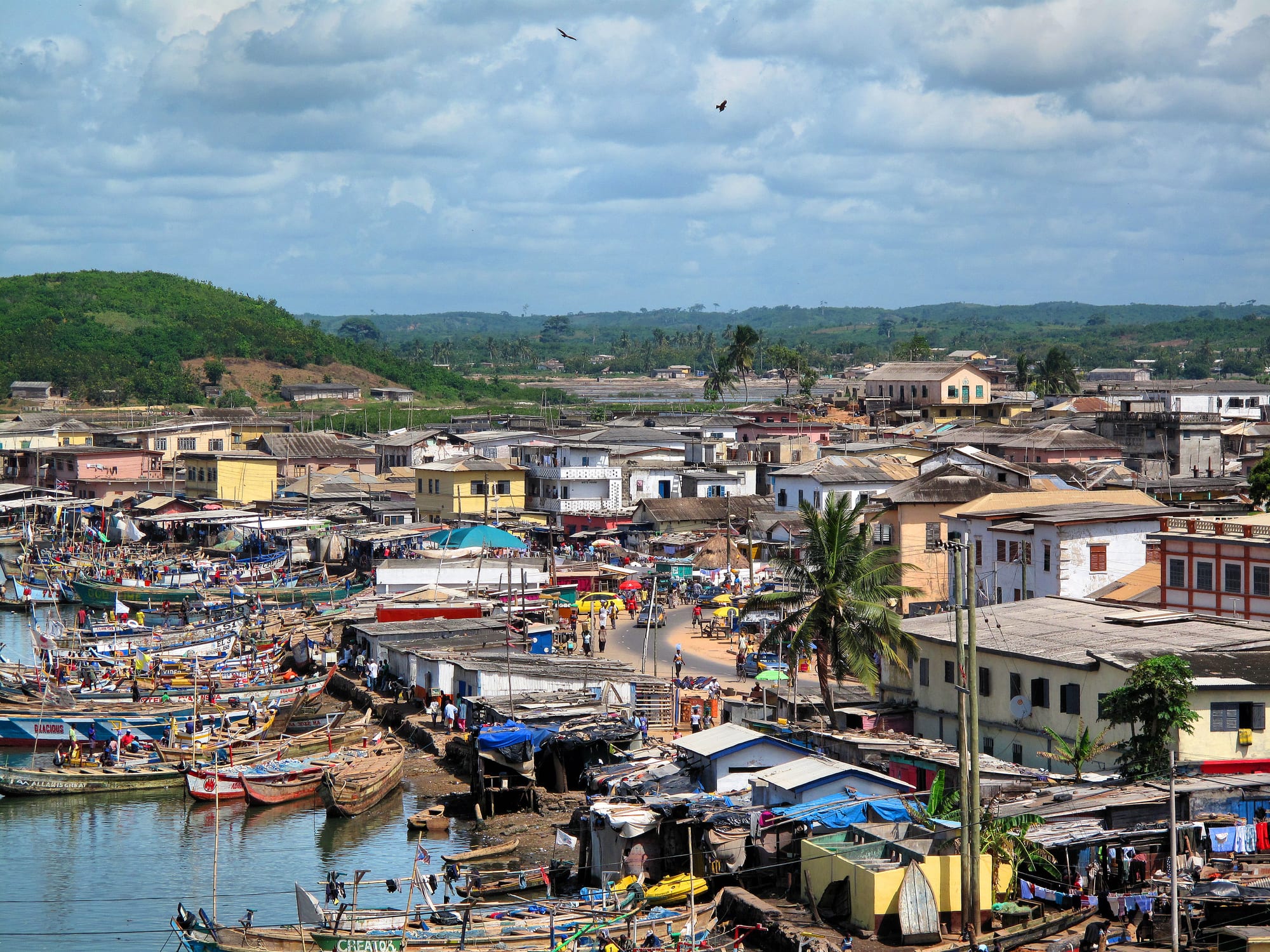
Painted wooden fishing canoes crowded along a lagoon below a hillside town of white and coloured houses with tin roofs

Accra & the Coast, Ghana

Elmina

Fishing canoes on the Benya lagoon below the town of Elmina. (Francisco Anzola / Wikimedia Commons · CC BY 2.0)

A Fante fishing town on Ghana's central coast, wrapped around the Benya lagoon beneath St George's Castle, which the Portuguese built in 1482 and the Dutch held for more than two centuries. Hundreds of painted canoes work from its harbour, and the castle and the fort on the hill above it draw visitors from across the world.

Neighbourhoods

  • The old town and Chapel Square
    • Historic district
    • First-time visitors
    • Photography

    The peninsula between the lagoon and the sea, laid out in narrow lanes around Chapel Square, with nineteenth-century merchant houses, Methodist and Catholic churches, asafo shrines and the castle at its tip.

    Open in Maps
  • The Benya lagoon and the wharves
    • Local life
    • Street food

    The working waterfront where several hundred canoes tie up, nets are spread to dry and the catch is landed, sorted and smoked. Crowded and noisy from before dawn, and the reason the town exists in its present form.

    Open in Maps
  • Bantoma and the inland roads
    • Quiet and residential
    • Close to public transport

    The newer neighbourhoods spreading north and east along the Cape Coast road, where most people live and where tro-tros, petrol stations and the larger shops are found.

    Open in Maps
  • The coast road west
    • Beaches
    • Quiet and residential

    A strip of sandy shore and coconut palms beyond the town towards Brenu, with beach hotels and guesthouses set back from the water and fishing hamlets in between.

    Open in Maps

Things to do

The castle and the forts

  • Elmina Castlelandmark

    São Jorge da Mina, begun by the Portuguese in 1482 and taken by the Dutch in 1637, whose courtyards, governor's rooms and slave dungeons are part of a UNESCO World Heritage listing of Ghana's forts and castles.

    Open in Maps
  • Fort St Jagolandmark

    Fort Coenraadsburg, the Dutch fort of the 1660s on the hill opposite the castle, built on the site of a Portuguese chapel to Saint Jago and on the ground from which the Dutch had bombarded the Portuguese in 1637, with a wide view over the lagoon.

    Open in Maps

The harbour and the town

  • Benya lagoon fishing harbourattraction

    The lagoon inlet where the canoe fleet moors and unloads, with fish auctions on the quay, boatbuilders at work and smoking ovens behind.

    Open in Maps
  • Elmina Java Museummuseum

    A small private museum, opened in 2003, telling the story of the Belanda Hitam — the men recruited in the Dutch Gold Coast in the nineteenth century to serve in the Dutch colonial army in the East Indies.

    Open in Maps
  • The posuban shrineslandmark

    Brightly painted concrete shrines of the asafo military companies, modelled as ships, forts and figures, standing in the quarters of the old town.

    Open in Maps
  • Elmina beachbeach

    The long stretch of sand east of the castle, used by fishermen and for football at low tide rather than for swimming, with a strong Atlantic undertow.

    Open in Maps

Short trips from the town

  • Cape Coast Castlelandmark

    The British headquarters on the Gold Coast, about 12 km east, with its dungeons, museum and 'Door of No Return'.

    Open in Maps
  • Kakum National Parkpark

    Rainforest inland from the coast, crossed by a canopy walkway of suspension bridges high among the trees.

    Open in Maps
  • Fort Amsterdamlandmark

    A ruined English and later Dutch fort above the fishing village of Abandze, further east along the coast road.

    Open in Maps

Seasonal events

  • BakatueJuly

    Held on the first Tuesday of July and recorded since at least 1847, the festival that opens the fishing season on the Benya lagoon, with the chief priest casting a net three times into the water, a regatta of canoes and a durbar.

  • Edina BuronyaJanuary

    Elmina's own version of Christmas, dating from the Portuguese and Dutch centuries and usually kept on the first Thursday of January, with family gatherings, church services and street celebration.

  • PanafestEvery second year

    A pan-African historical theatre festival first held in 1992 and staged in Ghana every two years, whose performances and ceremonies draw visitors from the African diaspora to this coast.

Eat and drink

Long-standing places and food districts in Elmina. Hours, ratings and directions come from your maps app, always current.

Elmina classics

  • Grilled and fried fish at the harbourmarket

    Tilapia, red snapper, mackerel and whatever the canoes have landed, grilled over charcoal or fried and eaten with banku and pepper sauce.

    Open in Maps
  • Fante kenkey sellersmarket

    Maize dough fermented and steamed in plantain leaves, sold in balls from basins and eaten with fried fish, ground pepper and shito.

    Open in Maps
  • Chop bars of the old townrestaurant

    Small canteens serving fufu in palm-nut or light soup, fante fante fish stew and rice with fish, at the prices local families pay.

    Open in Maps

Food districts

  • Chapel Square and the lanes around itneighborhood

    The centre of the old town, where food sellers set up in the late afternoon with khebab, fried yam, roasted plantain and bofrot.

    Open in Maps

Experience Elmina

History

The Fante town the local people call Edina stood on this spit of land before Europeans arrived, living by fishing and by trading gold brought down from the forest. In 1482 a Portuguese expedition under Diogo de Azambuja negotiated with the local ruler and built São Jorge da Mina, a fortified trading post that gave the surrounding coast its name, A Mina — the mine. It is the oldest surviving European building south of the Sahara, and for a century and a half Portugal ran the gold trade from it.

The Dutch West India Company took the castle in 1637, attacking from the hill where they then built Fort Coenraadsburg to make sure nobody repeated the manoeuvre, and held Elmina as the capital of the Dutch Gold Coast for 235 years. The trade shifted from gold to captives, and the castle's cells, the courtyard where women were selected and the narrow sea gate remain as the record. A community of Euro-African families grew up in the town, and in the nineteenth century the Dutch recruited soldiers here for the East Indies, the origin of lasting links between Elmina and Java.

In 1872 the Dutch sold their Gold Coast possessions to Britain. The king of Asante, who claimed suzerainty over Elmina, objected to the transfer, and the third Anglo-Asante war followed in 1873–74. Elmina was rebuilt as a fishing port and has stayed one. The castle and Fort St Jago were restored in the twentieth century and inscribed on the UNESCO World Heritage list in 1979 as part of Ghana's forts and castles.

Culture & Customs

Elmina is Fante, and the traditional state of Edina has its own paramount chief and a set of asafo companies whose rivalries organise much of town life. Their posuban shrines — concrete structures painted in bright colours and modelled as ships, aeroplanes, lions or biblical scenes — stand in the quarters, and their flags and drumming appear at every festival. Bakatue, on the first Tuesday of July, opens the fishing season with a net cast into the lagoon, a canoe regatta and a durbar of chiefs.

The town keeps traces of its European centuries that exist nowhere else in Ghana. Edina Buronya, celebrated in early January, is a local version of Christmas inherited from the Dutch, and Dutch and Portuguese surnames are still carried by old families. Catholicism arrived with the Portuguese and remains strong beside Methodism and the newer Pentecostal churches, and traditional priests continue to serve the lagoon gods.

Fishing sets the rules. A weekly rest day keeps the canoes ashore, and the lagoon and the sea have their own taboos and offerings. The castle brings a steady flow of visitors from the African diaspora, for whom this is a place of return rather than sightseeing, and ceremonies are held in the dungeons and on the shore.

Daily Life

About 34,000 people lived in the town at a 2013 count, with more in the district spreading inland. Almost everything turns on the canoe fleet: crews of a dozen or more go out at night or before dawn, the catch is landed at the wharves and auctioned, and women known as fishmongers buy, smoke and sell it on to markets across southern Ghana. Boatbuilders, net menders, ice sellers and outboard-motor mechanics work along the same stretch of water.

Catches have declined, blamed locally on industrial trawling, small mesh nets and the use of light and chemicals, and closed seasons imposed by the government are argued over every year. Salt production, small trade and government jobs in a district capital make up much of the rest, and tourism supports guides, drivers, craft sellers and the beach hotels west of town, though the money it brings is unevenly spread.

The old town is dense, low-built and short of space, with families in nineteenth-century houses subdivided many times over; newer building spreads inland along the Cape Coast road. Days start before dawn on the water, the market runs through the morning, and evenings belong to food stalls, church services and televised football. Waste in the lagoon, erosion of the shore and the state of the old houses are the recurring local arguments.

Food

Elmina eats what the canoes bring in. Grilled tilapia and snapper, fried mackerel, smoked herring and anchovy appear at every meal, alongside banku, the sour maize-and-cassava dough, and Fante kenkey, maize dough fermented and steamed in plantain leaves. Pepper — ground fresh with onion and tomato, or as shito, the dark chilli and dried-fish paste — is served with all of them.

Fante fante, fish stewed in palm oil with pepper and onion, is the local dish above all others, and abenkwan, the palm-nut soup, is eaten with fufu pounded from cassava and plantain. Etsew, plain rice with fish stew, and abom, a ground vegetable relish, are chop-bar standards, and the smoking ovens behind the wharves turn a large share of the catch into the dried and smoked fish sold inland.

Street food follows the day: koko, the spiced millet porridge, with koose bean fritters in the morning; waakye at midday; and in the evening khebab skewers, fried yam, roasted plantain with groundnuts and bofrot dough balls. Sobolo, the hibiscus drink, and coconut water are sold from carts, and palm wine and akpeteshie come in from the villages inland.

Planning tools

Budget

Elmina is inexpensive apart from the beach hotels on the road west, which are priced for foreign visitors and tour groups. Guesthouses in town, chop bars and shared taxis cost very little, and the main fixed expenses are castle entry, which is charged at a higher rate for foreigners, and a hired taxi for the day.

Daily Budget Midrange
USD 70–150 (beach hotel or town hotel, sit-down meals, a hired taxi and guided castle visits)
Daily Budget Shoestring
USD 30–50 (guesthouse, chop-bar meals, shared taxis and tro-tros)

Castle guides are engaged at the ticket office rather than at the gate, and taxi fares are agreed before setting off.

Best Time to Visit

November to March is the driest and most comfortable stretch. The first week of July brings Bakatue, the lagoon festival and the busiest days of the year, and Panafest brings visitors from the diaspora in alternate years. The long rains of May and June make the lanes muddy and the coast road slow.

Suggested Number of Days

The castle, the fort on the hill and the harbour fill a single day. Two or three allow the neighbouring fort town along the coast, the rainforest inland and time on the beaches west of the town.

First Visit
1 day
With Surroundings
2–3 days

Transportation

The town is small and most of it is walked. Shared taxis run along the main road and to Cape Coast for a few cedis, and tro-tros leave from the lorry park for Cape Coast, Takoradi and the villages west. Taxis can be chartered by the trip or the day for the forest and the other forts.

Shared taxis are flagged down on the main road and the fare is stated before getting in; a chartered taxi is a separate and much higher price.

Airport & Station Connections

Elmina sits on the coast highway about 12 km west of Cape Coast, reached in twenty minutes or so by shared taxi. Accra is about 140 km east, three to four hours by coach, tro-tro or car, and Takoradi is about an hour and a quarter west. The nearest airports are Accra International Airport, known as Kotoka until its name was changed back in 2026, and the domestic airport at Takoradi.

Walkability

The old town is walkable end to end in half an hour, and the castle, the lagoon, Chapel Square and the shrines are all within it. The climb to the fort on the hill is short but steep. Lanes are narrow, busy and often wet near the harbour, and the outer neighbourhoods and beach hotels need a taxi.

Safety

The town is calm and serious crime against visitors is rare. Touts and self-appointed guides at the castle gate, and children asking for money, are the common irritations, and petty theft happens in crowds at the harbour and at festival times. The Atlantic here has a strong undertow, and the lagoon and harbour water is polluted.

Swim only where locals advise and never alone, use app-based or registered taxis in Accra at night, and hire official castle guides at the ticket office. Permission is asked before photographing people, shrines or the fish trade. Check current official travel advice before travelling.

Climate

Hot and humid all year, cooled by a sea breeze. Two wet seasons — a long one from about April to July and a shorter one in September and October — separate the drier months, and the sea is roughest during the long rains.

Summer
the long rains, about April to July: 24–30°C, humid, with heavy downpours
Winter
the dry season, about November to March: 24–32°C, sunny, with some Harmattan haze

Local Customs

The castle dungeons are a place of mourning for many visitors and quiet is expected there. The asafo companies, their shrines and the chief's ceremonies are taken seriously, and photography of shrines, ceremonies or individual people needs permission. The fishing community observes a weekly rest day when the canoes stay ashore.

Greetings come first and are made with the right hand, modest dress is expected away from the beach, and permission is asked before photographing people, shrines or funerals.

Common Payment Methods

The currency is the Ghanaian cedi. Cash and mobile money cover everything in town, including castle entry; cards are accepted only at the larger beach hotels. There are a few ATMs on the main road, but Cape Coast has more, and foreign exchange is easier there or in Accra.