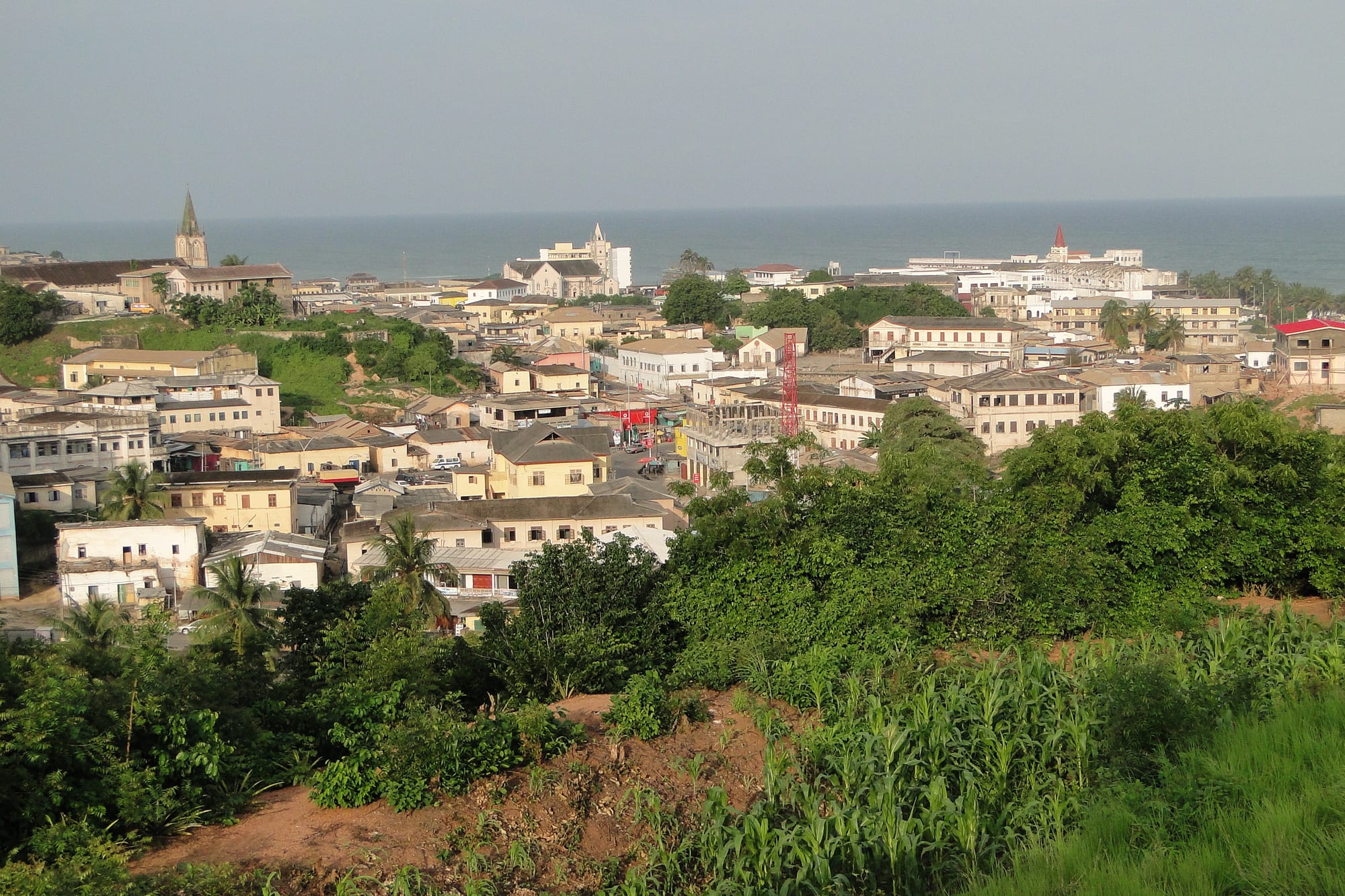
Low white and ochre houses with tin roofs running down a green hillside to church spires and the grey Atlantic behind

Accra & the Coast, Ghana

Cape Coast

Cape Coast seen from Fort Victoria on the hill above the town, with the Atlantic beyond. (Adam Jones from Kelowna, BC, Canada / Wikimedia Commons · CC BY-SA 2.0)

A Fante town on Ghana's central coast, built around the whitewashed castle that served as the headquarters of the British slave trade and then of the Gold Coast colony. It was the colonial capital until 1877, became the country's great school town, and now lives on fishing, the university and visitors to the castle and to Kakum's rainforest.

Neighbourhoods

  • The castle quarter and Commercial Street
    • First-time visitors
    • Historic district
    • Photography

    The old core between the castle, the lagoon and the shore, with colonial merchant houses, Methodist churches, the post office and the market streets running inland. Most of the town's history stands within a few hundred metres of the castle gate.

    Open in Maps
  • Bakaano and the fishing shore
    • Local life
    • Street food

    The crowded fishing quarter west of the castle, where canoes are drawn up on the sand, nets are mended in the open and smoke rises from the fish ovens. Loud, close-packed and the heart of the town's Asafo company rivalries.

    Open in Maps
  • Pedu and Abura
    • Quiet and residential
    • Close to public transport

    Inland suburbs along the road north, where much of the town now lives and where newer hotels, guesthouses and petrol stations line the highway. Tro-tros to Kakum and Accra pass through.

    Open in Maps
  • The university district
    • Students and nightlife
    • Beaches

    Amamoma, Apewosika and the streets around the University of Cape Coast, a few kilometres west of the centre, with cheap food, student bars and hostels, and a campus that runs down towards the sea.

    Open in Maps

Things to do

The castle and the forts

  • Cape Coast Castlelandmark

    The white fortress above the fishing beach, built by the Swedes in 1653 and enlarged by the British as their Gold Coast headquarters; its dungeons, chapel and 'Door of No Return' are part of a UNESCO World Heritage listing of Ghana's forts and castles.

    Open in Maps
  • Fort William Lighthouselandmark

    A square white tower on Dawson's Hill in the old town, built in 1820 as Smith's Tower and part of the UNESCO listing of Ghana's forts and castles, with old cannons beside it and a view over the town and harbour.

    Open in Maps
  • Fort Victoriaviewpoint

    A small fort in the western part of the town, built in 1821 on the site of an earlier one, with the standard view over the roofs to the sea.

    Open in Maps

Museums and learning

  • University of Cape Coastattraction

    Established in October 1962 to train graduate teachers and now one of Ghana's largest universities, on a campus west of the town that runs towards the sea.

    Open in Maps
  • Mfantsipim Schoolattraction

    A Methodist boys' school founded in 1876, the oldest secondary school in Ghana, whose old boys include the UN secretary-general Kofi Annan.

    Open in Maps
  • Adisadel Collegeattraction

    An Anglican boarding school of 1910 on a hill above the town, one of the coast's long-established schools and a rival of Mfantsipim in sport and debate.

    Open in Maps

The shore and the market

  • Cape Coast fishing harbourattraction

    The beach and landing below the castle where canoes come in, the catch is auctioned and women smoke fish in mud ovens along the shore.

    Open in Maps
  • Kotokuraba Marketmarket

    The town's central market, rebuilt as a covered hall, selling fish, vegetables, cloth and household goods in the streets around it.

    Open in Maps

Short trips from the town

  • Kakum National Parkpark

    Rainforest about 30 km north of the town, crossed by a canopy walkway of suspension bridges strung between tall trees, with forest elephants and many bird species.

    Open in Maps
  • Elmina Castlelandmark

    São Jorge da Mina, built by the Portuguese in 1482 and taken by the Dutch in 1637, about 12 km west above a harbour of painted canoes.

    Open in Maps
  • Fort Amsterdamlandmark

    A ruined English and later Dutch fort at Abandze on the coast road east, above a fishing village and a long beach.

    Open in Maps
  • Assin Manso Slave River Siteattraction

    A town about 40 km north on the Kumasi road, known for its part as a slave market where captives were held on the way to the coast, and now a memorial site.

    Open in Maps

Seasonal events

  • Oguaa Fetu AfahyeSeptember

    The town's great festival, held on the first Saturday of September, with Asafo companies, the chief carried in a palanquin, drumming and a procession through the streets.

  • PanafestEvery second year

    A pan-African historical theatre festival first held in 1992 and staged in Ghana every two years, with performances, forums and ceremonies that draw visitors from the African diaspora to the coast.

Eat and drink

Long-standing places and food districts in Cape Coast. Hours, ratings and directions come from your maps app, always current.

Cape Coast classics

  • Fante kenkey and fried fish standsmarket

    Fermented maize dough steamed in plantain leaves, eaten with fried or smoked fish, ground pepper and shito from roadside sellers all over town.

    Open in Maps
  • Chop bars around Kotokurabarestaurant

    Plain canteens near the market serving fufu in palm-nut or light soup, banku with okro, and fante fante, the coastal fish stew in palm oil.

    Open in Maps
  • Smoked fish from the shore ovensmarket

    Herring, anchovy and mackerel smoked in clay ovens along the beach and sold by the basket, a trade that supplies markets far inland.

    Open in Maps

Food districts

  • Commercial Street and the centreneighborhood

    The old trading street and the lanes near the castle, with small restaurants, bakeries, fruit sellers and drinking spots.

    Open in Maps
  • The university areaneighborhood

    Student kitchens and night stalls at Amamoma and Apewosika, selling waakye, jollof, khebab, kelewele and fried yam late into the evening.

    Open in Maps

Experience Cape Coast

History

The Fante town of Oguaa grew on a rocky shore where a small lagoon and a landing beach made trade possible. The Portuguese traded here from the late fifteenth century, and in 1653 the Swedish Africa Company built a lodge called Carolusborg on the headland. It changed hands repeatedly — Danish, Dutch, local Fante rulers, and from 1664 English — and under the Royal African Company and its successors it grew into Cape Coast Castle, the headquarters of British trade on the Gold Coast. For a century and a half captives brought down from the interior were held in its dungeons before being shipped across the Atlantic.

After Britain abolished its slave trade in 1807 the castle became the centre of a different kind of authority. Cape Coast was the capital of the British Gold Coast until the seat of government moved to Accra in 1877, and Fante merchants, clergymen and lawyers made the town the intellectual centre of the colony. The Fante Confederacy, an alliance of coastal states that became a constitutional confederation in 1868 in an early attempt at self-government, drew on the town's merchants and lawyers, and Methodist and Anglican missions founded the boarding schools — Mfantsipim in 1876, Adisadel in 1910, Wesley Girls' among them — that educated much of Ghana's later leadership.

The move of government to Accra, and of trade to the deep-water harbours at Takoradi and Tema, left the town without its old business. It settled into the roles it still holds: a school and university town, a fishing port and, since the castle was restored and opened as a museum in the 1990s, the main place in Ghana where the history of the Atlantic slave trade is told.

Culture & Customs

Cape Coast is Fante, and the Fante way of organising a town is still visible. The Oguaa traditional state has its paramount chief, the Omanhene, and the town is divided among seven Asafo companies, the old militia groups whose appliqué flags, shrines and posts stand in their quarters and whose rivalries surface at festivals. Fetu Afahye, on the first Saturday of September, brings out the palanquins, the drums, the durbar of chiefs and a week of celebrations.

Education is the other identity. The rivalry between Mfantsipim, Adisadel, St Augustine's and Wesley Girls' runs through Ghanaian public life, and old students' associations, speech days and inter-school sport fill the calendar. The University of Cape Coast adds several thousand students to a small town, with the cultural and nightlife that follows.

The castle gives the town a particular weight. Visitors from the United States, the Caribbean and Britain come as descendants rather than tourists, and naming ceremonies, libations and wreath-layings are held at the dungeons and at the Assin Manso river inland. Methodism arrived early and remains strong, Christianity is the dominant faith, and traditional priests and shrines continue alongside it. Manners are formal and unhurried: greetings first, the right hand used for giving and receiving, respect shown to elders and chiefs.

Daily Life

About 190,000 people lived in the Cape Coast metropolitan district at the 2021 count, up from 108,000 at the 2010 census, many of them students, and the town's rhythm follows the school and university terms as much as the seasons. It is the capital of the Central Region, so government offices and the regional hospital are significant employers, along with the university, the schools and the trade that serves them.

Fishing is the other pillar. Canoe crews launch before dawn from the beach below the castle, the catch is auctioned on the sand, and women buy, smoke and carry it to markets inland. Catches have fallen over recent decades, and the pressure on the fishery, the cost of fuel for outboard motors and coastal erosion along the shore are constant worries. Tourism supports guides, drivers, guesthouses and craft sellers, and is concentrated on the castle and the road to Kakum.

Most people live inland from the old core, at Pedu, Abura and Kwaprow, and commute in shared taxis. Days begin early with church or school, the market peaks mid-morning, and evenings are spent at drinking spots and food stalls along the main streets. Weekends belong to funerals, church and football, and the Central Region's poverty relative to Accra is a steady topic.

Food

Cape Coast eats Fante food, which means fish in almost everything. Fante kenkey, maize dough fermented and steamed in plantain leaves, is the staple, eaten with fried or smoked fish, raw ground pepper and shito. Banku, the softer maize-and-cassava dough, goes with grilled tilapia or okro stew, and fufu pounded from cassava and plantain is served in light soup, groundnut soup or abenkwan, the palm-nut soup.

Fante fante, a fish stew cooked in palm oil with pepper and onions, is the dish most associated with this coast, and etsew, plain boiled rice with fish stew, and abom, a ground vegetable relish, appear on chop-bar menus. Smoked herring and anchovy from the ovens along the beach flavour soups and stews across Ghana, and salted, dried fish is a Fante speciality in its own right.

Street food fills the evenings: waakye in the morning, khebab skewers, kelewele, fried yam with pepper sauce, roasted plantain with groundnuts, and bofrot, the sweet fried dough balls sold from glass boxes. Sobolo, the hibiscus drink, fresh coconut water and palm wine from the villages inland are the usual drinks, with akpeteshie poured at ceremonies and wakes.

Planning tools

Budget

Cape Coast is much cheaper than Accra and is the usual base for the castles and Kakum. Guesthouses in town and beach hotels on the road west cover most tastes, and chop bars cost very little. Entry to the castle and to the canopy walkway is charged at higher rates for foreign visitors, and a hired taxi for the day is the main extra.

Daily Budget Midrange
USD 70–150 (town or beach hotel, sit-down meals, a hired taxi and guided castle and Kakum visits)
Daily Budget Shoestring
USD 30–50 (guesthouse, chop-bar meals, tro-tros and shared taxis)

Castle and Kakum guides are hired at the ticket office rather than from touts at the gate, and taxi fares for the day are agreed before setting off.

Best Time to Visit

November to March is driest, with firm forest paths at Kakum and calm evenings in town. Early September brings Fetu Afahye and the biggest crowds of the year, and Panafest brings visitors from the diaspora in alternate years. The long rains of May and June make the forest trails muddy and the coast road slow.

Suggested Number of Days

A day or two covers the castle, the forts and the old streets. Three or four allow the rainforest north of the town, the neighbouring fort towns along the coast and time on a beach. Festival weekends need longer.

First Visit
1–2 days
With Surroundings
3–4 days

Transportation

The town is small enough that shared taxis, which run fixed routes for a few cedis, cover almost everything, with tro-tros from the lorry park for Elmina, Kakum and the coast road. Taxis can be chartered by the trip or the day, which is how most visitors reach the forest and the other forts.

Shared taxis are flagged down on the main roads and the fare is stated before getting in; a chartered taxi is a separate and much higher price.

Airport & Station Connections

Most people arrive by road from Accra, about 130 km east along the coast highway — three to four hours by STC or VIP coach, tro-tro or private car, longer when Accra traffic is bad. Sekondi-Takoradi is about 60 km west. The nearest airports are Accra International Airport, known as Kotoka until its name was changed back in 2026, and the domestic airport at Takoradi; there is no useful passenger rail.

Walkability

The old town is compact and walkable: the castle, the market, the churches and the lanes of the fishing quarter sit within a short walk of each other, and the two hill forts are a steep climb above them. Pavements are patchy, the streets are busy with taxis, and the heat makes midday walking slow. The university and the outer suburbs need a taxi.

Safety

The town is calm and crime against visitors is uncommon, though touts and self-appointed guides around the castle gate can be persistent and children may ask for money or addresses. Pickpocketing happens at the market and the lorry park. The sea in front of the town has a strong undertow and rip currents, and is a working fishing beach rather than a swimming one.

Swim only where locals advise and never alone, use app-based or registered taxis in Accra at night, and hire official castle guides at the ticket office. Valuables are best kept out of sight at the market and the lorry park. Check current official travel advice before travelling.

Climate

Hot and humid all year, with sea breezes and more rain than Accra because the forest belt begins just inland. There are two wet seasons, a long one from about April to July and a shorter one in September and October.

Summer
the long rains, about April to July: 24–30°C, humid, with heavy downpours and muddy forest paths
Winter
the dry season, about November to March: 24–32°C, sunny, with some Harmattan haze

Local Customs

The castle is a place of mourning for many visitors from the African diaspora, and quiet behaviour in the dungeons is expected. Photography of people, and of Asafo shrines and festival ceremonies, needs permission. The Fante chieftaincy and the Asafo companies are taken seriously, as are the old schools and their rivalries. Sunday mornings belong to church.

Greetings come before questions and are made with the right hand, modest dress is expected away from the beach, and permission is asked before photographing people, shrines or ceremonies.

Common Payment Methods

The currency is the Ghanaian cedi. Cash and mobile money run everyday life, and castle and park entry can usually be paid in cedis. Cards are accepted at some hotels but rarely elsewhere; ATMs are in the centre and on the main road, and foreign exchange is easier in Accra or Takoradi.