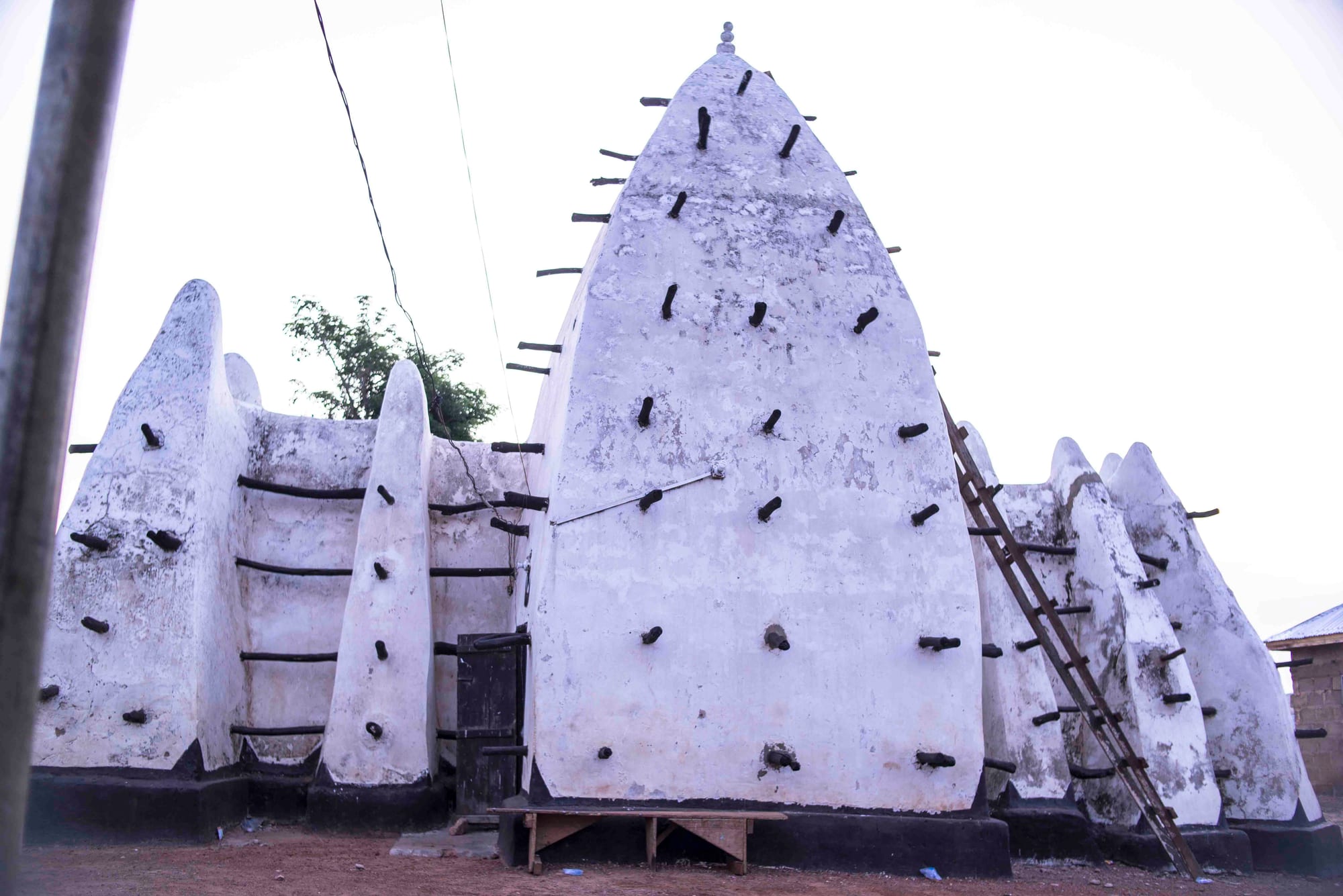
The whitewashed mud mosque at Larabanga, with tapering conical buttresses, dark timbers projecting from the walls and a wooden ladder leaning against it

Tamale & the North, Ghana

Larabanga

The mud-and-timber mosque at Larabanga, in Ghana's Savannah Region. (Amuzujoe / Wikimedia Commons · CC BY-SA 4.0)

A small Muslim village in the savanna of northern Ghana, on the road to Mole National Park. It is known for its whitewashed mud-and-timber mosque, built in the Sudano-Sahelian style with conical buttresses and projecting beams, and for a stone at the roadside that local tradition holds cannot be moved. Most visitors come on the way to the park.

Neighbourhoods

  • The old village around the mosque
    • First-time visitors
    • Historic centre
    • Local life

    A close-packed grid of earth-walled compounds and narrow sandy lanes around the mosque, with the chief's house, small shops and the village school nearby. Everything in Larabanga is within a few minutes' walk of it.

    Open in Maps
  • The Mole road
    • Close to transport
    • Quiet

    The strip along the road that runs on to the park gate, where the junction traffic, a few guesthouses, stalls and the transport to Damongo and Tamale are found. It is the part of the village most visitors see first.

    Open in Maps

Things to do

In the village

  • Larabanga Mosquelandmark

    The village's mud-and-timber mosque, whitewashed and buttressed in the Sudano-Sahelian style found across the savanna, held by tradition to be the oldest in Ghana and dated by that tradition to 1421.

    Open in Maps
  • The Mystic Stonelandmark

    A boulder at the roadside outside the village, which villagers say returned to its place each time road builders moved it, and which is treated with respect accordingly.

    Open in Maps

Short trips into Mole National Park

  • Mole National Parkpark

    Ghana's largest wildlife refuge, whose main gate is a short drive from the village; savanna woodland with elephants, antelope, warthogs and baboons, seen on walking and driving safaris led by rangers.

    Open in Maps

Short trips from the village

  • Damongoattraction

    The capital of the Savannah Region and the gateway town for Mole, with the main market, banks and offices of the district.

    Open in Maps

Seasonal events

  • Dambamoves with the Islamic calendar

    The great northern festival, which began as a marking of the Prophet's birth and is now above all a celebration of chieftaincy and heritage, with drumming, dancing and gatherings at the chief's house, as across Gonja and Dagbon.

  • Eid al-Fitr and Eid al-Adhamove with the Islamic calendar

    The two Eids are the village's biggest days, with prayers at the mosque, new clothes, shared meat and visiting between compounds.

  • The dry season at MoleDecember to April

    As the waterholes shrink, wildlife concentrates in the park and visitor numbers to the village rise sharply, at their highest around Christmas and Easter.

Eat and drink

Long-standing places and food districts in Larabanga. Hours, ratings and directions come from your maps app, always current.

Village food

  • Larabanga village stallsneighborhood

    Small stands and home kitchens selling tuo zaafi with soup, rice and stew, koko porridge with koose fritters in the morning, and roasted maize or groundnuts through the day.

    Open in Maps
  • The junction chop barsneighborhood

    Simple open kitchens by the road to the park, serving rice dishes, beans and grilled meat to drivers and passengers, with soft drinks and water in sachets.

    Open in Maps
  • Damongo marketmarket

    The nearest real market, in the district town east of the village, where yams, grain, shea butter, dried fish and guinea fowl are traded.

    Open in Maps

Experience Larabanga

History

Larabanga's history is bound up with the spread of Islam across the West African savanna. Muslim traders and scholars moved south along the routes that carried kola and salt between the Niger and the forest, and villages of Muslim clerics grew along them, keeping prayer, learning and Arabic writing far from the great cities. The village's mosque belongs to that tradition of mud-built Sudano-Sahelian architecture, and local tradition dates its founding to 1421 and attributes it to a trader who is said to have been told in a dream to build it where he had slept.

The village lies in the country of Gonja, the state founded by Mande horsemen in the seventeenth century, and Larabanga's people are counted among the Muslim families attached to the Gonja chiefs, serving as imams and scholars. The village is small and has never been a market town; its importance was religious and its position on the road.

Mole changed its modern fortunes. The reserve to the west, declared in the 1950s and made a national park in 1971, turned the road past Larabanga into a tourist route, and the village became the place where visitors stop on the way to the elephants. The mosque has been repaired and replastered repeatedly over its life, as mud buildings must be, and restoration work has been supported by the World Monuments Fund, which lists it among the world's most endangered sites. Damongo, a short way east, became the capital of the new Savannah Region when it was created in 2019.

Culture & Customs

The village is Muslim and its year follows the Islamic calendar: the two Eids, Damba, which marks the Prophet's birth and is celebrated across the north with drumming and gatherings at the chief's house, and the fasting month, when the rhythm of the day changes entirely. The mosque is used for the five daily prayers and for Friday, and the imam's family has long-standing standing in the village. An old Quran is kept as a treasured possession, which local tradition holds was granted to an imam of the mosque in answer to his prayers.

Gonja, Dagbani and Hausa, the market language of the north, are all heard in the village, and English is used with visitors. Chieftaincy runs in the Gonja manner, with chiefs enskinned rather than enstooled, and the village chief and the imam between them handle most matters.

Custom shapes how the village is seen. The Mystic Stone is a site of local devotion, credited with healing powers, and its story — of a rock that would not be shifted when the road was built — is told to every visitor. Because the village receives a steady stream of travellers heading for Mole, guiding, hosting and craft selling have become part of its economy. Hospitality is warm and greetings are long.

Daily Life

Larabanga is a small place, its compounds of earth walls and metal or thatched roofs gathered tightly around the mosque. Farming fills most of the year: yam, maize, millet, sorghum, groundnuts and beans on land around the village, with goats, sheep and guinea fowl kept at the compounds. Women gather shea nuts in the bush and boil and pound them into shea butter, a major source of cash in the savanna, and collect firewood and water.

Work follows the heat. People are in the fields at first light, back in the shade of the compounds through the middle of the day, and out again in the late afternoon; the evening belongs to sitting outside, talking and prayer. Children walk to the village school, and further schooling means Damongo or Tamale.

The road brings the other half of the economy. Guides, guesthouse keepers, drivers and traders sell to the traffic bound for Mole, and dry-season visitor numbers make a real difference to household income. The village's standing concerns are ordinary northern ones: water supply, the timing of the rains, the price of food and fertiliser, the state of the road, and the young people who leave for work in Kumasi and Accra. Crop damage by elephants and other wildlife from the park is a recurring problem for farmers near its edge.

Food

Village food here is the food of the savanna, and it is plain and filling. The staple is tuo zaafi, a stiff porridge of maize or millet flour, dipped into ayoyo soup made from jute leaves, or into okra or groundnut soup, seasoned with dawadawa, the pungent fermented locust bean that gives northern cooking its depth. Meat is occasional rather than daily: guinea fowl, goat or dried fish.

Breakfast is koko, a spiced millet porridge, taken with koose, fried bean fritters, or with bread from the roadside. Rice with a tomato and groundnut stew, beans with fried plantain or gari, and roasted maize, yam or groundnuts are the everyday alternatives, and tubaani, steamed cakes of bean flour eaten with oil and pepper, appears at stalls. Shea butter from the village's own trees is used for frying.

Drink is water, sold in sachets along the road, and sweet tea; hibiscus sobolo and soft drinks come in with the traffic. Pito, the millet beer of the north, is brewed and drunk widely in the region, but Larabanga is a devout Muslim village and alcohol is not part of life here. Visitors heading to the park usually buy food and water in Damongo or Tamale, since the village shops carry little.

Planning tools

Budget

Larabanga is inexpensive. Village guesthouses are simple and cheap, and village food costs very little. The real costs are the park — entry fees and guided safaris are charged separately — and transport, since reaching the village and moving on again usually means hiring a vehicle or waiting for infrequent minibuses.

Daily Budget Midrange
USD 60–130 (better accommodation at the park, safari fees, a hired car with driver)
Daily Budget Shoestring
USD 15–35 (village guesthouse, village food, tro-tros and shared transport)

Draw cash in Tamale or Damongo before arriving, as there is no bank in the village and card payment is not possible.

Best Time to Visit

December to April, the dry season, when the roads are firm and animals in Mole gather at the waterholes; the viewing is best late in that spell, though March and April are extremely hot. The rains from May to September bring green savanna, fewer visitors and rougher roads.

Suggested Number of Days

The village itself takes an hour or two. Most people stay one or two nights in the area to allow for the park and the long drive in and out, and a second night makes the early-morning and late-afternoon wildlife hours possible.

First Visit
half a day
With Surroundings
2 days

Transportation

The village is small enough to cross on foot. Beyond it, minibuses and shared vehicles run along the Damongo road to Tamale and Wa, though not often; motorbikes carry people and goods locally, and most visitors arrive in a hired car or on a tour. Transport into the park itself is arranged at the park.

Arrange the return journey before arriving, and set off early, as through traffic on the Damongo road thins out after the middle of the day.

Airport & Station Connections

Larabanga lies roughly 110 kilometres west of Tamale as the crow flies and further by road, about four hours by vehicle through Damongo, which is the nearest town. Buses from Tamale to Wa pass along the road, and the park gate is a short distance beyond the village. The nearest airport is at Tamale.

Walkability

Everything in the village is walkable, on sandy lanes between earth compounds, and the mosque, the chief's house and the shops are all within a few hundred metres. The stone stands by the road a short walk out. There are no pavements, the sun is fierce in the middle of the day, and walking inside the national park is only done with a ranger.

Safety

The village is calm and used to visitors, though persistent requests for guiding fees and donations around the mosque are a common complaint and are best handled politely and firmly. The serious hazards are wildlife — elephants and buffalo are dangerous and the park is entered only with rangers — and the long, rough roads in and out.

Check current official advice on the Bawku area and the Burkina Faso border districts before going, follow curfews and local guidance, and stay with rangers in Mole. Check current official travel advice before travelling.

Climate

Hot savanna climate with a single rainy season from about May to September or October, and a long dry season for the rest of the year. The Harmattan blows dust from the Sahara between November and February, with hazy days and cool nights, and March and April are the hottest months.

Summer
the rains, about May to September: 24–32°C, humid, with storms and muddy roads
Winter
the dry season, about November to April: 18–38°C, dusty and hazy, then very hot before the rains

Local Customs

Larabanga is a devout Muslim village, and its mosque is a working place of prayer rather than a monument. Non-Muslims are generally shown the outside only, modest dress covering shoulders and knees is expected, and photographs of people, and of the building, are taken after asking. Greetings are long and come before any request.

Ask before photographing the mosque, its worshippers or village life, agree any guiding fee clearly beforehand, and use the right hand for giving and receiving.

Common Payment Methods

The currency is the Ghanaian cedi, and in the village it means cash in small notes. There is no bank or cash machine; the nearest are in Damongo and Tamale. Mobile money is used by some traders, and park fees are best prepared for in advance.