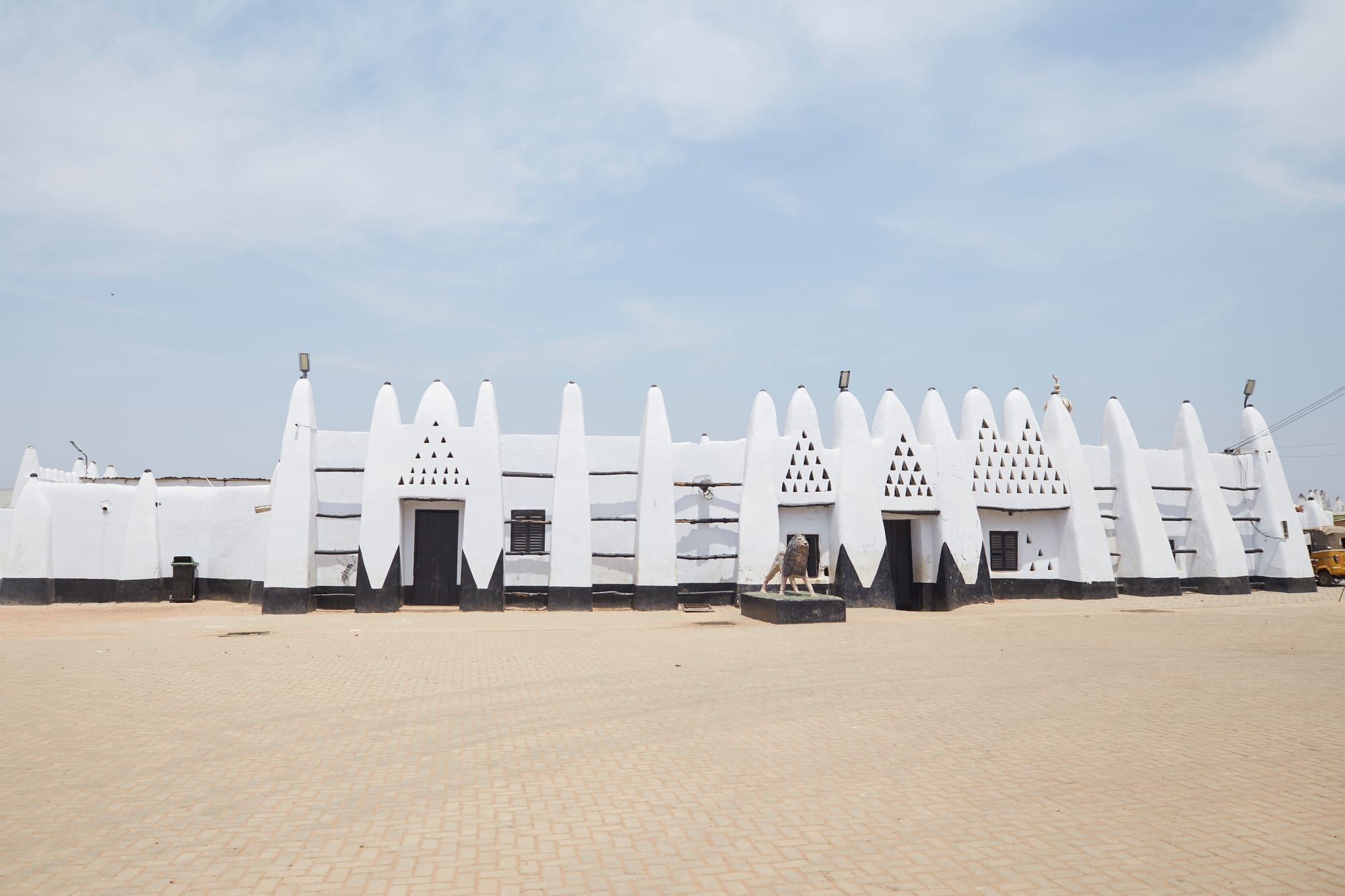
A long whitewashed earthen palace with tapering buttresses and triangular openings, under a hazy sky

Tamale & the North, Ghana

Wa

The Wa Naa's Palace in Wa, built in the Sudano-Sahelian style of mud and timber. (Isaac Gyamfi Assumend / Wikimedia Commons · CC BY-SA 4.0)

The capital of Ghana's Upper West Region, a flat savanna town near the Black Volta and the Burkina Faso border. It grew as the seat of the Wa Naa, the ruler of the Muslim Wala state, and keeps his whitewashed earthen palace and an old quarter of mud-walled compounds beside a modern grid of university campuses, ministries and motorbike-filled roads.

Neighbourhoods

  • Wa central
    • First-time visitors
    • Historic district
    • Markets

    The old heart of the town, where the Wa Naa's Palace, the central mosque and the main market stand within a few minutes of each other. Lanes of mud-walled and concrete compounds run off the through roads, and the lorry park and shared-taxi ranks are close by.

    Open in Maps
  • Dondoli
    • Local life
    • Quiet and residential

    A residential quarter on the northern side of town, a mix of older compound houses and newer blocks along dusty side streets. It is ordinary working Wa rather than a sight, with small shops, drinking spots and a rhythm set by the school and prayer times.

    Open in Maps
  • Bamahu
    • Students
    • Quiet and residential

    The university side of Wa, a few kilometres out along the Wa–Bamahu road, where campus buildings have drawn student hostels, printing shops, phone kiosks and cheap food joints. It is newer and more spread out than the centre.

    Open in Maps

Things to do

Landmarks in town

  • Wa Naa's Palacelandmark

    The seat of the ruler of the Wala, a whitewashed earthen building in the Sudano-Sahelian style with tapering buttresses, generally dated to the nineteenth century.

    Open in Maps
  • SD Dombo University of Business and Integrated Development Studiesattraction

    Wa's university, grown out of the Wa campus of the University for Development Studies, made autonomous in 2019 and opened in 2020, and a large part of the town's recent expansion.

    Open in Maps

Mosques and old architecture

  • Nakore Mosquelandmark

    A small mud-and-timber mosque in the Sudano-Sahelian style in a village a short way south-west of Wa, with conical buttresses and projecting timbers.

    Open in Maps
  • Dondoli Mosquelandmark

    A nineteenth-century mosque in the Dondoli quarter of Wa, built in the same Sudano-Sahelian style of mud and timber and now standing in partial ruin.

    Open in Maps

Short trips from the town

  • Wechiau Community Hippo Sanctuaryattraction

    A community-run reserve on the Black Volta south-west of Wa, created by local chiefs in 1999 around one of the two hippopotamus populations left in Ghana, where the animals are watched from canoes and the riverside villages run the guiding themselves.

    Open in Maps
  • Gbele Resource Centrepark

    The fourth largest game reserve in Ghana, a stretch of savanna with hartebeest, waterbuck, duiker, warthog and baboon, recognised by BirdLife International as an Important Bird Area.

    Open in Maps

Seasonal events

  • Dambamoves with the Islamic calendar

    The northern chiefs' festival, which began as a marking of the Prophet's birth and is now above all a celebration of chieftaincy, kept at the Wa Naa's Palace with drumming, praise singing and a gathering of the Wala chiefs.

  • Eid al-Fitr and Eid al-Adhamove with the Islamic calendar

    The two great Muslim feasts, when prayer grounds fill in the morning and families visit through the rest of the day.

  • The Harmattan dry seasonNovember to February

    Dust haze from the Sahara, cool nights and clear roads — the season when most travel and most outdoor celebration happens.

Eat and drink

Long-standing places and food districts in Wa. Hours, ratings and directions come from your maps app, always current.

Wa classics

  • Tuo zaafi at the chop barsrestaurant

    Stiff maize or millet porridge with ayoyo, okra or groundnut soup, usually with guinea fowl or beef, sold at simple kitchens across the town.

    Open in Maps
  • Grilled guinea fowl and khebab standsrestaurant

    Roadside grills work through the evening, turning skewers of beef and offal and whole guinea fowl over charcoal, dusted with pepper and groundnut powder.

    Open in Maps
  • Pito barsrestaurant

    Millet beer brewed in households and served from calabashes at informal bars, the everyday drink of the savanna north.

    Open in Maps

Markets and food streets

  • Wa central marketmarket

    The town's trading centre, with grain, yams, dried fish, shea butter, dawadawa and smocks, busiest on market day.

    Open in Maps
  • Food stalls around the lorry parkneighborhood

    Waakye, koko with koose, rice and stew and fried yam are sold from pans and trestle tables where the tro-tros load.

    Open in Maps

Experience Wa

History

Wa grew up as the capital of the Wala state, a Muslim polity of the far north-west whose ruler carries the title Wa Naa. Its ruling houses trace descent from Mande and Dagomba incomers who settled among the Dagaaba and Sisaala farmers of the area from about the seventeenth century, while Muslim traders and scholars arrived along the routes that carried kola, salt and cloth between the forest and the Niger bend. The town was never large, but it was a court, a market and a centre of Quranic learning, and its palace was built of mud and timber in the Sudano-Sahelian manner.

The late nineteenth century was violent. The wars of Samori Toure and his lieutenants reached the north-west in the 1890s, and a British force was routed at Wa in 1897, before British and French officers divided the region between their spheres. Wa fell inside the Northern Territories protectorate declared by Britain in 1901, which was governed cheaply and used as a source of migrant labour for the mines and cocoa farms of the south.

After independence the town's fortunes turned on administration. It lay in the Upper Region formed in 1960 and became, when that was divided in 1983, the capital of the new Upper West Region, which brought ministries, a hospital and schools. A campus of the University for Development Studies arrived in the 1990s and became a university in its own right, made autonomous in 2019 and opened in 2020, and the town has grown outwards along its main roads since. The palace remains the centre of Wala ceremonial life.

Culture & Customs

Wa is the Wala town, and Waali, a Mabia language close to Dagaare and Dagbani, is heard in the market alongside Dagaare from the surrounding countryside, Sisaali from the east and Hausa from the traders. Islam has been established here for centuries and shapes the calendar: Friday prayers empty the offices, Ramadan reorders the day, and the two Eids and Damba bring the chiefs, drummers and praise singers to the palace, where the Wa Naa sits in state and the town turns out to greet him. Christian churches and traditional shrines belong to the same landscape, particularly among families with roots in the Dagaaba villages.

Chiefs here are enskinned rather than enstooled, seated on animal skins, and the Wala state has its own hierarchy of divisional chiefs, elders and Muslim officeholders whose roles in festivals are fixed by custom. Respect is shown by greeting first and at length, using the right hand, and lowering the head or removing a hat before a chief.

The smock — batakari or fugu — is everyday wear as well as ceremonial dress, woven in narrow strips and sewn into a wide tunic, and is worn with a woven cap. Xylophone music of the Dagaaba, drumming, and funeral dances that can last for days are the region's best-known performing traditions, and funerals remain the largest social gatherings of all, drawing relatives home from Kumasi and Accra.

Daily Life

About 200,000 people lived in Wa at the 2021 census, making it a city by Ghanaian standards and the largest place for a long way in any direction. Its economy is built on being a capital: the regional administration, the hospital, banks, schools and the university employ many, and everyone else trades, farms or rides. Maize, millet, sorghum, yams and groundnuts come in from the villages, cattle and guinea fowl are kept, and women gather and process shea nuts into butter, much of it bought by exporters for cosmetics.

The centre is dense, with compound houses, shops and workshops packed around the palace, the mosque and the market; the newer quarters spread along the roads towards Bamahu, Kpaguri and Charia in a thinner grid of concrete blocks and building plots. Motorbikes are the characteristic sound and sight of the town, and the yellow shared taxis fill the main streets.

Days start early and finish early. Farming, trading and offices are all morning work, the afternoon belongs to shade, and the evening to the grills, the drinking spots and the mosque. Water supply, electricity cuts, the timing of the rains and the pull of migration to the south are the running concerns, and illegal small-scale gold mining has spread in parts of the Upper West.

Food

The staple is tuo zaafi, universally called TZ: a stiff porridge of maize or millet flour, dipped by hand into ayoyo soup made from jute leaves, or into okra or groundnut soup, and eaten with guinea fowl, beef or dried fish. Dawadawa, fermented locust beans, gives the soups their deep, pungent base, and shea butter is used as cooking fat as well as on the skin.

Breakfast is koko, a spiced millet porridge, taken with koose, fried bean fritters, or with a slab of bread from a clay oven. Later in the day the chop bars serve waakye — rice and beans with stew, gari and egg — jollof, plain rice with groundnut soup, and fried yam. Tubaani, steamed bean-flour cakes eaten with oil and pepper, and wasawasa, made from yam-peel flour, are northern specialities sold from bowls at the roadside. Guinea fowl is the celebration meat, grilled whole or stewed, and khebab skewers of beef and offal appear as the sun goes down.

Pito, a lightly fermented beer of millet or sorghum brewed in households, is the regional drink, sold from big pots and drunk from calabashes at the pito bars, though in a Muslim town many people do not drink it. Sobolo, the hibiscus infusion, sachet water, and strong sweet tea with condensed milk from the roadside kiosks round out the day.

Planning tools

Budget

Wa is among the cheapest towns in Ghana. Guesthouse rooms, chop-bar meals and shared taxis cost very little, and the real expense is distance: reaching Wechiau, Gbele or the Burkina border means hiring a car, a taxi for the day or a motorbike with a rider. Banks and cash machines are in the centre, and they are the last reliable ones before the villages.

Daily Budget Midrange
USD 70–150 (a better hotel in town, a hired car with driver, guide and community fees)
Daily Budget Shoestring
USD 25–45 (simple guesthouse, chop-bar food, shared taxis and tro-tros)

Cash and mobile money run the town; small cedi notes are needed for shared taxis and market stalls.

Best Time to Visit

November to February, the Harmattan months, are the most comfortable: dry, dusty and cooler at night, with the rural roads passable. March and April are punishing, with afternoons near or above 40°C. The rains from about May to September turn the country green but make dirt roads to the Black Volta villages slow and sometimes impassable.

Suggested Number of Days

A day or two covers the town itself, which is small and quickly walked. Three or four allow the Black Volta and the reserves out of town, where transport rather than the sights sets the pace, and a night away from Wa is often the simplest way to do it.

First Visit
1–2 days
With Surroundings
3–4 days

Transportation

The town is small enough to cross on foot, and everything else moves by motorbike, bicycle or shared taxi, which run fixed routes along the main roads for a few cedis. Tro-tros and coaches leave from the lorry park for Tamale, Kumasi and Accra, and motorbike riders can be hired by the day for the villages. Rural roads west and east of Wa are dirt.

Fares on shared taxis and motorbikes are best agreed before setting off, and rural journeys are best made in daylight.

Airport & Station Connections

Wa sits at the end of the long roads from Kumasi and from Tamale; the Tamale road across the savanna is the usual link to the rest of the north, and coaches from Accra run overnight and take most of a day. Wa Airport has had scheduled flights to Accra by way of Tamale since 2019, though most people still arrive by road, and the Hamile crossing into Burkina Faso lies north-west.

Walkability

Flat, compact and easy to walk in the centre, where the palace, the mosque and the market are within a few hundred metres of each other. Pavements are patchy, motorbike traffic is constant, and the heat and dust make midday walking hard work, so mornings and evenings are the sensible hours. The university and outer quarters are too far out to reach on foot.

Safety

Wa is a calm town with little violent crime, and the usual precautions against opportunistic theft in markets and lorry parks are enough. The Upper West is one of the border regions where spillover from the insurgency in Burkina Faso is a stated concern, so the districts along the frontier are treated differently from the town. Road accidents and heat are the practical risks.

Check current official advice on the Bawku area and the Burkina Faso border districts before going, follow curfews and local guidance, and stay with rangers in Mole. Check current official travel advice before travelling.

Climate

Savanna climate with one rainy season and one long dry season. Rain falls from about May to September, often as heavy afternoon storms; the rest of the year is dry, with the Harmattan blowing dust from the Sahara between about November and February and March to April the hottest months.

Summer
the rains, about May to September: roughly 24–33°C, humid, with storms and green country
Winter
the dry season, about November to February: roughly 18–35°C, hazy, dusty and cool at night

Local Customs

Wa is a predominantly Muslim town and dress is modest, with shoulders and knees covered; shoes come off at the door of a mosque, and permission matters before entering the palace grounds or photographing people, chiefs or prayers. Greetings are unhurried and the right hand is used for giving, receiving and eating. Alcohol is sold discreetly and pito bars sit apart from the centre of town.

Tipping is not customary in chop bars; a guide, a motorbike rider or a palace attendant is normally thanked with a small payment agreed in advance.

Common Payment Methods

The currency is the Ghanaian cedi. Cash and mobile money dominate; card payment is rare outside a hotel or two, and cash machines in the centre are the last dependable ones before the Black Volta villages and the reserves, where nothing electronic works.