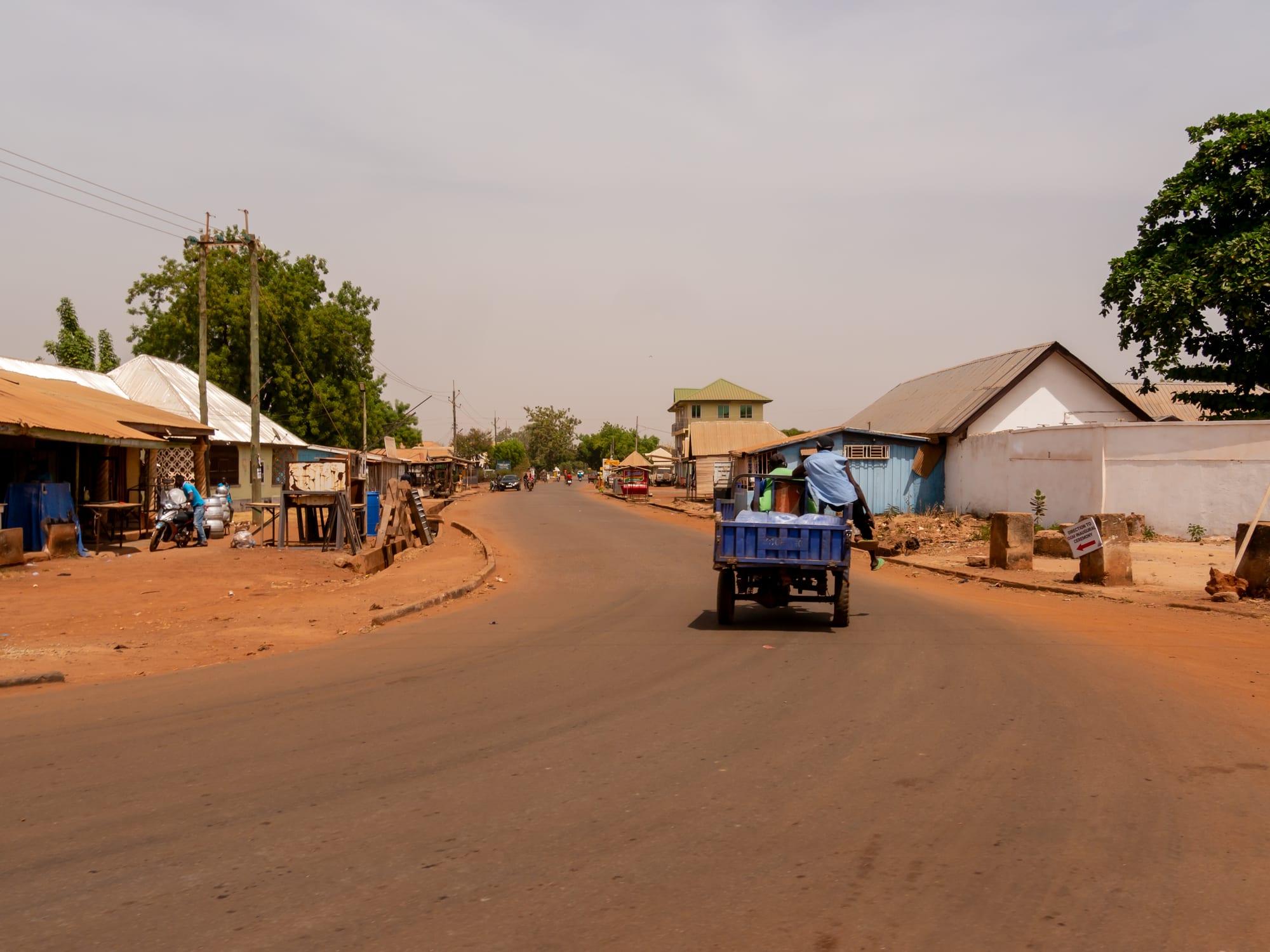
A wide tarred street in Tamale under a hazy sky, with a loaded motor tricycle, roadside stalls and metal-roofed houses along red earth verges

Tamale & the North, Ghana

Tamale

A street in Tamale during the dry-season Harmattan haze, in northern Ghana. (Matti Blume / Wikimedia Commons · CC BY-SA 4.0)

The largest city of northern Ghana and the capital of the Northern Region, set on flat savanna in the heart of Dagbon, the Dagomba kingdom. It grew from a cluster of villages into the colonial headquarters of the Northern Territories, and is now a spreading city of markets, mosques, motorbikes and universities, and the usual staging post for Mole National Park.

Neighbourhoods

  • The central business district
    • First-time visitors
    • Markets
    • Close to transport

    The core around the central market, the main mosque and the banks, where the hotels, offices and lorry parks are concentrated. Traffic here is dominated by motorbikes and motor tricycles, and the stations for Accra, Kumasi, Bolgatanga and Wa lie on its edges.

    Open in Maps
  • Aboabo
    • Street food
    • Local life
    • Markets

    A dense, largely Muslim quarter east of the centre with its own market and a steady trade in food, cloth and hardware. Mosques, grills and tailoring workshops line the lanes, and it is one of the busiest parts of the city in the evenings.

    Open in Maps
  • Lamashegu
    • Local life
    • Quiet and residential

    A large residential area on the southern side of the city, grown from an old village into streets of compound houses, small shops and schools. It has its own chief and the ordinary rhythm of a Dagomba neighbourhood.

    Open in Maps
  • Sakasaka and the western suburbs
    • Quiet and residential
    • Close to transport

    Residential neighbourhoods spreading west and north along the roads out of the city, mixing older compounds with newer concrete houses, guesthouses, churches and mosques. They are calmer than the centre and linked to it by shared taxis and motorbikes.

    Open in Maps

Things to do

Markets and the city centre

  • Tamale Central Marketmarket

    The city's main market, a huge covered and open trading ground for grain, yams, shea butter, dried fish, cloth, smocks and household goods, busiest in the morning.

    Open in Maps
  • Aboabo Marketmarket

    The second of the city's big markets, in the eastern quarter, known for food, livestock and everyday goods and for the cooked-food sellers around its edges.

    Open in Maps
  • Tamale Central Mosquelandmark

    The main mosque in the centre of the city, a landmark for the largely Muslim population, with the Friday crowds spilling into the surrounding streets.

    Open in Maps
  • Tamale Centre for National Cultureattraction

    The regional cultural centre, with craft stalls selling smocks, baskets and leatherwork and a performance space used for drumming and dance.

    Open in Maps

Learning and sport

  • University for Development Studiesattraction

    The fifth public university in Ghana, established in 1992 to speed the development of the north, with its central administration in Tamale and campuses across the region.

    Open in Maps
  • Aliu Mahama Sports Stadiumattraction

    The city's football stadium, completed in 2008 and used for matches in that year's Africa Cup of Nations, renamed in 2017 after the former vice-president Aliu Mahama and home to Real Tamale United.

    Open in Maps

Short trips west to Mole

  • Mole National Parkpark

    A large tract of savanna woodland where elephants, antelope, warthogs and baboons gather at waterholes below an escarpment, visited on walking and driving safaris with rangers.

    Open in Maps
  • Larabanga Mosquelandmark

    A small whitewashed mud-and-timber mosque in the Sudanese style, with conical buttresses and projecting timbers, the oldest mosque in Ghana and traditionally dated to 1421.

    Open in Maps

Short trips into Dagbon

  • Yendiattraction

    The old capital of the Dagbon kingdom and the residence of its paramount chief, a town of compounds and a palace where the kingdom's ceremonies are held.

    Open in Maps
  • Salagaattraction

    A town that was a great kola market in the eighteenth and nineteenth centuries and the largest slave market of that time, where the pond used to wash enslaved people and the site of the old market are still shown.

    Open in Maps

Seasonal events

  • Dambamoves with the Islamic calendar

    The Dagomba festival marking the birth of the Prophet, with drumming, praise singing and a durbar of chiefs in smocks, some riding horses, at the palaces of Tamale and Yendi.

  • Bugum, the fire festivalthe ninth day of the first month of the Dagomba lunar year

    Night processions of torch-bearers through the streets and neighbourhoods, accompanied by drumming, marking the Dagomba new year.

  • Eid al-Fitr and Eid al-Adhamove with the Islamic calendar

    The two Eids fill the prayer grounds and are followed by visiting, new clothes, shared meat and horse riding at the chiefs' palaces in a mainly Muslim city.

Eat and drink

Long-standing places and food districts in Tamale. Hours, ratings and directions come from your maps app, always current.

Markets and food streets

  • Tamale Central Market food sellersmarket

    Cooked-food rows inside and around the market selling tuo zaafi with ayoyo soup, rice and stew, koko and koose, alongside stalls of shea butter, dawadawa and dried fish.

    Open in Maps
  • Aboabo street foodneighborhood

    The eastern quarter's evening grills and fried-food stalls, where khebab skewers, guinea fowl, tubaani and wasawasa are sold from the roadside.

    Open in Maps
  • Chop bars and rice joints in the centreneighborhood

    Open kitchens around the lorry parks and offices serving waakye, jollof and plain rice with stew at midday, and tuo zaafi in the evenings.

    Open in Maps
  • Pito barsneighborhood

    Yards where millet beer brewed in households is poured from clay pots into calabashes, the traditional drink of the savanna and a meeting place at the end of the day.

    Open in Maps

Experience Tamale

History

Tamale grew where several Dagomba farming villages met on open savanna, in the kingdom of Dagbon, whose rulers, the Ya-Na, have long held their seat at Yendi to the east. The place had no great trading past of its own: the famous markets of the north were at Salaga, on the kola route, and the seats of power were the chiefs' towns. What made Tamale was colonial administration. After Britain declared the Northern Territories a protectorate in 1901, the British established their administrative headquarters here in 1907, once German officials had taken Yendi, on a site central, flat and well-watered enough to build on.

Administration brought roads, a garrison, schools and a hospital, and the town drew people from across the north. Colonial investment in the region as a whole was slight — the Northern Territories were treated mainly as a labour reserve for the mines and cocoa farms of the south — so Tamale's growth was also a concentration of the little that existed. Its plan still shows the colonial layout, with a central grid of offices and markets and the old aerodrome on the edge.

Tamale became the capital of the Northern Region in 1960 and the hub of every northern route. Universities, hospitals, aid agencies and government departments followed, and the population multiplied several times over in a few decades. When the old Northern Region was divided in 2019 to create the Savannah and North East regions, Tamale remained the capital of what was left and the unquestioned capital of the north as a whole.

Culture & Customs

This is the centre of Dagbon, and Dagbani is the language of the streets. Dagomba society is organised around chieftaincy: chiefs are enskinned, seated on animal skins rather than stools, and the hierarchy runs from village chiefs up to the Ya-Na at Yendi. Drummers, the lunsi, are a hereditary class who keep the genealogies of the royal houses and recite them at ceremonies, and praise singing and the talking drum are still central to public occasions.

Islam is the majority faith and gives the city its calendar. Damba, marking the Prophet's birth, brings chiefs out in smocks under umbrellas with horses and drumming; Bugum, the fire festival, fills the night with torch processions; and the two Eids empty the streets for prayer and fill them again afterwards. Christian churches and traditional practice exist alongside, and communities from the Upper regions, Gonja and the south add other languages.

The smock — batakari or fugu, hand-woven in narrow strips and sewn into a wide tunic — is the north's signature garment and a Tamale speciality, worn with a distinctive hat at festivals. Weavers, leatherworkers and shea-butter processors work in the city and its villages. Football is followed closely, and bicycles and motorbikes are so much part of daily life that the city is known across Ghana for them.

Daily Life

The 2021 census counted 374,744 people in Tamale, which makes it Ghana's third largest city and much the largest in the north. It is young, fast-growing and low-rise, spreading outwards in compounds and concrete houses as farmland on the edges is turned into plots. Most households combine several kinds of work: trading, transport, a salaried job, and farming on land outside the city.

The economy rests on trade, government, education and services rather than industry. The market moves grain, yams, livestock and shea; aid organisations and NGOs have a heavy presence in the north and employ many people in the city; universities, colleges and the teaching hospital anchor a professional class, and craft work in smocks, leather and baskets sells to traders from the south.

Life follows the heat and the calendar. Markets and building sites are busiest in the early morning, afternoons are slow and shaded, and the streets refill in the cool of the evening around grills and pito bars. Water supply, electricity, the price of fertiliser and the timing of the rains are the standing concerns, along with the gap in wealth and services between the north and the south, and the migration of young people to Kumasi and Accra for work.

Food

Tamale eats the food of the savanna. The staple is tuo zaafi, known everywhere as TZ, a stiff porridge of maize or millet flour, served with ayoyo, the slippery soup of jute leaves, or with okra or groundnut soup, and usually with guinea fowl or beef. Dawadawa, fermented locust beans pressed into dark balls, gives northern soups their pungent depth, and shea butter, produced by women's groups across the region, is used in cooking as well as on the skin.

Breakfast is koko, a spiced millet porridge, with koose, fried bean fritters, sold at the roadside from before dawn. Tubaani, steamed bean-flour cakes eaten with oil and pepper, and wasawasa, a dish of steamed yam-peel flour, are local specialities found much more easily here than in the south. Guinea fowl is the celebratory meat, grilled whole or in stew, and khebab skewers of beef and offal, dusted with ground groundnut and pepper, grill along the roads after dark. Waakye and jollof rice have come north and are everywhere at midday.

Pito, the lightly fermented millet or sorghum beer brewed in households and sold in calabashes, is the region's drink, though in a mainly Muslim city many people take sobolo, the chilled hibiscus drink, or milk drinks and sweet tea instead.

Planning tools

Budget

Tamale is among the cheapest cities in Ghana. Guesthouses, street food and motorbike taxis cost little, and the city has enough hotels to keep prices reasonable. The expense is getting out of it — a hired car with driver to Mole, park fees and the lodge there are what stretch a budget in the north.

Daily Budget Midrange
USD 60–130 (hotel, restaurant meals, a hired car with driver for trips)
Daily Budget Shoestring
USD 20–40 (guesthouse, street and chop-bar food, shared taxis and motorbikes)

Draw cash in Tamale before travelling on to Mole, Damongo or the villages, where cash machines are scarce and mobile money is the usual alternative.

Best Time to Visit

November to April, the dry season, when roads are open and wildlife at Mole gathers at the waterholes, especially from about January. December and January bring Harmattan haze and cool nights. March and April are fiercely hot, and the rains from May to September can cut rural roads.

Suggested Number of Days

A day or two is enough for the city itself, its markets and craft workshops. Four or five allow for Mole, Larabanga and a run east into Dagbon, all of which involve long road journeys. Festival dates and slow rural transport both push the number up.

First Visit
1–2 days
With Surroundings
4–5 days

Transportation

Tamale moves on two wheels. Motorbikes and bicycles fill the roads, motor tricycles carry goods, and shared taxis and motorbike taxis are the way most people cross the city. Tro-tro minibuses and coaches leave the lorry parks for Accra, Kumasi, Bolgatanga, Wa and Damongo, and cars with drivers can be hired for the park.

Agree fares before setting off, and hire a car with driver for Mole rather than relying on infrequent rural buses.

Airport & Station Connections

Yakubu Tali International Airport, about 11 kilometres from the centre, has flights from Accra and has handled Hajj pilgrim charters to Saudi Arabia, though as of 2024 it carried no scheduled international services. By road the city is several hours north of Kumasi and a long day by coach from Accra; roads continue north to Bolgatanga and the Burkina Faso border and west to Wa.

Walkability

The centre is flat and compact enough to walk between the market, the mosque and the main offices, but the city spreads a long way and the distances between neighbourhoods are considerable. Pavements are intermittent, motorbike traffic is constant, and the heat and dust make midday walking hard work. Most people use a motorbike or shared taxi.

Safety

Tamale is generally calm and crime against visitors is uncommon, though crowded markets and lorry parks bring the usual pickpocketing. Road traffic, and motorbikes in particular, is the most serious everyday risk. Chieftaincy disputes in the wider region have caused unrest at times, and the areas near the Burkina Faso border, well to the north, carry a security concern.

Check current official advice on the Bawku area and the Burkina Faso border districts before going, follow curfews and local guidance, and stay with rangers in Mole. Check current official travel advice before travelling.

Climate

Hot savanna climate with a single rainy season. Rain falls from about May to September or October; the rest of the year is dry, with the Harmattan blowing dust from the Sahara between November and February, bringing hazy skies and cooler nights.

Summer
the rains, about May to September: 24–32°C, humid, with heavy storms
Winter
the dry season, about November to April: 18–38°C, dusty and hazy early on, then fiercely hot in March and April

Local Customs

Tamale is mainly Muslim and more conservative in dress than southern Ghana; covered shoulders and knees are the norm, and Friday prayers shape the middle of the day. Dagomba chiefs are enskinned rather than enstooled, and elders are greeted first and at length. The smock, or fugu, is the formal dress for men at festivals and weddings.

Dress modestly, greet elders before beginning any conversation, ask permission before photographing people, mosques or chiefs, and use the right hand for giving, receiving and eating.

Common Payment Methods

The currency is the Ghanaian cedi. Cash and mobile money dominate; bank ATMs and card payment exist in the city centre and at larger hotels but almost nowhere beyond it. Small notes are needed for motorbike taxis and market stalls.