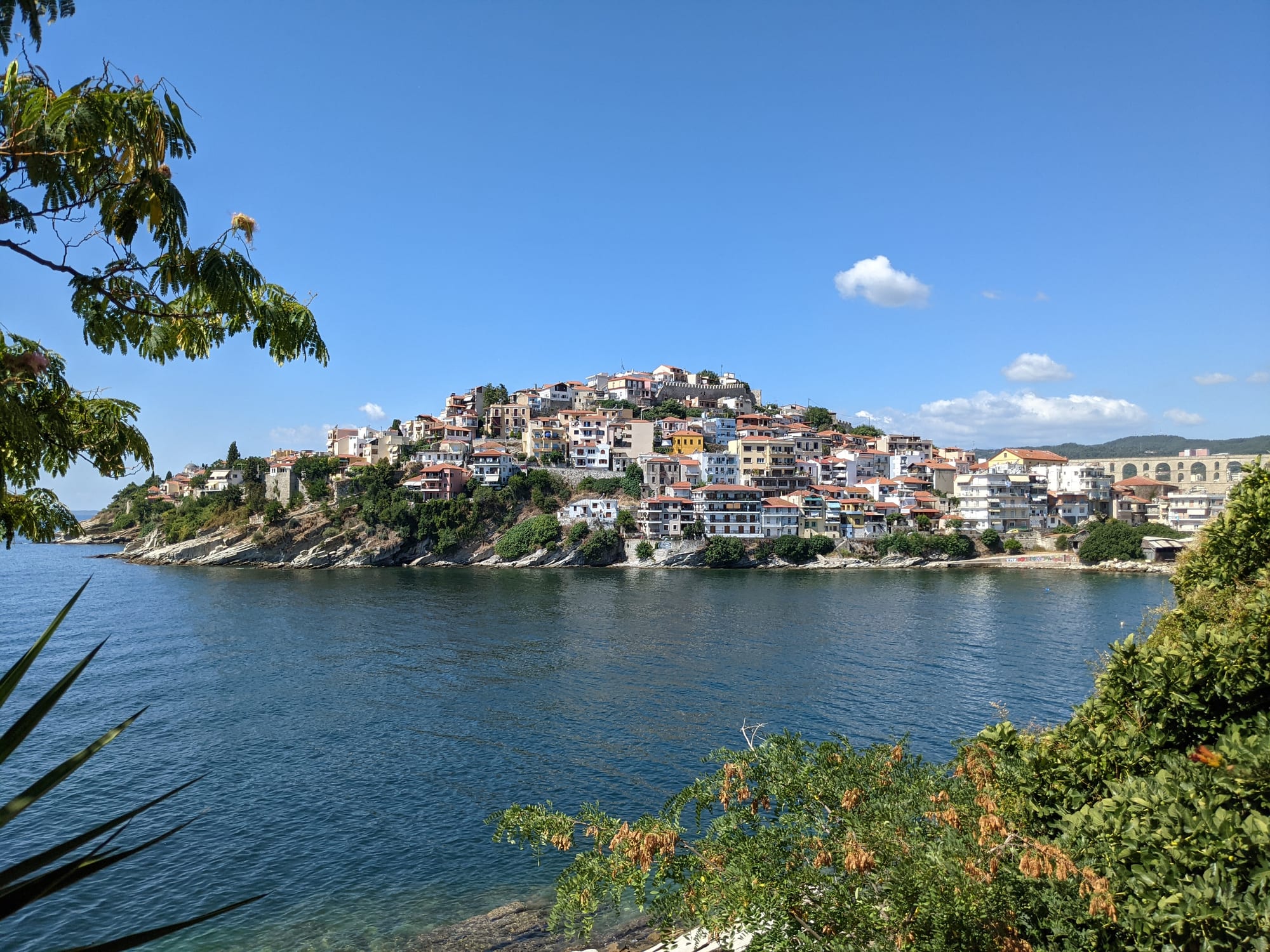
Pastel houses climbing a rocky headland above calm blue water

Macedonia & Thrace, Greece

Kavala

The old town of Kavala on the Panagia peninsula. (Patrik Kunec / Wikimedia Commons · CC BY-SA 4.0)

The principal seaport of eastern Macedonia, on the Bay of Kavala facing the island of Thasos. Ancient Neapolis, near Philippi, became Byzantine Christoupolis and then an Ottoman town whose 16th-century aqueduct still strides across the centre. Tobacco made it rich; today it lives on trade, fishing, tourism and the ferries, with an old quarter of lanes on the Panagia peninsula.

Neighbourhoods

  • Panagia (the old town)
    • Historic district
    • First-time visitors
    • Views

    The peninsula above the port, where remains of the Byzantine fortifications can still be seen. Cobbled alleys of colourful houses and tavernas climb past Muhammad Ali's house and the domes of his Imaret to the castle, with a small lighthouse and lookout over the sea towards Thasos.

    Open in Maps
  • The harbour and town centre
    • Close to public transport
    • Best for food
    • Shopping

    The modern town spreading west of the aqueduct around the port, where the ferries leave for Thasos and the north Aegean islands. The tobacco warehouses of the early 20th century, the Archaeological Museum and a Saturday-morning market are here, among cafés and apartment blocks.

    Open in Maps
  • The eastern fishing harbour
    • Seafood
    • Quiet evenings

    A small harbour of fishing and sailing boats at the east end of the town, with restaurants and bars right on the seafront.

    Open in Maps

Things to do

Landmarks of the old town

  • Kamares aqueductlandmark

    The town's best-known landmark, a long arcade of arches of Roman origin rebuilt by the Ottomans in the 16th century, dividing the old town from the new.

    Open in Maps
  • Kavala castlelandmark

    A Byzantine citadel at the highest point of the Panagia peninsula, extended by the Ottomans, with all-round views of the Aegean and the town.

    Open in Maps
  • Mehmet Ali Housemuseum

    The preserved 18th-century Ottoman mansion of the family of Muhammad Ali, founder of the dynasty that ruled Egypt, with his bronze equestrian statue beside it.

    Open in Maps
  • Panagia lighthouseviewpoint

    A small lighthouse a few metres from the Panagia church, with a lookout point over the sea.

    Open in Maps

Museums

  • Archaeological Museum of Kavalamuseum

    Founded in 1934 and housed since 1964 in its current building, with finds from Neapolis, Amphipolis, Avdira and other sites of the area.

    Open in Maps
  • Tobacco Museummuseum

    The municipal museum of the town's tobacco era, showing the trade, processing and tools that made Kavala rich.

    Open in Maps

Short trips from the town

  • Philippiattraction

    The ruins of the city renamed by Philip II, scene of the battle of 42 BC and of Paul's mission, a UNESCO World Heritage Site since 2016 for its Roman remains.

    Open in Maps
  • Nea Karvaliattraction

    A resort village east of the town, home to descendants of Cappadocian Greeks who arrived in the 1924 population exchange, famous for its kourabiedes.

    Open in Maps
  • Lion of Amphipolislandmark

    A 4th-century BC marble lion set up as a tomb monument, standing about 1 km outside the south gate of ancient Amphipolis.

    Open in Maps

Seasonal events

  • Philippi FestivalJuly to September

    Held since 1957, with theatre and music performances, including in the ancient theatre at Philippi.

Eat and drink

Long-standing places and food districts in Kavala. Hours, ratings and directions come from your maps app, always current.

Kavala classics

  • Seafood tavernas of Panagianeighborhood

    Tavernas on the old-town lanes serving the town's fish and seafood — sardines, shrimp salad and grilled sun-dried mackerel.

    Open in Maps
  • Kourabiedes of Nea Karvalineighborhood

    Sugar-coated almond biscuits from the refugee village east of Kavala, the area's best-known sweet.

    Open in Maps

Food districts and markets

  • The eastern fishing harbourneighborhood

    Restaurants and bars on the seafront beside the small fishing harbour at the east end of town.

    Open in Maps
  • Saturday marketmarket

    A Saturday-morning market of fruit and clothing in the town centre.

    Open in Maps

Experience Kavala

History

Settlers from Thasos founded Neapolis, the "new city", in the 7th century BC, to exploit the gold and silver mines of Mount Pangaion. By the end of the 6th century BC it had broken away from Thasos and was issuing its own silver coins, and during the Peloponnesian War it stayed loyal to Athens. It became a Roman civitas in 168 BC and was a base for Brutus and Cassius before their defeat there in 42 BC, and the apostle Paul landed at Neapolis on his first voyage to Europe. As Byzantine Christoupolis it was fortified against Bulgarian raids, and the Normans probably burnt it in 1185.

The Ottomans first took the town in 1387. In the 16th century Ibrahim Pasha, Grand Vizier of Suleiman the Magnificent, rebuilt the old Roman aqueduct and helped the town grow, and the Byzantine fortress on Panagia was extended. Muhammad Ali, the founder of the dynasty that ruled Egypt, spent his youth here, the son of an Albanian tobacco and shipping merchant, and in 1817 he endowed the Imaret, a large charitable and religious complex on the peninsula. By the 19th century Kavala was a major centre for processing and trading tobacco.

Bulgaria captured the town in the First Balkan War; the Greek navy took it in the Second, and it became Greek under the Treaty of Bucharest of 1913. Bulgarian forces occupied it again from 1916 to 1918. After 1922 thousands of refugees from Anatolia provided the labour for a new tobacco boom, and many of the warehouses of that era still stand. During the Bulgarian occupation of 1941–1944 almost the entire Jewish community was deported and murdered at Treblinka.

Culture & Customs

Kavala calls itself the "cyan city", and its municipal symbol is the head of the goddess Parthenos, patron of ancient Neapolis, taken from the town's old coins. The townscape tells its story: an Ottoman aqueduct and Imaret, the Byzantine castle, the Mehmet Ali house with its equestrian statue, and the tobacco warehouses; the town hall, built by a Hungarian tobacco trader, is a miniature Hungarian castle.

The Philippi Festival, held every summer since 1957, brings theatre and music to the ancient theatre at Philippi. Religious tradition is strong: the apostle Paul's arrival is part of local identity, and a small church on the road to Philippi marks the spot where, according to Christian tradition, Paul, Silas, Timothy and Luke rested. The local church still carries the title "Metropolis of Philippi, Neapolis and Thasos".

The refugees from Pontus, Cappadocia and Asia Minor who arrived after 1922 shaped the town and the villages around it, from the kitchen to the Cappadocian village of Nea Karvali. Kavala's character is that of a working port — ferries, fishing boats and tobacco history — more than a resort, with an evening life centred on the harbour and the old town's tavernas.

Daily Life

The municipality had about 66,000 people at the 2021 census, a little fewer than in 2011, making Kavala one of the larger towns of northern Greece. It is the principal seaport of eastern Macedonia and the capital of its regional unit.

Fishing was traditionally the main occupation, and the town remains an important centre of commerce, tourism, fishing and oil-related activity, while the tobacco trade that once made it prosperous survives mainly in its buildings and museum. The port handles the ferries to Thasos, Lemnos and Lesbos as well as fishing boats and a marina, and the town is a base for visitors heading to the island and the beaches of the coast.

Daily life follows the sea and the seasons. Apartment blocks climb the hillside above the harbour, the Saturday market brings fruit and clothing stalls to the centre, and summer swells the population with ferry passengers and holidaymakers. In the evenings people walk the waterfront and eat at the harbour and in Panagia.

Food

Fish and seafood dominate Kavala's cooking, and the recipes of the refugees from Pontus and Asia Minor have added their own influence. Sardines, garidosalata (shrimp salad), mackerel gouna — sun-dried and grilled — kavouropilafo, mussels with rice, herring saganaki and anchovies wrapped in vine leaves are among the town's known dishes, with stuffed aubergines and lamb with spinach on the meat side.

The area's grapes, wine and tsipouro, the grape spirit drunk with meze, are well regarded. The best-known sweet comes from Nea Karvali, the village east of town settled by Cappadocian refugees: kourabiedes, sugar-coated almond biscuits.

Eating out means the fishing harbour at the east end of town, where restaurants and bars line the seafront, and the tavernas tucked into the lanes of Panagia. Many restaurants line the street that climbs from the port to Muhammad Ali's house, and the old district around Agios Nikolaos church has cafés, ouzo bars and small restaurants. The Saturday-morning market in the centre sells fruit and clothing.

Planning tools

Budget

Kavala is good value: rooms and meals cost less than in Thessaloniki or on Thasos opposite, and fish tavernas are part of everyday life rather than a tourist treat. Prices rise in July and August, when the town fills with visitors on their way to the island and the beaches.

Daily Budget Midrange
USD 100–190 (mid-range hotel, seafood dinners, museum tickets, a hire car for Philippi)
Daily Budget Shoestring
USD 50–85 (simple room, gyros and bakery food, town buses)

Walking the old town, the aqueduct and the harbour costs nothing; a car makes Philippi and the coast easy.

Best Time to Visit

May, June and September are warm and comfortable for the old town's steep lanes and for day trips. July and August are the busiest months, with the Philippi Festival and the ferry traffic to Thasos at its height. Winters are cool and wet, and the town keeps going all year as a working port.

Suggested Number of Days

One or two days cover the old town, the harbour and the museums. Allow three or four with the ancient sites and villages around the bay, or longer as a base for crossing to Thasos.

First Visit
1–2 days
With Surroundings
3–4 days

Transportation

The town is compact enough to walk, and town buses run along the coast, with a summer-only line to the beaches. KTEL coaches link Kavala with Thessaloniki, Athens and other Greek cities, and the A2 Egnatia motorway passes above the town. A hire car is the easiest way to reach Philippi and the coast.

Park by the port below the old town and explore Panagia on foot; its lanes are narrow and steep.

Airport & Station Connections

Kavala Airport 'Alexander the Great', in the municipality of Nestos, is 27 km from the town, with flights to Athens and scheduled and charter flights to European cities. Thessaloniki is 160 km west, about an hour and a half by motorway. Ferries link the port with Thasos and other islands of the north Aegean.

Walkability

The centre and the harbour are flat and easy on foot, and the aqueduct, the museums and the port lie within a short walk. Panagia is steep, with cobbled lanes and steps up to the castle, and comfortable shoes help.

Safety

Greece is a safe country for visitors, with low levels of violent crime. Kavala is a quiet provincial port; the usual precautions against petty theft around the ferry terminal and in summer crowds are enough.

Watch bags in ferry queues, take care on the old town's uneven cobbles, and follow local warnings in wildfire season. Check current official travel advice before travelling.

Climate

A hot-summer Mediterranean climate with fairly low rainfall, about 466 mm a year. Summers are hot and dry, and winters cool and wet.

Summer
hot and mostly dry — the highest temperature recorded is 38°C
Winter
cool and wet — the lowest temperature recorded is −8°C

Local Customs

Tipping is not traditionally expected, though leaving a little in restaurants is now common and taxi fares are rounded up. Meals are long and shared, and dinner starts late. The town's Ottoman monuments, its churches and the memory of the refugees and of the deported Jewish community are all part of local identity.

Cover shoulders and knees in churches and monasteries, and ask before photographing people at worship.

Common Payment Methods

Greece uses the euro. Cards and contactless payment are widely accepted, and ATMs are easy to find in the centre; cash is useful at kiosks, the Saturday market and small tavernas.