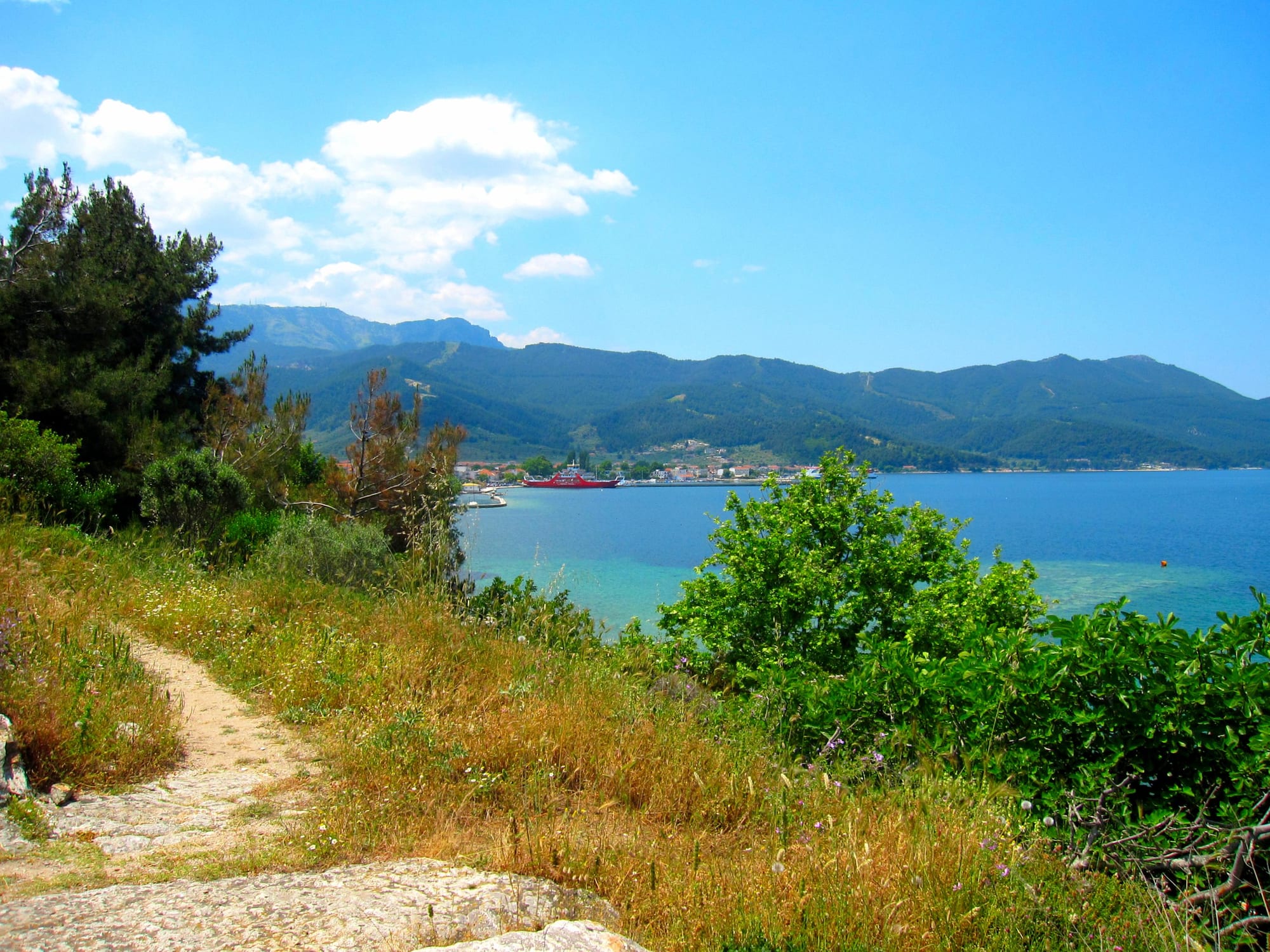
Coastal footpath through grass and shrubs above turquoise water, looking across to a small harbour town below forested mountains

Macedonia & Thrace, Greece

Thasos

Looking across the bay to the harbour of Limenas, the main town of Thasos, with the island's wooded mountains behind. (Ronald Saunders from Warrington, UK / Wikimedia Commons · CC BY-SA 2.0)

The northernmost major Greek island, a green, mountainous circle of marble and pine about 7 km off the coast of eastern Macedonia. Its capital and port, Limenas, stands on the ruins of an ancient city enriched by gold, wine and marble. Today tourism leads the economy, alongside honey, olives and marble quarrying, with sandy bays and hill villages around the coast road.

Neighbourhoods

  • Limenas (Thasos town)
    • First-time visitors
    • Historic district
    • Close to the ferries

    The capital and main port on the island's north-east corner, built over the ancient city. The old fishing harbour, beach bars, the Archaeological Museum and the ruins of the agora lie together by the sea, and a path climbs from the old port to the theatre and the acropolis.

    Open in Maps
  • Golden Beach and the Skalas
    • Beaches
    • Families

    The long sandy bay of Golden Beach on the east coast, lined by the resort strips of Skala Panagia and Skala Potamia, with a small fishing harbour at its northern end from which excursion boats leave.

    Open in Maps
  • The hill villages
    • Quiet and residential
    • Walking
    • Traditional villages

    Panagia and Potamia sit inland on the slopes of Mount Ypsario among pine and sweet chestnut forest, and Theologos, the island's Ottoman-era capital, lies in the centre of the island — quieter bases with stone houses and village squares.

    Open in Maps
  • Limenaria and the south-west
    • Beaches
    • Quiet stays

    The second-largest settlement on the island, a holiday village since the 1960s, on the quieter west and south-west side between Limenas and Limenaria, where the beaches are longer and less crowded.

    Open in Maps

Things to do

Ancient Limenas

  • Archaeological Museum of Thasosmuseum

    Sculpture, pottery and architecture from the Neolithic to the Roman period, led by a three-and-a-half-metre kouros carrying a goat, from around 600 BC.

    Open in Maps
  • Ancient agoralandmark

    The economic and civic centre of the ancient city beside the old harbour, with foundations, columns, a small 2nd-century odeion and an early Hellenistic shrine of Artemis.

    Open in Maps
  • Theatre and acropolis walktrail

    A path from the old port up through the woods to the ancient theatre, the acropolis and the ruins of a castle on the hill above the town.

    Open in Maps
  • Gate of Zeus and Heralandmark

    The most elaborate and best preserved of the ancient city's gates in the walls, near the remains of an honorary arch for the emperor Caracalla.

    Open in Maps

Villages and the mountain

  • Panagianeighborhood

    A village at about 300 metres on the slopes east of Mount Ypsario, a popular stop near the resorts of Golden Beach.

    Open in Maps
  • Potamianeighborhood

    A valley village below Mount Ypsario surrounded by pine and chestnut forest, birthplace of the sculptor Polygnotos Vagis, whose works fill a museum here.

    Open in Maps
  • Mount Ypsariotrail

    The island's highest point at about 1,204 metres, most often climbed by hikers from Potamia.

    Open in Maps
  • Theologosneighborhood

    An inland village that was the marketplace and administrative centre of the island under Ottoman rule, from 1455 to 1902.

    Open in Maps

Beaches and the coast

  • Golden Beachbeach

    The island's best-known beach, a long sandy bay on the east coast lined with restaurants, campsites and places to stay.

    Open in Maps
  • Alikilandmark

    A peninsula in the south with an ancient marble quarry worked from antiquity to early Byzantine times; its settlement was destroyed by pirates in 1651.

    Open in Maps
  • Archangelos Monasterylandmark

    A monastery complex built on the mountainside, about 5 km from Aliki.

    Open in Maps
  • Limenarianeighborhood

    The island's second-largest settlement, a holiday village since the 1960s with a small harbour and beaches.

    Open in Maps

Eat and drink

Long-standing places and food districts in Thasos. Hours, ratings and directions come from your maps app, always current.

Thasos classics

  • Pine honey and spoon sweetsmarket

    Thasos is known for its dark pine honey and for fruit and vegetables preserved in very sweet syrup, sold in shops across the island.

    Open in Maps
  • Throumba olivesmarket

    The island's Throumba olives hold a protected designation of origin, and Thasos olive oil is sold alongside them.

    Open in Maps

Food districts and markets

  • Old harbour of Limenasneighborhood

    Tavernas and beach bars around the old fishing harbour and the customs building, beside the ancient agora.

    Open in Maps
  • Prinos Monday marketmarket

    A weekly market held each Monday in the village of Prinos in the north-west of the island.

    Open in Maps

Experience Thasos

History

Greeks from Paros founded a colony on Thasos around 650 BC. A generation later the poet Archilochus, a descendant of those settlers, described the island as "an ass's backbone crowned with wild wood". Gold mines, wine, nuts and marble made the island rich, and its capital, on the site of Limenas, had two harbours. Prosperity drew powerful enemies: Darius I of Persia forced the Thasians to give up their ships and pull down their walls, and later Athens defeated the island's navy and took the capital after a two-year siege. Thasos changed hands between Athens and Sparta and was disputed with Philip II of Macedon.

The island remained a major source of marble until the Slavic invasions of the late 6th and 7th centuries. It served as a Byzantine naval base in the 13th century and passed to the Genoese, first under Tedisio Zaccaria in 1307–13 and later under the Gattilusi family, before the Ottomans took it. Under Ottoman rule the inland village of Theologos served as the capital, and pirates destroyed the settlement at Aliki in 1651. A Russian fleet occupied the island in 1770–74, and in 1813 the Sultan gave Thasos to Muhammad Ali of Egypt as a personal fiefdom.

The Greek navy took the island on 20 October 1912, during the First Balkan War. In the Axis occupation of 1941–44 it was assigned to Bulgaria, which renamed it "Tasos" and closed its schools. Since the 1960s tourism has transformed the coast, though wildfires have repeatedly scarred its forests, most destructively in 2013 and 2016.

Culture & Customs

Thasos has a long written record. Archilochus wrote of the island in the 7th century BC, and Hippocrates made some of the earliest systematic observations of its climate in the 5th century BC, noting that winter generally resembled spring. The ancient city's ruins are woven into modern Limenas: the agora lies beside the old fishing harbour, and the city walls and gates run through the gardens and woods above it.

Village life keeps its own character in the hill settlements. Theologos, the Ottoman capital, preserves stone houses and churches, Potamia honours its native son, the Greek-American sculptor Polygnotos Vagis, with a museum of his work, and Panagia is the stop for visitors coming up from the beaches below. The local church belongs to the Metropolis of Philippi, Neapolis and Thasos, shared with Kavala across the strait.

The island attracts different crowds to different coasts: the developed south and east sides draw younger visitors, while older travellers often prefer the quieter west side between Limenas and Limenaria.

Daily Life

About 13,000 people live on the island, and Limenas, the largest town, had about 3,300 at the 2021 census; Limenaria is the second-largest settlement. Thasos forms its own regional unit within East Macedonia and Thrace, having been split from the Kavala prefecture in 2011.

Tourism is the most important part of the economy. Farming produces honey, almonds, walnuts, olives — including the protected Throumba variety — olive oil and wine, and islanders also fish and herd sheep and goats. The only mining in recent decades has been marble quarrying, especially around Panagia, where a large quarry works the mountainside; the oil-producing Prinos basin lies offshore between the island and the mainland.

The year is sharply seasonal. In summer the resorts and the ferries are full, with long queues at Keramoti on Friday afternoons and at Limenas on Sunday afternoons; in winter most hotels and tavernas on the beaches close, and life returns to the villages and the main town.

Food

The island's best-known products come from its forests and olive groves. Dark pine honey is sold everywhere, as are fruits and vegetables preserved in very sweet syrup. The local Throumba olive carries a protected designation of origin, and olive oil, almonds and walnuts are other island staples, as they have been since nuts and wine made the island's name in antiquity.

Tavernas around the coast serve the catch of the island's fishing boats, and the harbours of Limenas, Limenaria and the smaller villages are lined with places to eat by the water. Tsipouro, a pomace brandy, is made and sold on the island and drunk with meze, and local wine continues a trade that was famous in antiquity.

The weekly Monday market in Prinos and shops in Limenas sell honey, preserves, oil and olives, and the villages of the interior keep a quieter, more traditional kitchen than the resort strips, built on the island's own olives, honey and the produce of its farms and flocks of sheep and goats.

Planning tools

Budget

Thasos costs more than the mainland opposite but less than the Cyclades. Prices peak in July and August, when Golden Beach and Limenas fill with visitors from Greece and the Balkans, and fall sharply in spring and autumn. A car or scooter is the main extra cost for exploring the island.

Daily Budget Midrange
USD 110–210 (mid-range room or apartment, taverna dinners, a hire car, museum tickets)
Daily Budget Shoestring
USD 55–90 (simple room or campsite, gyros and bakery food, the island bus)

Visit in June or September for lower prices and quieter beaches; the ancient sites around Limenas can be walked for free.

Best Time to Visit

June and September are the most comfortable months, warm enough for the sea without the peak crowds. July and August are the busiest, with long queues for the ferries at weekends. Spring brings green hillsides for walking; in winter most resorts close and the island returns to its villages.

Suggested Number of Days

Three or four days allow a look at Limenas and a drive around the island. A week suits a beach holiday with time for the hill villages and the mountain; a day trip from Kavala covers only the main town.

First Visit
3–4 days
With Surroundings
5–7 days

Transportation

Two main roads serve the island, and a bus service runs in summer, but a hire car, scooter or bicycle is the practical way to reach the villages and beaches. Excursion boats leave from the small harbours around the coast.

Hire a car for at least a day to drive the coast road round the island, and allow time for winding mountain roads to the inland villages.

Airport & Station Connections

Ferries cross from Keramoti to Limenas in about 45 minutes, the shortest crossing; Keramoti is close to Kavala's airport. A second route links Kavala with Skala Prinou, about 20 km south-west of Limenas. Most visitors fly into Thessaloniki or Kavala and drive or take KTEL coaches to the ferry ports.

Walkability

Limenas is small and flat around the harbour, and the ancient sites, museum and seafront are all within an easy walk, with a shaded uphill path to the acropolis. Beyond the town distances are long and roads winding, so walking is for hiking trails rather than getting around.

Safety

Greece is a safe country for visitors, with low levels of violent crime. Crime on Thasos is low. The greater risk is fire: the island's dense forests have been hit repeatedly by large wildfires, most destructively in 2013 and 2016. Mountain roads are narrow and winding.

Follow fire bans and local warnings in summer, never light fires outdoors, and drive carefully on the mountain roads. Check current official travel advice before travelling.

Climate

A typical Mediterranean climate, with mild, wet winters and warm, dry summers. Its northern position exposes the island to continental air masses, which take the edge off the summer heat.

Summer
warm and dry; in nearby Kavala the highest temperature recorded is 38°C
Winter
mild and wet; in nearby Kavala the lowest temperature recorded is −8°C

Local Customs

Tipping is not traditionally expected, though leaving a little in restaurants is now common. Village life is quiet and traditional, dinner is late, and churches and monasteries expect modest dress.

Cover shoulders and knees at monasteries and churches, and keep beachwear to the beach.

Common Payment Methods

Greece uses the euro. Cards are accepted in Limenas and the resorts, and ATMs are found in the main villages; cash is useful in the hill villages and at small tavernas and markets.