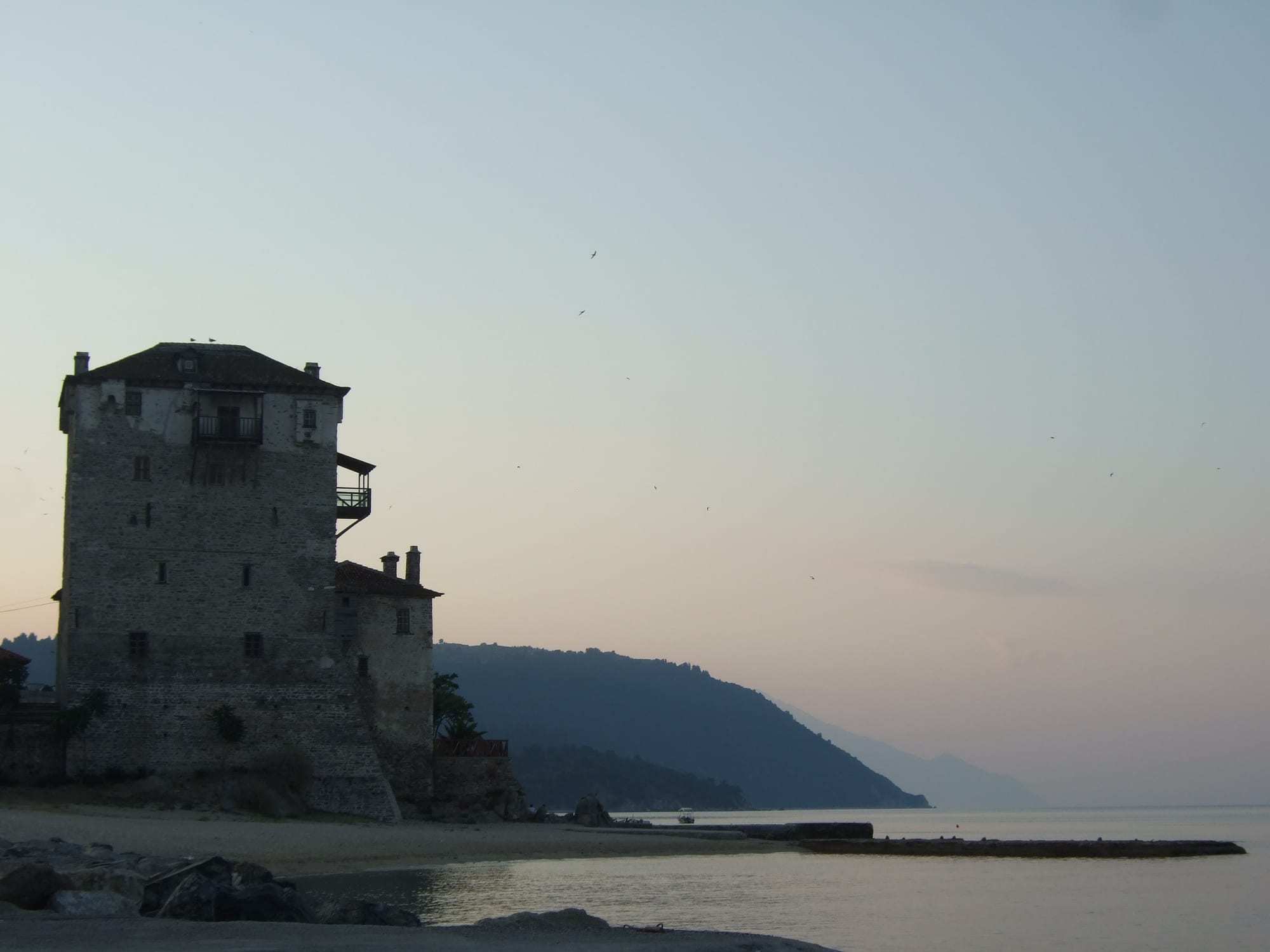
A tall square stone tower with wooden balconies beside a calm sea at dawn, with wooded hills fading into haze behind

Macedonia & Thrace, Greece

Ouranoupoli

The Byzantine tower of Ouranoupoli at dawn, seen from the harbour pier. (malenki / Wikimedia Commons · CC BY-SA 3.0)

A seaside village of about 800 people at the start of the Athos peninsula in Halkidiki, the last settlement before the border of the monastic state of Mount Athos. Built on an ancient city's site and resettled by refugees in 1922, it grew around a Byzantine tower and a harbour from which pilgrim ferries and sightseeing cruises leave for the Holy Mountain.

Neighbourhoods

  • The village centre and harbour
    • First-time visitors
    • Close to the ferries
    • Best for food

    The compact centre around the Byzantine tower, where the buses from Thessaloniki stop and the pier sends ferries to Mount Athos. The pilgrims' office stands by the main pier, and restaurants and shops line the main road and the town beach.

    Open in Maps
  • The coast road to the Athos border
    • Walking
    • Quiet stays
    • History

    An unpaved road runs east along the shore through olive groves towards the fenced border of the monastic state, passing a post-Byzantine aqueduct and the ruins of Zygou monastery. Tracks climb into the hills above the village.

    Open in Maps

Things to do

In and around the village

  • Byzantine towerlandmark

    The Tower of Prosforion, built in the Byzantine era under the monastery of Vatopedi, home of the writers Sydney and Joice Loch from 1928 and now an exhibition on Christian Halkidiki.

    Open in Maps
  • Zygou Monasterylandmark

    A ruined medieval monastery by the Athos border, abandoned at the end of the 12th century and occupied by Crusaders in the early 1200s — hence its other name, Frangokastro, the castle of the Franks — with frescoes protected under glass.

    Open in Maps
  • Post-Byzantine aqueductlandmark

    A restored 16th-century archway, all that remains of the aqueduct that fed the village, reached on foot through olive groves off the coast road.

    Open in Maps
  • Agios Nikolaos church ruinslandmark

    The remains of a Byzantine church used from the 11th to the 14th centuries, in the middle of the peninsula near the Athos border.

    Open in Maps

Mount Athos by boat

  • Mount Athos coastal cruiseattraction

    Summer sightseeing boats follow the coast of the monastic state, a UNESCO World Heritage Site, keeping 500 metres offshore — the only way for women to see the monasteries.

    Open in Maps
  • Pilgrim ferry to Dafnitransit hub

    Daily ferries carry male pilgrims holding a diamonitirion, the entry permit, from Ouranoupoli to Dafni, the port of Mount Athos.

    Open in Maps

Short trips from the village

  • Ammoulianiattraction

    A small island in the Singitic Gulf off the coast, the only permanently inhabited island of Halkidiki.

    Open in Maps
  • Xerxes Canallandmark

    The line of the canal that King Xerxes I of Persia cut through the neck of the Athos peninsula in the 5th century BC, ahead of his invasion of Greece.

    Open in Maps
  • Akanthoslandmark

    The site of an ancient city founded in the 7th century BC as a colony of Andros, on a ridge beside modern Ierissos.

    Open in Maps

Seasonal events

  • OuranopolitikaJuly

    A summer programme of events organised by the village's cultural association.

  • Full-moon nightsAugust

    Night-time events held by the cultural association under the August full moon.

Eat and drink

Long-standing places and food districts in Ouranoupoli. Hours, ratings and directions come from your maps app, always current.

Food districts

  • Main road and town beachneighborhood

    Restaurants and tavernas along the main road and the beach; most do not stay open late.

    Open in Maps
  • Harbour tavernasneighborhood

    Places to eat near the pier and the tower, busy with pilgrims and day-trippers waiting for the boats.

    Open in Maps

Experience Ouranoupoli

History

The modern village takes its name from Uranopolis, the "city of heaven", founded in the late 4th century BC by Alexarchus, the brother of King Cassander of Macedon, on the ruins of ancient Sane, which Philip II had destroyed. Its coins show the goddess Urania, and the city was later destroyed by an earthquake. The land belonged to the monastery of Vatopedi as a dependent estate, and in the Byzantine era a tall tower, the Prosforion, was built to guard it; nearby, the monastery of Zygou was abandoned at the end of the 12th century and occupied by Crusaders in the early 1200s.

In 1922 the Greek government took the area from the monastery to house refugees from the population exchange with Turkey. About fifty families from Asia Minor arrived under the auspices of the League of Nations, each given a small house, a plot of arid land and ten sheep, and they set up rug-weaving workshops. From 1928 the tower was the home of the writers Sydney and Joice Loch, who ran a carpet enterprise employing many villagers and made the tower a meeting place for monks and travellers on their way to and from Athos.

Without a road, the village stayed isolated until 1947, when residents cut a dirt track by hand and the first tourists followed. It took its present name around 1960 and grew from then on as a resort and as the gateway to the Holy Mountain.

Culture & Customs

Ouranoupoli lives in the shadow of Mount Athos, the self-governing monastic community whose territory begins just beyond the village. By Greek law and religious tradition women may not enter it, so the village is both a last stop for male pilgrims and a place where women travelling with them stay; the sightseeing boats that keep 500 metres offshore are the only way for women to see the monasteries. Most of the souvenirs sold in the village are religious.

The refugee founders of 1922 brought their crafts, and rug weaving became the village's trade, encouraged by the Lochs from their tower. The tower itself now holds an exhibition on Christian Halkidiki. The parish church is dedicated to Saints Constantine and Helen, and an active cultural association organises the Ouranopolitika events in July and full-moon nights in August.

Because of its isolation at the end of the road, the village has not been swept up by mass tourism, and the visitors it receives — pilgrims, cruise passengers and families on holiday — give it an unusual mix of the devout and the relaxed.

Daily Life

About 800 people lived in Ouranoupoli at the 2011 census, working mainly in tourism and fishing. It is a local community of the Aristotelis municipality, whose seat is 17 km away, and it has a kindergarten, a primary school and a police station. Life is still shaped by the village's origins: many families descend from the refugees of 1922, and the land itself once belonged to the monasteries across the border.

Trade and pilgrimage connected to Mount Athos are the biggest source of income. Pilgrims usually spend a night in the village, present their diamonitirion at the pilgrims' office beside the main pier and board the ferries to Dafni, which run throughout the year. In summer cruise boats, beach visitors and day-trippers from the rest of Halkidiki swell the population.

Restaurants along the main road and the beach serve meals, but the village goes to bed early, with few places open late.

Food

Eating in Ouranoupoli means tavernas on the main road, by the beach and around the harbour, where fish is an obvious choice. With fishing one of the two mainstays of local life, the catch of the Singitic Gulf shapes the menus.

Halkidiki as a whole is known for its green olives and its honey, and both turn up on tables and in shops here. The monks of Athos make wine as well, and the religious shops of the village sit alongside those selling local produce. Tsipouro, the grape spirit of northern Greece, is drunk with meze.

Meals follow the Greek pattern of shared plates, salads, grilled fish and meat, and the restaurants cater to a mixed crowd of pilgrims, Greek families and international visitors, with English and Russian commonly spoken. Most places close relatively early, in step with the rhythm of a village whose day is set by the ferries to the Holy Mountain.

Planning tools

Budget

Ouranoupoli is modest in price by Halkidiki standards: it has escaped mass tourism, and simple pensions serve pilgrims. Prices rise in July and August, when Halkidiki is in peak season. The Athos cruise is the main extra cost for most visitors.

Daily Budget Midrange
USD 110–200 (mid-range room, taverna dinners, an Athos coastal cruise, a hire car)
Daily Budget Shoestring
USD 50–85 (pension room, bakery and taverna meals, KTEL bus from Thessaloniki)

Pilgrims usually spend a night here before the morning ferry; book that night early in summer, and buy cruise tickets in the village.

Best Time to Visit

May, June and September suit walking along the coast and taking the cruise in comfort, with a warm sea from June. July and August are busiest across Halkidiki. Pilgrim ferries run all year, so the village never closes completely, but the sightseeing cruises are a summer service.

Suggested Number of Days

One or two days cover the village, the coast walk and a cruise. Allow three or four to see more of the peninsula and its islands; pilgrims visiting the monasteries need extra days for the stay on Athos itself.

First Visit
1–2 days
With Surroundings
3–4 days

Transportation

The village is small enough to walk, and unpaved roads lead along the coast and into the hills. KTEL Halkidiki buses run several times a day to and from Thessaloniki, a trip of two to three hours; a hire car is the easiest way to explore the rest of the peninsula.

Remember that the land border with Mount Athos is fenced and crossing it is forbidden — entry is only by ferry with a permit.

Airport & Station Connections

Ouranoupoli is about 132 km from Thessaloniki, the nearest major city and airport. Most travellers arrive by KTEL bus from the Halkidiki coach station in Thessaloniki, which takes two to three hours, or by car or taxi. Men visiting the monasteries must first obtain a diamonitirion from the Mount Athos Pilgrims' Bureau.

Walkability

Everything in the village is within a few minutes' walk of the tower and the pier. The coast road to the Athos border is unpaved and makes a pleasant walk, about half an hour to the aqueduct; shade is scarce in summer.

Safety

Greece is a safe country for visitors, with low levels of violent crime. Ouranoupoli is a quiet village with little crime. The main practical rules concern Mount Athos: the land border is fenced and may not be crossed, and women may not enter the monastic territory. Summer heat and wildfire risk in the hills are the natural hazards.

Respect the border and the rules of the monastic state, carry water on coastal walks, and follow local fire warnings in summer. Check current official travel advice before travelling.

Climate

Halkidiki has a mainly Mediterranean climate, with cool, wet winters and hot, relatively dry summers.

Summer
hot and relatively dry; in Thessaloniki, the nearest city, July and August average around 28°C over the day and night
Winter
cool and wet, with snow possible but short-lived; in Thessaloniki, the nearest city, January averages 8°C

Local Customs

Life in the village revolves around Mount Athos, and souvenirs are mostly religious. Visitors are expected to treat monks and pilgrims with respect. Tipping is not traditionally expected, though leaving a little in restaurants is now common; English and Russian are widely spoken in shops and restaurants.

Dress modestly near the pilgrims' office and at religious sites, ask before photographing monks, and keep in mind that women are not allowed on Mount Athos.

Common Payment Methods

Greece uses the euro. Cards are accepted in most restaurants and shops, but carry some cash for small purchases; the monasteries of Athos are a cash world for pilgrims.