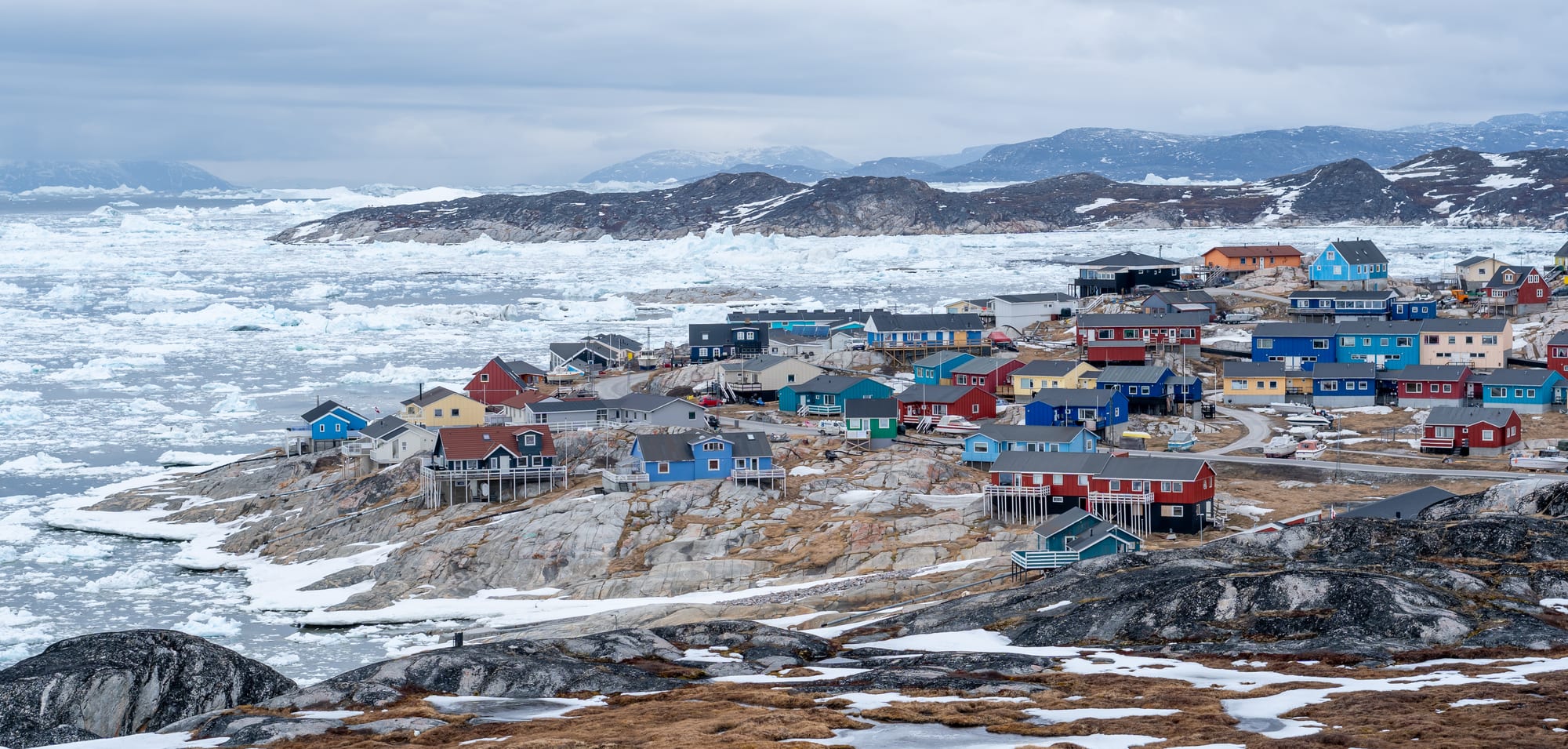
Red, blue and yellow wooden houses on bare rock above a bay packed with sea ice, with snowy hills behind

Greenland

Ilulissat

Ilulissat seen from the south-west, with ice filling the water beside the town. (Ekrem Canli / Wikimedia Commons · CC BY-SA 4.0)

A town of about 5,100 people on the eastern shore of Disko Bay in western Greenland, about 350 km north of the Arctic Circle. Founded as a Danish trading post in 1741 in an area inhabited since prehistoric times, it stands at the mouth of the Ilulissat Icefjord, a UNESCO World Heritage Site, and tourism is now its main industry.

Neighbourhoods

  • Town centre and harbour
    • First-time visitors
    • Museums
    • Boat trips

    The compact centre on the rocky shore of Disko Bay, where brightly painted wooden houses, shops, the museums and the harbour sit close together. Boat trips among the icebergs leave from the harbour, and sled dogs are kept in many places around town.

    Open in Maps
  • Sermermiut and the icefjord edge
    • Walks and viewpoints
    • Nature

    The open ground south of town, past the camping ground, where walking routes lead to the old settlement site of Sermermiut and the mouth of the icefjord. The Icefjord Centre stands on the way, and from the rocks above the water the icebergs fill the view.

    Open in Maps

Things to do

The icefjord and walks

  • Sermermiutlandmark

    A former Inuit settlement inside the World Heritage Site, with remains of the Saqqaq, Dorset and Thule cultures; its last resident moved to Ilulissat in 1850.

    Open in Maps
  • Icefjord Centremuseum

    A museum and visitor centre beyond the edge of town on the road to Sermermiut, with exhibits about the icefjord and the ice.

    Open in Maps
  • Kællingekløften (Nakkarfik)viewpoint

    A cleft in the coastal rocks near the fjord mouth; west of it the path runs high above the water, while on the east side walkers can climb down to the shore among the ice.

    Open in Maps

Museums and the town

  • Knud Rasmussen's Museummuseum

    The town museum, devoted above all to the polar explorer and ethnographer Knud Rasmussen, who was born in Ilulissat in 1879.

    Open in Maps
  • Ilulissat Art Museummuseum

    A small art museum showing paintings by Emanuel A. Petersen and other Greenlandic, Danish and Faroese artists.

    Open in Maps
  • Zion's Churchlandmark

    The town's church, built in the late 18th century, when it was the largest man-made structure in Greenland.

    Open in Maps

Short trips from the town

  • Ilulissat Icefjordviewpoint

    The 40 km fjord running west from the ice sheet to Disko Bay, ending just south of the town, listed as a UNESCO World Heritage Site in 2004. Icebergs up to a kilometre tall break from its glacier and lie stuck in the fjord's shallower areas, sometimes for years.

    Open in Maps
  • Disko Bay by boatattraction

    Boat trips from the harbour run among the icebergs and on to settlements around the bay, which is visited in spring by bowhead and humpback whales.

    Open in Maps
  • Jakobshavn Glacier (Sermeq Kujalleq)landmark

    The glacier at the head of the icefjord, the most productive in the Northern Hemisphere and one of the fastest-moving glaciers, its front flowing at over 45 m a day on annual average in 2012–2013, calving the icebergs that crowd the bay.

    Open in Maps
  • Oqaatsutattraction

    A settlement of a few dozen people north of Ilulissat, known in Danish as Rødebugt, reached by a hiking path of five to seven hours or by boat.

    Open in Maps
  • Ilimanaqattraction

    A small settlement across the icefjord, known in Danish as Claushavn, with about 55 inhabitants in 2025.

    Open in Maps

Seasonal events

  • Arctic palerfikMarch or April

    The ceremonial last dog-sled run of the winter, a parade of around a hundred sleds before the snow starts to melt.

  • Arctic midnight orienteeringsummer

    An orienteering competition run in the light of the midnight sun, held every year.

Eat and drink

Long-standing places and food districts in Ilulissat. Hours, ratings and directions come from your maps app, always current.

Ilulissat classics

  • Restaurants in the town centreneighborhood

    A handful of restaurants and cafés, some with views over the iceberg-filled bay, serving Greenlandic buffets and dishes of local produce such as musk ox, reindeer, Greenland halibut, Arctic hare, ptarmigan and seafood.

    Open in Maps
  • Cafés in Ilulissatcafe

    Small cafés for coffee and cake, the drink and snack at the centre of the Greenlandic kaffemik, with musk-ox burgers on some menus.

    Open in Maps

Experience Ilulissat

History

The land around Ilulissat has been lived in for thousands of years. Excavations at Sermermiut, just south of the present town, show Saqqaq settlement around 1500 BC, Dorset occupation from about 300 AD and later the Thule people, ancestors of today's Greenlanders. In the 17th and 18th centuries Dutch whalers traded heavily with the local people and called the place Maklykout.

In 1741 the merchant Jacob Severin's company founded a trading post here, and the town was named Jakobshavn in his honour after the Battle of Jacobshavn, in which Danish forces defeated the Dutch whalers. Zion's Church followed in the late 18th century, at the time the largest man-made structure in Greenland. The last resident of nearby Sermermiut moved to the town in 1850, the year Ilulissat counted 262 inhabitants. The explorer Knud Rasmussen, later called the father of Eskimology, was born here in 1879, as was his companion Jørgen Brønlund.

Helicopters served the town from a heliport built in the 1960s until Ilulissat Airport opened in 1984, making it Air Greenland's base for the north. Tourism has since become the town's principal industry, and the icefjord, a UNESCO World Heritage Site since 2004, has made Ilulissat the most popular tourist destination in Greenland. In May 2008 the town hosted the Arctic Ocean Conference of Canada, Denmark, Norway, Russia and the United States, which produced the Ilulissat Declaration on the law of the sea in the Arctic. A longer runway, meant to bring direct flights from mainland Europe and the Americas, is the latest change.

Culture & Customs

Ilulissat lives with its sled dogs: the town has almost as many dogs as people, and the dog sled remains a working form of transport as well as a tourist ride. The last big run of the winter, the Arctic palerfik, brings around a hundred sleds out together in March or April before the snow softens, while in summer the town hosts an orienteering competition run under the midnight sun.

Knud Rasmussen is the town's most famous son, and the museum devoted to him keeps his expeditions and the study of Inuit culture at the centre of local memory. The artist Jens Rosing, who designed Greenland's coat of arms and many of its stamps, was also born here, and the town's art museum holds paintings by Emanuel A. Petersen and other Greenlandic, Danish and Faroese artists.

The kaffemik, an open house with coffee and cake, is the most common way local people gather, and visitors may be invited. Football is followed closely: Nagdlunguaq-48, the town's club, had won the Greenlandic championship ten times by 2016. The town has also been a film location, for Smilla's Sense of Snow in 1997 and for the fourth series of the Danish political drama Borgen in 2022.

Daily Life

Ilulissat had about 5,100 inhabitants in 2025, which makes it the third-largest town in Greenland after Nuuk and Sisimiut and the seat of the Avannaata municipality. The population has changed little since the early 2000s. Residents still fish and hunt on the icefjord — for Greenland halibut and ringed seal, mainly in winter and usually with dog sleds on the ice — but tourism has become the town's principal industry.

Houses painted red, blue, green and yellow climb over the rocks above the harbour, with sled dogs staked out between them. In winter and spring the settlements around the bay are served by small planes, and in summer and autumn by boat. The seasons shape everything: winters are long and cold, with March usually the coldest month, while summer brings long light, open water and the year's busiest tourist season.

The expanded airport is the biggest change for years. It has been debated for decades, pushed for by the tourist industry and the municipality, and its cost has risen: in 2025 the project needed a further DKK 400 million subsidy from the Danish government on top of the support it already had.

Food

Food in Ilulissat follows the Greenlandic pattern of imported staples combined with what comes from the sea and the land. Greenland halibut from the icefjord is the local fish, alongside redfish, wolffish, mussels and sea urchins, and restaurant menus draw on musk ox, reindeer, Arctic hare and ptarmigan. Some kitchens add herbs gathered on the fells, such as mountain sorrel. Suaasat, a soup of seal, whale or reindeer with rice or barley, is the national dish.

Greenlandic buffets, with many kinds of fish and meat on one table, are a common way to try local food, and musk-ox burgers appear on café menus. Supermarkets supply most everyday meals, and prices are high because nearly everything arrives by sea or air.

Coffee is at the heart of social life. A kaffemik brings neighbours and family together over coffee and cake, and it is the easiest way for a visitor to share a table with people who live in the town.

Planning tools

Budget

Ilulissat is expensive, as everywhere in Greenland: most food is imported and almost every activity beyond walking is a guided tour. Boat trips among the icebergs, dog-sled rides and helicopter flights are the big costs. The town has more accommodation than anywhere else in Greenland, including a youth hostel, but summer rooms fill up.

Daily Budget Midrange
USD 290–580 (hotel, restaurant meals, one boat or sledding excursion; flights extra)
Daily Budget Shoestring
USD 100–170 (hostel bed, supermarket food, walking the icefjord trails)

The walks to Sermermiut and the mouth of the icefjord cost nothing; reserve rooms and tours well ahead for summer.

Best Time to Visit

Summer brings open water for boat trips among the icebergs, long daylight and the easiest hiking, though also mosquitoes. Late winter and spring are the dog-sledding season, ending with the parade of sleds in March or April. The town is one of the driest and sunniest in Greenland.

Suggested Number of Days

Three or four days allow time for the trails, the museums and a boat trip. Allow a week to add settlements around Disko Bay or longer sled tours. Weather often delays flights and boats, so a spare day helps.

First Visit
3–4 days
With Surroundings
5–7 days

Transportation

There are no roads out of town. Within Ilulissat most people walk or take a taxi, and in winter and spring Air Greenland flights serve the settlements of the bay. Sleds have right of way in town and move fast and quietly. Boats link the settlements of Disko Bay in summer and autumn, and the Arctic Umiaq ferry sails to Sisimiut, Nuuk and other west-coast towns.

Watch for dog sleds in winter: they have right of way and make little noise.

Airport & Station Connections

Ilulissat Airport lies about 3 km north-east of the centre, a short taxi ride or a walk in good weather. It is Air Greenland's hub for northern Greenland, with flights to towns in north-western and mid-western Greenland, and as of 2025 its only international route was to Reykjavík–Keflavík. A new 2,200 m runway just north of the old one is being built so that larger jets can fly in directly; in November 2025 Greenland Airports announced that the expanded airport would open in October 2026.

Walkability

The town is small enough to cross on foot, though it is hilly and built over bare rock. The walks to the icefjord start at the southern edge of town and the airport is within walking distance. Paths are rough and uneven, and snow and ice cover them for much of the year.

Safety

Towns are safe, with little serious crime, though alcohol-related problems and, more privately, high rates of suicide and social distress are part of the picture. In Ilulissat the practical risks come from the ice, the cold water and the weather, and from fast-moving dog sleds in winter.

Keep well back from the water's edge when icebergs are calving or turning over, stay on marked trails, and in summer carry a mosquito net. Check current official travel advice before travelling.

Climate

A tundra climate with long, cold winters and short, cool summers, and little precipitation — about 271 mm a year. March, not February, is usually the coldest month.

Summer
cool and often sunny — on Greenland's ice-free coast summer days are roughly 5–15°C
Winter
long, cold and dark, with the lowest temperatures usually in March; the record low is −37.8°C

Local Customs

The kaffemik, an open house with coffee and cake for a birthday or other milestone, is the easiest way to meet local people, and visitors are often welcome; the tourist offices can help arrange an invitation. Sled dogs are working animals, kept in many places around town.

Greenlandic is the main language and Danish is widely spoken; English is common in tourism. Ask before photographing people.

Common Payment Methods

The currency is the Danish krone. Cards are accepted in shops, restaurants and by tour operators, and the town has ATMs. Carry some cash for trips to small settlements.