💰 Budget
Basse-Terre is a working administrative town rather than a resort, with French prices and much imported. Market food and lolos are far cheaper than restaurants. A hire car is the main cost for reaching the volcano, the falls and the rainforest trails.
- Daily Budget Midrange
- USD 150–300 (hotel or good gîte, restaurants, car hire, ferry to Les Saintes and excursions)
- Daily Budget Shoestring
- USD 65–105 (gîte or guesthouse, market and lolo food, local buses)
The fort, the cathedral, the churches and the national park's trails cost nothing to visit; budget instead for a car and the ferry.
📅 Best Time to Visit
December to April is the peak and drier season, busiest around Christmas, carnival and Easter. The mountains above the town are far wetter than the lowlands all year, and summit views of the Soufrière depend on the clouds. The hurricane risk is highest from August to October.
⏳ Suggested Number of Days
The town itself needs a day or so. Most visitors use it as a base for the volcano, the rainforest and the islands to the south, and the weather on the mountain decides how many days that takes.
- First Visit
- 1–2 days
- With Surroundings
- 3–5 days
🚆 Transportation
Three main roads link the town to the rest of the island: the N1 round the windward coast towards Pointe-à-Pitre, the N2 north along the leeward coast, and the N3 inland to Saint-Claude. A hire car is the practical way to reach the trailheads, and there is a basic bus network.
Drive up to the trailheads early, before the clouds settle on the mountain, and keep to marked trails.
🛬 Airport & Station Connections
Most visitors fly into Guadeloupe Maryse Condé Airport near Pointe-à-Pitre and drive across to Basse-Terre on the N1 along the windward coast. The town's maritime station receives cruise ships and has a ferry service to the Îles des Saintes, from a terminal opened in 2015.
🚶 Walkability
The town stretches about 3 km along a narrow coastal strip cut by ravines, so walking between districts means hills, heat and a long main street. The centre around the cathedral, the market and the ferry terminal is manageable on foot; the fort is up on its spur.
🛡️ Safety
Guadeloupe is broadly safe for visitors, with burglary of holiday rentals and cars, and some violent crime concentrated in parts of Pointe-à-Pitre and Les Abymes, the main concerns. Around Basse-Terre the main natural hazards are the active Soufrière volcano, hurricanes, earthquakes and the steep, wet mountain trails.
Follow volcano-alert guidance and keep out of the closed summit areas and closed waterfall paths, leave nothing in parked cars at trailheads, and use repellent. Check current official travel advice before travelling.
🌦️ Climate
The town lies between the tropical rainforest and tropical monsoon types, with fairly even temperatures through the year. Across the islands temperatures are mostly between about 25 and 32°C, and the rainforested heights above the town are far wetter than the lowlands.
- Summer
- the wetter hivernage, July to December — hot and humid, mostly about 25–32°C across the islands, with heavy showers and the hurricane season
- Winter
- the drier Carême, January to June — still warm, mostly about 25–32°C across the islands, with clouds and rain on the mountains
🤝 Local Customs
French is the official language and Guadeloupean Creole the everyday one; in Creole the town is Bastè, and its people are the Basse-Terriens.
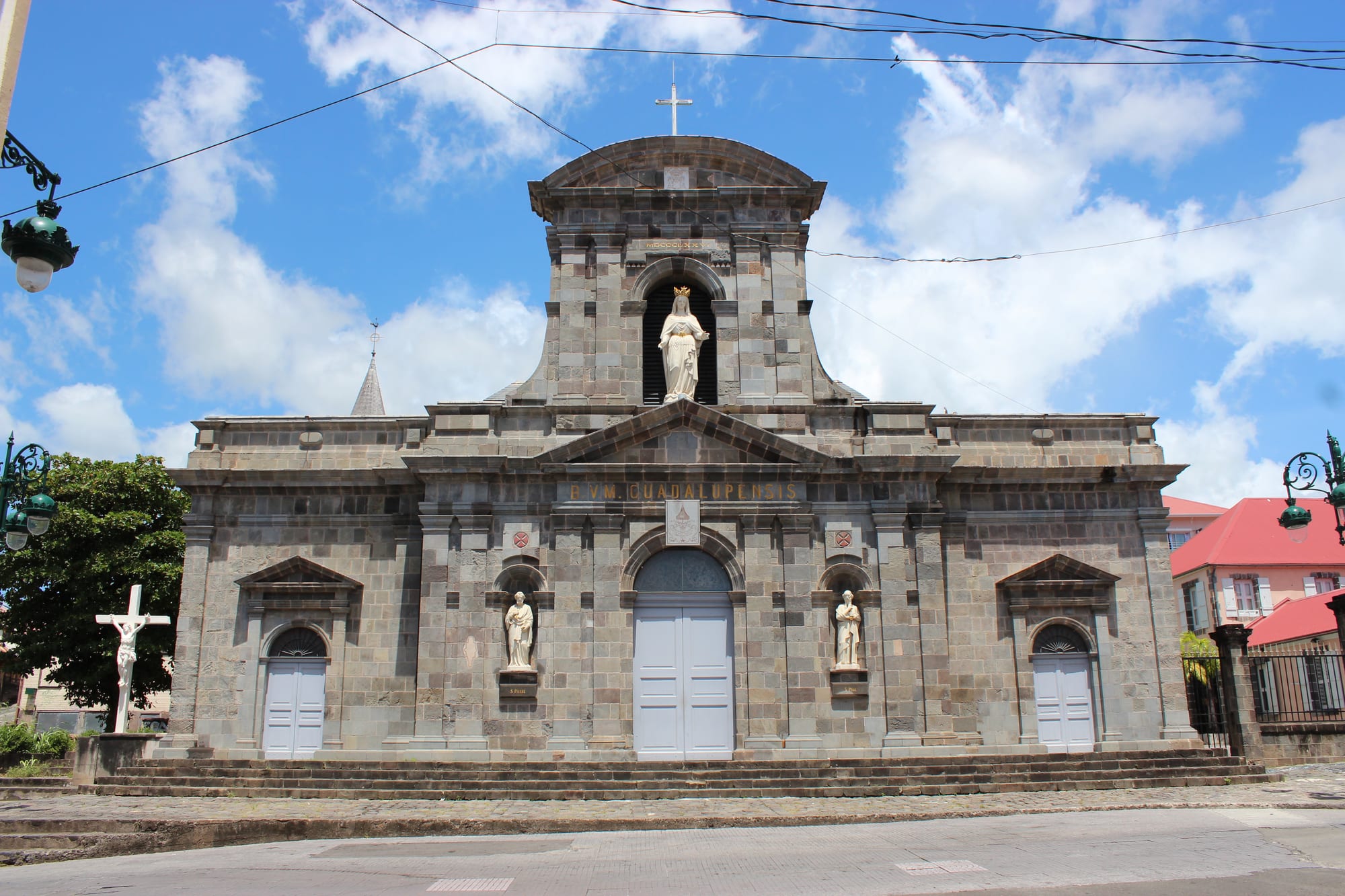
Dress modestly in the cathedral and churches, and treat Fort Delgrès as a memorial of the 1802 resistance.
💳 Common Payment Methods
The currency is the euro. Cards are widely accepted; carry some cash for the market, lolos, small shops and rural areas.