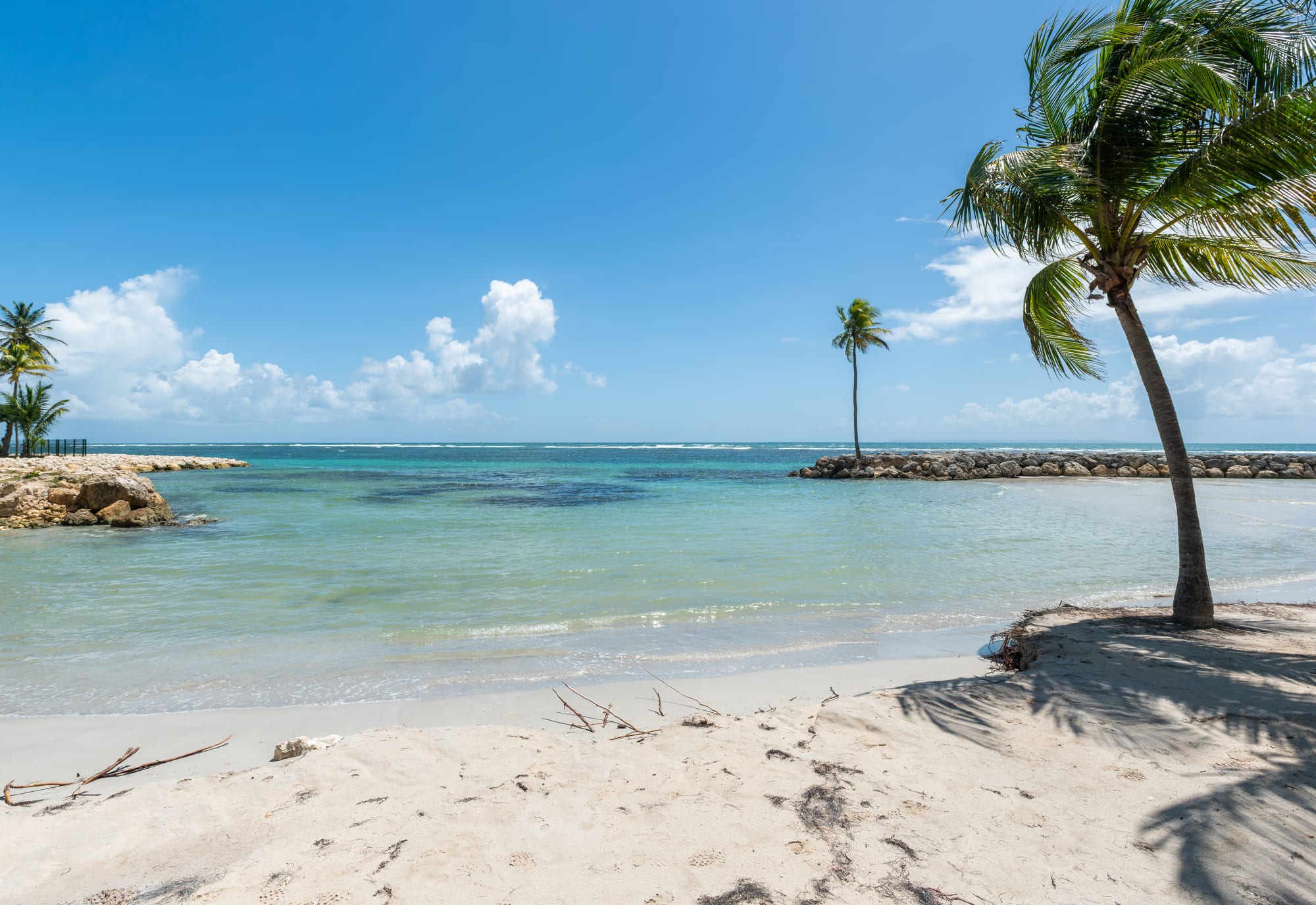
White sand and a leaning coconut palm beside a shallow turquoise lagoon enclosed by rock breakwaters, under a blue sky

Guadeloupe

Sainte-Anne

The shallow, sheltered water of the Plage du Bourg in Sainte-Anne. (Tournasol7 / Wikimedia Commons · CC BY 4.0)

A town in the middle of Grande-Terre's south coast, founded as a parish in 1691 and once ringed by more than thirty sugar works. Since the first hotels of 1970 it has become one of Guadeloupe's three largest seaside resorts, with palm-shaded beaches partly sheltered by a coral reef, while cane is still grown on its flat land and food crops in its hilly interior.

Neighbourhoods

  • The bourg and the town beach
    • First-time visitors
    • Beaches
    • Families

    The small town centre around Place Schœlcher, with the Ali Tur church, the town hall and the market, and the wide, shady Plage du Bourg on its eastern side. The water is shallow and calm, the beach is lit until midnight, and Creole restaurants line the shore.

    Open in Maps
  • La Caravelle
    • Beaches
    • Water sports

    A palm-lined beach at the Pointe de l'Accul, outside the bourg, among the best known on the island and busy with water sports; access is via a large holiday village beside the beach.

    Open in Maps
  • Bois-Jolan
    • Quiet and residential
    • Beaches

    A coastal hamlet whose beach has fine white sand, emerald water enclosed by the coral reef, shady palms and a campsite; it fills with local families on public holidays.

    Open in Maps
  • Galbas
    • Boat trips
    • Local life

    The fishing port, with a small craft village of shops and a snack bar, a grill restaurant, and departures for boat trips to the outer islands.

    Open in Maps

Things to do

Beaches

  • Plage du Bourgbeach

    The town beach, wide, white and shaded, known for family gatherings at weekends; its shallow, calm water suits children.

    Open in Maps
  • Plage de la Caravellebeach

    One of the best-known beaches on the island, fringed with coconut palms and offering all kinds of water sports.

    Open in Maps
  • Plage de Bois-Jolanbeach

    A natural beach with fine white sand and emerald water, kept shallow and calm by the offshore reef.

    Open in Maps
  • Plage de Gros Sablebeach

    A surf spot in the Helleux area, where the swell is strong and swimming is not supervised.

    Open in Maps

Landmarks and museums

  • Church of Sainte-Annelandmark

    The parish church on Place Schœlcher, dedicated to Saint Anne, rebuilt in 1933 to plans by the architect Ali Tur after the 1928 hurricane; a bust of the abolitionist Victor Schœlcher stands on the square.

    Open in Maps
  • Gissac windmilllandmark

    The windmill that is all that remains of the Gissac sugar estate, listed as a historic monument since 2009 and a reminder of the town's sugar past.

    Open in Maps
  • Espace Musée Léthièremuseum

    A museum on rue Léthière.

    Open in Maps

Short trips from the town

  • Saint-Françoisneighborhood

    The neighbouring town at the south-eastern point of Grande-Terre, along the same coast road.

    Open in Maps
  • Petite Terre Islandspark

    Two small uninhabited islands off the south-east of Grande-Terre, protected with the sea around them as a national nature reserve.

    Open in Maps

Eat and drink

Long-standing places and food districts in Sainte-Anne. Hours, ratings and directions come from your maps app, always current.

Sainte-Anne classics

  • Beach restaurants on the Plage du Bourgneighborhood

    The strip along the town beach, where simple Creole and seafood restaurants and sandwich and ice-cream stands look out over the water.

    Open in Maps
  • Galbas fishing portneighborhood

    The fishing harbour, with a grill restaurant and a snack bar in the craft village.

    Open in Maps

Food districts and markets

  • Sainte-Anne marketmarket

    The town market, beside the office of an island ferry company, one of the places to find local spices and tropical fruit.

    Open in Maps

Experience Sainte-Anne

History

Sainte-Anne grew from a parish founded in 1691, when Capuchin monks served what was then a small fishing village; the first written sources mention a chapel near the site of today's church. English soldiers destroyed the settlement in 1759. With the growth of sugar and rum exports the port became the seat of the Admiralty in the 18th century, and the commune was formally established at the end of the 1830s.

Sugar shaped the town for two centuries. Between 1870 and 1940 there were thirty-four sugar works in the area, the densest concentration of sugar processors in Guadeloupe; the windmill of the Gissac estate, listed in 2009, is one of the few survivors. The 1928 hurricane destroyed almost everything, and the church was rebuilt in 1933 to plans by the architect Ali Tur; the town hall was completed around 1950, under the mayor Maurice Satineau.

When the sugar industry went into crisis, the town's reef-sheltered, palm-shaded beaches offered another living. The first hotels were built in 1970, and in the decades since Sainte-Anne has become one of the three largest seaside resorts in Guadeloupe, alongside Le Gosier and Saint-François, while remaining dependent on agriculture.

Culture & Customs

Sainte-Anne is at once a resort and an ordinary Creole town. Its church, dedicated to Saint Anne, stands on Place Schœlcher with a bust of the abolitionist Victor Schœlcher, as in many communes of the islands, and its bell tower was renovated in 2021.

The beaches are as much a part of local life as of tourism. The Plage du Bourg is known for family gatherings at weekends, and Bois-Jolan fills with local families on public holidays. Water sports, boat trips and diving draw visitors to La Caravelle and the reef, while the surfers go to Gros Sable on the exposed Helleux shore. Cycling has a following too, and the town has its own cycling club.

The people of the town are the Saintannais, and in Creole the town is Sentann'. As across Guadeloupe, French is the language of administration and school, Creole the language of everyday life, and English is understood in the tourist trade but not widely.

Daily Life

About 24,000 people lived in the commune in 2023, according to INSEE — a small rise since 2017, at a time when Guadeloupe's population as a whole was falling. The commune covers about 80 km² of the middle of Grande-Terre's south coast, and is counted as part of the Pointe-à-Pitre–Les Abymes urban area.

Besides the main bourg, the commune is made up of many hamlets and localities, Bois-Jolan and Douville among them. Sugar cane is still grown on the flat land, while the hilly Grands Fonds interior is given over to food crops and market gardening. Tourism is the other pillar, and two large holiday villages stand in the commune.

The beaches are busiest in the peak season from December to April and at weekends and on public holidays, when local families gather on the sand. Like the rest of the islands, the town lives with the high cost of living and recurring problems with an ageing water network.

Food

Sainte-Anne eats like a fishing and farming town that turned to the beach. Along the Plage du Bourg, simple Creole and seafood restaurants serve grilled fish, court-bouillon de poisson — fish in a tomato and lime broth — and the colombo curry of chicken, goat or fish, a staple made with a spice blend brought by Indian labourers.

Accras de morue, salt-cod fritters, and boudin créole, a spiced blood sausage, are the usual starters, and bokit, a fried-bread sandwich, is the snack of the market and roadside stalls. Lolos, simple roadside eateries, grill fish and chicken to serve with rice and red beans, and are among the cheapest ways to eat.

The market is one of the places to buy spices and tropical fruit. Ti-punch — rhum agricole, cane syrup and lime — is the aperitif, made with the islands' agricultural rums, a reminder of the cane and rum that built the town.

Planning tools

Budget

As one of the main resorts, Sainte-Anne carries French prices plus a holiday premium in high season. Gîtes and guesthouses are cheaper than the big beach resorts, and the market, the lolos and the simple Creole places on the beach are far cheaper than sit-down restaurants.

Daily Budget Midrange
USD 150–300 (hotel or good gîte, restaurants, car hire, boat trips and island ferries)
Daily Budget Shoestring
USD 65–105 (gîte or guesthouse, market and beach-shack food, shared car or buses)

The beaches are free; a hire car or scooter makes it easy to stay in a cheaper gîte inland and drive to the shore.

Best Time to Visit

December to April is the peak season, drier and busiest around Christmas, carnival and Easter. May and November are quieter. The wetter hivernage runs from July to December, with the hurricane risk highest from August to October.

Suggested Number of Days

A few days are enough for the town and its beaches. Sainte-Anne is mostly used as a beach base for a week or more, from which the rest of Grande-Terre, Basse-Terre and the outer islands are explored by car and ferry.

First Visit
2–3 days
With Surroundings
5–7 days

Transportation

Sainte-Anne lies on the national road 4, halfway between Pointe-à-Pitre and Saint-François. There are many car-hire agencies, as well as scooter and bicycle hire and local taxis. Buses are basic, and a car is the practical way to reach the outlying beaches and hamlets.

Hire a car or scooter; boats to the outer islands leave from the fishing port of Galbas.

Airport & Station Connections

Sainte-Anne is about 19 km from Pointe-à-Pitre along the south coast road. The islands' main airport, Guadeloupe Maryse Condé Airport, is in Les Abymes beside Pointe-à-Pitre, and most visitors arrive there and drive on in a hire car.

Walkability

The bourg is small and easy on foot, and the Plage du Bourg is on its eastern side. The other beaches — La Caravelle, Bois-Jolan and Gros Sable — lie outside the town and are reached by car or scooter. The midday heat makes walking along the main road tiring.

Safety

Guadeloupe is broadly safe for visitors, with burglary of holiday rentals and cars, and some violent crime concentrated in parts of Pointe-à-Pitre and Les Abymes, the main concerns. In Sainte-Anne the main risks are theft from parked cars and holiday rentals, and the sea at Gros Sable, where the swell is strong and swimming is not supervised.

Leave nothing in parked cars or unattended on the beach, lock holiday rentals, swim on the reef-sheltered beaches rather than at Gros Sable, and use repellent against mosquitoes. Check current official travel advice before travelling.

Climate

Tropical, hot and humid all year, with temperatures across the islands mostly between about 25 and 32°C. Grande-Terre's flat south coast is far drier than the rainforested heights of Basse-Terre, and the reef keeps the beach water calm.

Summer
the wetter hivernage, July to December — hot and humid, with temperatures across the islands mostly between about 25 and 32°C, with showers and the hurricane season
Winter
the drier Carême, January to June — hot and sunny, with temperatures across the islands mostly between about 25 and 32°C

Local Customs

French is the official language and Guadeloupean Creole the everyday one; in Creole the town is Sentann', and its people are the Saintannais. English is understood in tourist businesses but not widely. The town beach is a gathering place for local families at weekends and on public holidays.

Cover up away from the beach, especially in the church and shops, and ask before photographing people.

Common Payment Methods

The currency is the euro. Cards are widely accepted; carry some cash for the market, beach stalls, lolos and small shops.