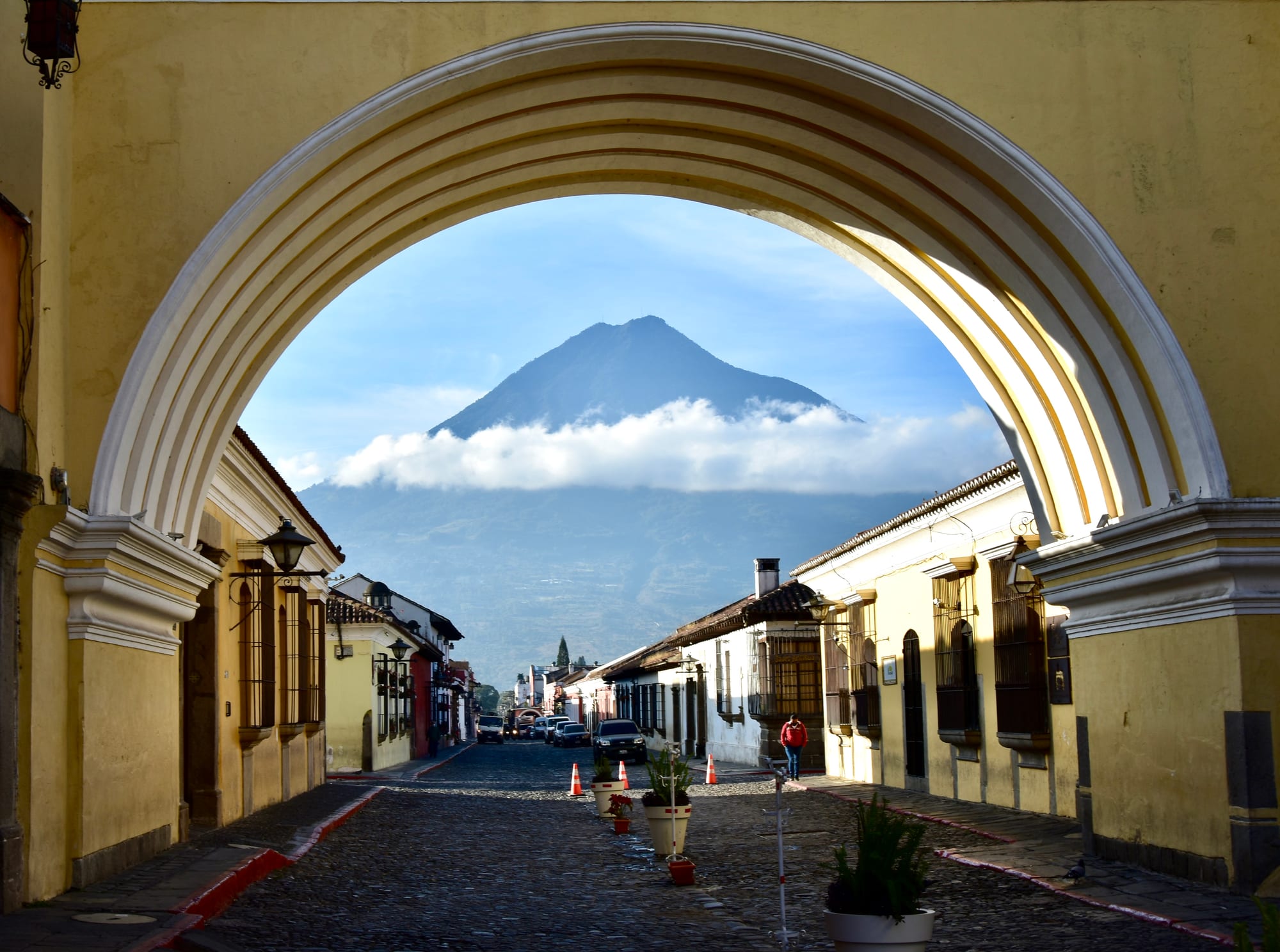
A cobbled street seen through a yellow colonial arch, with low painted houses and a volcano cone rising above the clouds

Guatemala City & Antigua, Guatemala

Antigua Guatemala

The Volcán de Agua framed by the Arco de Santa Catalina on 5a Avenida Norte, Antigua Guatemala. (Not So Dusty / Wikimedia Commons · CC BY 2.0)

A small colonial city in the central highlands, ringed by the volcanoes Agua, Fuego and Acatenango. It was the capital of Spanish Central America from 1543 until the earthquakes of 1773, and its Baroque churches, ruined convents and cobbled grid earned it UNESCO World Heritage status in 1979. Today it lives from tourism, Spanish schools, coffee and its famous Holy Week.

Neighbourhoods

  • Parque Central and the historic centre
    • First-time visitors
    • Historic district
    • Best for food

    The tree-filled main square with its fountain, framed by the cathedral and the Palacio de los Capitanes Generales. Most sights, cafés, restaurants, tour agencies and Spanish schools lie within a few cobbled blocks, in a compact grid that is easy to cross on foot.

    Open in Maps
  • The north side, around the arch and La Merced
    • Historic district
    • Photography

    The blocks along 5a Avenida Norte, where the Arco de Santa Catalina spans the street, lead to the church of La Merced. Low painted houses, courtyard guesthouses and craft shops line the streets, with the Volcán de Agua in view to the south.

    Open in Maps
  • The west side, near the market
    • Local life
    • Close to public transport

    Around the municipal market and the bus terminal at the western edge of town, near the ruins of La Recolección. Busier and less polished than the centre, it is where chicken buses leave for the surrounding villages.

    Open in Maps
  • Jocotenango
    • Quiet and residential
    • Local life

    A separate small town and municipality just north of Antigua, whose name means 'place of many plums' in Kaqchikel. Buses from Antigua's terminal pass through it, and it is quieter than the old city.

    Open in Maps

Things to do

Famous landmarks

  • Arco de Santa Catalinalandmark

    A 17th-century arch over 5a Avenida Norte that let the nuns of the Santa Catalina convent cross to a school without entering the street; the clock on top was added later.

    Open in Maps
  • Antigua Guatemala Cathedrallandmark

    On Parque Central, the parish of San José occupies part of the old cathedral, begun in 1545 and wrecked in 1773, whose roofless ruins stretch behind it.

    Open in Maps
  • Palacio de los Capitanes Generalesmuseum

    The long arcaded seat of colonial government on the main square, now home to tourism offices and the National Museum of Guatemalan Art.

    Open in Maps
  • Iglesia de La Mercedlandmark

    A church dedicated in 1767, its façade decorated with stucco sculptures of Mercedarian saints; it survived the 1773 earthquakes, and its ruined monastery courtyard holds a very large fountain.

    Open in Maps

Ruined churches and convents

  • Las Capuchinaslandmark

    A convent consecrated in 1736 and damaged in the earthquakes of 1751 and 1773, one of the finest 18th-century convents in Guatemala, known for nuns' cells built in a circle around a central chamber.

    Open in Maps
  • San Francisco el Grandelandmark

    A church, rebuilt in 1967, that holds the shrine of Santo Hermano Pedro and is one of the sanctuaries most frequented by local people.

    Open in Maps
  • La Recolecciónlandmark

    The massive ruins of a church and monastery of the Recollect friars on the western edge of the old city, with the park beside it.

    Open in Maps
  • La Compañía de Jesúslandmark

    The Jesuit church and college, built between 1690 and 1698 and left ruined by the 1773 earthquakes, a short walk from the main square.

    Open in Maps
  • Santo Domingo monasterylandmark

    The ruins of the Dominicans' great monastery, destroyed in 1773, whose grounds now hold a hotel and museums.

    Open in Maps

Walks and viewpoints

  • Cerro de la Cruzviewpoint

    A short climb on the edge of town to a large cross looking over the rooftops to the Volcán de Agua; robberies have happened on the path in the past and police now patrol it.

    Open in Maps

Short trips from the town

  • Ciudad Viejaattraction

    The town on the site of the second colonial capital, destroyed by a lahar from the Volcán de Agua in 1541; its district of San Miguel Escobar holds the remains.

    Open in Maps
  • San Antonio Aguas Calientesattraction

    A municipality whose seat, San Andrés Ceballos, is known for its weavers; Maya women work on backstrap looms and a market on the square sells textiles.

    Open in Maps
  • Volcán de Aguatrail

    The extinct volcano, about 3,760 metres high, that dominates every southern view from the city; its Kaqchikel name is Junajpú.

    Open in Maps
  • Acatenangotrail

    A strenuous guided climb, usually overnight, to base camps facing the eruptions of neighbouring Volcán de Fuego; it is hard and cold, and there are usually no water sources on the trail.

    Open in Maps
  • Pacayatrail

    An active volcano south-west of Guatemala City, reached by tours from Antigua, with a shorter walk across lava fields.

    Open in Maps
  • Iximcheattraction

    The capital of the Late Postclassic Kaqchikel Maya kingdom from 1470 to 1524, on a ridge almost surrounded by ravines, with temples, palaces and ballcourts.

    Open in Maps

Seasonal events

  • Lent processionsthe Sundays of Lent

    Each Sunday during Lent one of the city's parishes sponsors a procession through the streets, building up to Holy Week.

  • Semana Santa (Holy Week)March or April

    The great processions of Holy Week, held every year since before the capital moved away, pass over carpets of dyed sawdust, flowers and pine needles that take hours to make and are swept away once walked over.

Eat and drink

Long-standing places and food districts in Antigua Guatemala. Hours, ratings and directions come from your maps app, always current.

Antigua classics

  • Mercado de Antiguamarket

    The municipal market beside the bus terminal on the west side of town, with produce, comedores serving set lunches and a craft section.

    Open in Maps
  • Cafés and restaurants around Parque Centralneighborhood

    The blocks around the main square hold most of the town's cafés and restaurants, from comedores serving pepián to coffee houses pouring the local highland coffee.

    Open in Maps

Coffee

  • Coffee farms on the volcano slopesneighborhood

    Antigua is one of Guatemala's named coffee-growing regions, and small farms on the slopes around the valley offer tours of picking, processing and roasting.

    Open in Maps

Experience Antigua Guatemala

History

The Spanish founded the city on 10 March 1543, after a lahar from the Volcán de Agua buried their second capital in the Almolonga valley in 1541. As Santiago de los Caballeros it became the third seat of the Kingdom of Guatemala, which reached from Chiapas to Costa Rica. Religious orders filled it with churches, convents, schools and hospitals: the Jesuits opened the college of San Lucas in 1608, the University of San Carlos began classes in 1681, and the Franciscan tertiary Hermano Pedro de San José de Betancur founded shelters for the poor and the Bethlemite order in 1656. The chronicler Bernal Díaz del Castillo was buried here.

Earthquakes shaped its fate. The San Miguel earthquakes of 1717 damaged the Royal Palace and prompted talk of moving the capital; the San Casimiro earthquake of 1751 struck again, though prosperity and a new water supply followed. The city reached a peak of some 65,000 people in the 1770s, but the Santa Marta earthquakes of 1773 destroyed much of it, and the capital moved to the valley of La Ermita, today's Guatemala City. Most of the population left.

What remained became La Antigua, the old city. Only about 9,000 people lived here by 1850, and a liberal government decreed that confiscated church property be turned into schools; the Jesuit buildings became a market in 1912. Earthquakes in 1917–18 and 1976 damaged churches that had survived 1773. The architecture and layout won the city UNESCO World Heritage status in 1979, and tourism and language schools are now its primary industries.

Culture & Customs

Antigua's identity is religious and colonial. Its celebrations during Lent and Holy Week are very elaborate: each Sunday of Lent a parish sponsors a procession, and in Holy Week brotherhoods carry huge platforms bearing images of Christ and the Virgin over carpets of dyed sawdust, flowers, pine needles, fruit and vegetables, which families spend hours making and which are swept away once walked over. Holy Week processions have been held every year since before the capital moved away.

The cult of Hermano Pedro, a Franciscan tertiary from the Canary Islands who cared for the city's poor and was canonised in 2002, draws steady pilgrims to his tomb in San Francisco el Grande. The Palacio de los Capitanes Generales houses the National Museum of Guatemalan Art.

The town is also one of the best-known places in the Americas to learn Spanish through immersion, with many language schools drawing students from Europe, Asia and North America. The surrounding valley is Kaqchikel Maya country: the Kaqchikel still call the Volcán de Agua Hunapú, and villages such as San Antonio Aguas Calientes are known for backstrap weaving in traditional patterns. The marimba is Guatemala's national instrument.

Daily Life

The 2018 census counted about 46,000 people in Antigua Guatemala, the most populous place in the department of Sacatepéquez, of which it is the capital. Tourism dominates the economy — hotels, restaurants, tour agencies, Spanish schools — alongside the coffee grown on the surrounding volcanic slopes, one of the country's named coffee regions.

Traffic on the narrow cobbled streets is a constant issue, and tuk-tuks, chicken buses and tourist shuttles crowd the routes in and out of town.

The day starts early, with the market busy from the morning and chicken buses leaving for the valley villages. Parque Central is the meeting place, full of families, vendors and visitors through the day. The volcanoes are part of daily life: Fuego erupts frequently, and its eruption of 3 June 2018, the largest of its current period of activity, buried the community of Los Lotes on its eastern side and left a heavy death toll; it has erupted repeatedly since.

Food

Antigua eats the cooking of the central highlands. Pepián, a thick meat stew thickened with gourd seeds and made with chicken or beef, tomato and chilli, is one of the oldest Guatemalan dishes, with colonial and indigenous roots. Tamales colorados, red with tomato and achiote and wrapped in plantain leaves, are eaten especially around Christmas, and on 1 November families prepare fiambre, a huge cold salad of cured meats, sausages, cheeses and pickled vegetables. Hand-patted tortillas, black beans, fresh cheese and cream come with almost every meal.

The municipal market is where the town shops, with produce stalls and comedores serving set lunches. Around the main square the restaurants are more international, reflecting the many foreign students and visitors.

Coffee is the local pride. Antigua is one of the country's named coffee regions, its beans grown on volcanic soils at altitude, and farm tours on the surrounding slopes show the work of picking, washing, drying and roasting. Atol, a warm maize drink, is sold at markets across the highlands.

Planning tools

Budget

Antigua is one of the most expensive towns in Guatemala. Courtyard hotels, restaurants, Spanish schools and tour agencies charge well above the national average, and prices rise sharply in Holy Week. Hostels, the market and simple comedores keep a tight budget workable. Volcano hikes and language lessons are the biggest extra costs.

Daily Budget Midrange
USD 80–160 (courtyard hotel, restaurants, a guided volcano hike)
Daily Budget Shoestring
USD 35–50 (hostel dorm, comedor and market meals, chicken buses and shared shuttles)

Compare several agencies before booking the Acatenango hike and check what the price includes; book well ahead for Holy Week, or arrive in the week or two before, when practice processions already fill the streets.

Best Time to Visit

November to April is the dry season, with the clearest volcano views and the best conditions for Acatenango. Lent and Holy Week, in March or April, are the city's great spectacle but fill every bed and raise prices. The wet season from May to October is green and quieter, with rain mostly in the afternoon.

Suggested Number of Days

Two or three days cover the old city at an easy pace. Allow four to six to add the overnight volcano hike and the villages of the valley, and much longer for a course at one of the Spanish schools, which many students take by the week.

First Visit
2–3 days
With Surroundings
4–6 days

Transportation

The centre is small enough to walk. Tuk-tuks and taxis wait at Parque Central and cruise the main streets, but tuk-tuks stop working late in the evening and do not go to Guatemala City. Chicken buses to the valley villages and the capital leave from the terminal beside the market, and travel agencies all over town sell tourist shuttles to Lake Atitlán, Chichicastenango, Quetzaltenango and the coast.

Use tourist shuttles rather than chicken buses for longer journeys, and a taxi or shuttle rather than a tuk-tuk after dark.

Airport & Station Connections

La Aurora International Airport in Guatemala City is the gateway, about 45 minutes to an hour away by car and longer in the capital's heavy traffic. Shared shuttle vans leave the airport for Antigua through the day, and taxis and pre-booked private vans also make the trip. Shuttles link Antigua directly with Lake Atitlán and other tourist centres.

Walkability

Very walkable. Most sights sit within a compact grid of streets around Parque Central. Every street is cobbled and the pavements are narrow and uneven, so good shoes help, and walkers often have to step into the road. Take care walking at night.

Safety

Guatemala has significant crime, including gang activity and armed robbery, concentrated in parts of Guatemala City and on some highways and rural routes. Antigua is well policed but has bag-snatching and occasional robberies on its outskirts. Fuego is one of the most active volcanoes in Central America, and Acatenango is a hard, cold climb.

Keep valuables out of sight, take a taxi or shuttle at night, climb volcanoes only with registered guides and follow volcanic activity alerts. Check current official travel advice before travelling.

Climate

At around 1,500 metres Antigua is mild all year, with warm days and cool nights. The dry season runs from November to April; the wet season from May to October brings afternoon storms. The volcano summits can drop below freezing at night. The figures below are for the wider region.

Summer
wet season (May–October): 18–26°C in the highlands, with afternoon downpours
Winter
dry season (November–April): sunny and 20–27°C by day in Antigua, with nights down to around 10°C

Local Customs

Antigua is a deeply Catholic city, and Lent and Holy Week processions are acts of devotion as well as spectacle: the carpets laid in their path are for the procession, not for walking on. Many people in the surrounding villages are Kaqchikel Maya, and dress and weaving carry local meaning.

Dress modestly in churches, ask before photographing people and especially children, and never step on a procession carpet.

Common Payment Methods

The currency is the Guatemalan quetzal (Q). Cards are accepted at many hotels, restaurants and agencies in Antigua, and US dollars are taken by some hotels and tour operators, but quetzales are needed for markets, tuk-tuks, buses and village trips. ATMs are common in town.