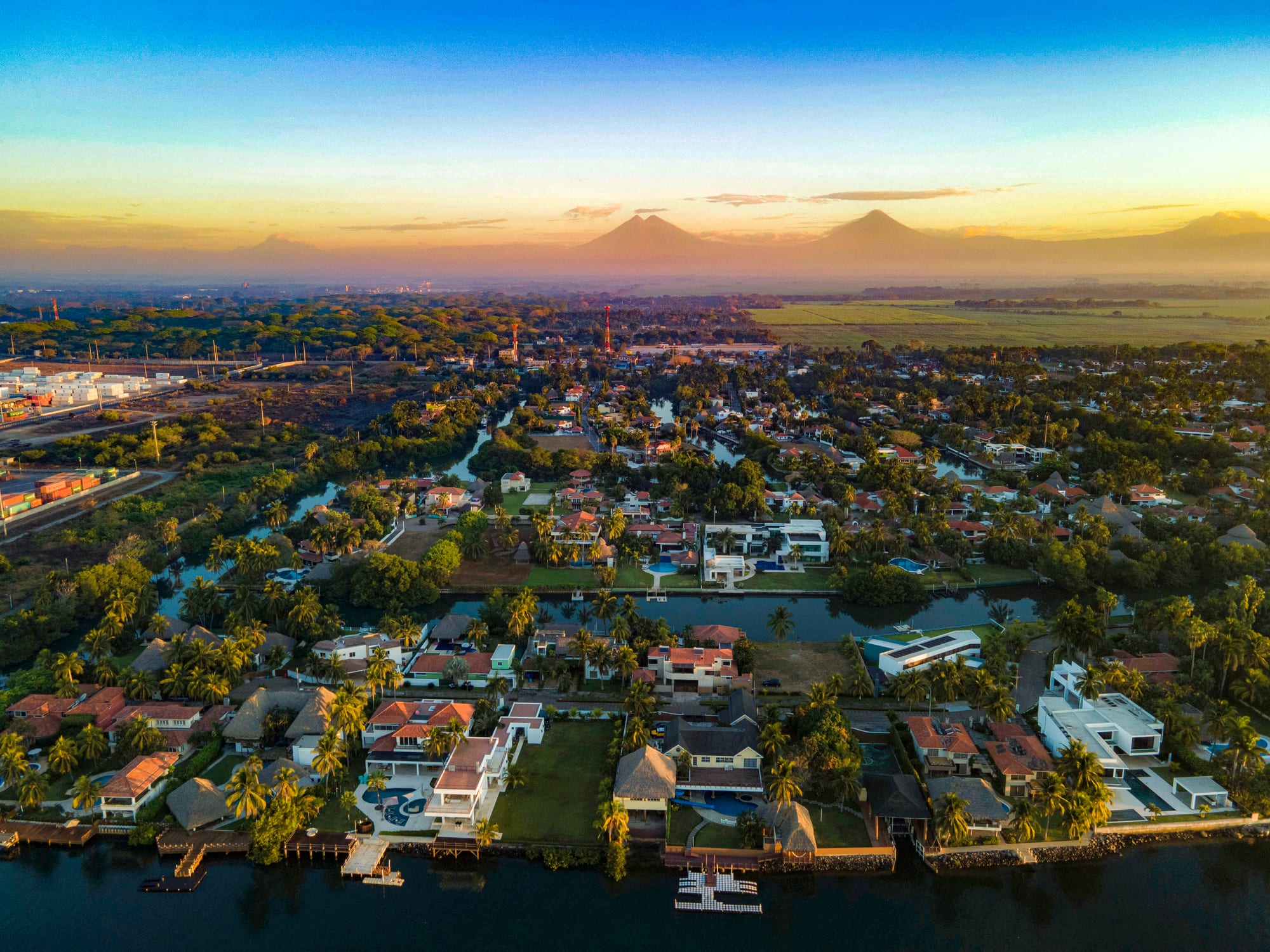
Aerial view of houses with pools beside palm-lined canals, with port containers on the left and volcanoes on the horizon at sunset

Guatemala City & Antigua, Guatemala

Puerto San José

Canal-side houses near Puerto San José, with the container yards of Puerto Quetzal and the volcanoes of the highlands behind. (Juan Francisco / Wikimedia Commons · CC BY-SA 2.0)

The largest town on Guatemala's Pacific coast, in the hot lowlands of Escuintla. Founded in 1853, it was the country's main Pacific port for well over a century until the container port of Puerto Quetzal, just to the east, replaced it. Today it lives from that port and from weekenders who drive down from Guatemala City to its black-sand beaches and resorts.

Neighbourhoods

  • The town and its beach
    • Local life
    • Beaches
    • Best for food

    The old port town behind a long beach of dark volcanic sand, with simple comedores serving fried fish and seafood soups. It fills with families from the capital at weekends and in holiday weeks and is quiet on weekdays.

    Open in Maps
  • Chulamar and Likín
    • Beaches
    • Quiet and residential

    Resort and holiday-home areas along the coast near the town, with walled beach houses, pools and canals.

    Open in Maps
  • Puerto Quetzal
    • Cruise passengers
    • Sport fishing

    The modern port a few kilometres east of the town, Guatemala's largest on the Pacific, with container quays and the Marina Pez Vela, where cruise ships dock.

    Open in Maps

Things to do

The coast near the town

  • Puerto San José beachbeach

    The long black-sand beach in front of the town, busy with weekenders from the capital.

    Open in Maps
  • Puerto Quetzaltransit hub

    Guatemala's largest Pacific port, built around 1980 as a container port, where cruise liners also stop.

    Open in Maps
  • Iztapaattraction

    The neighbouring coastal town, once a rival port, considered one of the best places in the world to catch sailfish.

    Open in Maps
  • Sipacate-Naranjo National Parkpark

    A strip of mangroves, lagoons and sandy beaches west along the coast, where sea turtles nest and more than 90 bird species have been recorded.

    Open in Maps

Short trips from the town

  • Monterricobeach

    A beach town in Santa Rosa known for its volcanic black sand and its sea-turtle conservation, where hatcheries collect eggs during the nesting season.

    Open in Maps
  • Escuintlaattraction

    The department capital on the edge of the highlands and the coastal plain, nationally known for its sugar agribusiness.

    Open in Maps

Eat and drink

Long-standing places and food districts in Puerto San José. Hours, ratings and directions come from your maps app, always current.

Puerto San José classics

  • Beach comedoresneighborhood

    Simple open-air restaurants along the beach serving fried whole fish, shrimp and seafood soups to weekend crowds.

    Open in Maps
  • Iztapa seafoodneighborhood

    Fish and seafood comedores in the neighbouring town, a short drive along the coast.

    Open in Maps

Experience Puerto San José

History

Puerto San José was founded in 1853. For more than a century it was the country's main gateway on that coast, controlled for decades by the Empresa Marítima Nacional, which held a monopoly on unloading goods. Passengers landed by being swung over the side of anchored ships and lifted on to a tall iron pier, and Anne Maudslay, wife of the archaeologist Alfred Maudslay, arriving in the 1890s, described a long beach of hot sand, palms and banana groves and a handful of houses.

The port was at the end of the railway line that crossed the country from Puerto Barrios on the Caribbean, and in the late 19th century a rival port was promoted at neighbouring Iztapa. In August 1890 the town was at the centre of an international dispute between Guatemala and the United States after the exiled general Juan Martín Barrundia was killed aboard an American ship in the harbour while Guatemalan officials tried to arrest him.

In the 20th century the pier passed to the International Railways of Central America and then to Guatemala's state railways. Its nearness to the capital also made the town a setting for films, including a Mexican film of 1962. Around 1980 the container port of Puerto Quetzal was built a few kilometres to the east, and within a few years it replaced the old port, which ceased to operate as a port in 1985. The town turned to the new port and to tourism.

Culture & Customs

Puerto San José is a Spanish-speaking coast town, quite different in character from the Maya highlands a few hours inland. Its culture is that of a weekend escape: families from Guatemala City drive down to swim, eat seafood and stay in beach houses, and the town's busiest days are Saturdays, Sundays and holiday weeks.

The sea shapes local life. The coast is known for sport fishing: nearby Iztapa is considered one of the best places in the world to catch sailfish. Along the wider coast, from the mangroves of Sipacate-Naranjo to Monterrico, sea turtles come ashore to nest, and hatcheries collect eggs to protect them. Monterrico, along the coast in Santa Rosa, is another major weekend beach resort for the capital.

The resorts of Chulamar and Likín, with their canals, pools and walled beach houses, show the other side of the coast: holiday homes a short distance from the working town and the cane fields of Escuintla that stretch inland.

Daily Life

Puerto San José lies in the municipality of San José, in the department of Escuintla. The 2018 census counted about 24,000 people in the town, making it the largest on Guatemala's Pacific coast. The Puerto Quetzal complex, the country's largest Pacific port, is the main employer in the district, handling cargo and cruise ships, and tourism, centred on the resorts of Chulamar and Likín, is the other important source of work.

Life follows the heat and the week. Mornings start early, before the temperature climbs, and the town is quiet on weekdays, when fishermen, port workers and traders go about their business. At weekends the beach and the comedores fill with visitors, buses and cars arrive from the capital, and the resort areas come alive.

Inland, the plain of Escuintla is sugar country, with cane fields, mills and cattle ranches. The small San José airport has been refurbished and serves as the official alternate for the capital's international airport. Some highways through Escuintla see hold-ups, so most people avoid driving them at night.

Food

The food of Puerto San José is the food of the Pacific coast: fish and seafood. Beach comedores serve whole fried fish with rice, salad and tortillas, shrimp, and seafood soups, and the neighbouring town of Iztapa has its own seafood restaurants. These simple places are the heart of a weekend at the coast, eaten under thatch or tin roofs a few steps from the sand.

Beyond the seafood, meals follow the national pattern: tortillas, black beans, fresh cheese and cream, with tamales especially around Christmas, usually wrapped in plantain or banana leaves rather than corn husks. Escuintla's economy rests on sugar cane, with seafood, tobacco and cattle among its other products. Comedores serve set lunches, and pepián, a meat stew thickened with seeds, is one of four traditional dishes declared part of the nation's intangible cultural heritage.

To drink, there is cold beer — Gallo comes from a brewery based in the capital — and soft drinks.

Planning tools

Budget

Puerto San José is cheap on weekdays and busier and dearer at weekends and in holiday weeks, when families from the capital fill the beach. Simple beach hotels and comedores cost little; the gated resorts and rented beach houses of Chulamar and Likín, and sport-fishing charters are the main expenses.

Daily Budget Midrange
USD 80–160 (resort or beach-house room with a pool, seafood restaurants, taxis or a hire car)
Daily Budget Shoestring
USD 30–50 (simple beach hotel, comedor seafood, buses from the capital)

Visit on a weekday for an empty beach and lower prices; Holy Week and long weekends are the busiest times.

Best Time to Visit

The dry season from November to April brings sunshine and the calmest weather. The wet season from May to October brings heavy afternoon rain but fewer visitors. Weekends are lively all year, and the coast is at its most crowded in Holy Week.

Suggested Number of Days

Most visitors come for a night or a weekend from Guatemala City or Antigua. Allow three or four days to see more of the coast on either side, or to fit in a day at sea.

First Visit
1–2 days
With Surroundings
3–4 days

Transportation

The town is small and can be walked, but the resorts, Puerto Quetzal and the neighbouring beach towns are spread along the coast road, so most visitors drive or take taxis.

Avoid driving the Pacific lowland highways at night, when hold-ups are more likely.

Airport & Station Connections

Puerto San José is about 110 kilometres south of Guatemala City by the CA-9 highway, through Escuintla. La Aurora International Airport in the capital is the nearest with scheduled international flights; the small San José airport serves as its official alternate. Cruise ships dock at Puerto Quetzal.

Walkability

The town centre and its beach are compact and walkable, though the heat makes walking hard in the middle of the day. The resort areas and the port are spread out along the coast and are reached by car.

Safety

Guatemala has significant crime, including gang activity and armed robbery, concentrated in parts of Guatemala City and on some highways and rural routes. Some highways through the metropolitan area and Escuintla see hold-ups. On the beach the main danger is the sea, with rip currents on the Pacific beaches.

Travel by day, keep valuables out of sight on the beach, swim only where locals do and watch for rip currents on the Pacific beaches. Check current official travel advice before travelling.

Climate

A tropical savanna climate, hot all year, with a wet season from May to October and a dry season from November to April. The wet-season figure below is the region's for the coast, and the dry-season one the country's for the lowlands.

Summer
wet season (May–October): 30–35°C and humid on the coast, with heavy afternoon rain
Winter
dry season (November–April): hot and sunny, around 28–35°C in the lowlands

Local Customs

This is a Spanish-speaking coast, relaxed and family-oriented. Beach life is informal, but swimwear belongs on the beach and in resort pools rather than in town or in shops.

Dress modestly away from the beach and in churches, and ask before photographing people.

Common Payment Methods

The currency is the Guatemalan quetzal (Q). Resorts and larger restaurants take cards, but beach comedores, buses and small shops want cash, so carry enough quetzales for the day.