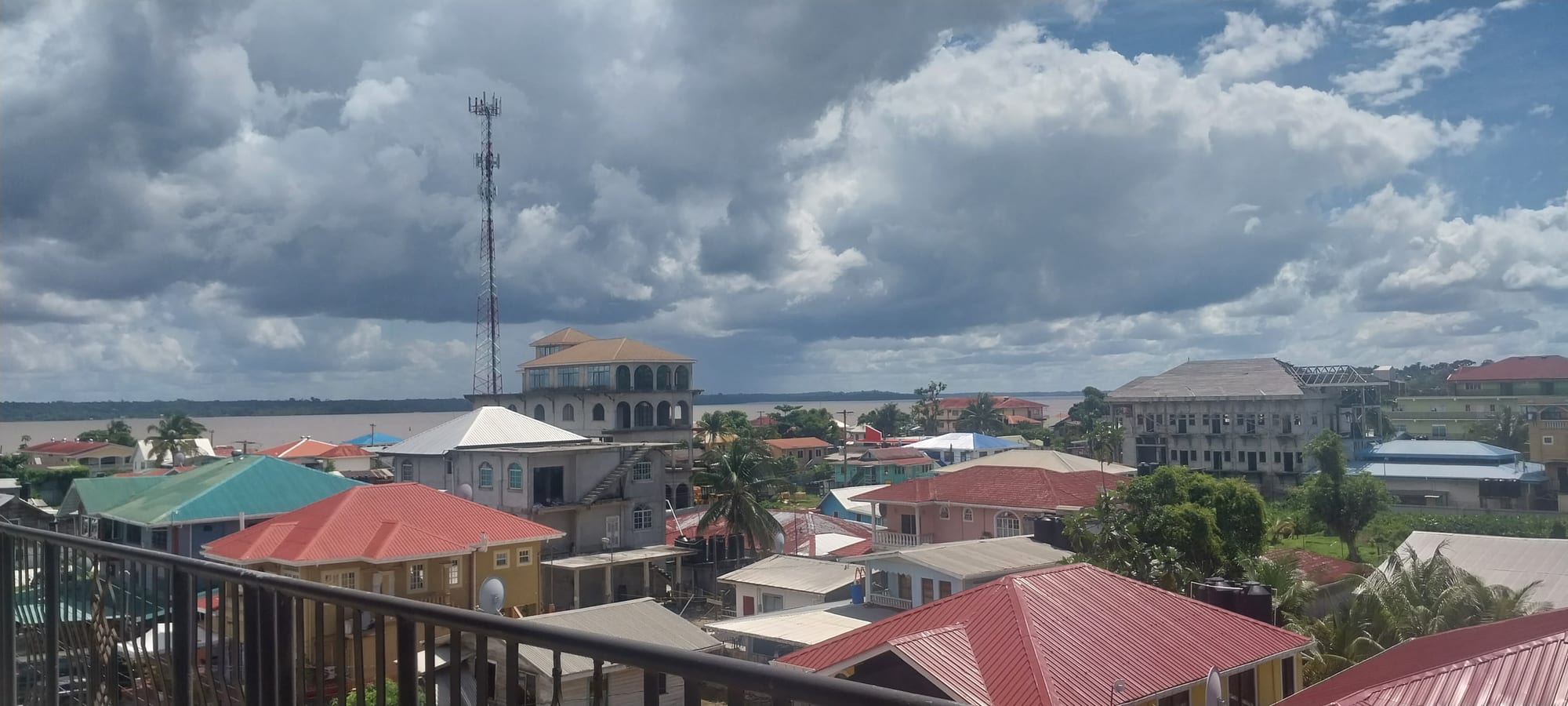
Colourful tin-roofed houses and taller concrete buildings of Bartica, with the wide Essequibo River behind under heavy clouds

Guyana

Bartica

Bartica's rooftops seen from Third Avenue, with the Essequibo River beyond. (Luisdavidleonlopez / Wikimedia Commons · CC0)

A river town on the west bank of the Essequibo, where the Cuyuni and Mazaruni rivers join it, and the capital of the Cuyuni-Mazaruni region. Grown from an Anglican mission founded in 1837, it is known as the Gateway to the Interior — the supply and departure point for gold and diamond miners heading upriver, with a Brazilian community and an Easter regatta.

Neighbourhoods

  • Front Street and the riverside
    • First-time visitors
    • River views
    • Close to the boats

    The street along the Essequibo riverfront, with the hospital nearby and a breeze off the wide river; the stelling, where the boats land, is close by at First Avenue.

    Open in Maps
  • The avenues
    • Shops and restaurants
    • Local life

    The grid of numbered avenues and streets behind the waterfront — First, Second and Third Avenue — holds many of the shops, restaurants and bars, including Brazilian eateries. The whole town covers only about a square mile, though its hills make taxis popular.

    Open in Maps

Things to do

History on the rivers

  • Fort Kyk-Over-Allandmark

    The ruins of a Dutch fort built in 1616 on a small island where the Essequibo, Cuyuni and Mazaruni meet, once the seat of the Dutch administration of Essequibo; its name means 'see over all', for its view of the river. It is reached by boat.

    Open in Maps

Short trips from the town

  • Marshall Fallsattraction

    Falls close to Bartica, visited on tours from the town.

    Open in Maps
  • Fort Zeelandialandmark

    A brick fort of 1743 on Fort Island in the Essequibo delta, among the oldest structures in Guyana, which replaced Kyk-Over-Al as the capital of Essequibo.

    Open in Maps
  • Parikatransit hub

    A port village in the Essequibo Islands-West Demerara region, the speedboat and ferry departure point for Bartica and the Essequibo islands.

    Open in Maps

Seasonal events

  • Bartica RegattaEaster weekend

    The town's annual Easter festival on the river, its best-known event.

Eat and drink

Long-standing places and food districts in Bartica. Hours, ratings and directions come from your maps app, always current.

Bartica classics

  • Brazilian restaurants and barsneighborhood

    Several Brazilians live in Bartica, and their restaurants and bars are a feature of the town — known for beef on a stick.

    Open in Maps
  • Restaurants on the avenuesneighborhood

    Local restaurants and fast-food places on the avenues and Front Street serving everyday Guyanese food.

    Open in Maps

Experience Bartica

History

Bartica stands on the west bank of the Essequibo River where the Cuyuni and Mazaruni rivers join it, a meeting of waters that drew the Dutch long before the town existed. In 1616 they built Fort Kyk-Over-Al on a small island at the confluence; it served as the seat of the Dutch administration of Essequibo until 1739, when the capital moved downriver to Fort Zeelandia, and only ruins remain.

The town itself grew from an Anglican missionary settlement established in 1837 and consecrated in 1843. Its name comes from an Indigenous word meaning "red earth", for the soil common in the area. As gold and diamonds drew prospectors into the forests of the Mazaruni and Cuyuni, Bartica became the launching point for people working in the bush and earned the name Gateway to the Interior. It became the capital of the Cuyuni-Mazaruni region, one of the largest regions of Guyana by area.

On 17 February 2008 an armed gang attacked the town, overrunning the police station, robbing businesses and killing twelve people, including three police officers. The town lies in the territory west of the Essequibo that Venezuela claims and Guyana administers, the subject of a case before the International Court of Justice; the dispute has raised political tension but has not affected travel to date.

Culture & Customs

Bartica's culture is that of a river and mining town. Miners and traders come and go between the coast and the goldfields, and the town's shops, bars and nightlife serve them. Several Brazilians live in Bartica, so Brazilian restaurants and bars are part of the scene. Several guesthouses and a busy nightclub serve those passing through.

The great event of the year is the Bartica Regatta, held annually over Easter weekend. Around the town, riverine communities along the Essequibo and Mazaruni keep an Indigenous way of life, and visitors reach them by boat. Boats also carry visitors north of the town to the ruins of the Dutch fort of Kyk-Over-Al, a reminder of the area's colonial past.

The town has produced notable figures including the abstract painter Frank Bowling, the West Indies cricketer Ivor Mendonca and the FIFA referee Dianne Ferreira-James. Life here is shaped by the river — boats are the main link to the outside world, and the riverside is where much of the town's business and social life happens.

Daily Life

Bartica had a population of about 8,000 in 2012, and the whole Cuyuni-Mazaruni region about 30,000 at the 2022 census. As the regional capital it holds the region's hospital — which in 2005 introduced Guyana's first electronic health information system — two secondary schools and several primary schools, with more schools in the riverine communities around it.

The economy rests on mining and supply. Gold and diamond miners set off from Bartica for the interior; the speedboats to Parika carry people and goods to the coast. Timber and agriculture are also important in the wider region. The Denham Suspension Bridge, also known as the Garraway Stream Bridge, carries the road inland from Bartica towards Mahdia.

The rhythm of the town follows the boats to and from Parika and the miners passing through on their way to or from the bush, and its nightlife centres on the bars and restaurants of the avenues.

Food

Bartica eats like the rest of Guyana, with some Brazilian additions. Everyday dishes include cook-up rice, the local version of rice and peas; curry and roti from the Indian indentured tradition; and pepperpot, the dark meat stew of Amerindian origin flavoured with cassareep, a bitter-cassava extract, which is eaten above all at Christmas. Metemgee — ground provisions and dumplings in coconut milk — bake and saltfish, garlic pork and a Guyanese chow mein inherited from Chinese settlers are all common, and seven curry, seven vegetarian curries eaten with roti, is the meal of Hindu weddings and festivals.

The town's Brazilian residents have brought their own restaurants and bars, and beef on a stick is the dish they are known for. Local restaurants and fast-food places line the main avenues.

Banks is the national beer, and dark Demerara rum the national spirit. Non-alcoholic favourites across Guyana include mauby, sorrel, ginger beer and fresh fruit juices, and bottled water is the safe choice for drinking.

Planning tools

Budget

Day-to-day costs are modest — local food, taxis and simple rooms. The main extras are boat hire for trips to the fort ruins and the falls, and stays at the riverside resorts around the town.

Daily Budget Midrange
USD 150–300 (better room, restaurant meals, a chartered boat for river trips)
Daily Budget Shoestring
USD 55–90 (simple room, local food, taxis and the public speedboat)

Arrange boat trips with established local operators and agree the price and route before setting off.

Best Time to Visit

The drier spells from about September to November and in February and March are the most comfortable for river trips. The long rainy season runs from about May to August. Easter brings the regatta and the town's busiest weekend.

Suggested Number of Days

The town itself needs a day or less. Most visitors add river trips, and the total depends on how many boat excursions are planned and on river and weather conditions.

First Visit
1–2 days
With Surroundings
3–4 days

Transportation

The town covers about a square mile and can be walked, but its hills mean that residents use taxis a great deal, and taxis are plentiful and inexpensive for short drops. Everything beyond the town — the forts, the falls and the riverside communities — is reached by boat.

Use the town's registered taxi services, and wear a life jacket on river boats.

Airport & Station Connections

Most travellers come by river: a minibus from Georgetown's Stabroek Market to Parika takes about 45 minutes, then a speedboat up the Essequibo about an hour, or a slower ferry several hours. Bartica can also be reached by road from Linden. Bartica Airport, a 760-metre asphalt strip 6 km south-west of the town, takes light aircraft.

Walkability

Compact and easy to cover on foot, with a grid of avenues behind the riverfront, though some streets are hilly and the heat is strong by midday. Walking by day is straightforward; taxis are the easier choice after dark.

Safety

Georgetown has significant crime, including armed robbery and burglary, and visitors are advised to be cautious downtown and after dark and to avoid certain districts. Bartica is a small mining town whose taxi services are regarded as reliable and safe. In February 2008 an armed gang attacked the town, killing twelve people, including three police officers.

Keep valuables out of sight, take taxis at night, travel on the river with established boat operators, and take malaria precautions for trips into the forest. Check current official travel advice before travelling.

Climate

A tropical rainforest climate, hot and humid all year with rain in every season. Across Guyana's coast, temperatures run between about 25°C and 31°C, with the wettest months from May to August and a shorter rainy season from November to January.

Summer
there is no real summer — across the coast temperatures stay around 25–31°C all year, and the long rains fall from about May to August
Winter
no real winter either — a shorter rainy season comes from about November to January, with temperatures little changed at around 25–31°C

Local Customs

Bartica is a working frontier town where miners come and go, and its life mixes Guyanese, Brazilian and Amerindian influences. English is the official language and Guyanese Creole the everyday speech. The riverine communities around the town keep an Indigenous way of life, and visits are best arranged with a guide.

Ask before photographing people, especially in Amerindian communities and around the mining trade, and dress modestly away from the river.

Common Payment Methods

The currency is the Guyanese dollar (GYD); US dollars are often accepted by tour operators. Cash is needed for taxis, food and boats. Banks and ATMs are few, so it is best to bring enough cash from Georgetown.