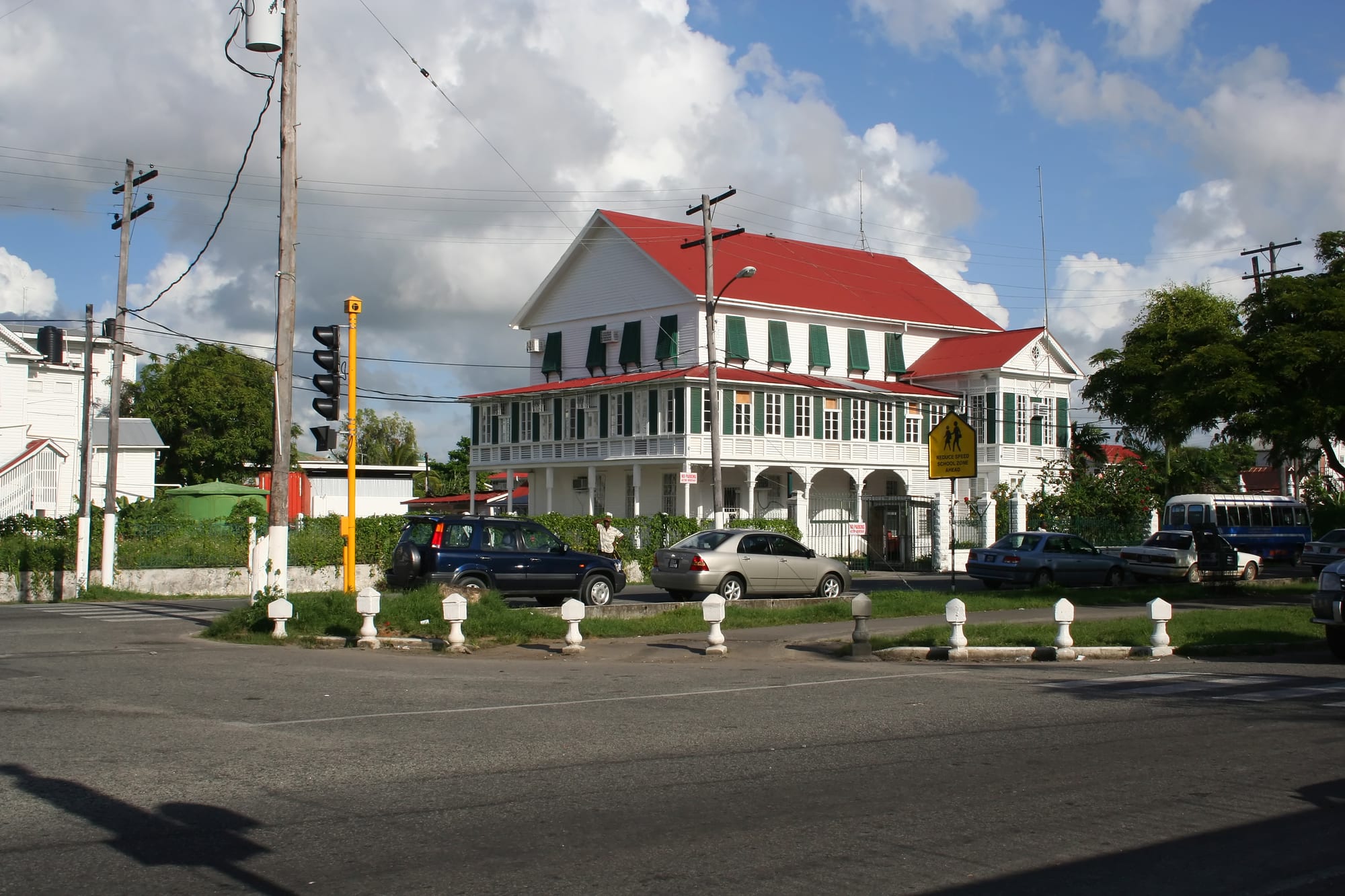
A white two-storey timber building with green shutters and a red roof on a quiet street corner in Georgetown

Guyana

Georgetown

A timber building at a street corner in Georgetown. (Ian Mackenzie / Wikimedia Commons · CC BY 2.0)

Guyana's capital, at the mouth of the Demerara River on the Atlantic coast, laid out by the Dutch and British on drained land below high-tide level behind a long sea wall. Known as the Garden City of the Caribbean, it keeps a grid of canals, painted timber buildings and Victorian landmarks, and is now the busy centre of an oil-boom economy.

Neighbourhoods

  • Stabroek and Water Street
    • First-time visitors
    • Markets
    • Close to public transport

    The central ward that carried the whole town's name between 1784 and 1812. Stabroek Market and its clock tower, the river ferries and the main minibus park make it the busiest part of the city, with the port on the Demerara just to the west.

    Open in Maps
  • Cummingsburg
    • Historic district
    • Museums

    A former plantation laid out as a town by the Scotsman Thomas Cumming, replanned after a fire in 1864. Its grid holds the national museum, the anthropology museum, St George's Cathedral and many of the tree-lined streets of old timber houses.

    Open in Maps
  • Kingston
    • Historic district
    • Sea wall

    A former village on the Atlantic shore that became a ward of the city in 1837. It lies between the river mouth and the sea wall, with the Umana Yana, the lighthouse and many older public buildings close by.

    Open in Maps
  • Bel Air and Lamaha Gardens
    • Quiet and residential

    Residential districts in the north-east of the city, near the university and the CARICOM Secretariat, known for higher-income homes and gated communities. They are quiet, car-based and some way from the old centre.

    Open in Maps

Things to do

Famous landmarks

  • St George's Cathedrallandmark

    The Anglican cathedral, a Gothic Revival building of timber 43.5 metres high, designed by Sir Arthur Blomfield, opened in 1892 and completed in 1899; it is a national monument.

    Open in Maps
  • Stabroek Marketmarket

    The city's largest market, housed in an iron and steel structure of 1880–81 with a prominent clock tower, and a hub for minibuses and Demerara River ferries.

    Open in Maps
  • Georgetown City Halllandmark

    A neo-Gothic timber city hall of 1889 on the Avenue of the Republic, with a prominent tower.

    Open in Maps
  • St Andrew's Kirklandmark

    A church completed in 1818, among the oldest buildings of the city centre.

    Open in Maps
  • Georgetown Lighthouselandmark

    A lighthouse on Water Street first built by the Dutch in 1817 and rebuilt in 1830, maintained by the National Trust of Guyana.

    Open in Maps
  • Umana Yanalandmark

    A conical palm-thatched benab built by Wai-Wai craftsmen for a conference of non-aligned foreign ministers in 1972; it was destroyed by fire in 2014 and rebuilt in 2016.

    Open in Maps

Museums

  • Walter Roth Museum of Anthropologymuseum

    A museum of Guyana's Amerindian heritage on Main Street, open to the public since 1982, with artefacts and archaeological finds.

    Open in Maps
  • Guyana National Museummuseum

    The national museum, established in 1868, whose long-standing displays include a figure of a pork-knocker, the gold and diamond prospector of the interior.

    Open in Maps
  • Castellani Housemuseum

    A large 19th-century house beside the Botanical Gardens, built by the Maltese architect Cesar Castellani and home to the National Art Gallery since 1993.

    Open in Maps

Parks and the sea wall

  • Guyana Botanical Gardenspark

    Gardens founded in the late 19th century on a former sugar estate, with manatees in a pond — the first were placed there in the 1870s — and the Place of Heroes, where national leaders are buried.

    Open in Maps
  • Guyana Zoopark

    A small zoo opened in 1952 beside the Botanical Gardens, best known for its harpy eagles and manatees.

    Open in Maps
  • Promenade Gardenspark

    A small downtown garden of tropical plants beside Independence Park, the former parade ground where slaves who took part in the uprising of 1823 were executed.

    Open in Maps
  • Guyana National Parkpark

    An urban park in the north of the city, built on a former golf club and opened in the presence of Queen Elizabeth II.

    Open in Maps
  • The Sea Walltrail

    The wall that keeps the Atlantic out of a city below high-tide level, begun after the Kingston flood of 1855; its promenade is where much of Georgetown gathers in the evening.

    Open in Maps

Cricket and the stage

  • Bourdaattraction

    The Georgetown Cricket Club ground, which has staged Test matches and is unusual in being surrounded by a moat for drainage.

    Open in Maps
  • Providence Stadiumattraction

    The national stadium south of the city, built for the 2007 Cricket World Cup, where Lasith Malinga took four wickets in four balls.

    Open in Maps
  • National Cultural Centreattraction

    The main stage for theatre in Georgetown, in D'Urban Park on Homestretch Avenue, south of the Botanical Gardens.

    Open in Maps

Seasonal events

  • MashramaniFebruary, around Republic Day

    The festival of the republic, with costume competitions, float parades, masquerade bands, steel bands and calypso, soca and chutney contests.

  • PhagwahMarch

    The Hindu spring festival, celebrated across Guyana with coloured powder and water.

  • DiwaliOctober or November

    The Hindu festival of lights, one of the national holidays that reflect the country's mixed heritage.

Eat and drink

Long-standing places and food districts in Georgetown. Hours, ratings and directions come from your maps app, always current.

Georgetown classics

  • Stabroek Market cookshopsmarket

    Small cookshops in and around the market serving everyday Guyanese food by day.

    Open in Maps
  • Rum shopsneighborhood

    Small neighbourhood bars where local dark rum and Banks beer are drunk; they are found all over the city and the country.

    Open in Maps

Food districts

  • Sheriff Streetneighborhood

    The city's main entertainment street, with most of its clubs, bars and restaurants.

    Open in Maps
  • Regent Street and the central shopping areaneighborhood

    The premier shopping street, in the central shopping area between Water Street and Albert Street.

    Open in Maps

Experience Georgetown

History

In 1748 the Dutch governor Laurens Storm van 's Gravesande built a guard post at the mouth of the Demerara River, and English planters began to put up houses around it. A town was formally established in 1782, during a brief French occupation of the Dutch colony of Demerara, under the name Longchamps; in 1784 it was renamed Stabroek after Nicolaas Geelvinck, Lord of Stabroek and then president of the Dutch West India Company. It grew quickly, from fewer than a thousand people in 1789 to around 8,500 by 1807, and when the British took control it was renamed Georgetown in 1812, in honour of King George III. It became a city in 1842.

The town grew by absorbing neighbouring plantations and villages: Cummingsburg began as a plantation laid out in lots by the Scotsman Thomas Cumming, and Kingston became a ward in 1837. Because the land lies below high-tide level, the city depended on canals, sluices called kokers and earthen dams. When the Kingston flood of 1855 broke through, the sea wall was begun in 1858, built largely by convict labour with granite from the Mazaruni penal settlement, and extended along the shore over the following decades. The Victorian city of timber churches, iron markets and law courts dates from this period, and fires — in 1864 and the Great Fire of 1945 — repeatedly reshaped it.

Georgetown became the capital of independent Guyana in 1966 and is home to the CARICOM Secretariat. Since offshore oil production began in 2019 it has seen a construction and spending boom, heavier traffic and new roads, and in October 2025 a new bridge across the Demerara was opened.

Culture & Customs

Georgetown calls itself the Garden City of the Caribbean, and its tree-lined avenues, canals and painted timber buildings set it apart from other South American capitals. Its culture is Caribbean and English-speaking, shaped by Afro-Guyanese and Indo-Guyanese communities alongside people of mixed, Amerindian, Portuguese and Chinese descent. The Walter Roth Museum and the Umana Yana, built by Wai-Wai craftsmen, are the city's main places for Amerindian heritage.

The calendar mixes faiths. Mashramani, the republic festival around 23 February, fills the streets with costume bands, floats, steel band music and calypso and chutney-soca competitions; Phagwah and Diwali are celebrated by Hindus and widely shared; Easter and Christmas are major occasions. Cricket is the great shared sport: Bourda, the old ground with its drainage moat, has staged Test matches, and Providence Stadium south of the city was built for the 2007 World Cup.

Theatre is centred on the National Cultural Centre, and the Theatre Guild, opened in 1957, is the oldest playhouse in the country. The city has produced writers such as Wilson Harris, Grace Nichols and John Agard. Everyday social life happens on the sea wall in the evening, in rum shops and around Stabroek Market, and conversation about politics and ethnicity is approached carefully.

Daily Life

The city had about 126,000 people at the 2022 census and about 118,000 in 2012. Georgetown is the retail, administrative and financial centre of Guyana and accounts for a large part of its economy; all the government ministries, Parliament, the courts and State House are here, and the port west of Stabroek Market is the busiest in the country.

The city divides sharply by income. Bel Air Park, Bel Air Gardens and Lamaha Gardens in the north-east are well-off, with gated communities, while Albouystown, Sophia and Agricola in the south are among the poorest districts. Regent Street is the main shopping street and Sheriff Street the centre of nightlife. Drainage through the canals and kokers remains a constant concern.

The oil boom has brought rising rents and prices, new roads and heavy traffic — the Heroes Highway opened in 2022 and a new Demerara River bridge in 2025 — and a wide debate about how the new wealth is shared. Minibuses, the market and the evening walk along the sea wall set the rhythm of the day.

Food

Georgetown eats the whole range of Guyanese cooking. From the Indian indentured tradition come curry, dhal and roti, including dhalpuri. Pepperpot, a dark meat stew of Amerindian origin flavoured with cassareep, a bitter-cassava extract, is eaten above all at Christmas. Cook-up rice, the local version of rice and peas, is a staple, alongside metemgee — ground provisions and dumplings in coconut milk — bake and saltfish, garlic pork and a Guyanese chow mein inherited from Chinese settlers.

The cheapest local meals are at the cookshops in and around Stabroek Market, which serve by day; Sheriff Street and the central shopping streets have most of the restaurants. Rum is the national drink: dark Demerara rum, with El Dorado from Demerara Distillers, headquartered in Georgetown, the best-known brand, drunk neat or mixed with cola or coconut water. Banks is the national beer, made as a lager and a milk stout. Non-alcoholic favourites include mauby, sorrel, ginger beer, the sweet malt drink Malta and fresh fruit juices.

Planning tools

Budget

Georgetown has become expensive since the oil boom, above all for hotels, where demand from the energy industry has pushed prices up. Local food, minibuses and the free parks and markets keep day-to-day costs down. The big extra is the interior: a flight to Kaieteur Falls or a lodge stay adds far more than a day in the city.

Daily Budget Midrange
USD 150–300 (city hotel, sit-down meals, taxis; more with interior flights)
Daily Budget Shoestring
USD 55–90 (guesthouse room, market and cookshop food, minibuses)

The cathedral, Stabroek Market, the gardens and the sea wall cost nothing to see; interior flights have little capacity and are best arranged early.

Best Time to Visit

September to November is the drier, less humid stretch, and February and March are also relatively dry. The rainiest months are usually May, June, August and December–January, though no month is truly dry. February brings Mashramani, and the dry months are best for combining the city with the interior.

Suggested Number of Days

The city itself takes one or two days. Most visitors use it as a base for the interior, and the total depends on how many flights or river and overland journeys are added; travel in the rainy months can take longer.

First Visit
1–2 days
With Surroundings
4–6 days

Transportation

Minibuses are the most common way to get around and run all hours; taxis are plentiful, with plates beginning with 'H', and are the usual choice after dark. The Heroes Highway, opened in 2022, eased traffic on the East Bank, and since October 2025 the new Bharrat Jagdeo Demerara River Bridge has replaced the old Demerara Harbour Bridge as the main crossing to the west bank. Ferries on the Demerara leave from beside Stabroek Market.

Once a reliable taxi driver is found, keep the number for later journeys, and use taxis rather than minibuses at night.

Airport & Station Connections

Cheddi Jagan International Airport, at Timehri on the right bank of the Demerara River, is 41 km south of the city — about 45 to 60 minutes by taxi depending on traffic, or longer by minibus. Eugene F. Correia International Airport at Ogle, 6 km east of the city, handles regional flights and smaller aircraft. From Suriname, travellers cross the Corentyne River by ferry to Molson Creek and continue by minibus. Light aircraft from Georgetown reach Kaieteur Falls and the interior.

Walkability

The city is flat and laid out on a grid, and the historic centre around Stabroek, Cummingsburg and Kingston can be covered on foot by day. Canals and drainage ditches line many streets, pavements are uneven, and the heat is tiring by midday. Walking at night, or alone in unfamiliar areas, is not advised.

Safety

Georgetown has significant crime, including armed robbery and burglary, and visitors are advised to be cautious downtown and after dark and to avoid certain districts. Armed robberies occur regularly, especially at businesses and in shopping districts, and Tiger Bay, Albouystown, Sophia and Agricola are among the areas with the highest crime. Pickpocketing is a daily occurrence around Stabroek Market.

Use hotel or arranged taxis at night, keep jewellery and valuables out of sight, and visit the market with care. Check current official travel advice before travelling.

Climate

A hot, humid tropical rainforest climate with little change through the year. North-east trade winds off the Atlantic moderate the heat, and the temperature rarely goes above 31°C. Rain falls in every month, with the heaviest usually in May–August and December–January.

Summer
there is no real summer or winter — days are around 30°C all year, and the long rainy season runs roughly May to August
Winter
nights stay around 23°C; December and January bring a shorter rainy season, and September to November is drier and less humid

Local Customs

English is the official language and Guyanese Creole the everyday speech. The city's religious calendar is mixed — Hindu, Muslim and Christian festivals are all public occasions. Politics and relations between the two largest communities are sensitive subjects, best discussed with tact and patience. Gaudy jewellery attracts unwanted attention.

A small tip is customary for taxi drivers and good service; dress modestly in temples, mosques and churches, and ask before photographing people, particularly in the market.

Common Payment Methods

The currency is the Guyanese dollar (GYD), and US dollars are widely accepted in Georgetown and by tour operators. Cards are accepted in hotels and larger restaurants; cash is needed elsewhere. ATMs are common in the capital, but cash for the interior should be drawn before leaving.