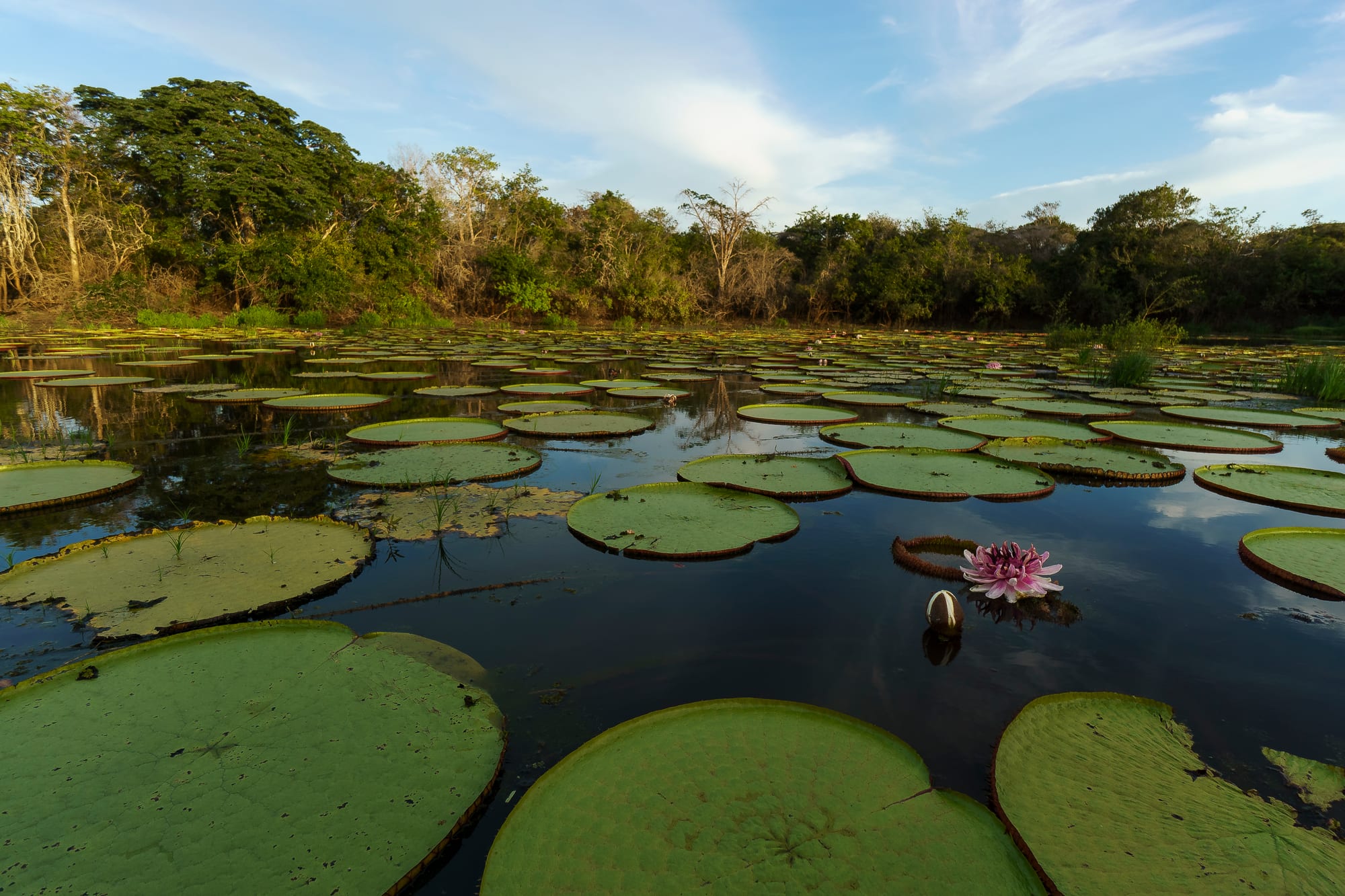
Giant round water-lily pads spread across a dark, still pond with a single pink lily in bloom, ringed by forest glowing in warm low sunlight under a blue sky with wispy clouds

Guyana

Giant water lilies, one in pink bloom, cover a forest-ringed pond at Karanambu Ranch in Guyana. (Dan Sloan / Wikimedia Commons · CC BY-SA 2.0)

An English-speaking country on the shoulder of South America but Caribbean in culture — a thin, populated coastal strip backed by vast rainforest, savanna, and one of the world's most powerful single-drop waterfalls, now transformed by an offshore oil boom.

Explore Guyana

History

The Dutch were the first Europeans to settle, from the late sixteenth century, draining the coastal swamp behind an elaborate system of sea walls, dams, and canals — Georgetown still sits below high-tide level — and working sugar estates with enslaved Africans. Britain took the colonies in 1796, kept them under the Anglo-Dutch Treaty of 1814, and united them as British Guiana in 1831.

Slavery was abolished in 1834 and the apprenticeship that followed it ended in 1838, after which the planters imported indentured labourers, overwhelmingly from India, from 1838 until the system was ended in 1917, to keep the sugar economy going. Their descendants and the descendants of enslaved Africans became the country's two largest communities, and the split between them has shaped politics ever since, with the main parties drawing support along ethnic lines.

Guyana became independent in 1966 and a republic in 1970, following a socialist, increasingly authoritarian path under Forbes Burnham into the 1980s. In 1978 the American cult leader Jim Jones directed the mass murder-suicide of more than 900 of his followers at "Jonestown" in the northwest interior. Democracy and the economy recovered slowly from the 1990s; then, from 2015, ExxonMobil discovered enormous offshore oil reserves, and production since 2019 has made Guyana one of the fastest-growing economies in the world — while Venezuela has revived a long-standing claim to the Essequibo, the territory west of the Essequibo River that makes up the greater part of the country.

Venezuela held a referendum in December 2023 on annexing the Essequibo and in March 2024 passed a law designating it a Venezuelan state governed from Tumeremo. Guyana administers the territory, apart from Ankoko Island, which Venezuela has occupied since 1966, and has asked the International Court of Justice, which accepted the case in December 2020, to rule on the 1899 arbitration award that fixed the border; the court held hearings on the merits in May 2026. President Irfaan Ali and the People's Progressive Party/Civic were returned at the general election of 1 September 2025. Through the United States military build-up in the southern Caribbean that began in 2025, Guyana was described as supportive of the American effort; when US forces removed Nicolás Maduro from power on 3 January 2026, Guyana's response was muted but broadly supportive of his removal.

  • Guyana: Land of Many Waters — An English-speaking corner of South America built on Dutch dykes and sugar — enslaved Africans and indentured Indians, a race-divided politics, decades of decline, and a sudden oil boom

Culture & Customs

Guyana's culture is Caribbean rather than Latin American, and shaped above all by its two main groups: Indo-Guyanese, mostly Hindu with a Muslim minority, and Afro-Guyanese, mostly Christian, alongside smaller communities of Indigenous "Amerindian" peoples (nine nations, mainly in the interior), and people of mixed, Portuguese, and Chinese descent.

The result is an unusual religious calendar in which Diwali, Eid, Christmas, Easter, Phagwah (Holi), and Mashramani, the republic festival, are all widely celebrated. Chutney and chutney-soca music blend Indian and Caribbean sounds; "limin'," cricket, and the rum shop are shared Caribbean institutions.

Politics has long been polarised between the parties associated with the two big communities, and elections are tense; the oil wealth has raised the stakes and the debate over how it should be shared. Family, faith, and a strong pull to emigrate — there are large Guyanese communities in New York, Toronto, and London — are constants.

  • Guyana: Many Faiths, One Calendar — Temples, mosques and churches on the same street, a festival year shared across communities, elders who are everyone's auntie and uncle, and a pre-wedding night of song that grew up nowhere else

Daily Life

Some 90 percent of Guyanese live on the narrow coastal plain, most in and around Georgetown, a city of wooden colonial buildings, canals, and a long sea wall, and in the sugar and rice belts of the Berbice and Demerara regions. The vast interior — rainforest, the Rupununi savanna, and tabletop mountains — holds only a small, mostly Indigenous population.

The economy, long dependent on sugar, rice, gold, and bauxite, is now dominated by oil, which has brought a construction and spending boom, inflation, and a strained capital. The challenge, widely discussed, is turning offshore revenue into schools, roads, and jobs rather than a new round of division and waste.

Coastal daily life runs on the minibus, the market, the mosque, temple, or church, and the rhythm of the rice and sugar seasons; in the interior it follows the rivers, the ranch, and the farming and hunting calendar.

  • Guyana: Life Behind the Sea Wall — A capital that sits below the ocean at high tide behind Dutch-built dykes, a shared calendar that swings between Diwali, Eid and Christmas, and a Sunday evening ritual that turns a sea defence into the biggest gathering of the week

Food

Guyanese food is a genuine fusion. Curry, roti, and dhal from the Indian indentured tradition sit alongside African-rooted dishes and Indigenous ingredients. One of the national dishes is pepperpot, a dark, slow-cooked meat stew of Amerindian origin flavoured with cassareep (a bitter-cassava extract) and hot wiri wiri peppers, cooked for hours and eaten above all at Christmas.

"Cook-up rice," a one-pot of rice, beans, coconut milk, and meat, is the everyday staple; metemgee (ground provisions and dumplings in coconut milk), garlic pork, "bake and saltfish," and chow mein (a Chinese legacy) are all common. "Seven curry" — seven vegetarian curries eaten with dhalpuri or paratha roti — is the meal at Hindu weddings and festivals.

Demerara rum — the name is shared with Demerara sugar — is the national spirit, and El Dorado, made by Demerara Distillers, is its best-known brand. Mauby, sorrel, ginger beer, and fresh fruit juices are the non-alcoholic favourites.

  • Guyana: Food and the National Dish — A dark, slow-cooked stew built on a cassava syrup made by Indigenous Amerindian communities long before colonial settlement, at the meeting point of the Caribbean and South America

Attractions & Natural Wonders

Kaieteur Falls is the headline: a single sheer drop of about 226 metres — several times the height of Niagara — on the Potaro River, deep in rainforest, with only a short trail and a handful of visitors on any day flying in from Georgetown, plus golden rocket frogs, which breed only in the giant bromeliads of the Kaieteur plateau and nowhere else on earth.

The interior rewards those with time. The Iwokrama rainforest reserve, some 3,700 square kilometres managed for conservation and sustainable use, is one of the places where wild jaguar are still found; the Rupununi savanna to the south has working cattle ranches turned eco-lodges (Karanambu, Dadanawa), giant river otters and giant anteaters, arapaima in the ox-bow lakes, and the Kanuku Mountains. Shell Beach on the northwest coast is a nesting site for four species of sea turtle.

Georgetown itself is worth a day for St George's Cathedral, a Gothic Revival timber cathedral 43.5 metres high, the ornate Stabroek Market and its clock tower, the Walter Roth Museum of Anthropology, the botanical gardens with their manatees, and the long Atlantic sea wall where the city gathers in the evening.

  • Guyana: Nine Attractions and Natural Wonders — A single-drop waterfall about four and a half times the height of Niagara, rainforest that covers most of the country, a wooden colonial capital below sea level, and savanna cattle ranches full of jaguars and giant otters

Planning basics

Budget

Guyana has become expensive since the oil boom, especially for hotels in Georgetown, where demand from the energy industry has pushed up prices. Interior travel is costly because it usually means charter flights or long 4x4 and boat journeys, and jungle lodges are premium-priced. The coast is cheaper if you use guesthouses and minibuses.

Kaieteur Day Trip
A charter flight to Kaieteur Falls from Georgetown runs to several hundred USD per person
Daily Budget Midrange
USD 150–300, more with interior flights and lodges
Daily Budget Shoestring
USD 55–90 on the coast (guesthouse, local food, minibuses)

Book interior lodges and Kaieteur flights well ahead; capacity is small.

Visa Requirements

Citizens of the US, Canada, the UK, the EU, and Commonwealth countries generally do not need a visa for tourist stays of up to 30 or 90 days depending on nationality; everyone else needs an e-Visa arranged before departure. All visitors must hold a passport valid for at least six months. Check vaccination requirements, including yellow fever, well before you travel.

Typical Stay
30 to 90 days, visa-free, for most Western and Commonwealth passports

Safety

Georgetown has significant crime, including armed robbery and burglary, and visitors are advised to be cautious downtown and after dark and to avoid certain districts. The interior and the eco-lodges are generally safe. The oil boom has brought rapid change, traffic, and cost-of-living pressure. Venezuela claims the Essequibo region, which Guyana administers and which is the subject of a case Guyana brought to the International Court of Justice; Venezuela held a referendum on the region in December 2023 and in March 2024 passed a law designating it a Venezuelan state. Guyana's government was broadly supportive of the United States operation that removed Nicolás Maduro in January 2026. The dispute has raised political tension but has not affected travel to date.

Source
US Department of State and UK FCDO travel advisories — check for the latest wording.

Use hotel or arranged transport at night in Georgetown, don't display valuables, keep to established tour operators for the interior, and take malaria precautions in the rainforest and savanna.

Source: US Department of State and UK FCDO travel advisories — check for the latest wording.

Climate

Equatorial, hot and humid all year, with two wet seasons — a long one from about May to August and a shorter one from November to January — and two drier spells between. The interior savanna (the Rupununi) has a more marked single dry season around September to April.

Coast
hot and humid, 25–31°C; wettest May–August
Rupununi Savanna
dry roughly September–April, flooded and hard to travel in the rains

Transportation

Cheddi Jagan International Airport, south of Georgetown, is the gateway, with a second, smaller airport at Ogle, Eugene F. Correia International, just east of the city, for domestic and regional flights. The interior is reached by light aircraft or by long 4x4 and boat journeys on rough trails; the coast is served by minibuses and shared taxis. There is no passenger rail.

Most visitors fly to Kaieteur and to Rupununi ranches and lodges rather than attempting the multi-day overland route.

Best Time to Visit

September to mid-April, spanning the coastal and interior dry periods, for the best road and river access, wildlife viewing in the Rupununi, and reliable flights to Kaieteur. The falls are impressive year-round but the interior is difficult in the height of the rains.

Currency

The currency is the Guyanese dollar (GYD). US dollars are widely accepted in Georgetown and by tour operators. ATMs are common in the capital and coastal towns, scarce or absent in the interior.

Cards
Accepted in Georgetown hotels and restaurants; cash needed elsewhere
Symbol
$ (G$)
Currency Code
GYD — Guyanese dollar

Language

English is the official language and the language of government, schooling, and the media — Guyana is the only country in mainland South America with English as its official language. Most people also speak Guyanese Creole (Creolese). Indigenous languages are spoken in the interior, and some Guyanese Bhojpuri persists among the Indo-Guyanese.

Everyday Speech
Guyanese Creole (Creolese)
Official Language
English