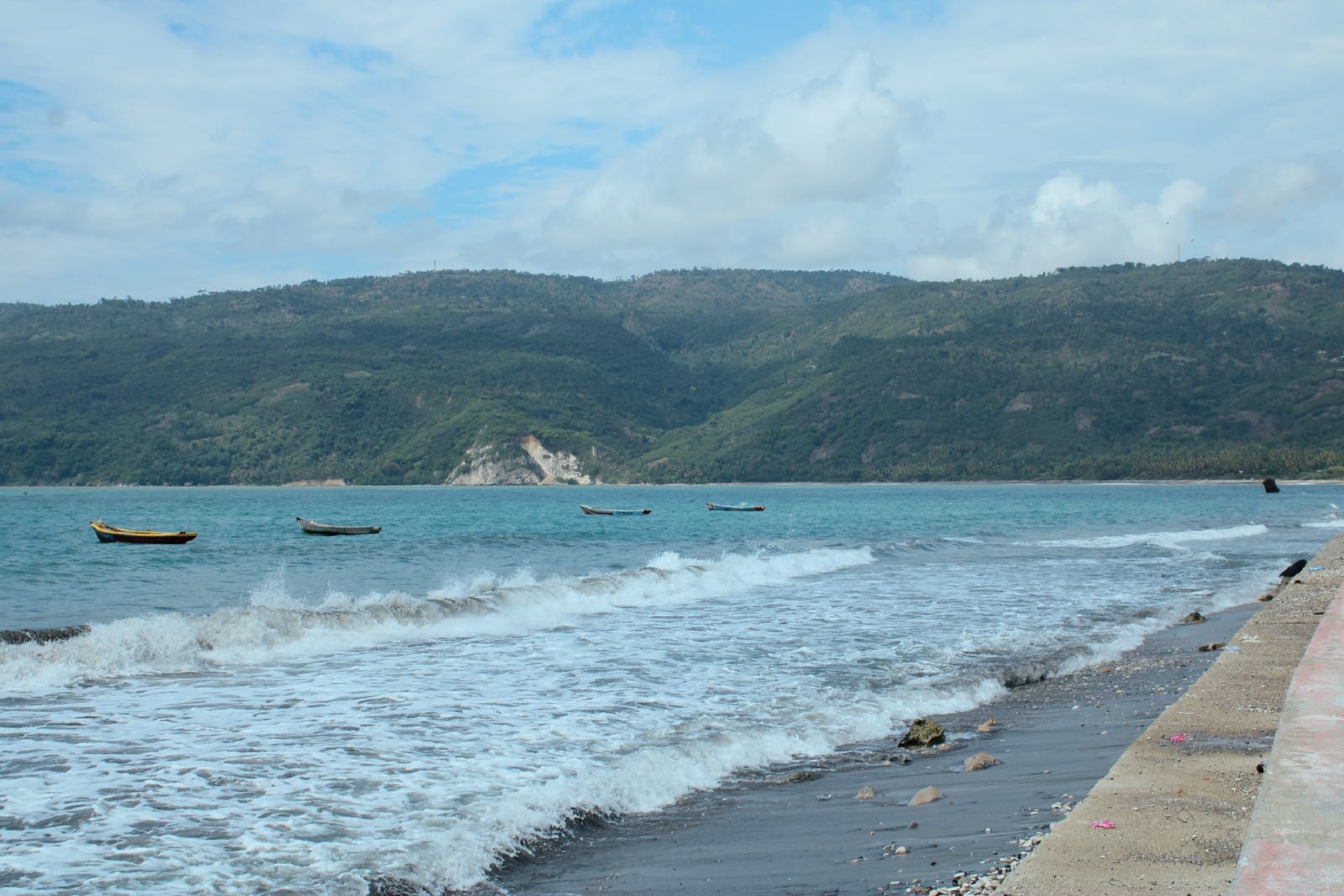
Waves breaking on a dark-sand shore beside a sea wall, with small fishing boats at anchor and green hills across the bay

Haiti

Jacmel

The bay of Jacmel, with fishing boats at anchor below the hills. (Community User Group Wikimédia Haïti / Wikimedia Commons · CC BY-SA 4.0)

A port on Haiti's south coast, 39 kilometres south-west of Port-au-Prince across the mountains, refounded by the French in 1698 and enriched by the coffee trade. Its merchant mansions with cast-iron pillars and balconies, its papier-mâché carnival masks and its arts and film scenes made it known as Haiti's arts town; it was damaged in the 2010 earthquake. This page is written to explain the city, not to encourage travel.

Neighbourhoods

  • The historic centre
    • Historic district
    • Arts and crafts

    The old merchant town above the port, rebuilt after a great fire in 1896 with prefabricated cast-iron pillars and balconies shipped from France. Many of the coffee merchants' mansions survive with little change, and many now hold artisan shops selling papier-mâché masks, handicrafts and carved wooden animals.

    Open in Maps
  • The port and the bay
    • Waterfront

    The harbour where coffee was once shipped, with a pleasure-craft dock that survived the 2010 earthquake and a 200-year-old coffee-sorting house that has been under restoration.

    Open in Maps
  • The beaches east of town
    • Beaches

    The coast towards Cyvadier and Cayes-Jacmel, with white-sand beaches such as Timouillage, Cabic and Raymond-les-Bains, long popular with local holidaymakers and the Haitian diaspora.

    Open in Maps

Things to do

The town

  • The merchant housesneighborhood

    Ornate 19th-century coffee merchants' mansions with cast-iron pillars and balconies, an architecture said to have influenced the houses of New Orleans; the town is on UNESCO's tentative list of World Heritage Sites.

    Open in Maps
  • Papier-mâché workshopsattraction

    Nearly 200 artisans have worked in papier-mâché in Jacmel, making the masks and figures for which the town and its carnival are known.

    Open in Maps
  • Ciné Instituteattraction

    Haiti's first film school, which grew out of the Jacmel Film Festival in 2008 and has offered two years of free tuition with master classes from visiting filmmakers.

    Open in Maps

Waterfalls and beaches

  • Bassin Bleupark

    A series of deep blue pools and a waterfall on the Petite Rivière de Jacmel west of town, the best-known natural pools in Haiti.

    Open in Maps
  • Cayes-Jacmelbeach

    A neighbouring commune down the road from Cyvadier with a public beach, a farmers' market and artisans known for miniature ships.

    Open in Maps
  • Raymond-les-Bainsbeach

    One of the white-sand beaches east of Jacmel, with Timouillage and Cabic, that drew holidaymakers from across Haiti and the diaspora.

    Open in Maps

Seasonal events

  • Jacmel Carnivalthe month before Lent, ending the week before the national carnival

    A month-long carnival known for its papier-mâché masks and costumes, which mix folklore, historical figures, sports stars and political caricature.

  • Jacmel Film Festivalannually

    A festival of world and Haitian cinema first held in 2004, founded by the filmmaker David Belle and the Haitian artist Patrick Boucard.

  • RaraLent, peaking in Easter Week

    Street processions led by bands of bamboo vaksin trumpets and drums, celebrated across Haiti.

Eat and drink

Long-standing places and food districts in Jacmel. Hours, ratings and directions come from your maps app, always current.

Jacmel classics

  • Seafood and Creole platesrestaurant

    Fish, lambi (conch) and Haitian Creole dishes such as griot with pikliz and fried plantain, served in small restaurants in the old town and by the sea.

    Open in Maps

Markets

  • Cayes-Jacmel farmers' marketmarket

    The neighbouring beach town's farmers' market, traditionally held on Wednesdays and Saturdays.

    Open in Maps

Experience Jacmel

History

The bay was Taíno territory in the Xaragua chiefdom, and the town's name comes from its Taíno name, Yaquimel. The Spanish founded a settlement here in 1504, but it was abandoned when the colonists were moved to the east of the island. In 1698 the Compagnie de Saint-Domingue refounded it as the capital of the south-east of French Saint-Domingue, to boost sugar production and trade, and it soon became a coffee-trading centre.

Coffee made Jacmel rich in the 19th century. The town was rebuilt with prefabricated cast-iron pillars and balconies shipped from France, and many of the merchants' mansions from that era survive almost unchanged; the whole centre has changed little in a hundred years, and its architecture is said to have influenced houses in New Orleans. In 1925 it was dubbed the City of Light, the first town in the Caribbean to have electricity. The town is on UNESCO's tentative list of World Heritage Sites.

On 12 January 2010 the magnitude 7.0 earthquake caused heavy damage and casualties in Jacmel; the later tremor stopped the cathedral clock. A local radio station estimated at least 5,000 dead, but the mayor later put the figure at 300–500 deaths and 4,000 injured. The civil court building was destroyed, and restoration projects followed, including work on a 200-year-old coffee-sorting house at the port.

Culture & Customs

Jacmel is known as Haiti's arts town. Nearly 200 artisans have worked in papier-mâché here, making the masks and figures that fill its carnival, and the old merchant houses hold workshops and shops selling crafts, masks and carved wooden animals. The town has long drawn painters and craftspeople, and the country's leading film school, the Ciné Institute, grew out of the Jacmel Film Festival in 2008.

The carnival is the town's great event: a month-long celebration ending the week before the national carnival, famous for costumes and masks that mix folklore legends, figures from Haiti's past, sports stars and political caricature. One of its characters, the robalagallina, a caricature of a planter's wife, was adopted by the carnival of the Dominican Republic, and the carnival has been promoted for UNESCO recognition.

The Jacmel Film Festival, first held in 2004, brought filmmakers from more than 30 countries and was attended by about 50,000 people a year, and an international music festival was launched in 2007. Religious life mixes Catholicism, Protestant churches and Vodou, as across Haiti.

Daily Life

The commune had 221,965 inhabitants at the 2024 census, making it the capital and main town of the Sud-Est department. Before the crisis its growth was driven in large part by income from tourism, which drew visitors from within Haiti, the diaspora and abroad for its carnival, its beaches and Bassin Bleu.

The economy rests on the port, trade, crafts and small businesses, and there have been efforts to revive the once flourishing cigar and coffee industries. The town has two hospitals, Hôpital Saint-Michel and the Complexe Médico Chirurgical Rose Marie Paul, and neighbouring Cayes-Jacmel has had a farmers' market twice a week. Summer has traditionally brought holidaymakers from within Haiti and from the diaspora to the beaches of Kabik, Timouillage and Raymond-les-Bains.

Where life continues with some normality, it centres on the market, the church, workshops and small shops, as in Haiti's other provincial towns.

Food

Jacmel eats the Creole food of all Haiti, built on rice, beans, plantain and root vegetables, with seafood from the bay. Diri ak pwa, rice and beans, is the everyday staple, and diri djon djon, rice cooked black with tiny local mushrooms, is made for special occasions. Griot — pork marinated in citrus and epis seasoning, then boiled and fried — is served with pikliz, a fiery pickled-cabbage relish, and bannann peze, flattened fried plantain.

By the sea, fish and lambi, conch, are common. Street food includes fritay, an assortment of fried snacks, and akasan, a thick spiced corn drink. On 1 January every household makes soup joumou, the squash soup eaten to mark independence.

The town grew rich on coffee, which is still grown in Haiti's mountains, and efforts have been made to revive local coffee production. Barbancourt rum, double-distilled from sugarcane in the manner of cognac, is Haiti's most admired drink.

Planning tools

Budget

There is effectively no tourism industry in Haiti at present, and the town that once drew visitors for carnival and the film festival is no exception. The few who travel usually arrange secured lodging and transport, which makes any stay expensive. Cash in US dollars and gourdes is essential.

Daily Budget Midrange
USD 150–350+ (secured hotel and arranged transport)
Daily Budget Shoestring
USD 150+ (no realistic shoestring option given the security situation)

Any movement is planned around security; independent travel is not advisable.

Best Time to Visit

In more normal times the drier months from December to March were the season, and carnival before Lent was the town's busiest time. The Atlantic hurricane season runs from June to November. At present the security situation, not the weather, decides whether any visit is possible.

Suggested Number of Days

In calmer times a day or two covered the town, and a third added the coast and the pools inland. Today the length of any stay is set by security and access rather than by sightseeing.

First Visit
1–2 days
With Surroundings
3 days

Transportation

The old town is compact and residents walk it or use motorbike taxis and tap-taps. The road to Jacmel starts in Port-au-Prince, where overland travel is extremely dangerous and many routes through and around the capital are controlled by gangs.

Take professional security advice before any road journey in Haiti.

Airport & Station Connections

Jacmel is 39 kilometres south-west of Port-au-Prince across the mountains. Jacmel Airport, near the town, opened in 2006 for flights to the capital and elsewhere in Haiti and was used for relief flights after the 2010 earthquake. Whether any flights or safe road connections operate should be confirmed before any plans are made.

Walkability

The historic centre is small, and its streets of merchant houses run down to the port. The beaches and Bassin Bleu lie outside town and are reached by road; any movement depends on the security situation of the moment.

Safety

This is the decisive fact about Haiti today. Jacmel lies away from the capital, but it depends on the same roads, fuel and supplies as the rest of the country, and since the 2021 assassination of the president armed gangs have taken control of most of Port-au-Prince and key highways, with kidnapping, killings and looting widespread. Most governments advise against all travel to the entire country.

Globeway covers Haiti so it can be understood, not to encourage travel there now. Anyone with an unavoidable reason to go should take professional security advice and read their government's current advisory in full. Check current official travel advice before travelling.

Climate

Tropical, hot and humid on the coast and cooler in the mountains behind the town. The main rainy season runs from April to June with a second spell in October and November, and the Atlantic hurricane season runs from June to November.

Summer
hot and humid — the Haitian coast is typically 28–34°C, with heavy rain in April–June
Winter
December to March is the drier season, still warm on the coast at around 28–34°C, and cooler at night in the mountains

Local Customs

Kreyòl is the everyday language and French the language of government and formal life. Jacmel prides itself on its artists and artisans, and carnival masks and crafts are made to be sold; Vodou ceremonies and churches are places of worship.

Ask before photographing people, especially artisans at work, carnival performers and religious ceremonies; dress modestly in churches.

Common Payment Methods

The currency is the Haitian gourde, though prices are often quoted in the notional 'Haitian dollar' of five gourdes, and US dollars circulate widely. Cash is essential, as cards are accepted in few places.