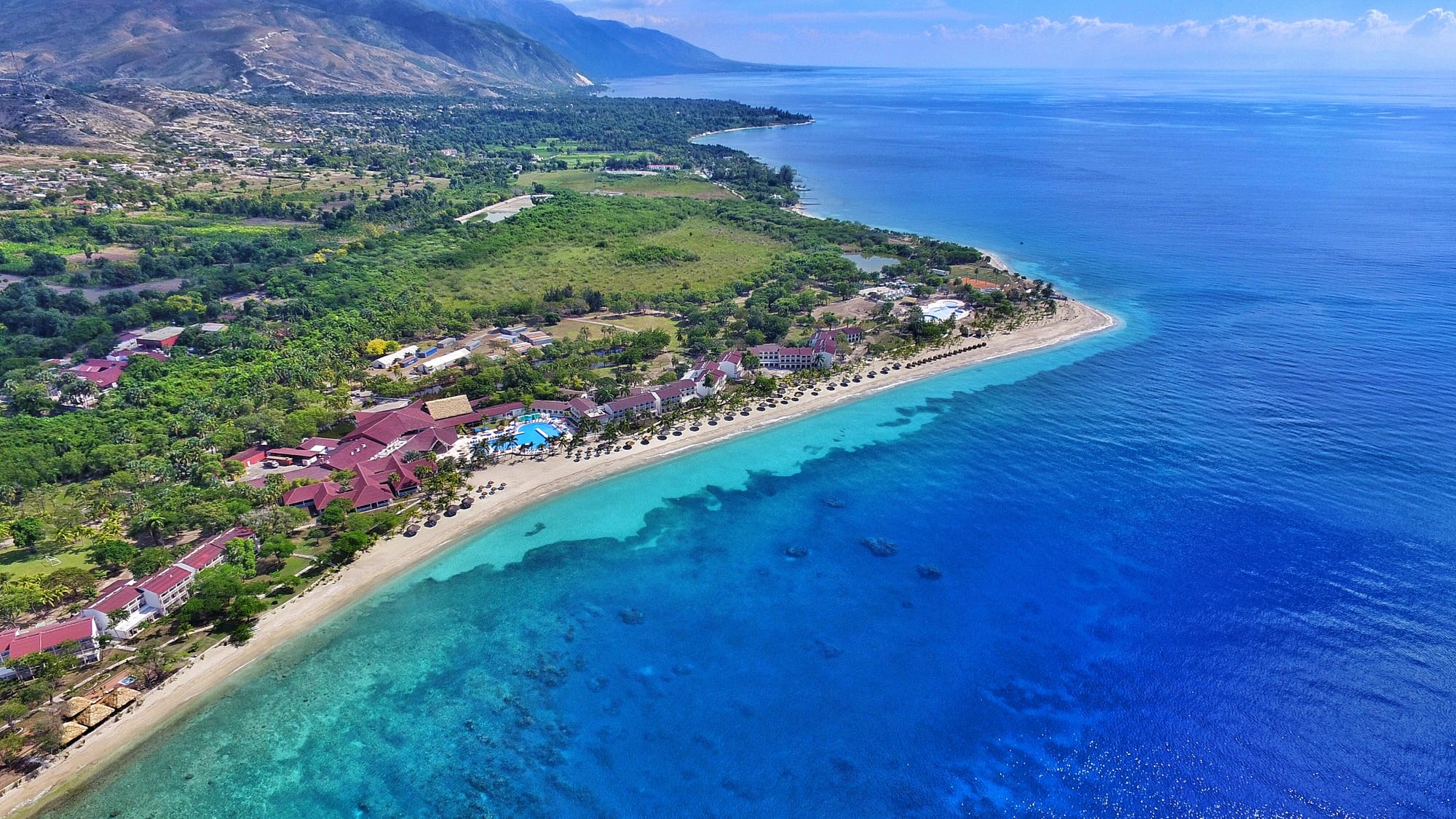
Aerial view of a long white-sand beach and red-roofed resort beside bright turquoise shallows and deep blue sea, with dry mountains rising behind

Haiti

The Côte des Arcadins near Montrouis from the air — a resort beach, turquoise shallows and mountains rising straight behind the shore. (Bowersbill / Wikimedia Commons · CC BY-SA 4.0)

The western three-eighths of Hispaniola — the first nation founded by a successful revolt of enslaved people, with an extraordinary history and culture, and now a state in deep crisis, with armed gangs holding much of the capital and no elected officials in office.

Explore Haiti

History

Saint-Domingue, the French half of Hispaniola, was the richest colony in the world in the eighteenth century, producing much of the globe's sugar and coffee with the brutal labour of hundreds of thousands of enslaved Africans. In 1791 they rose in revolt, and after more than a decade of war — defeating French, Spanish, and British forces, including an army Napoleon sent to restore slavery — the colony declared independence in 1804 as Haiti, the first nation in the world founded by a successful slave revolt and the first independent state in the Caribbean.

The new republic was diplomatically isolated and, in 1825, France demanded a vast indemnity — compensation to former slaveholders — in exchange for recognition. Haiti paid, and borrowed to pay, for more than a century, a debt now widely seen as a foundational drain on its development. The nineteenth century brought coups and division; the United States occupied the country from 1915 to 1934.

The Duvalier dictatorships — François "Papa Doc" from 1957 and his son Jean-Claude "Baby Doc" until 1986 — ruled through the Tontons Macoutes militia and drove many into exile. Democratic politics since 1986 has been repeatedly interrupted by coups, foreign interventions, and disasters: the catastrophic 2010 earthquake killed somewhere between 100,000 and more than 300,000 people depending on whose estimate is used, a UN-introduced cholera epidemic followed, and the 2021 assassination of President Jovenel Moïse was followed by a collapse of state authority and the rise of the gangs.

A Transitional Presidential Council took over the powers of the presidency in April 2024, but its mandate ran out on 7 February 2026 without an election, leaving the acting prime minister, Alix Didier Fils-Aimé, as the sole executive while general elections, repeatedly delayed since 2019, were set for 13 December 2026. There have been no elected officials in Haiti since 2023. The fighting between the Viv Ansanm gang coalition, the police and vigilante groups has driven hundreds of thousands of people from their homes and left roughly half the population facing crisis levels of hunger or worse.

  • Haiti: The First Free Black Republic — One of the world's richest slave colonies became, through the only slave revolt in history to found a nation, the first independent nation in Latin America — then paid for it for two centuries

Culture & Customs

Haiti's culture is one of its great achievements, forged from West and Central African roots, the French colonial inheritance, and the pride of the revolution. Vodou (Vodun), a religion of its own with an elaborate pantheon of lwa served through drumming, dance, and possession, is practised by many alongside Catholicism and, increasingly, evangelical Protestantism; it is officially recognised and deeply misrepresented abroad.

Haitian visual art — vivid, densely patterned painting and sculpture from Port-au-Prince and the arts town of Jacmel, and the ironwork of Croix-des-Bouquets — has an international following. Kompa is the signature dance music; rara bands parade with bamboo trumpets in Lent; and a rich literature in French, Kreyòl and English (Danticat, Laferrière, Alexis, Roumain) carries the country's voice outward.

Kreyòl proverbs, extended-family obligation, and the lakou (family compound) are the fabric of social life. Soup joumou, a squash soup once forbidden to the enslaved and now eaten every 1 January to mark independence, is on UNESCO's heritage list and captures the way food and history are bound together here.

  • Haiti: Honour at the Door, Respect in Return — A greeting called out at the gate, Christian churches and Vodou temples that share the same faithful, a festival of the dead that is anything but sombre, and a music that UNESCO now counts among the world's living heritage

Daily Life

Haiti is the poorest country in the Americas, and the crisis of recent years has pushed much of the population into acute hunger and displacement. More than a quarter of Haitians live in the Port-au-Prince metropolitan area, where armed groups have been estimated to control as much as 90 per cent of the city; the rest live in provincial towns and in the countryside, farming small, eroded plots on steep hillsides.

The economy runs on subsistence agriculture, remittances from the large diaspora in the United States, Canada, France, the Dominican Republic, and Chile — the main source of foreign exchange — some garment manufacturing, and, before the collapse, aid. Charcoal production for cooking has stripped the country's forests.

Where life continues with some normality, in parts of the north and the smaller towns, it centres on the market, the church or the Vodou peristil, the lakou, and the struggle to keep children in school and food on the table.

  • Haiti: A Day Carried on Someone's Head — A rural family compound shared across generations, tens of thousands of market women who move the country's food on foot and by tap-tap, and an ordinary day that, for a large and growing share of the population, has been reshaped by years of crisis

Food

Haitian cooking is Creole, bold, and built on rice, beans, plantain, and root vegetables. Diri ak pwa (rice and beans), often with diri djon djon (rice cooked with tiny black mushrooms) for special occasions, is the staple. Griot — pork shoulder marinated in citrus and epis seasoning, then boiled and fried — is the celebrated dish, served with pikliz, a fiery pickled-cabbage relish, and fried plantain (bannann peze).

Tasso (fried goat), legim (a vegetable stew), lambi (conch) on the coast, and soup joumou on New Year's Day fill out the table. Street food includes fritay — an assortment of fried snacks — and akasan, a spiced corn drink.

Coffee, once a major export, is still grown in the mountains; Barbancourt, a sugarcane rum double-distilled in the manner of cognac, is one of Haiti's most admired products.

Attractions & Natural Wonders

Haiti's landmark is the Citadelle Laferrière, a colossal early-nineteenth-century fortress on a 900-metre peak near Cap-Haïtien, built by King Henri Christophe with the labour of thousands to defend the young nation against a French return that never came. With the ruined Sans-Souci Palace below it, it forms a UNESCO World Heritage Site and the emotional centre of Haitian national pride.

Elsewhere, in calmer times, the draws were Jacmel, a faded coffee-boom town on the south coast with iron-laced mansions, a strong arts scene, and a papier-mâché carnival; the blue swimming holes of Bassin Bleu nearby; the beaches of the Côte des Arcadins and Île-à-Vache; the mountain coolness of Kenscoff and Furcy above Port-au-Prince; and the National History Park's revolutionary sites.

At present, almost none of this is safely accessible, and Haiti is a country to learn about — its revolution, its art, its resilience — rather than to visit.

  • Haiti: Eight Attractions and Natural Wonders — A mountaintop fortress built by the first free Black nation in the Americas, a French-style seaside town of coffee-boom mansions, cobalt swimming holes, and a sacred waterfall — a portrait of a country most people cannot currently visit

Planning basics

Budget

There is effectively no tourism industry at present. What travel occurs is by aid workers, diaspora Haitians, and missionaries, usually with private security and transport, which makes any visit expensive. Port-au-Prince has a handful of fortified hotels priced for that market. Cash — US dollars and gourdes — is essential.

Source
Very limited data — verify everything against current advice.
Daily Budget Midrange
USD 150–350+ per day for a secured hotel and arranged transport
Daily Budget Shoestring
Not realistically applicable given the security situation

Any movement is planned around security; independent travel is not advisable.

Source: Very limited data — verify everything against current advice.

Visa Requirements

Citizens of the US, Canada, the EU, and many other countries do not need a visa for stays of up to three months; a tourist fee of USD 10 is collected on arrival from every non-Haitian passport holder. In practice, entry and internal movement are governed by the security situation rather than by paperwork.

Typical Stay
Up to three months, visa-free, for most Western passports

Confirm which airports are operating before travel; Port-au-Prince's airport has closed repeatedly during gang violence.

Safety

This is the decisive fact about Haiti today. Since the 2021 assassination of the president, armed gangs have taken control of most of Port-au-Prince and key highways, there are no elected officials in office, and kidnapping for ransom, killings, sexual violence, and looting are widespread. A Kenya-led multinational security mission deployed from 2024 and was turned by the UN Security Council into the Gang Suppression Force in October 2025, a larger force working with the Haitian police and army and due to reach its full strength of 5,500 personnel during 2026. The Transitional Presidential Council's mandate expired on 7 February 2026 with no election held, leaving acting prime minister Alix Didier Fils-Aimé as the sole executive; general elections are now scheduled for 13 December 2026. Gang violence has also spread into the Artibonite region north of the capital. Most governments advise against all travel to the entire country and have drawn down their embassies.

Source
US Department of State, UK FCDO, and Canadian advisories — check for the latest wording.

Worldlore covers Haiti so it can be understood, not to encourage travel there now. Anyone with an unavoidable reason to go should take professional security advice and read their government's current advisory in full.

Source: US Department of State, UK FCDO, and Canadian advisories — check for the latest wording.

Climate

Tropical, hot and humid on the coast and cooler in the mountains that cover most of the country. The main rainy season runs April to June, a second spell comes in October and November, and the Atlantic hurricane season (June to November) is a serious annual threat to a country with little capacity to respond.

Coast
hot and humid, 28–34°C
Mountains
noticeably cooler, especially at night

Transportation

Toussaint Louverture International Airport at Port-au-Prince and Cap-Haïtien International Airport in the north are the entry points, both subject to closure during unrest. Port-au-Prince was shut to commercial flights for long stretches in 2024, reopened in June 2025, and lost its scheduled flights again in November 2025 when the main Haitian airline suspended services after one of its aircraft was hit by bullets on the taxiway. Roads are poor and many routes through and around the capital are controlled by gangs. Domestic flights and, for aid operations, helicopters are used to bypass blocked roads.

Overland travel through Port-au-Prince is extremely dangerous; the northern coast around Cap-Haïtien has at times been more accessible.

Best Time to Visit

In more normal times, the drier months from December to March were the season. At present, the security situation, not the weather, determines whether and where travel is possible.

Currency

The currency is the Haitian gourde (HTG), though prices are often quoted in the notional "Haitian dollar" (five gourdes) and US dollars circulate widely. The gourde has lost value steadily amid the crisis.

Symbol
G
Cash To Bring
US dollars, in cash
Currency Code
HTG — Haitian gourde

Language

Haitian Creole (Kreyòl) and French are both official. Kreyòl, a French-based creole with West African grammar, is spoken by the entire population; French is the language of much government, law, and elite education and is spoken fluently by a minority. English and Spanish are understood by some, especially returnees and those near the Dominican border.

Everyday Language
Kreyòl, universal
Official Languages
Haitian Creole (Kreyòl), French