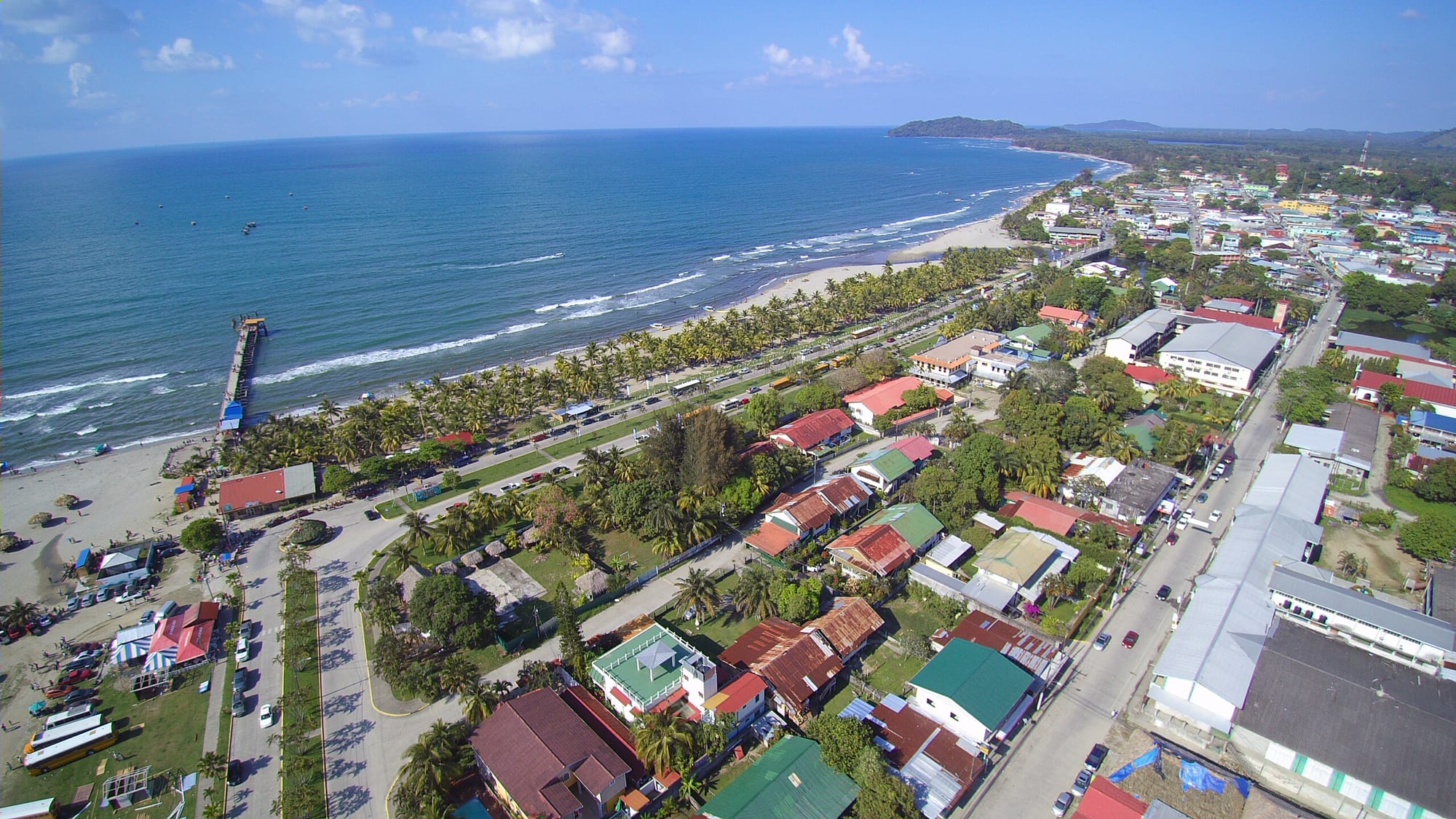
Aerial view of Tela's palm-lined beach and pier, with red and green roofs of the town and a headland beyond

San Pedro Sula & the North Coast, Honduras

Tela

Tela's seafront and pier on the Caribbean coast of Honduras. (Stefano Foggetti / Wikimedia Commons · CC BY-SA 4.0)

A beach town on a wide bay of Honduras's Caribbean coast, between San Pedro Sula and La Ceiba. Founded by the Spanish in 1524, it grew in the twentieth century as the headquarters of United Fruit's Tela Railroad Company; today it lives from beaches, fishing and farming, with Garífuna villages along the sand on either side and two protected areas close by.

Neighbourhoods

  • Tela Viejo
    • First-time visitors
    • Beaches
    • Close to public transport

    The older town east of the Lancetilla river, where the main shopping street, the town park, the market and the beachfront meet. Banks, small shops, bars and restaurants line the busy centre, and the beach lies directly in front of the streets.

    Open in Maps
  • Tela Nuevo
    • Historic district
    • Quiet and residential

    The western side of the river, built by the United Fruit Company as a planned town for its staff, with the best houses once kept for its American employees. Some of the old company bungalows survive as part of a hotel complex beside the beach.

    Open in Maps
  • The Garífuna villages
    • Beaches
    • Local life

    Garífuna communities line the shore on both sides of town: Ensenada and Triunfo de la Cruz to the east, San Juan at the western edge and Tornabé further west. Small beach restaurants and a slower, village pace set them apart from the centre.

    Open in Maps

Things to do

Beaches and the waterfront

  • Tela town beachbeach

    The beach right in front of the town centre, Tela's main attraction, at its busiest in Holy Week when Hondurans crowd into town.

    Open in Maps
  • The old pierviewpoint

    The remnant of the long banana-company dock, which burned in 1994; its hasty replacement was wrecked by high winds, and what is left is used by fishermen and as a sunset gathering point.

    Open in Maps
  • Museo Tela Railroad Companymuseum

    A museum of the town's years as a banana-shipping port and headquarters of the United Fruit Company's railway; the abandoned pier and old station lie near the bridge downtown.

    Open in Maps
  • Iglesia San Antoniolandmark

    The town's main Catholic church, just across the river from downtown, dedicated to its patron saint.

    Open in Maps

Garífuna villages

  • Triunfo de la Cruzneighborhood

    A Garífuna village a few kilometres east along the beach, settled in the early nineteenth century, with small beach restaurants and a quieter shore than the town.

    Open in Maps
  • Tornabéneighborhood

    The largest Garífuna village of the area, about 8 kilometres west of the town, on the way towards Punta Sal.

    Open in Maps

Short trips from the town

  • Lancetilla Botanical Gardenpark

    A garden and research centre founded in the United Fruit era, about 7 kilometres south-east of town, with an arboretum of tropical fruit and timber trees, bamboo and orchids, and protected forest that supplies Tela's water.

    Open in Maps
  • Jeannette Kawas National Parkpark

    The coastal park around the Punta Sal headland, created in 1994 and renamed after an environmental activist murdered in 1995, with beaches, mangroves, lagoons, rivers and forest.

    Open in Maps
  • Punta Izopo National Parkpark

    A coastal wetland of mangroves, rivers and forest east of Triunfo de la Cruz, explored on guided van and kayak tours from Tela.

    Open in Maps

Seasonal events

  • Feria de San AntonioJune

    Tela's carnival in honour of its patron saint, San Antonio de Padua, with a parade and a week of parties, after which bands play along the seafront boulevard.

  • Holy WeekMarch or April

    The town's busiest week, when many tens of thousands of Hondurans crowd in to party, lie on the beach and swim.

Eat and drink

Long-standing places and food districts in Tela. Hours, ratings and directions come from your maps app, always current.

Tela classics

  • Baleadasrestaurant

    Thick flour tortillas folded over refried beans, cheese and cream, with egg, avocado or meat added; many Hondurans say the Tela and La Ceiba versions are the best in the country.

    Open in Maps
  • Seafood soupsrestaurant

    Sopa de caracol, conch soup, and sopa de jaiba, crab soup, are the dishes to look for in local seafood restaurants.

    Open in Maps
  • Garífuna coconut breadmarket

    Garífuna women bake pan de coco and coconut sweets and sell them along the beaches, often carried in buckets.

    Open in Maps

Markets and the beach

  • Tela marketmarket

    A block-square market, half open and half covered, two blocks from the town park, selling fruit, vegetables, meat and the day's fish.

    Open in Maps
  • Beach restaurants of Triunfo de la Cruzneighborhood

    Small beach restaurants in the Garífuna village east of town, often with changing cabins and showers for a day on the beach.

    Open in Maps

Experience Tela

History

Tela was founded by the Spanish conquistador Cristóbal de Olid on 3 May 1524, near an Indigenous town called Tehuacán with good water, food and medicinal plants. Olid named it Triunfo de la Cruz, the Triumph of the Cross, after the feast day, and the name survives in a promontory on the bay; some historians derive "Tela" instead from Tetela, a Nahuatl word for a land of hills. Spanish control was light, and by the late sixteenth century buccaneers used the bay to lie in wait for treasure ships. After the British exiled the Garífuna from St Vincent to Roatán in 1797, groups moved along the coast and settled at Tela in 1808, founding Triunfo de la Cruz to the east and San Juan to the west.

Tela became a municipality in 1876 and a city in 1927. Its great years came with bananas: from 1914 it was the headquarters of the Tela Railroad Company, the Honduran subsidiary of the United Fruit Company, which stayed until 1970. The company built a planned town for its staff across the river, segregated by race, with a hospital, schools and a golf course, and brought in workers from Jamaica, Belize and the English-speaking Caribbean. Hostility towards these workers grew, immigration laws were tightened in 1929 and 1934, and hundreds were deported in the 1930s.

Floods ruined plantations in 1930, and Tela declined before slowly recovering. In 1954 it was the epicentre of the general strike that won major concessions for banana workers. The company returned its lands to the town in 1976. The long dock burned in 1994, and a hasty replacement, opened in January 1995, collapsed in high winds; since then the town has turned to tourism, fishing and farming.

Culture & Customs

Tela is one of the favourite beach towns of Hondurans themselves. In Holy Week tens of thousands arrive to swim, drink and party, and in June the town celebrates its patron saint, San Antonio de Padua, with a week of parades and parties; after the carnival parade, bands play on the seafront boulevard. Most Teleños are Catholic, with the church of San Antonio across the river from downtown, but Episcopal, Mormon and evangelical churches are part of the town as well, including a large evangelical church near the beach known locally as the "Jumping Church".

The Garífuna villages around the bay are the town's most distinctive communities. Some, such as Tornabé, hold their land under a communal title, and the Garífuna language, dance and music, recognised by UNESCO, are part of life along this coast. Women from the villages sell pan de coco, coconut sweets and crafts along the beaches, including jewellery made from shells and coconut shell.

The banana-company years left their own mark: the planned streets and bungalows of Tela Nuevo, the abandoned station and pier near the bridge downtown, and a memory of the English-speaking Caribbean workers who brought Methodist and Anglican churches to the town.

Daily Life

The town of Tela has about 40,000 people, by a 2023 calculation, and is the centre of a large municipality that includes the Garífuna villages, farming settlements and protected forest. Tourism, fishing, agriculture, cattle and trade are the main sources of work, and tourist jobs swell in Holy Week and December. In the Garífuna communities, families grow cassava to make casabe and sell starch, fish and coconut oil to towns as far as San Pedro Sula.

The Lancetilla river divides the town into Tela Viejo, the old commercial centre to the east, and Tela Nuevo, the former company town to the west. Downtown's main street is a busy row of shops, banks, bars and pool halls, and in the barrios almost every corner has a pulpería, a small shop in the front of a family house. Fishermen bring their catch to the market and to restaurants each day.

Emigration to the United States, Canada, the Cayman Islands and Spain is common, and many households depend on money sent home.

Food

Tela eats like the rest of the north coast, with the Caribbean close at hand. The baleada — a thick flour tortilla folded over refried beans, cheese and cream, often with egg, avocado or meat — is everywhere, and many Hondurans say the best are made in Tela and La Ceiba. Fresh fish arrives daily, and sopa de caracol, conch soup made with coconut milk, and sopa de jaiba, crab soup, are the seafood dishes to try.

Garífuna cooking is built on coconut, cassava, plantain and fish. Casabe is a large flat bread of dried cassava, made in the villages around the bay, and pan de coco, coconut bread, is baked and sold door to door and on the beaches along with coconut sweets. A cold coconut, cut open on the beach, is the usual drink in the heat, and the beach bars serve local beers.

The town market, two blocks from the park, sells fruit, vegetables and meat from the surrounding farms as well as the morning's fish.

Planning tools

Budget

Tela is a cheap place to stay by Caribbean standards. Simple guesthouses and hotels in town cost little, food at comedores and beach restaurants is inexpensive, and taxis around town are cheap. Guided trips into the national parks and the botanical garden are the main extra costs. The town is at its busiest in Holy Week and in December.

Daily Budget Midrange
USD 65–140 (beach hotel, seafood restaurant meals, a guided boat or kayak trip)
Daily Budget Shoestring
USD 25–45 (guesthouse, baleadas and comedor meals, local buses and taxis)

Book well ahead for Holy Week, when the town is at its fullest, or come at another time for a quieter beach.

Best Time to Visit

April and May are the least rainy months and the best for the beaches and the parks. Rain is possible all year, and October to December is the wettest stretch, when cold fronts bring long downpours. Holy Week brings crowds and parties; June has the patron-saint carnival.

Suggested Number of Days

Two or three days cover the town and its beaches. Allow four or five to include the national parks, the botanical garden and the Garífuna villages, which mostly need a guide, a boat or a taxi. Rough weather in the rainy months can cancel boat trips and add a day.

First Visit
2–3 days
With Surroundings
4–5 days

Transportation

Taxis are the usual way around town and to the nearer villages and the botanical garden. Buses run from the town bus station to Triunfo de la Cruz, and the national parks are reached on guided tours by van, kayak or boat. Chicken buses and shared minibuses run along highway CA-13 to other coastal towns.

Take a bus or taxi to the Garífuna villages rather than walking the beach between them.

Airport & Station Connections

Ramón Villeda Morales International Airport outside San Pedro Sula is the nearest international gateway, less than 90 km west of Tela by a paved highway. Buses from San Pedro Sula take about two to two and a half hours, with direct coaches as well as cheaper local services, and yellow buses continue east along the coast to La Ceiba, the port for the Bay Islands, in about two and a half hours.

Walkability

The centre is flat and compact, and the main street, market, park and beach are all within a short walk of each other. The seafront makes an easy stroll, but the beach between town and the outlying villages is long and isolated in places and is better covered by taxi or bus.

Safety

Honduras has had one of the highest homicide rates in the world, driven by gangs (MS-13 and Barrio 18) and drug trafficking, and San Pedro Sula and parts of Tegucigalpa remain dangerous. Tela and the Garífuna villages are much calmer than the big northern cities, though beach theft and robbery on isolated stretches occur.

Keep belongings watched on the beach, avoid deserted stretches of sand, and do not travel by road after dark. Check current official travel advice before travelling.

Climate

Hot and humid all year, with rain on around 190 days a year and no true dry season. The average annual temperature is about 26°C, with average highs of about 30°C and lows of about 20°C. The rainiest months are October to December, the least rainy April and May, and hurricanes and tropical storms are a risk from June to November.

Summer
hot and humid, around 30°C by day, with the least rain in April and May and the hurricane season from June
Winter
warm, around 20–30°C, with the heaviest rain from October to December brought by cold fronts

Local Customs

Tela is a mostly Catholic town with many Protestant and evangelical churches, and the Garífuna villages have their own language, music and customs. Greetings are polite and unhurried; a good morning or good afternoon is expected before a question. Ask before photographing people, especially in the Garífuna villages.

Dress modestly away from the beach and in churches, and ask before photographing people or homes in the villages.

Common Payment Methods

The currency is the Honduran lempira. Banks and cash machines are on the main street in the centre, and larger hotels take cards, but beach restaurants, buses, taxis and market stalls deal in cash, so small notes are useful.