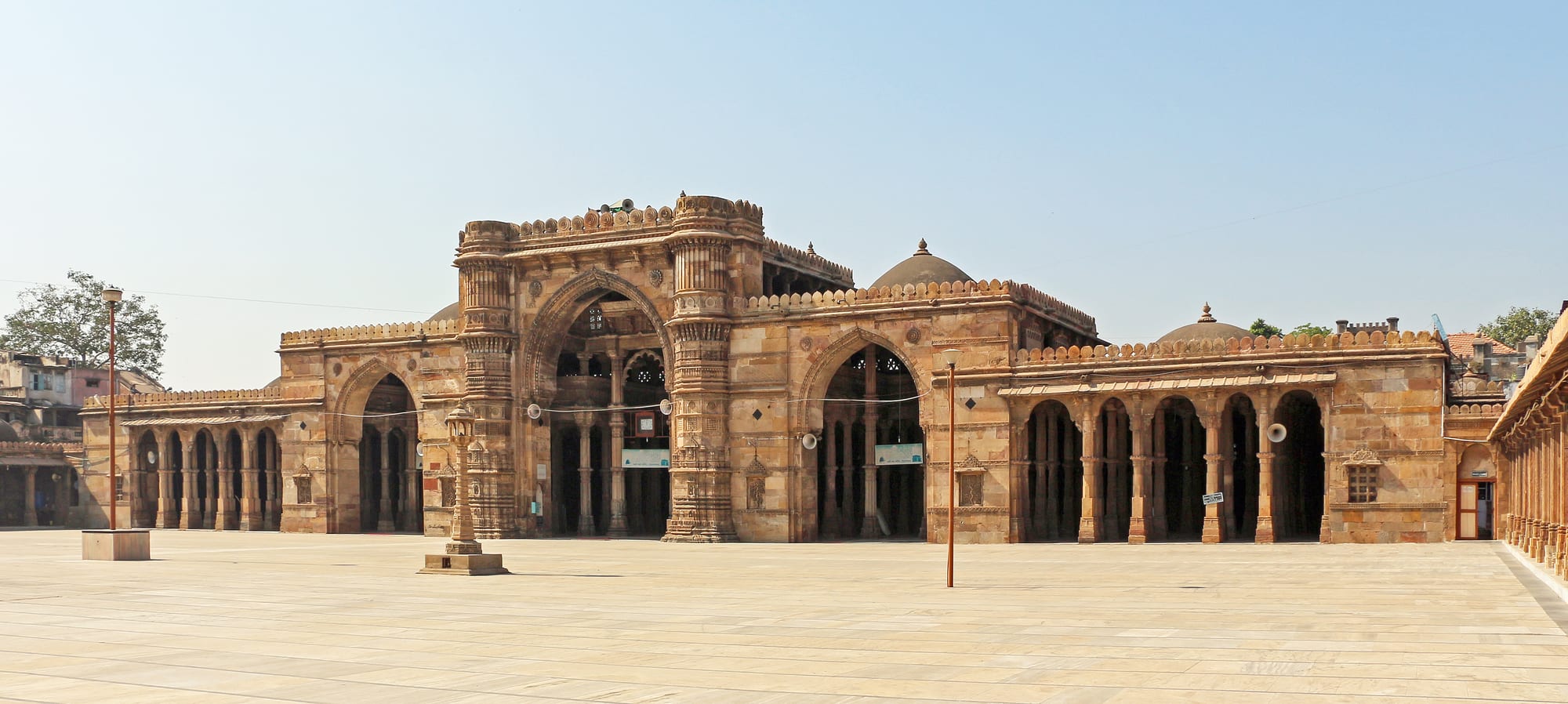
A wide stone mosque with carved arches, pillared wings and domes across a sunlit paved courtyard

Mumbai, Goa & the West, India

Ahmedabad

The courtyard of the Jama Masjid, built in the 15th century in the walled city of Ahmedabad. (Bernard Gagnon / Wikimedia Commons · CC BY-SA 3.0)

Gujarat's largest city, founded in 1411 on the Sabarmati River and long a centre of textile trade and manufacturing. Its walled old quarter of tightly packed pol houses, carved wooden façades, stepwells and sultanate mosques was inscribed by UNESCO in 2017, while the west bank holds Gandhi's Sabarmati Ashram, modernist architecture and the malls and offices of a fast-growing business city.

Neighbourhoods

  • The walled city
    • First-time visitors
    • Historic district
    • Best for food

    The old town east of the Sabarmati, laid out in pols — gated residential lanes of carved wooden houses shared by a caste or trade, with bird feeders at their centre. Mosques, Jain temples, bazaars and the Bhadra Fort stand among them, and the whole quarter carries a UNESCO World Heritage listing.

    Open in Maps
  • Ellisbridge
    • Arts and culture
    • Close to public transport

    The first district built on the west bank, named after the bridge that linked it to the old city. It holds cultural institutions, older apartment blocks and the shops of Ashram Road, and the riverfront promenade runs along its eastern edge.

    Open in Maps
  • Navrangpura
    • Students and nightlife
    • Shopping

    A central west-bank district of colleges, bookshops, cafés and offices around Gujarat University, busy with students through the day. Law Garden and its evening handicraft stalls lie on its southern side.

    Open in Maps
  • Satellite and SG Highway
    • Modern hotels
    • Shopping
    • Restaurants

    The affluent, spread-out south-west of the city, built since the 1980s along the Sarkhej–Gandhinagar Highway. Glass office towers, malls, chain restaurants and most of the newer hotels are here, and almost everything is reached by car.

    Open in Maps
  • Maninagar
    • Local life
    • Close to public transport

    A dense residential and commercial area south-east of the old city, developed around its railway station. Kankaria Lake and its lakeside promenade are on its northern edge, and the district is a hub for buses, trains and the metro.

    Open in Maps
  • Vastrapur
    • Quiet and residential
    • Parks

    A western neighbourhood of apartment blocks and offices around Vastrapur Lake, close to the Indian Institute of Management campus. It is greener and calmer than the old city, with restaurants and shopping streets nearby.

    Open in Maps

Things to do

The walled city

  • Jama Masjidlandmark

    The sultanate congregational mosque completed in 1424, its prayer hall carried on more than two hundred pillars cut with Hindu and Jain motifs.

    Open in Maps
  • Sidi Saiyyed Mosquelandmark

    A small 16th-century mosque famous for its stone lattice windows, one of which shows a spreading tree and has become the city's emblem.

    Open in Maps
  • Bhadra Fortlandmark

    The royal citadel of 1411 at the heart of the walled city, with a gateway, a clock tower and a temple to the goddess Bhadrakali.

    Open in Maps
  • Teen Darwazalandmark

    A triple-arched sultanate gateway east of Bhadra Fort, still the entrance to a crowded bazaar street.

    Open in Maps
  • Sidi Bashir Mosquelandmark

    The surviving gateway and pair of shaking minarets near the railway station, known locally as the Jhulta Minar.

    Open in Maps
  • Hutheesing Jain Templelandmark

    A white marble Jain temple of 1848 outside the Delhi Gate, built by a wealthy merchant family and dedicated to the fifteenth Tirthankara.

    Open in Maps
  • Swaminarayan Mandir, Kalupurlandmark

    The first temple of the Swaminarayan movement, finished in 1822, with brightly painted carved wooden galleries around a courtyard.

    Open in Maps
  • Dada Harir Stepwelllandmark

    A five-storey stepwell of 1499 north-east of the old city, its carved galleries descending to cool water far below street level.

    Open in Maps

Gandhi and museums

  • Sabarmati Ashrammuseum

    Gandhi's riverside home from 1917 to 1930, from which he set out on the Salt March; his rooms and a museum of his letters and photographs are open to visitors.

    Open in Maps
  • Calico Museum of Textilesmuseum

    A collection of Indian fabrics, court costumes and temple hangings founded in 1949 by a textile-mill family, housed in a carved wooden haveli in a garden compound.

    Open in Maps
  • Sanskar Kendramuseum

    A city museum in a raised concrete building designed by Le Corbusier, one of several works he built in Ahmedabad in the 1950s.

    Open in Maps
  • Indian Institute of Management Ahmedabadlandmark

    A business school whose old campus of brick arches and courtyards was designed by Louis Kahn, a landmark of modern Indian architecture.

    Open in Maps

Parks, river and lakes

  • Sabarmati Riverfrontpark

    A long paved promenade and park along both banks of the river, built since the 2000s, with gardens, a flower park and evening crowds.

    Open in Maps
  • Kankaria Lakepark

    A polygonal artificial lake dug in the 15th century, ringed by a walkway, gardens, a zoo and a toy train on the south-east side of the city.

    Open in Maps
  • Law Gardenpark

    A park in Navrangpura whose pavement stalls sell Gujarati mirror-work embroidery and bandhani cloth in the evenings.

    Open in Maps

Sport

  • Narendra Modi Stadiumattraction

    The cricket ground at Motera on the northern riverfront, rebuilt in 2020 as the largest cricket stadium in the world by capacity.

    Open in Maps

Short trips from the city

  • Adalaj Stepwelllandmark

    An ornately carved five-storey stepwell of 1498 about 18 km north of the city, built by Queen Rudabai in memory of her husband, Rana Veer Singh of the Vaghela dynasty.

    Open in Maps
  • Sarkhej Rozalandmark

    A complex of tombs, a mosque and pavilions around a tank on the south-western edge of the city, built for a Sufi saint and the sultans of Gujarat.

    Open in Maps
  • Lothalattraction

    A Harappan port town about 80 km south-west, excavated to reveal a brick basin usually interpreted as a dockyard, with a small museum.

    Open in Maps
  • Modhera Sun Templelandmark

    An 11th-century Solanki temple to Surya with a stepped tank of miniature shrines, about 100 km north-west of the city.

    Open in Maps

Seasonal events

  • Uttarayan kite festivalmid-January

    Rooftops across the old city fill for two days of kite flying at Makar Sankranti, which marks the sun's passage into Capricorn, with an international kite festival on the riverfront.

  • Rath YatraJune or July

    Chariots carrying the deities of the Jagannath temple in Jamalpur have been pulled through the old city since 1878, in a procession drawing very large crowds.

  • NavratriSeptember or October

    Nine nights of garba and dandiya dancing in circles, held in club grounds, housing societies and open spaces across the city.

  • DiwaliOctober or November

    Lamps, sweets and fireworks mark the festival, which is followed in Gujarat by the traditional new year and weeks of visiting.

Eat and drink

Long-standing places and food districts in Ahmedabad. Hours, ratings and directions come from your maps app, always current.

Ahmedabad classics

  • Gujarati thali housesrestaurant

    The city's signature meal is the unlimited thali — many small bowls of vegetables, dal, kadhi, farsan, rotli, rice and a sweet, served in dedicated dining halls across the west bank and the old city.

    Open in Maps
  • Fafda and jalebi stallsmarket

    Crisp gram-flour fafda with fried jalebi and papaya chutney is the Sunday breakfast, sold from sweet shops and street counters all over the city.

    Open in Maps

Food districts and markets

  • Manek Chowkmarket

    A square in the walled city that is a vegetable market in the morning, a jewellery bazaar by day and a street-food market at night, known for sandwiches, dosas, kulfi and ice creams.

    Open in Maps
  • Law Garden night marketmarket

    Carts and small stalls along the garden's edge serve Gujarati and Indian-Chinese street food in the evenings beside the handicraft market.

    Open in Maps
  • Old city bazaarsneighborhood

    The lanes around Teen Darwaza and Bhadra sell dabeli, bhajiya, khaman and sugarcane juice among cloth and spice shops.

    Open in Maps

Cafés and tea

  • Old-city tea stallscafe

    Small stalls sell strong milky chai with bun maska or biscuits through the day, and the city has no bars, as Gujarat prohibits alcohol.

    Open in Maps
  • West-bank caféscafe

    Coffee shops and dessert cafés cluster around Navrangpura, Vastrapur and the SG Highway, busy late into the evening with students and families.

    Open in Maps

Experience Ahmedabad

History

Ahmedabad was founded in 1411 by Sultan Ahmad Shah I of the Gujarat Sultanate on the east bank of the Sabarmati, near the older settlement of Ashaval and the Chaulukya-era town of Karnavati. Within a century it was one of the wealthiest cities in western India, its sultans building the Jama Masjid, Bhadra Fort and a wall pierced by a dozen gates, and its craftsmen turning out textiles traded as far as the Red Sea. The Mughals took Gujarat in 1573 and governed from the city; Shah Jahan lived here as a prince, and the merchant houses that grew up in this period gave the walled town its pols, gated lanes of shared courtyards and carved wooden houses.

Decline in the 18th century, under contested Maratha and Mughal rule, was reversed after the British annexed the city in 1818. A railway arrived in 1864, and in 1861 the merchant Ranchhodlal Chhotalal opened the first mechanised textile mill, beginning a century in which Ahmedabad was known as the Manchester of India, with dozens of mills and a large workforce drawn from the countryside. The mill labour movement produced the Textile Labour Association, founded in 1918 by Gandhi.

Gandhi made the city his base, founding the ashram at Sabarmati in 1917 and setting out from it on the Salt March to Dandi in 1930. After independence Ahmedabad served as the capital of Gujarat until the seat of government moved to the newly built Gandhinagar in the 1970s. The mills closed through the 1980s, throwing tens of thousands out of work, and the city was scarred by communal violence, most severely in 2002. It has since grown outward across the river and beyond, and in July 2017 the walled city was inscribed as a UNESCO World Heritage Site.

Culture & Customs

Ahmedabad is a merchant city, and its character reflects that: careful with money, family-centred, strongly vegetarian and deeply influenced by Jainism as well as Hinduism and Islam. Gujarati is the language of the street, with Hindi and English common in business. Jain and Hindu festivals fill the calendar, and the eleven days of Paryushan, when many Jains fast, are widely observed.

The great public festival is Uttarayan in mid-January, when the sky above the old city fills with kites flown from rooftops and families spend the day on terraces with sesame sweets. Navratri brings nine nights of garba, a circular dance performed to live music in grounds and courtyards across the city; the Rath Yatra procession in the monsoon is the third largest of its kind in India, after those at Puri and Kolkata. Craft traditions are strong, from bandhani tie-dye and mirror-work embroidery to block printing, and the National Institute of Design and the Calico Museum have made the city a centre for design and textile study.

Architecture is an unusual local pride. The sultanate monuments mix Islamic forms with Hindu and Jain stone carving, and in the 20th century Le Corbusier, Louis Kahn, B. V. Doshi and Charles Correa all built here, drawn by industrialist patrons. Ahmedabad is also inseparable from Gandhi's memory, and the ashram remains a place of pilgrimage for Indian visitors.

Daily Life

About 5.6 million people lived in the city at the 2011 census, with more in the surrounding urban area, making it the largest city in Gujarat and one of the largest in India. The economy has shifted from textile mills to chemicals, pharmaceuticals, engineering, diamonds and a large services and education sector; the state capital, Gandhinagar, lies 25 km north, and the financial district of GIFT City is being built between the two.

Life divides between the two banks. The walled city remains dense and sociable, its pols home to long-settled families, though many have moved out and some houses stand empty; the west bank holds the universities, offices, malls and gated apartment complexes where most middle-class residents now live. Workers from Saurashtra, Rajasthan and Bihar fill the construction sites and markets.

Days start early, with temple visits and walks along the riverfront before the heat, and business hours are long; evenings bring families to Kankaria Lake, Law Garden and the food streets. The persistent issues are heat, which is becoming more severe and has prompted one of India's first city heat action plans, air pollution in winter, traffic on the western arterial roads, and the unevenness between the prosperous suburbs and the older eastern districts.

Food

Ahmedabad eats Gujarati food, which is vegetarian, lightly sweetened and served in many small portions. The full thali is the defining meal: bowls of dal, kadhi made with yoghurt and gram flour, two or three vegetable dishes, a fried farsan snack, rotli, rice, pickles, buttermilk and a sweet, refilled until the diner stops. Winter brings undhiyu, a slow-cooked mix of root vegetables, beans and spiced dumplings traditionally buried in an earthen pot, eaten with puri and jalebi around Uttarayan.

Snacks, or farsan, are a category of their own: steamed dhokla and khaman of fermented gram flour, rolled khandvi, fried fafda served with papaya chutney, patra of spiced colocasia leaves, and thepla flatbreads made with fenugreek that travel well. Fafda and jalebi together are the Sunday morning ritual. Dabeli, a spiced potato filling in a bread roll with pomegranate and sev, came from Kutch and is sold on every busy street.

Manek Chowk, a jewellery market by day, becomes a night food bazaar of griddled sandwiches, dosas, pav bhaji, kulfi and ice creams, and the lanes around Teen Darwaza fry bhajiya through the afternoon. Sweets include mohanthal of gram flour and ghee, ghari, basundi of reduced milk and shrikhand, strained yoghurt with cardamom and saffron. Chai stalls are everywhere; alcohol is not sold, as Gujarat is a dry state, and sugarcane juice, chaas and soda with lime take its place.

Planning tools

Budget

Ahmedabad is good value by Indian city standards, well below Mumbai. Food is the clearest saving: a full thali or a street-food dinner costs little, and there are no bar bills in a dry state. Hotel rates rise around the kite festival in January, large cricket matches and business conferences. Autorickshaws, the metro and the bus rapid transit keep transport cheap.

Daily Budget Midrange
USD 55–120 (mid-range hotel, restaurant meals, a car with driver for a day, museum and monument fees)
Daily Budget Shoestring
USD 18–30 (guesthouse or hostel bed, thalis and street food, buses, metro and autorickshaws)

A guided walk through the pols of the walled city is the best value in Ahmedabad; most mosques, stepwells and the riverfront cost nothing to visit.

Best Time to Visit

November to February, when days are warm and dry and nights are cool. January brings the kite festival, the liveliest time in the old city. March warms quickly and April to early June are punishing, often above 40°C. The monsoon from late June to September is humid with heavy downpours, though the city is green and less dusty afterwards.

Suggested Number of Days

Two days cover the walled city, the ashram and the main museums at a reasonable pace. Four allow time for day trips out of the city. Heat is the main limit: in spring and early summer far less fits into the middle of the day.

First Visit
2 days
With Surroundings
4 days

Transportation

Autorickshaws are the everyday way to get about, with app-based taxis widely used. A metro runs on four lines across the city and out to Gandhinagar and GIFT City, and the Janmarg bus rapid transit system uses dedicated central lanes on the main corridors. The old city is best covered on foot, as its lanes are too narrow for much traffic; distances on the west bank are long and usually driven.

Agree an autorickshaw fare or ask for the meter before setting off, and allow extra time on the main roads at morning and evening rush hours.

Airport & Station Connections

Sardar Vallabhbhai Patel International Airport lies about 10 km north of the centre and has domestic flights across India and international services, mainly to the Gulf. Ahmedabad Junction, the main railway station at Kalupur, connects to Mumbai in roughly six to eight hours and to Delhi overnight. Long-distance buses serve Rajasthan, Kutch and Saurashtra, and a motorway runs to Vadodara and on towards Mumbai.

Walkability

The walled city is made for walking — narrow pols, bazaars and monuments within a small area — and the Sabarmati Riverfront gives a long traffic-free promenade on both banks. Beyond them the city is built for cars, with wide roads, long blocks and patchy pavements in the western suburbs. Heat and traffic make walking uncomfortable outside the cooler months and the early morning.

Safety

Ahmedabad is generally regarded as one of India's safer large cities for visitors, and violent crime against travellers is rare. The main risks are traffic, which is heavy and fast on the arterial roads, extreme heat between April and June, and petty theft in crowded bazaars and at festivals. Air quality is poor in winter.

Carry water and avoid the middle of the day in the hot season, take care crossing main roads, and keep valuables close in crowded markets. Check current official travel advice before travelling.

Climate

A hot semi-arid climate with three clear seasons: a dry warm winter, an intense dry summer and a monsoon. Most of the year's rain falls between late June and September, and the Sabarmati is held back by a barrage so the river looks full even in dry months.

Summer
very hot — April and May regularly reach 40–44°C, with dry heat before the monsoon and high humidity once it arrives
Winter
warm days around 27–30°C with cool nights near 12°C, occasionally colder in January

Local Customs

Gujarat has prohibited alcohol since the state was formed, so there are no bars and no alcohol in restaurants; foreign visitors can apply for a permit through authorised hotels. The city is strongly vegetarian, and many restaurants serve no meat, eggs or onion and garlic. Shoes are removed and shoulders and knees covered at mosques, Jain temples and Hindu temples, and leather items are left outside Jain temples.

Dress modestly in the old city, ask before photographing people or inside a place of worship, and greet people with a 'namaste' or 'kem chho' rather than a handshake.

Common Payment Methods

The currency is the Indian rupee. Cards are accepted in hotels, malls and larger restaurants, and QR-code payment by phone is used almost everywhere by residents, though foreign accounts often cannot use it. Cash is needed for autorickshaws, street food and small shops, and ATMs are plentiful across the city.