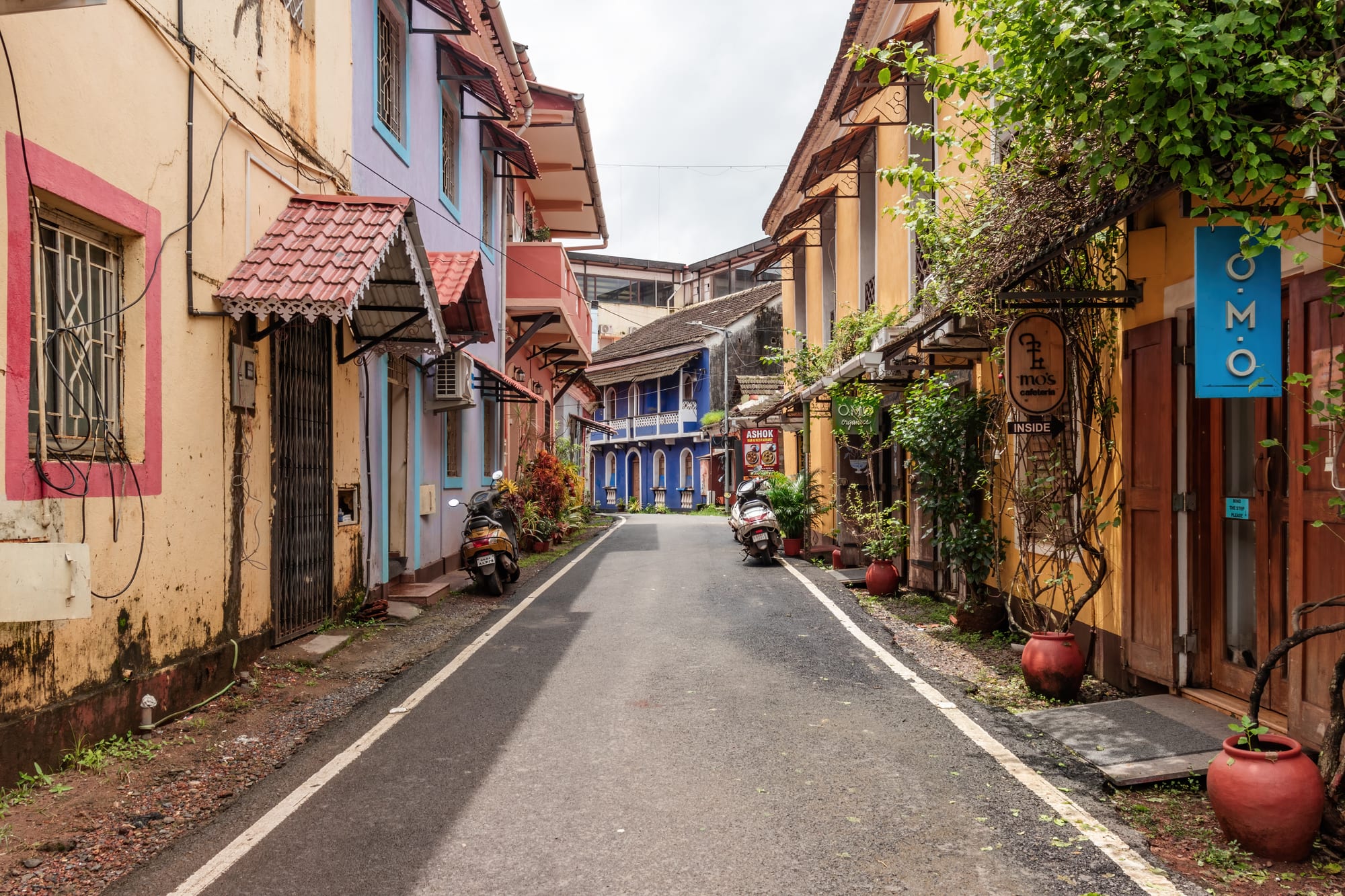
A narrow street of tiled houses painted pink, yellow and blue with wooden shutters and potted plants in Fontainhas

Mumbai, Goa & the West, India

Panaji

A lane of Portuguese-era houses in the Fontainhas quarter of Panaji. (iMahesh / Wikimedia Commons · CC BY-SA 4.0)

Goa's capital, a small riverside city on the left bank of the Mandovi where it meets the Arabian Sea. Panaji replaced Old Goa as the seat of Portuguese government in the 19th century, and its planned squares, tiled houses and the Latin Quarter of Fontainhas remain. Administration, ferries, casino boats and the state's film festival now share the waterfront.

Neighbourhoods

  • Fontainhas and São Tomé
    • First-time visitors
    • Historic district
    • Walking

    The Latin Quarter below Altinho hill, a grid of narrow lanes with tiled roofs, wooden balconies and houses repainted in ochre, blue and green each year after the monsoon. Small guesthouses, galleries and bars occupy the old buildings, and the chapel of St Sebastian stands on its own square.

    Open in Maps
  • The city centre and Church Square
    • Close to public transport
    • Shops
    • Landmarks

    The commercial heart around the whitewashed Church of Our Lady of the Immaculate Conception and its zigzag staircase, with the municipal market, government offices, banks and the main bus stand a short walk away.

    Open in Maps
  • Altinho
    • Quiet and residential
    • Views

    The hill directly above the old town, with the bishop's palace, official bungalows and quiet tree-lined streets. The lanes give long views over the Mandovi, the rooftops of Fontainhas and the sandbar at the river mouth.

    Open in Maps
  • Campal and Miramar
    • Beaches
    • Walking
    • Families

    The riverside stretch west of the centre, with a promenade, the state art and culture complex used by the film festival, and the sandy beach at Miramar where the Mandovi meets the sea.

    Open in Maps
  • Dona Paula
    • Views
    • Quiet and residential

    A headland about seven kilometres west of the centre between the Mandovi and Zuari estuaries, with a jetty, viewpoint, marine science institutes and hotels looking back at the harbour.

    Open in Maps
  • Ribandar and the road to Old Goa
    • Historic district
    • Quiet and residential

    A long causeway built in the 17th century carries the road east from Panaji past waterside chapels, old mansions and salt pans towards Old Goa, with ferries crossing to Chorão island on the way.

    Open in Maps

Things to do

Landmarks and churches in the city

  • Church of Our Lady of the Immaculate Conceptionlandmark

    The white baroque church above the main square, built in 1541 and enlarged in the 17th century, with a double flight of steps and a bell brought from Old Goa.

    Open in Maps
  • Fontainhasneighborhood

    The 18th-century Latin Quarter of narrow lanes and painted houses, a conservation area and the best surviving piece of Portuguese-era domestic architecture in Goa.

    Open in Maps
  • Adil Shah Palacelandmark

    The riverfront palace built about 1500 as a summer residence for the sultan of Bijapur, later the seat of the Portuguese government in Goa and then the state secretariat, now used as a cultural centre and gallery.

    Open in Maps
  • Goa State Museummuseum

    The state collection at Patto, with sculpture, Christian art, furniture, coins and a gallery on Goa's printing and independence movement.

    Open in Maps

Beaches and the riverfront

  • Miramar Beachbeach

    The city's own beach where the Mandovi meets the sea, a wide strip of sand backed by palms, busy in the evenings and not recommended for swimming because of currents.

    Open in Maps
  • Dona Paula viewpointviewpoint

    A headland jetty between two estuaries, long a local landmark and a place to watch boats and sunsets.

    Open in Maps
  • Campal riverfront promenadetrail

    A shaded walkway along the Mandovi between the centre and Miramar, past the children's park and the state cultural complex.

    Open in Maps

Forts and islands

  • Reis Magos Fortlandmark

    A restored laterite fort of 1551 on the north bank of the Mandovi opposite Panaji, with a church below it and galleries inside the walls.

    Open in Maps
  • Fort Aguadalandmark

    A large Portuguese fort of 1612 guarding the river mouth, with a freshwater spring, a lighthouse of 1864 and a former prison below.

    Open in Maps
  • Chorão and the Salim Ali Bird Sanctuarypark

    Mangrove and mudflat on the island of Chorão, reached by ferry from Ribandar, good for waders, kingfishers and migrant birds.

    Open in Maps
  • Divar Islandattraction

    A quiet farming island in the Mandovi reached by ferry, with old village houses, a hilltop church and empty lanes.

    Open in Maps

Old Goa

  • Basilica of Bom Jesuslandmark

    The laterite basilica of 1605 that holds the relics of St Francis Xavier in a silver casket, part of the UNESCO-listed Churches and Convents of Goa.

    Open in Maps
  • Sé Cathedrallandmark

    The great cathedral of the Portuguese capital, begun in 1562 and finished in 1619; one of its two towers fell in 1776 and was never rebuilt, and the surviving one holds the Golden Bell, the largest in Goa.

    Open in Maps
  • Old Goaneighborhood

    The former Portuguese capital upriver, now a village among monumental churches and convents listed together by UNESCO, with an archaeological museum and the ruins of the Augustinian church.

    Open in Maps

Short trips from the city

  • Mangueshi Templelandmark

    The best-known Hindu temple in Goa, at Priol in Ponda taluka, with a white lamp tower and an image moved here from the coast during the Portuguese period.

    Open in Maps
  • Calangute and Candolimbeach

    The main beach strip of north Goa, a short drive across the river, with shacks, water sports, hotels and the largest beach in north Goa.

    Open in Maps
  • Anjunabeach

    A rocky-ended beach north of the Baga river known since the 1960s for its counterculture and its long-running weekly flea market in season.

    Open in Maps
  • Dudhsagar Fallsattraction

    A four-tiered waterfall about 310 metres high on the Mandovi, known upstream as the Mahadayi, in the Western Ghats near the Karnataka border, at its most powerful just after the monsoon.

    Open in Maps

Seasonal events

  • Goa CarnivalFebruary or early March

    Four days of parades, floats and street dancing before Lent, presided over by a local resident who takes the part of King Momo.

  • International Film Festival of IndiaNovember

    India's national film festival, founded in 1952 and held in Goa each year since 2004, with screenings at the riverside cultural complex and Campal.

  • ShigmoMarch

    The Goan spring festival, when village troupes bring drums, folk dance and decorated floats through the city at night.

  • Feast of St Francis Xavierearly December

    The novena and feast at Old Goa that draws pilgrims from across India to the Basilica of Bom Jesus.

  • Sao JoaoJune

    A monsoon festival of the feast of St John the Baptist, marked in villages around Panaji with wreaths of leaves and jumping into wells and ponds.

Eat and drink

Long-standing places and food districts in Panaji. Hours, ratings and directions come from your maps app, always current.

Goan classics

  • Fish curry rice canteensrestaurant

    Everyday Goan eating is xit kodi — rice with a coconut and kokum fish curry and a fried mackerel or kingfish steak — served at plain lunch canteens around the market and the offices.

    Open in Maps
  • Taverns and fenirestaurant

    Old Goan taverns serve urrak in the cashew season and feni, the local spirit distilled from cashew fruit or coconut sap, with salted snacks and fried fish.

    Open in Maps
  • Goan bakeriescafe

    Neighbourhood bakeries sell poee, the round wheat-bran bread carried through the streets by the poder on a bicycle, along with coconut cakes, bebinca and dodol.

    Open in Maps

Districts and markets

  • Panaji municipal marketmarket

    The city's produce and fish market, at its liveliest in the early morning with fresh catch, coconuts, kokum, chillies and Goan sausages.

    Open in Maps
  • Fontainhas restaurants and barsneighborhood

    Small kitchens and bars in the old houses of the Latin Quarter cook Goan Catholic dishes such as pork sorpotel, chouriço and prawn balchão.

    Open in Maps
  • Miramar and Campal seafront stallsneighborhood

    Carts and cafés along the beach road sell bhaji pav, cutlet rolls, ros omelette and chilled drinks in the evening.

    Open in Maps

Experience Panaji

History

Panaji began as a fishing settlement at the mouth of the Mandovi, guarded from the early 16th century by the riverside fortress of the Adil Shahi sultans of Bijapur, which the Portuguese took with Old Goa in 1510 and converted into the governor's residence. For two centuries the town was a landing point and customs post for the capital nine kilometres upriver, and little more.

Old Goa's decline changed that. Epidemics, silting of the river and the shift of trade left the capital depopulated, and from the 1750s the viceroys began spending their time at Panaji. In 1843 it was formally made the capital of Portuguese India under the name Nova Goa. The 19th century built the city that is visible today: the reclamation of marshland behind the waterfront, the Campal promenade, the causeway to Ribandar, the church square, and the Fontainhas quarter, settled by a returning expatriate and laid out in narrow lots that now form the Latin Quarter.

Indian forces took Goa, Daman and Diu in 1961, ending 451 years of Portuguese rule. Goa was governed as a union territory, with Panaji as its capital, and in 1987 became India's twenty-fifth state; the same year Konkani was recognised as its official language, after a long campaign and a 1967 referendum that rejected merger with Maharashtra. Since statehood the city has gained a state assembly complex across the river at Porvorim, the Konkani theatre and arts complex at Campal, offshore casino boats on the Mandovi and, since 2004, the annual home of India's international film festival.

Culture & Customs

Panaji is a Konkani city with a Portuguese inheritance that shows in its buildings, surnames, church calendar and music. Catholic and Hindu communities live side by side, and the year runs through both: Carnival and Lent, Easter and the December feast of St Francis Xavier at Old Goa on one side; Ganesh Chaturthi, Diwali and the spring Shigmo processions on the other. Village brass bands, choirs and the Goan tradition of church music are strong, and mando, a slow sung dance form in Konkani that grew among Goan Catholic families in the 19th century, is performed at competitions and weddings.

The state's musical reach is wider than its size. Goan musicians trained in Western classical and dance-band traditions supplied Bombay's film studios for decades, and small live venues in and around the capital still work in jazz, fado-influenced song and Konkani pop. Tiatr, Konkani-language musical theatre with songs and topical comedy, plays to full houses at the city's auditoriums and is followed closely by Goans at home and abroad.

Daily manners are unhurried by Indian urban standards, and the long Goan lunch break is real. Susegad, from the Portuguese sossegado, is the word Goans use, half proudly and half ironically, for a contented, unhurried temperament. Visitors are expected to dress modestly away from the beaches and to keep quiet in churches, and the city's conservation lobby is vocal about protecting the old quarters from redevelopment.

Daily Life

Panaji is small: about 114,000 people in the city and its immediate suburbs at the 2011 census, with the wider conurbation reaching across the river to Porvorim and along the coast. It is the seat of the state government, and administration is the biggest employer, alongside tourism, education, shipping and services. The state assembly sits at Porvorim, and the courts, secretariat offices and the university a little way out at Taleigão shape the working population.

The rhythm of the day is coastal and unhurried. Markets and bakeries open early, the poder delivers bread by bicycle twice a day, offices break for a long lunch, and the riverfront and Miramar fill in the cooler evening. School and office traffic makes the bridges busy, but the old quarter stays quiet, and much of the housing in Fontainhas and Altinho is still in the hands of long-standing families.

Current issues are those of a small capital under pressure: the volume of tourism and its effect on prices and water supply, mining and its legacy in the interior, the casino boats moored on the Mandovi and their place in public life, the conversion of old houses into shops and guesthouses, and the drift of young Goans abroad — many hold Portuguese passports through descent and work in Britain or the European Union, sending money home.

Food

Goan cooking is coastal, sour and coconut-rich, and the capital eats it in two traditions. The everyday meal is xit kodi, rice with fish curry, made with coconut, chillies, tamarind or kokum, and served with a fried mackerel, kingfish or pomfret steak, pickled vegetables and papad. Prawn balchão, hot and vinegary, and ambot tik, a sour and spicy fish curry, belong to the same table, as does xacuti, chicken or mutton in a dark sauce of roasted coconut and spices.

The Catholic kitchen adds the Portuguese inheritance: pork vindaloo, sharpened with palm vinegar and garlic, sorpotel of pork and liver that improves for days, chouriço sausages stuffed with vinegar and chilli, and cafreal, green chicken with coriander and green chilli. Bread is a Goan distinction in a rice-eating country — poee, pao and kankonn are baked in wood ovens and delivered by the poder on a bicycle horn round.

Sweets are elaborate: bebinca, a layered coconut and egg pudding baked one layer at a time, dodol of jaggery and coconut, bolinhas biscuits and the Christmas tray of kuswar. To drink, there is feni, distilled from cashew fruit in the spring or from coconut sap, drunk with lime and soda, and urrak, the young first distillation, sold only in the cashew season. Ros omelette, an omelette in chicken-coconut gravy with pao, is the standard late-night street food.

Planning tools

Budget

Panaji is cheaper than the beach resorts for rooms and eats very inexpensively if meals come from the lunch canteens and bakeries. Costs rise steeply between Christmas and New Year, during the carnival and around the film festival, when the city fills. Scooter hire is the usual transport expense; taxis in Goa are unmetered and comparatively dear.

Daily Budget Midrange
USD 65–150 (mid-range or heritage hotel, restaurant meals, scooter hire or taxis, entry fees)
Daily Budget Shoestring
USD 20–35 (guesthouse room, fish curry rice and bakery food, buses and shared transport)

Visiting outside late December brings much lower room rates, and the churches of Old Goa, Fontainhas and the riverfront cost nothing.

Best Time to Visit

November to February is the season: dry, warm days, the film festival in November, Christmas and New Year, and the carnival in February. March to May is hot and humid. The monsoon from June to September closes many beach shacks and brings heavy rain, but the countryside is green, rates are low and the waterfalls are full.

Suggested Number of Days

One or two days cover the capital itself. Four to six make sense for the churches, the islands and the beaches on either coast. The season, the pace chosen and whether transport is hired all change the figure.

First Visit
1–2 days
With Surroundings
4–6 days

Transportation

The old town is walked. Beyond it, hired scooters and motorcycles are the Goan norm, along with taxis and app-based services that operate unevenly in the state. Kadamba buses run from the main bus stand at Patto to the beach villages, Margao, Vasco and Ponda, and free vehicle ferries cross the Mandovi to Chorão and Divar. Traffic on the bridges is heavy at peak times.

A helmet is compulsory on a two-wheeler and the rule is enforced; agree the fare before taking a taxi, since taxis here are rarely metered.

Airport & Station Connections

Two airports serve the state: Goa International Airport at Dabolim, about 30 kilometres south, and Manohar International Airport at Mopa, roughly 35 kilometres north, both about an hour away by road. The main railway stations are Karmali, some 12 kilometres east, on the Konkan Railway line from Mumbai, and Madgaon near Margao. Buses run from Mumbai, Pune and Bengaluru to the Patto bus stand.

Walkability

Panaji is one of the more walkable Indian cities. The centre, Fontainhas, the church square and the riverfront are within a compact area of level streets and lanes, and Miramar is a pleasant walk or short ride west. Pavements disappear in places and monsoon rain floods low corners, but distances are short and traffic in the old quarter is light.

Safety

Panaji is a calm, small city and serious crime against visitors is uncommon. The main risks are road accidents, particularly on hired scooters, strong currents and drownings on the beaches, petty theft in crowded places, and monsoon rain that makes roads slippery. India's drug laws are strictly enforced in Goa, including in the party areas north of the river.

Wear a helmet, avoid riding at night or after drinking, swim only where lifeguards are posted and never in the monsoon sea. Check current official travel advice before travelling.

Climate

Tropical and coastal, with a long dry season and an intense monsoon. Humidity is high through the year and the sea keeps temperatures fairly even, so the difference between seasons is mainly rain.

Summer
hot and humid, roughly 27–33°C, with torrential monsoon rain from June to September
Winter
warm and dry, roughly 20–32°C, sunny with cooler evenings and the most comfortable weather of the year

Local Customs

Goa is relaxed about dress on the coast but the capital is a working city, and beachwear is out of place in the market, in churches and in restaurants. Shoulders and knees should be covered in churches and temples, and shoes removed at temple doors. Konkani is the state language and many people also speak Marathi, English, Hindi and some Portuguese surnames and customs survive from the colonial period.

Alcohol is cheap and legal in Goa but drinking in public places is restricted, smoking on beaches is banned, and photographing people, especially at religious events, needs permission.

Common Payment Methods

The currency is the Indian rupee. Cards are accepted in hotels, restaurants and larger shops, and UPI phone payments work in most small businesses. Cash is still needed for the market, ferries, buses and small taverns. ATMs are easy to find in the centre and at Miramar.