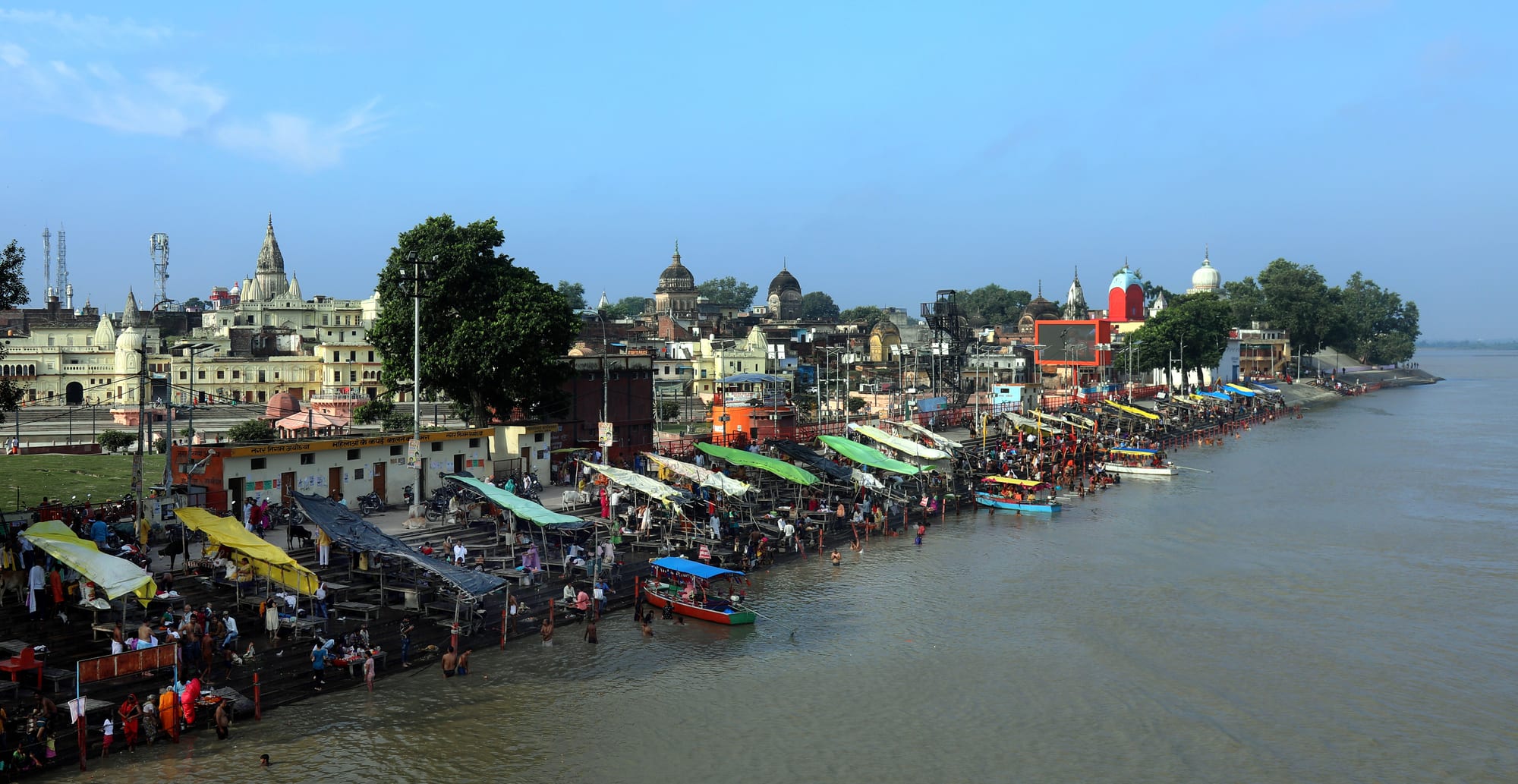
A curving riverbank lined with stepped ghats, market awnings and white temple spires, with boats drawn up on brown water

Agra, Varanasi & Central India, India

Ayodhya

The ghats and temple spires of Ayodhya along the Sarayu river. (Prashant Kharote / Wikimedia Commons · CC BY 4.0)

A pilgrimage town on the Sarayu river in eastern Uttar Pradesh, held in Hindu tradition to be the birthplace of Rama and one of the religion's seven sacred cities. Temples, monasteries and bathing ghats line the riverbank, and a large new temple consecrated in 2024 has brought an airport, wide new roads and millions of additional visitors.

Neighbourhoods

  • Ramkot and the temple quarter
    • Pilgrimage
    • First-time visitors
    • Historic district

    The raised ground at the centre of the old town, where the Ram temple, Hanuman Garhi and Kanak Bhavan stand within a few hundred metres of one another. Lanes of flower and offering stalls, monasteries and pilgrim lodges fill the gaps, and the area is crowded from early morning.

    Open in Maps
  • Naya Ghat and the riverfront
    • Sunrise and sunset
    • Quiet walks
    • Close to public transport

    The stretch of bank where the road from Faizabad meets the Sarayu, with boat landings, bathing steps and the long stepped terraces of Ram ki Paidi. Most of the town's newer hotels and its bus stands are close by.

    Open in Maps
  • Faizabad
    • Best for food
    • Historic district
    • Shopping

    The larger twin town about seven kilometres south-west, founded as a capital of the Nawabs of Awadh, with their garden tombs, a cantonment, a working bazaar and most of the area's restaurants and banks. The two towns share one municipal corporation.

    Open in Maps
  • Guptar Ghat and the western bank
    • Quiet and residential
    • Riverside

    A calmer group of ghats and small temples downstream near Faizabad, set among trees and used more by local families than by large pilgrim groups.

    Open in Maps

Things to do

Temples and shrines

  • Ram Mandirlandmark

    The large sandstone temple to Rama on the disputed site at Ramkot, consecrated in January 2024 and built in a Nagara style with carved pillars and a tall central spire.

    Open in Maps
  • Hanuman Garhilandmark

    A four-sided fortified temple to Hanuman, the most visited shrine in the town, reached by a flight of seventy-six steps and traditionally visited before the other temples.

    Open in Maps
  • Kanak Bhavanlandmark

    A 19th-century temple rebuilt by a queen of Orchha, its courtyard shrine holding gold-ornamented images of Rama and Sita.

    Open in Maps

The river and its ghats

  • Ram ki Paidilandmark

    A long series of bathing terraces and ghats built along a channel of the Sarayu, lit at night and used for the mass lamp-lighting at Diwali.

    Open in Maps

Nawabi Faizabad

  • Gulab Barilandmark

    The garden tomb of Nawab Shuja-ud-Daula, set among rose beds, fountains and a water channel in Faizabad.

    Open in Maps
  • Bahu Begum ka Maqbaralandmark

    A tall white mausoleum built for Bahu Begum, the wife of Shuja-ud-Daula, held to be one of the finest buildings of its kind in Awadh.

    Open in Maps

Short trips

  • Shravastiattraction

    About 110 kilometres north by road, the ruins of Jetavana monastery and ancient city where the Buddha is said to have spent many rainy seasons, now with modern temples built by Buddhist countries.

    Open in Maps
  • Lucknowattraction

    The state capital, roughly 135 kilometres west by road, with the Bara Imambara, the Rumi Darwaza, the ruined Residency and Awadhi kebab houses.

    Open in Maps

Seasonal events

  • Ram NavamiMarch or April

    The birthday of Rama is the town's biggest religious occasion, bringing very large crowds to the temples and a bathing fair on the Sarayu.

  • DeepotsavDiwali, October or November

    Hundreds of thousands of oil lamps are lit along the ghats of Ram ki Paidi for the state-organised Diwali celebration; the count has set world records.

  • Jhula festivals in SawanJuly or August

    In the monsoon month of Shravana, Vaishnava temples set their images on decorated swings, with songs, dance and processions between shrines.

  • Kartik PurnimaOctober or November

    The full-moon day of the month of Kartik is one of the great bathing days of the Hindu year, and pilgrims gather at dawn on the Sarayu ghats.

Eat and drink

Long-standing places and food districts in Ayodhya. Hours, ratings and directions come from your maps app, always current.

Pilgrim food

  • Stalls around Hanuman Garhineighborhood

    Puri with spiced potato, kachori, samosas and hot jalebi sold from morning onwards, along with the besan laddu and peda taken away as temple offerings.

    Open in Maps
  • Naya Ghat sweet and chaat shopsneighborhood

    Milk sweets, rabri, thick lassi in clay cups and chaat in the streets between the bus stand and the river.

    Open in Maps

Faizabad's kitchens

  • Chowk bazaar, Faizabadneighborhood

    The old market of the Nawabi town, where Awadhi cooking survives in small kitchens — biryani, korma and kebabs — alongside vegetarian thali houses.

    Open in Maps
  • Ayodhya Dham station road eateriesneighborhood

    Simple vegetarian dhabas and thali restaurants serving dal, seasonal vegetables and rice to travellers arriving by train.

    Open in Maps

Experience Ayodhya

History

Ayodhya appears in the oldest Indian literature as the capital of the Kosala kingdom and the city of the Ikshvaku dynasty, and the Ramayana makes it the birthplace and royal seat of Rama. Hindu tradition counts it among the seven sacred cities whose visit is held to bring liberation. The town is important to Jains as well, as the birthplace of several tirthankaras, and to Buddhists, for whom it is identified with Saketa.

Under the Mughals it was a provincial centre, and in the 18th century the Nawabs of Awadh made their capital at Faizabad, a few kilometres away, before moving to Lucknow. Faizabad kept the Nawabs' garden tombs and its bazaar. The British annexed Awadh in 1856, one of the grievances behind the rebellion of the following year, and the district settled into a quiet agricultural life around the pilgrim trade.

The modern history of Ayodhya is dominated by the dispute over a site at Ramkot, where the Babri Masjid, a mosque dating from the 16th century, stood on ground many Hindus regard as Rama's birthplace. The mosque was demolished by a crowd in December 1992, an event followed by riots in several parts of India. After decades of litigation the Supreme Court of India ruled in 2019 that the site should be handed over for the construction of a temple, with land elsewhere in the town allotted for a mosque. The Ram temple was consecrated in January 2024, and the town has since been rebuilt around it with an airport, widened streets and a much larger railway station.

Culture & Customs

Ayodhya's culture is the culture of pilgrimage. Its calendar is made of bathing days, processions and parikramas — circuits walked around the sacred area, the longest of them lasting days — and much of the resident population is connected to the temples as priests, musicians, flower sellers, boatmen or lodging keepers. Hundreds of temples and monasteries, many belonging to Vaishnava orders such as the Ramanandis, run their own kitchens, schools and guest houses, and saffron-clad ascetics are a constant presence in the lanes.

The Ramayana shapes everything. Recitations of Tulsidas's Ramcharitmanas, the 16th-century Awadhi retelling, are heard from temple courtyards; the Ram Lila, the dramatised cycle of the story, is performed in the autumn; and bhajan singing and kirtan go on through the night in the larger temples. Awadhi, a dialect of Hindi, is the everyday speech, and the courtesy formulas of the old Awadh region survive alongside pilgrims' greetings of Jai Shri Ram.

Faizabad gives the district a second layer. The Nawabi town has a Muslim population, Urdu culture and the tombs and gardens of the 18th-century court, and the two places have long lived side by side, although the dispute over the temple site made Ayodhya a focus of national religious politics for decades. Visitors find the town welcoming and intensely devotional, and are expected to behave as guests in a place of worship rather than as sightseers.

Daily Life

The old pilgrimage town is small — around 55,000 people at the 2011 census — while Faizabad, the administrative and commercial centre seven kilometres away, is several times larger; the two are administered by a single municipal corporation, and the joint urban area holds a few hundred thousand people. The district beyond is farmland, growing wheat, rice and sugar cane.

The economy runs on religion. Pilgrim numbers rose enormously after the temple was consecrated in 2024, and hotels, guest houses, shops, transport operators and guides have multiplied to meet them; construction of roads, a riverfront and new tourist facilities has been the other big employer. Faizabad supplies the offices, courts, colleges and markets, and many families still have members working in Lucknow, Delhi or the Gulf and sending money home.

The day begins before sunrise with bathers at the ghats and the first temple bells, and the lanes fill with pilgrim groups until the temples close in the middle of the day. They reopen in the late afternoon, and the evening ends with aarti at the river and lamps floated on the water. The rapid rebuilding is the main subject of local argument: land prices have jumped, shops and houses have been cleared for wider roads, and residents disagree about how much of the old town should give way to the new.

Food

Ayodhya eats as pilgrim towns do: vegetarian, simple and sweet. The standard meal is a thali of dal, a seasonal vegetable, rice and chapatis, often cooked without onion or garlic in keeping with temple practice, and served in small dining rooms around the bazaar and at dharamshalas. Breakfast is puri with spiced potato curry, or kachori, a fried pastry stuffed with lentils, eaten with hot jalebi straight from the pan.

Sweets are made and eaten in quantity, because almost everything offered to the deity is a sweet and is returned to the worshipper as prasad. Besan laddu, peda and barfi, all made from gram flour or reduced milk, are stacked in shop windows near the temples; rabri, thickened sweetened milk, and malpua, a fried pancake in syrup, appear at festivals. Thick lassi is drunk from clay cups, and tea is sold at every corner.

Faizabad is where the district's Awadhi cooking survives. The Nawabi court left behind biryani, korma and slow-cooked meat dishes, and the kitchens of the old Chowk bazaar still make them, alongside kebabs and the rich breads of the region. Because the two towns sit in the same municipality but keep different habits, it is common for visitors to eat vegetarian in Ayodhya and cross to Faizabad for anything else.

Planning tools

Budget

Ayodhya is cheap, and a great deal of accommodation is aimed at pilgrims on very small budgets, including dharamshalas attached to temples and monasteries. Rooms are scarce and prices rise sharply at Ram Navami, Diwali and other festivals. Entry to the temples is free; the main costs are transport from Lucknow and a hotel of Western standard, of which there are still few.

Daily Budget Midrange
USD 45–100 (mid-range hotel, restaurant meals, a car with driver for day trips)
Daily Budget Shoestring
USD 12–22 (pilgrim lodge or basic guesthouse, thalis and street food, shared autos and trains)

Book rooms well in advance for festival periods, and expect security checks and long queues at the main temple, where bags and phones may not be allowed inside.

Best Time to Visit

October to March, when the plains are cool and dry. Diwali, in October or November, is the most spectacular time on the riverfront but also the most crowded, and Ram Navami in spring brings even larger numbers. Summer from April to June is extremely hot, and the monsoon can flood parts of the Sarayu bank.

Suggested Number of Days

A day covers the main temples and the riverfront for most visitors, with a second useful for Faizabad and a slower look at the ghats. Add another for trips further out. Festival crowds and temple queues lengthen everything considerably.

First Visit
1–2 days
With Surroundings
2–3 days

Transportation

Cycle rickshaws, autorickshaws and shared electric rickshaws carry almost everyone between the ghats, the temples and Faizabad; fares are low and fixed by custom on the main routes. Roads close to the temple quarter are often restricted to pedestrians during festivals, and taxis have to stop some way out.

Agree fares before setting off, and allow much longer than the distance suggests on festival days, when whole streets are given over to processions.

Airport & Station Connections

Maharishi Valmiki International Airport, just outside the town, was inaugurated at the end of 2023 and took its first commercial flights in January 2024, with services from Delhi and other Indian cities. Trains stop at Ayodhya Dham Junction in the town and at Ayodhya Cantt in Faizabad, with direct services from Lucknow, Varanasi and Delhi. By road, Lucknow is about 135 kilometres away, roughly three hours on the expressway and main highway, and Varanasi is a longer half-day drive.

Walkability

The old town is small and best walked: the main temples, the bazaar lanes and the ghats sit within a couple of kilometres, and much of the temple quarter is closed to vehicles. Surfaces are uneven, crowds are dense in the mornings and on festival days, and the walk out to Faizabad or Guptar Ghat is too far and too busy with traffic to be pleasant on foot.

Safety

The everyday risks are crowds, heat and the pressure of pilgrim traffic rather than crime. Crush injuries are a real hazard at festivals, security around the main temple is heavy, and the town has been the focus of a long and sensitive religious and political dispute, so discussions of it are best approached with care. Monkeys near the temples snatch food and loose possessions.

Avoid the densest crowds at Ram Navami and Diwali if travelling with children, keep phones and bags secure around the temple gates, drink plenty of water in the hot months, and do not photograph security arrangements. Check current official travel advice before travelling.

Climate

The climate of the Ganges plain: a long hot season, a humid monsoon from late June to September that raises the level of the Sarayu, and a short cool winter with dense morning fog that can delay trains and flights.

Summer
very hot and dry — 40–45°C through May and early June, with hot winds in the afternoons
Winter
cool and foggy — days of 20–25°C, nights that can fall to around 6°C, and thick fog in December and January

Local Customs

This is a temple town and dress and behaviour are watched: shoulders and knees covered, shoes and often leather items left outside shrines, photography restricted or banned inside the main temples. Many pilgrims bathe in the Sarayu, and the ghats are treated as sacred ground. The sale of meat and alcohol is restricted in the temple quarters, and much of the town's food is vegetarian and cooked without onion or garlic.

Ask before photographing worshippers or ascetics, be ready to leave phones and bags in lockers at the main temple, and treat the religious dispute over the site as a subject to listen to rather than debate.

Common Payment Methods

The currency is the Indian rupee. Cash is essential for offerings, stalls and rickshaws, and small notes are useful. UPI mobile payments are widely used by residents and increasingly by shops; cards work in the newer hotels and in Faizabad, and ATMs are found along the main roads rather than in the lanes.