💰 Budget
Among the best value places in central India. Guesthouse rooms and meals cost very little, walking covers almost everything, and the monument ticket that admits visitors to the fort palaces and the main temples is the only substantial fixed cost, higher for foreign visitors than for Indian ones. Heritage hotels in converted palaces are the exception and are priced well above the rest of the town.
- Daily Budget Midrange
- USD 45–100 (hotel or heritage room, restaurant meals, a car with driver for Jhansi and Datia)
- Daily Budget Shoestring
- USD 10–22 (guesthouse room, thalis and street food, everything on foot)
One combined ticket covers most of the monuments, so it is worth buying early in the day and using it across several sites.
📅 Best Time to Visit
October to March, when the days are clear and mild and the sandstone takes the low sun well in the early morning and late afternoon. July to September turns the surrounding country green and fills the Betwa, which is when the river looks its best, though rain interrupts. April to June is severe, with temperatures over 40°C and little shade among the ruins.
⏳ Suggested Number of Days
A day covers the monuments comfortably, and two give a slower pace with time by the river. Longer stays are common among visitors who use the town as a quiet base between Agra, Khajuraho and the tiger parks.
- First Visit
- 1–2 days
- With Surroundings
- 2–3 days
🚆 Transportation
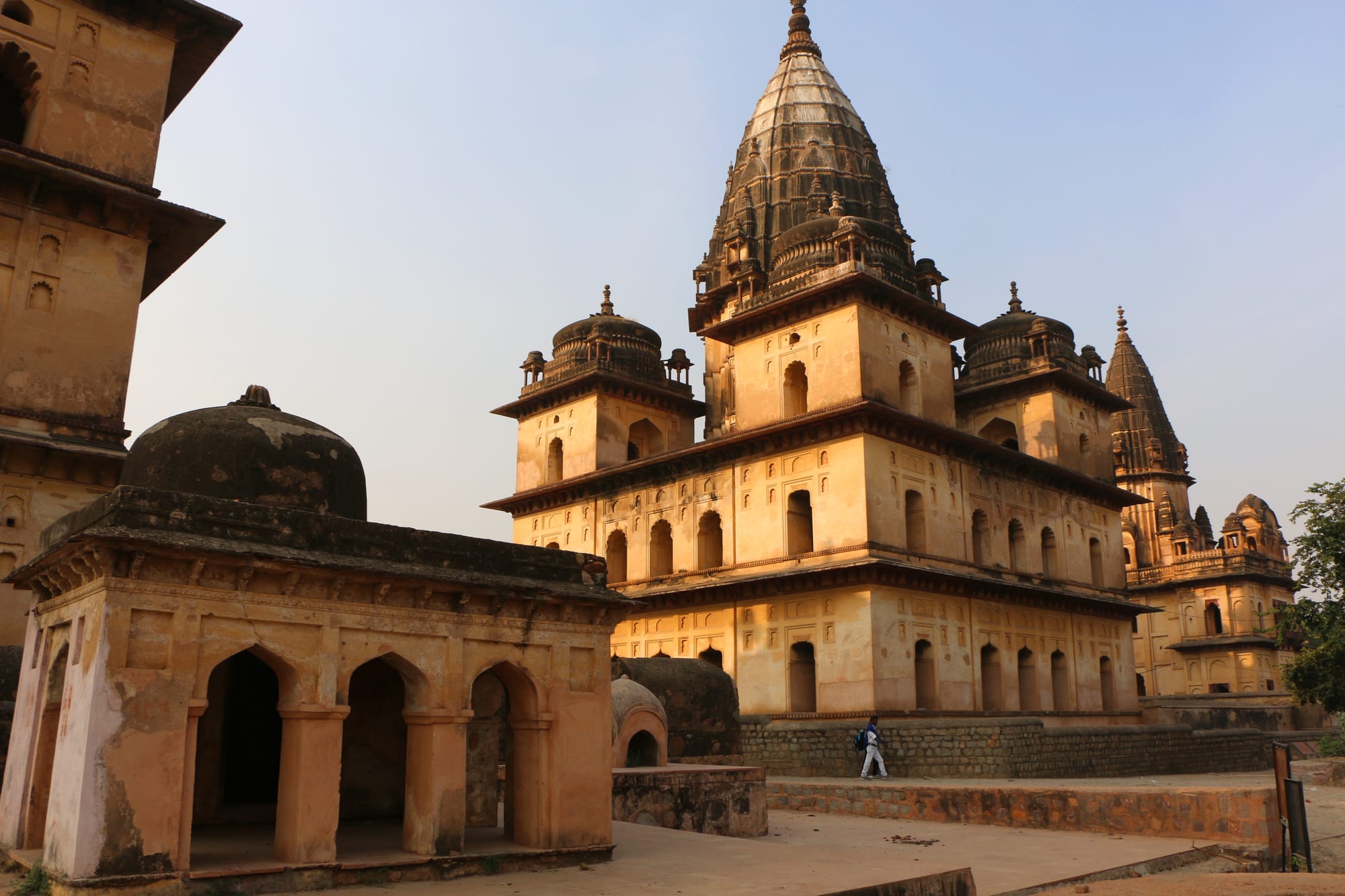
Orchha is walked. The fort, the temples, the bazaar and the cenotaphs are all within about a kilometre and a half of each other on flat ground, and cycle rickshaws and hired bicycles cover the rest. Auto rickshaws and shared tempos run the road to Jhansi through the day, and hotels arrange cars with drivers for Datia, Sonagiri and the railway station.
Fix a fare before boarding a shared vehicle to Jhansi, and allow extra time for the station run in the evening, when the road is busy.
🛬 Airport & Station Connections
Jhansi Junction, about 18 kilometres north, is the practical gateway: a major station on the main line south from Delhi through Bhopal, with fast trains from Delhi in roughly four to five hours and services from Agra, Gwalior and Bhopal. Auto rickshaws, shared vehicles and taxis cover the half-hour road link. Orchha has a small station with a limited service. The nearest airports are Gwalior, about 130 kilometres north, and Khajuraho to the east.
🚶 Walkability
One of the most walkable small towns in central India. The bazaar, the causeway to the fort island and the path along the Betwa to the cenotaphs make a natural circuit, with almost no traffic once away from the Jhansi road. Surfaces are uneven stone and dirt in places, the fort's stairs and upper terraces are steep and unrailed, and the middle of the day is very hot from March onwards.
🛡️ Safety
A quiet town where serious crime against visitors is rare. The practical risks are unrailed drops and dark stairways inside the palaces, monkeys that snatch food and bags around the temples, and the Betwa itself, which has strong currents and rocks and is not safe for casual swimming. Touts and unofficial guides work around the fort entrance.
Watch footing on the palace stairs, keep food out of sight near the temples, swim or raft only with an organised operator, and avoid walking alone by the river after dark. Check current official travel advice before travelling.
🌦️ Climate
A hot semi-arid climate on the Bundelkhand plateau: a long dry season, a monsoon from late June to September that greens the scrub and fills the Betwa, and short cool winters.
- Summer
- very hot and dry — May and June days commonly reach 42–45°C with hot winds
- Winter
- mild days and cold nights — December and January average about 22–25°C by day and can fall near 6°C before dawn
🤝 Local Customs
The Ram Raja temple is a working shrine, not a monument: shoes, leather and usually cameras and phones are left outside, and worshippers take precedence in the queue. Dress is conservative in a small Bundelkhandi town, with shoulders and knees covered for both men and women. Photography of residents, particularly women at the river or in the bazaar, is asked about first.
Alcohol is sold in hotels but rarely drunk in public; tipping is modest, and guides and drivers are given a small amount at the end of a day.
💳 Common Payment Methods
The currency is the Indian rupee. Hotels and the larger restaurants take cards, and phone payment by QR code is common, but the bazaar, rickshaws and monument tickets are easiest with cash. There are only a few ATMs in town and they sometimes run empty, so many visitors draw money in Jhansi before coming.