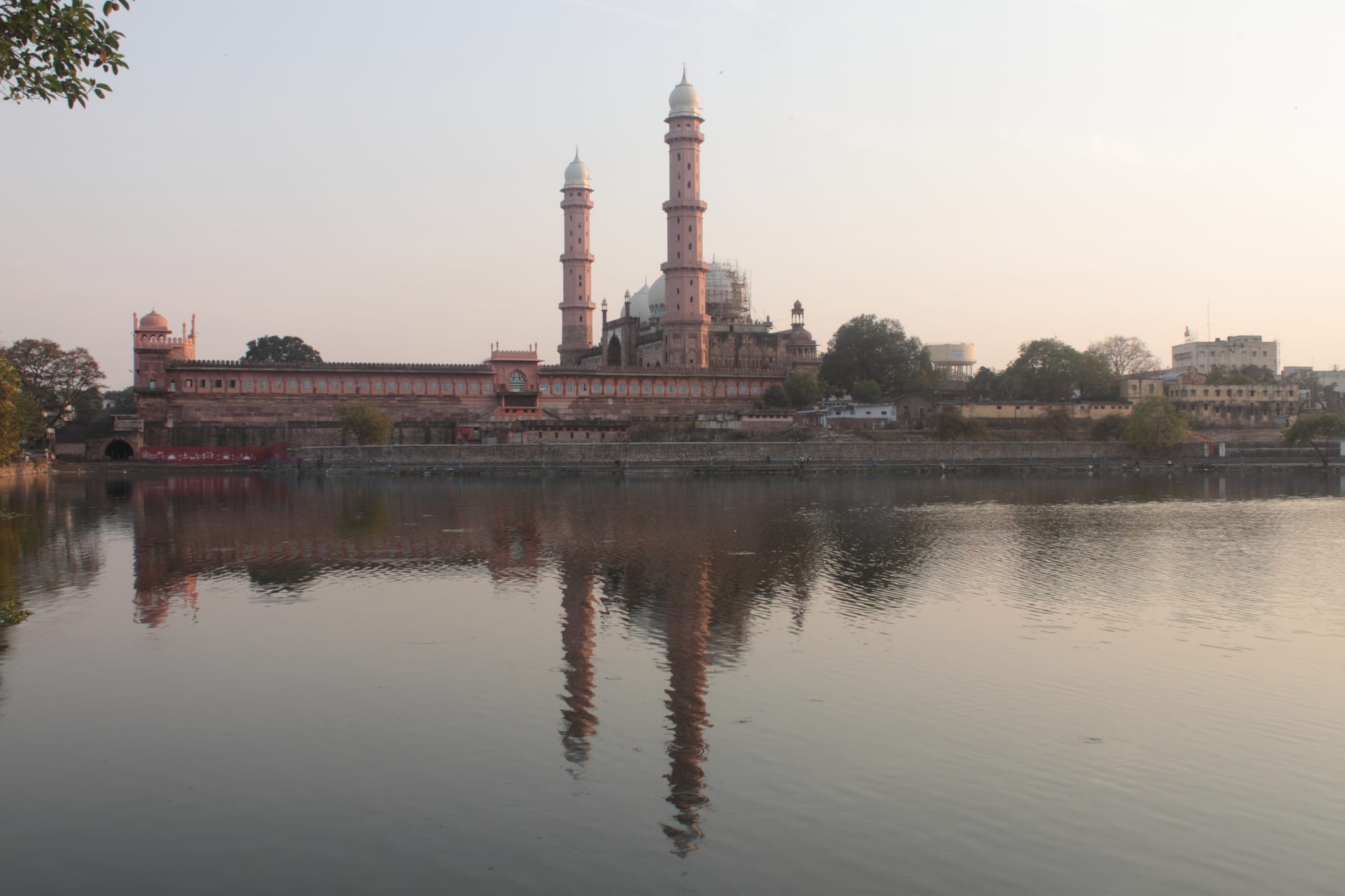
A long pink mosque with two white-topped minarets standing above a lakeshore, reflected in still water at dusk

Agra, Varanasi & Central India, India

Bhopal

Taj-ul-Masajid reflected in the water beside it in the old city of Bhopal. (Sutanu Mandal / Wikimedia Commons · CC BY-SA 4.0)

The capital of Madhya Pradesh, built around two large lakes on the edge of the Malwa plateau. An Afghan soldier founded the state in the early 18th century and four Muslim women, the Begums of Bhopal, ruled it for much of the 19th; their mosques and palaces still fill the old city. The 1984 Union Carbide gas leak marked the city permanently.

Neighbourhoods

  • The old city and Chowk
    • Historic district
    • Best for food
    • Markets

    The walled heart of Begum-era Bhopal, north of the lakes, where Taj-ul-Masajid and the Moti Masjid stand among lanes of jewellers, cloth merchants and kebab stalls. It is crowded, low-rise and noisy, and most of the city's Muslim quarters and oldest markets are here.

    Open in Maps
  • Shyamla Hills
    • Arts and culture
    • Views
    • Quiet and residential

    A wooded ridge above the Upper Lake holding Bharat Bhavan, the Museum of Mankind and the state's broadcasting studios, with large houses and embassy-style bungalows on winding roads. It has the best views over the water and the least traffic of any central district.

    Open in Maps
  • New Market and TT Nagar
    • Shopping
    • First-time visitors
    • Close to public transport

    The main shopping district of the planned city laid out after Bhopal became a state capital in 1956, with book and cloth shops, sweet shops and chain stores around a grid of pedestrian streets. Many mid-range hotels and government offices sit within walking distance.

    Open in Maps
  • MP Nagar
    • Business
    • Nightlife
    • Restaurants

    Bhopal's newer commercial centre south-east of the lakes, a district of office towers, coaching institutes, cafés and restaurants that stays busy into the evening. It is the most modern-feeling part of the city and close to Rani Kamlapati station.

    Open in Maps
  • Arera Colony and Shahpura
    • Quiet and residential
    • Parks

    Large planned residential colonies south of the centre, built in blocks around parks and markets, where much of the city's middle class lives. Shahpura Lake, with its lakeside promenade, is the focus of evening walks here.

    Open in Maps

Things to do

Mosques and palaces of the old city

  • Taj-ul-Masajidlandmark

    One of the largest mosques in India, begun under Shah Jahan Begum in the 19th century and finished only in the twentieth, with a vast courtyard and two tall minarets beside a lake.

    Open in Maps
  • Moti Masjidlandmark

    The 'pearl mosque' built by Sikandar Begum in 1860, a smaller red-sandstone mosque with two dark minarets in the middle of the old city.

    Open in Maps
  • Taj Mahal Palacelandmark

    The huge brick palace built for Shah Jahan Begum between 1871 and 1884, with courtyards, arcades and painted halls, derelict for decades and leased for conversion into a hotel.

    Open in Maps

Museums and the arts

  • Bharat Bhavanmuseum

    A multi-arts centre of 1982 designed by Charles Correa, stepping down the Shyamla Hills slope towards the lake, with galleries of tribal and modern art, a theatre and a poetry library.

    Open in Maps
  • Indira Gandhi Rashtriya Manav Sangrahalayamuseum

    The National Museum of Mankind, an open-air anthropological museum spread over a wooded hill, with full-size houses and shrines built by communities from across India.

    Open in Maps
  • State Museum of Madhya Pradeshmuseum

    The state collection of sculpture, coins, copper plates and miniature paintings, strongest on stone carving from the temple sites of Madhya Pradesh.

    Open in Maps
  • Birla Museum and Lakshmi Narayan Templelandmark

    A 1960s temple on Arera Hill above the city, beside a small archaeological museum of regional sculpture.

    Open in Maps

Lakes and parks

  • Bhojtal (Upper Lake)park

    The large reservoir on the city's western edge, said to date from the 11th century and still a main source of Bhopal's water, with boating, a lakeside road and long views at sunset.

    Open in Maps
  • Van Vihar National Parkpark

    A national park and zoological park along the southern shore of the Upper Lake, where rescued tigers, leopards and bears live in large enclosures beside a road open to walkers and cyclists.

    Open in Maps

Short trips from the city

  • Sanchilandmark

    About 45 kilometres north-east, the hilltop group of Buddhist stupas begun under Ashoka in the 3rd century BC, with carved gateways and a UNESCO World Heritage listing.

    Open in Maps
  • Bhimbetka rock sheltersattraction

    A UNESCO World Heritage Site about 45 kilometres south-east, where sandstone shelters hold prehistoric paintings of hunters, animals and dancers.

    Open in Maps
  • Bhojeshwar Templelandmark

    An unfinished 11th-century Shiva temple at Bhojpur, about 25 kilometres south-east, built around a monolithic lingam over two metres high.

    Open in Maps
  • Udayagiri Cavesattraction

    Rock-cut Hindu and Jain shrines of the Gupta period near Vidisha, about 50 kilometres north-east, including a large relief of Vishnu as a boar.

    Open in Maps

Seasonal events

  • Mahashivaratri fair at BhojpurFebruary or March

    Pilgrims fill the unfinished temple at Bhojpur for the night-long festival of Shiva, and a fair sets up around it.

  • Ramadan nights in the old cityvaries with the Islamic calendar

    Through the fasting month the lanes around the Chowk and Ibrahimpura stay open late for sweets, kebabs and haleem after sunset.

  • Ganesh Chaturthi and Durga PujaAugust to October

    Neighbourhood pandals, processions and immersions in the lakes mark the two biggest Hindu festivals of the Bhopal calendar.

  • Bhopal Tablighi IjtemaNovember

    One of the largest Islamic congregations in India gathers on open ground outside Bhopal over four days of preaching and prayer.

Eat and drink

Long-standing places and food districts in Bhopal. Hours, ratings and directions come from your maps app, always current.

Bhopal classics

  • Chowk and Ibrahimpura kebab stallsneighborhood

    The old city's grills and small meat kitchens, known for seekh and boti kebabs, slow-cooked korma and the thick wheat-and-meat porridge haleem.

    Open in Maps
  • Jehan Numa Palacerestaurant

    A palace on Shyamla Hills, long run as a hotel, whose kitchens keep the Bhopali meat dishes of the court.

    Open in Maps
  • Bhopali paan shopsmarket

    Betel leaf folded around lime, areca and sweet fillings; Bhopal's version is well known across Madhya Pradesh and sold from stalls all over the old city.

    Open in Maps

Markets and everyday food

  • New Marketneighborhood

    The shopping district where locals go for poha and jalebi in the morning, samosas and kachori through the day, and milk sweets from long-standing shops.

    Open in Maps
  • Lakeside food stalls at the Upper Lakeneighborhood

    Corn, chaat, tea and ice cream sold along the promenade by the boat club, where families gather in the cool of the evening.

    Open in Maps

Experience Bhopal

History

Bhopal takes its name from Raja Bhoj, the Paramara king of the 11th century who is credited with building the great dam that created the lake at the city's western edge. The modern city began much later, in the early 18th century, when Dost Mohammad Khan, an Afghan soldier who had served the Mughal emperor Aurangzeb, took control of the area as Mughal power collapsed and made a fortified settlement at Bhopal his base. The state he founded survived the turmoil of the 18th century, signed a treaty with the British in 1818 and remained a princely state until independence.

Its most unusual period followed. From 1819 to 1926 Bhopal was ruled, with one short break, by four women in succession: Qudsia Begum, her daughter Sikandar, her granddaughter Shah Jahan and her great-granddaughter Sultan Jahan. They built the mosques, palaces and waterworks that still define the old city, founded schools and a modern administration, and made Bhopal one of the best-known princely states in India. The last ruler, Nawab Hamidullah Khan, resisted joining the new republic; Bhopal acceded to India in 1949 and became the capital of the new state of Madhya Pradesh in 1956, which brought a planned new town of wide roads and government colonies south of the lakes.

On the night of 2–3 December 1984 methyl isocyanate gas escaped from a Union Carbide pesticide plant on the northern edge of the city and spread through densely populated neighbourhoods. Thousands of people died within days and many thousands more were injured or left with lasting illness, in what is widely described as the worst industrial disaster in history. Litigation, compensation and the contamination of the abandoned site have remained live issues ever since, and survivors' organisations still campaign in the city.

Culture & Customs

Bhopal is often described as a meeting of two cities: the Muslim old town of the Begums north of the lakes, and the planned Hindu-majority new town built after 1956 to the south. Urdu poetry, Nawabi manners and a tradition of composed, courteous speech belong to the first; the state government, its universities and a large migrant middle class from across Madhya Pradesh belong to the second. The result is a capital that is calmer and less commercial than Indore, its larger rival to the west.

The city has an outsized place in Indian cultural life for its size, mostly through institutions founded in the 1980s. Bharat Bhavan brought together galleries of tribal and contemporary art, a theatre repertory and a poetry archive in one building above the lake, and gave Adivasi artists from Madhya Pradesh a national platform; the Museum of Mankind, on another hill nearby, reconstructs village architecture from every part of the country. Both reflect a long state interest in the tribal traditions of the plateau.

Festivals follow both calendars. Eid transforms the Chowk, Ramadan nights keep the old-city lanes busy until very late, and the annual Tablighi gathering on the city's outskirts draws enormous crowds. Ganesh Chaturthi, Navratri and Durga Puja bring pandals and processions to the newer colonies, and immersion processions end at the lakes. Hindi is the language of daily life, with Urdu widely spoken and read in the old city.

Daily Life

About 1.8 million people lived in Bhopal at the 2011 census, and the urban area has grown steadily since, spreading south and east across the plateau. Government is the city's main business: the state secretariat, the assembly building designed by Charles Correa, courts, universities and the offices that go with them employ a large share of the middle class, and the coaching institutes of MP Nagar prepare thousands of young people for public service examinations. Textile and electrical works, a heavy-engineering plant to the east and a growing technology park make up much of the rest.

Residential life divides sharply by area. The old city is dense, poorer and mostly Muslim, built of narrow lanes and small shops; the colonies laid out after 1956 — Arera, Shahpura, Kolar Road and the newer suburbs beyond — are grids of houses and flats with their own markets and parks. Rents and property prices are low by the standards of Indian state capitals, which is part of the city's appeal.

The rhythm of the day is unhurried. Mornings begin with poha and tea at street stalls, offices and shops run through to the evening with a long lunch break, and families walk or sit along the lakes after dark. Water supply, traffic congestion and the unresolved clean-up of the Union Carbide site are the recurring civic arguments, along with the building of the metro across the city.

Food

Bhopali cooking is the meat-heavy Mughlai tradition of a princely court, and the old city is where to find it. Korma here means mutton slow-cooked in a thick yoghurt and onion gravy; seekh and boti kebabs are grilled over charcoal at stalls around the Chowk and Ibrahimpura; and rezala, biryani and haleem, the wheat-and-meat porridge eaten in Ramadan, are all part of the repertoire. Bread is the accompaniment rather than rice — sheermal, naan and roghni roti — and many of these dishes are cooked in small family kitchens rather than restaurants.

The vegetarian food of Madhya Pradesh dominates the newer districts. Poha, flattened rice steamed with onion, turmeric and mustard seed and topped with crisp sev and raw onion, is the breakfast of the whole state, often eaten with a hot jalebi alongside. Dal bafla, the Malwa dish of baked wheat balls dipped in ghee and eaten with lentils, appears at celebrations; samosas, kachori and chaat fill the afternoon; and milk sweets, above all thick reduced-milk barfi and gulab jamun, are bought from shops in New Market and the old bazaars.

Two things finish a Bhopali meal. Paan, betel leaf folded around lime, areca nut and sweet or savoury fillings, has a particular local reputation and is sold from stalls on almost every corner. And tea — strong, sweet and boiled with milk — is drunk all day from glasses at roadside stands, with lassi in clay cups and cold sugarcane juice taking over in the hot months.

Planning tools

Budget

Bhopal is inexpensive even by Indian standards, and cheaper than Agra or Varanasi because far fewer foreign visitors come. Hotels are good value, street food costs very little, and the main extra expense is a car with a driver for Sanchi, Bhimbetka and Bhojpur, which are awkward to reach by bus.

Daily Budget Midrange
USD 45–100 (mid-range or heritage hotel, restaurant meals, a driver for day trips)
Daily Budget Shoestring
USD 15–25 (guesthouse, street food and thalis, buses and shared autos)

A single hired car can cover Sanchi, Bhimbetka and Bhojpur in separate outings for less than most city day tours elsewhere in India, and several of the city's best sights cost little or nothing to enter.

Best Time to Visit

October to March, when days are warm and dry and the evenings cool enough for the old city and the lakeside. The monsoon from late June to September turns the surrounding plateau green and is a good time for Bhimbetka and Sanchi, though rain can interrupt travel. April to mid-June is very hot and best avoided.

Suggested Number of Days

Two days cover the old city, the lakes and the museums at an unhurried pace. Allow three or four to add the archaeological sites around the city, each of which takes half a day with travel. Anyone with a particular interest in prehistory or Buddhist art will want longer.

First Visit
2 days
With Surroundings
3–4 days

Transportation

Autorickshaws and shared tempos are the everyday way of getting about, and app-based taxis work well in the newer districts. City buses run on the main corridors, and the first stretch of the Bhoj Metro, between AIIMS and Subhash Nagar, opened in December 2025, with further lines being built. Lanes in the old city are too narrow for cars, so visits there are made on foot.

Agree an autorickshaw fare before setting off, or use an app; traffic between the old city and MP Nagar is heaviest in the early evening.

Airport & Station Connections

Raja Bhoj Airport lies about 15 kilometres north-west of the centre, with flights to Delhi, Mumbai and other Indian cities. Bhopal sits on the New Delhi–Chennai main line, and most travellers arrive by train at Bhopal Junction in the middle of the city or at Rani Kamlapati station to the south; fast daytime trains reach Delhi in roughly eight hours and Agra in about five.

Walkability

The old city is walkable and best seen that way, with the main mosques, the Chowk and the lakeshore palaces within a kilometre or two of each other. Beyond it Bhopal is spread out across hills and around the lakes, pavements are uneven and the distances between districts are long, so most journeys need a vehicle. The promenades along the Upper Lake and Shahpura Lake are the pleasant walks.

Safety

Bhopal is a quiet state capital with a low rate of crime against visitors, and the usual concerns are traffic, touts around the day-trip sites and petty theft in crowded bazaars. Heat in May and June is a real health risk, and air quality falls in winter. Women travelling alone generally report fewer difficulties here than in the larger cities of the Ganges plain.

Carry water and avoid the middle of the day in the hot months, use licensed guides at the archaeological sites, and keep bags closed in the Chowk. Check current official travel advice before travelling.

Climate

A hot semi-arid climate tempered slightly by the plateau's altitude of around 500 metres. The year divides into a hot dry season, a wet monsoon from late June to September, and a mild dry winter; the lakes keep humidity higher than in much of central India.

Summer
hot and dry — April to mid-June days of 38–42°C, with cooler evenings than on the plains
Winter
mild and dry — days of 22–27°C and nights that can fall to around 8°C in December and January

Local Customs

Bhopal has a large Muslim population alongside a Hindu majority, and both traditions shape daily manners. Shoulders and knees should be covered at mosques and temples, heads covered by women at mosques, and shoes removed before entering; visits to mosques are best avoided at prayer times. Greetings are namaste or, among Muslims, salaam. Eating and passing things is done with the right hand.

Ask before photographing people, particularly women and worshippers; tipping is modest, with small change for hotel staff and rounding up for drivers. Alcohol is sold in licensed shops, hotels and bars but is not part of everyday social life.

Common Payment Methods

The currency is the Indian rupee. Cards are accepted in hotels, malls and larger restaurants, and the UPI mobile payment system is used almost everywhere by residents, including street stalls. Foreign visitors should carry cash for autorickshaws, markets and small eateries; ATMs are common in New Market and MP Nagar.