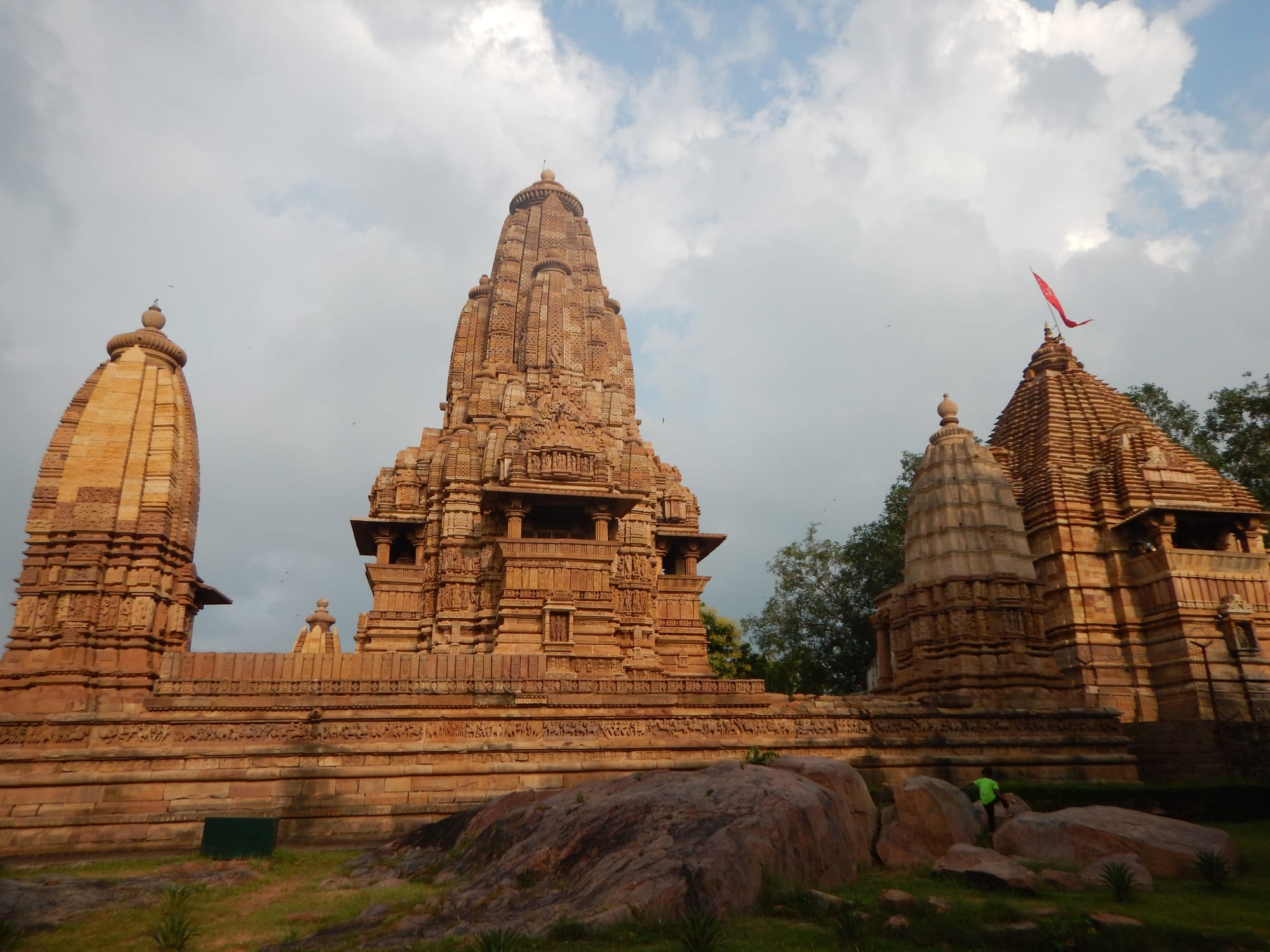
Tall sandstone temple towers with tiered carved spires rising from a stone platform under a cloudy sky

Agra, Varanasi & Central India, India

Khajuraho

Temples of the Western Group at Khajuraho, Madhya Pradesh. (Deepa Chandran2014 / Wikimedia Commons · CC BY-SA 4.0)

A small town in the Chhatarpur district of northern Madhya Pradesh, surrounded by fields and low hills, and known for the sandstone temples built by the Chandela dynasty between about 885 and 1050. Around two dozen of an original larger group survive, covered in carved figures, and are a UNESCO World Heritage Site; the town around them lives almost entirely from the visitors they draw.

Neighbourhoods

  • The Western Group and the main road
    • First-time visitors
    • Close to the main sights
    • Hotels

    The centre of the town, where the walled enclosure holding the largest temples faces a square of hotels, guesthouses, craft shops and travel agents. Almost everything a visitor needs is within a few hundred metres, and the enclosure is lit in the evening.

    Open in Maps
  • Khajuraho village
    • Local life
    • Quiet and residential

    The old settlement east of the main enclosure, a working Bundelkhandi village of lanes, small shops and farmland where the Eastern Group temples stand among houses and fields rather than in a landscaped park.

    Open in Maps
  • The Jain quarter and Southern Group
    • Temples
    • Quiet and residential

    The south-eastern edge of the town, around the walled Jain temple compound that is still in worship and its small museum. The Southern Group temples lie scattered a kilometre or two further out, reached by cycle rickshaw or bicycle along quiet roads.

    Open in Maps
  • The airport road
    • Hotels
    • Close to public transport

    The road running south towards the airport, about three kilometres out, with most of the larger hotels and resorts set back in gardens. It is quiet and green, but too far from the temples to walk.

    Open in Maps

Things to do

The Western Group

  • Kandariya Mahadeva Templelandmark

    The largest and tallest temple at Khajuraho, built for Shiva around 1030, its spire rising in a cascade of smaller peaks above hundreds of carved figures.

    Open in Maps
  • Lakshmana Templelandmark

    The oldest fully surviving temple of the group, dedicated to Vishnu and completed in the mid-tenth century, with friezes of court, army and daily life around its platform.

    Open in Maps
  • Vishvanatha Templelandmark

    An eleventh-century Shiva temple approached past a large stone Nandi bull in its own pavilion, known for the quality of its sculpted figures.

    Open in Maps
  • Chausath Yogini Templelandmark

    The oldest surviving structure at the site, a granite temple on a rocky rise built to house shrines for the sixty-four yoginis.

    Open in Maps

The Eastern and Southern groups

  • Parshvanatha Templelandmark

    The largest of the Jain temples in the eastern group, of the mid-tenth century, its outer walls carved with figures of Hindu as well as Jain subjects.

    Open in Maps
  • Adinatha Templelandmark

    A smaller Jain temple beside Parshvanatha, its sanctuary holding an image of the first tirthankara.

    Open in Maps
  • Duladeo Templelandmark

    A Shiva temple of the early twelfth century on the southern edge of the town, among the latest built at Khajuraho and known for its dense bands of apsara figures.

    Open in Maps

Museums and the town

  • Archaeological Museummuseum

    The site museum opposite the Western Group, holding sculpture recovered from the ruined temples, including fragments no longer in place on the buildings.

    Open in Maps
  • Khajuraho Airporttransit hub

    The small airport three kilometres south of the town, opened in 1978 to serve visitors to the temples, with flights from Delhi, Varanasi and Rewa.

    Open in Maps

Short trips from the town

  • Panna National Parkpark

    A tiger reserve on the Ken River a short drive from the town, repopulated with tigers after they were lost from the park in the 2000s, with jeep safaris and gorge scenery.

    Open in Maps
  • Raneh Fallsattraction

    A canyon of crystalline granite, in shades of pink, red and grey, on the Ken River about 20 kilometres away, where waterfalls run in and after the monsoon and the gorge is dry and striking the rest of the year.

    Open in Maps
  • Kalinjar Fortlandmark

    A large hill fort of the Chandelas in Uttar Pradesh, roughly 60 kilometres away, with rock-cut shrines, tanks and long views over the plain.

    Open in Maps

Seasonal events

  • Khajuraho Dance FestivalFebruary

    A week of Indian classical dance — Kathak, Bharatanatyam, Odissi and others — staged by the Madhya Pradesh government beside the Western Group temples.

  • Maha ShivaratriFebruary or March

    The Matangeshwar temple, the one temple of the Western Group still in daily worship, holds a large fair and night-long queues of pilgrims.

  • HoliMarch

    The spring festival of colour is marked across Bundelkhand with bonfires the night before and coloured powder in the village lanes the next morning.

Eat and drink

Long-standing places and food districts in Khajuraho. Hours, ratings and directions come from your maps app, always current.

Bundelkhand dishes

  • Dal baflarestaurant

    A Malwa and Bundelkhand staple of wheat dough balls boiled then baked and dipped in ghee, eaten with lentils and chutney, served in many local dining rooms.

    Open in Maps
  • Poha and jalebimarket

    The standard Madhya Pradesh breakfast — flattened rice steamed with onion, turmeric and mustard seed, topped with crisp sev and eaten alongside hot jalebi.

    Open in Maps

Where the town eats

  • Main road restaurantsneighborhood

    The blocks facing the main temple enclosure hold most of the town's restaurants and rooftop cafés, serving North Indian standards alongside Italian and Israeli dishes for long-stay visitors.

    Open in Maps
  • Khajuraho bazaarmarket

    The small daily market in the village, with vegetable sellers, sweet shops and tea stalls used by residents rather than visitors.

    Open in Maps

Experience Khajuraho

History

The temples were built by the Chandela dynasty, a Rajput house that rose in Bundelkhand in the ninth century and made Khajuraho its religious centre while with strongholds at the hill forts of Kalinjar and Ajaigarh. Most of the surviving buildings went up between about 885 and 1050, under rulers including Yashovarman, who built the Lakshmana temple, and Vidyadhara, credited with the Kandariya Mahadeva. Medieval accounts describe a far larger group, of which around twenty to twenty-five temples remain.

Building stopped as Chandela power declined and the region came under the Delhi Sultanate. The site was never systematically destroyed, but the town shrank to a village, the forest closed in, and worship at most of the temples ended. The fourteenth-century traveller Ibn Battuta passed by and recorded the temples, then they largely dropped out of written record for centuries, maintained only where local people kept a shrine in use.

In 1838 a British engineer, T. S. Burt, was led to the ruins by his bearers and sent a description to the Asiatic Society; Alexander Cunningham surveyed and catalogued them in the following decades, dividing them into the Western, Eastern and Southern groups still used today. Clearance and conservation followed under the Archaeological Survey of India. The group was inscribed as a UNESCO World Heritage Site in 1986, an airport opened to bring visitors directly, and a village of a few thousand people grew into a small town living from tourism, and an annual dance festival became its main cultural event.

Culture & Customs

Khajuraho's reputation rests on its sculpture, and the carving is far broader than the erotic panels that made it famous. The temple walls carry gods and attendant deities, mythical beasts, musicians and dancers, and long friezes of processions, battles and domestic scenes, with apsaras — celestial women shown writing, playing, dressing and dancing — the most frequent subjects. The erotic figures, often placed on the junctions between hall and sanctuary, are a minority of the total, and scholars still disagree about what they meant to their makers; the temples show Hindu and Jain patronage side by side, a tolerance unusual enough to be worth noting.

The living culture is Bundelkhandi. Bundeli, a dialect of Hindi, is spoken in the villages, and the folk traditions of the region include the Alha, a sung epic of Chandela-era warriors still performed at fairs, and Badhai and Rai dances at weddings and festivals. The dance festival each February gives the town a week of Indian classical performance in front of the temples and has become its main cultural event.

Village life close to the temple park keeps the rhythms of a farming district: weekly markets, cattle in the lanes, temple fairs at Shivaratri, and weddings concentrated in the winter months. Visitors are a constant presence, and the town has learned to live from them, which shows both in good English among guides and shopkeepers and in a fairly hard sell around the temple gates.

Daily Life

About 24,000 people live in the town, which is an unusual place: a rural Bundelkhand settlement with an international airport and a concentration of hotels that would suit a much larger city. Tourism is the economy — hotels, restaurants, guides, drivers, souvenir and stone-carving shops — and it is strongly seasonal, filling from October to March and emptying in the summer, when many workers take other jobs or leave for the cities. Farming continues around the town, with wheat, pulses and oilseeds on the black soil and grazing on the stony margins.

Chhatarpur district, to which Khajuraho belongs, is among the poorer parts of Madhya Pradesh, and the surrounding Bundelkhand region has a long history of drought, water shortage and migration for work to Delhi and the industrial cities. Government schemes, the national park and the tourism trade provide much of the cash income. Schools, banks and the main hospital are in the town or at Chhatarpur, about 45 kilometres away.

The day is ordered by the light. Visitors go to the temples early and again in the late afternoon; the middle of the day is quiet, with shops shuttered against the heat. Evenings bring a sound-and-light show at the Western Group and a slow circuit of the main road, where the hotel terraces, craft shops and tea stalls stay open until the tour buses have gone.

Food

Eating in Khajuraho divides between the visitor restaurants on the main road and the plain Bundelkhandi cooking of the village. The regional staple is wheat, eaten as chapati or as bafla — dough balls boiled and then baked or roasted, split and soaked in ghee, served with dal and a garlic or coriander chutney, the local version of Rajasthan's dal baati. Alongside it come kadhi, a yoghurt and gram-flour curry, seasonal vegetables such as pumpkin and gourds, and rice in smaller quantities than further east.

Breakfast is the Madhya Pradesh standard of poha, flattened rice steamed with onion, green chilli and turmeric and scattered with crisp sev and coriander, often eaten with hot jalebi and sweet milky tea. Snacks lean on gram flour: samosas, kachoris, pakoras and bhutte ka kees, grated maize cooked in milk with spices, which appears when the corn is in. Sweet shops sell milk-based mawa sweets, and peda and barfi are bought for temple offerings and weddings.

The restaurants around the Western Group serve a wider menu shaped by decades of foreign visitors — paneer and chicken curries, tandoori dishes, pizza, pasta and pancakes — and most have rooftops that look towards the temple spires. Alcohol is served in hotels and a few restaurants but is not part of everyday local life, and many village households are vegetarian.

Planning tools

Budget

Cheap even by central Indian standards outside the February festival week, when rooms fill and prices rise. The fixed costs are the ticket to the Western Group, which is higher for foreign visitors, a guide if one is wanted, and transport: safaris at Panna and the trip to Raneh Falls are priced per vehicle and are the main expense of a stay.

Daily Budget Midrange
USD 45–100 (hotel or resort room, restaurant meals, a car with driver and a Panna safari)
Daily Budget Shoestring
USD 12–25 (guesthouse room, thalis and street food, a hired bicycle)

Book rooms well ahead for the dance festival in February, and share a jeep at Panna to cut the cost of a safari.

Best Time to Visit

October to March, when days are warm and clear and the low sun picks out the carving on the temple walls. February brings the dance festival and the best conditions for tiger safaris at Panna. April to June is very hot, with little shade at the temples, and the monsoon from late June brings green countryside and full waterfalls at Raneh but heavy afternoon rain.

Suggested Number of Days

One full day covers the main groups of temples at a reasonable pace, and two suit anyone interested in the sculpture in detail. Stays stretch to three for those adding the national park and the river country nearby, which need a vehicle.

First Visit
1–2 days
With Surroundings
3 days

Transportation

The town is small enough to cross on foot, and bicycles and cycle rickshaws are the usual way to reach the Eastern and Southern groups a kilometre or two out. Auto rickshaws wait near the main enclosure. Anything further — Panna, Raneh Falls, Kalinjar, or the station at Jhansi — needs a hired car or a shared jeep, arranged through hotels or the agents on the main road.

Agree the price and the waiting time with a driver before setting out for the parks, as there is no transport back from them.

Airport & Station Connections

Khajuraho Airport, about three kilometres south, has flights from Delhi, Varanasi and Rewa. Khajuraho railway station is a terminus a few kilometres south with a limited service, including a train from Delhi; many visitors instead use Jhansi, about 170 kilometres west on the main Delhi–Bhopal line, or Satna to the east, and cover the rest by road. Buses run to Jhansi, Satna and Panna.

Walkability

The centre is very walkable: the Western Group, the museum, the hotels and the restaurants all stand within a few minutes of each other, and the temple enclosure itself is a landscaped park crossed on foot. The village and the Eastern Group are a pleasant flat walk or a short cycle away, and the Southern Group a little beyond that. Roads are quiet, but there are few pavements and little shade in the middle of the day.

Safety

A calm small town with little crime against visitors. The common annoyances are persistent sellers of souvenirs and guidebooks around the temple gates, unlicensed guides, and drivers steering visitors to shops that pay commission. Heat and dehydration are the real risks between April and June, and the countryside around has snakes and, near the parks, wildlife that should be kept at a distance.

Use guides licensed by the Archaeological Survey of India, carry water at the temples, and do not walk in the park areas outside organised safaris. Check current official travel advice before travelling.

Climate

A hot semi-arid to subtropical climate on the Bundelkhand plateau, with a long dry season, a June-to-September monsoon and cool, clear winter days.

Summer
very hot and dry — April to June days commonly reach 40–45°C with strong sun and little shade
Winter
warm days and cold nights — December and January average around 22–25°C by day, falling close to 5–10°C after dark

Local Customs

The temples are monuments rather than active shrines, with the exception of Matangeshwar and the Jain compound, where shoes are removed and modest dress expected. The erotic sculpture for which Khajuraho is known makes up a small part of the carving and is treated matter-of-factly by locals; photographing residents, especially women in the village, should be asked about first. This is a conservative rural district: alcohol is available in hotels but not drunk in public.

Bargain politely in the craft shops, remove shoes at working temples, and tip guides and drivers modestly rather than not at all.

Common Payment Methods

The currency is the Indian rupee. Hotels and larger restaurants take cards, and phone payment by QR code is widespread, but small shops, cycle rickshaws and village stalls work in cash. There are a few ATMs near the main road and the market, and they can run empty in the busy season, so it is worth arriving with cash.