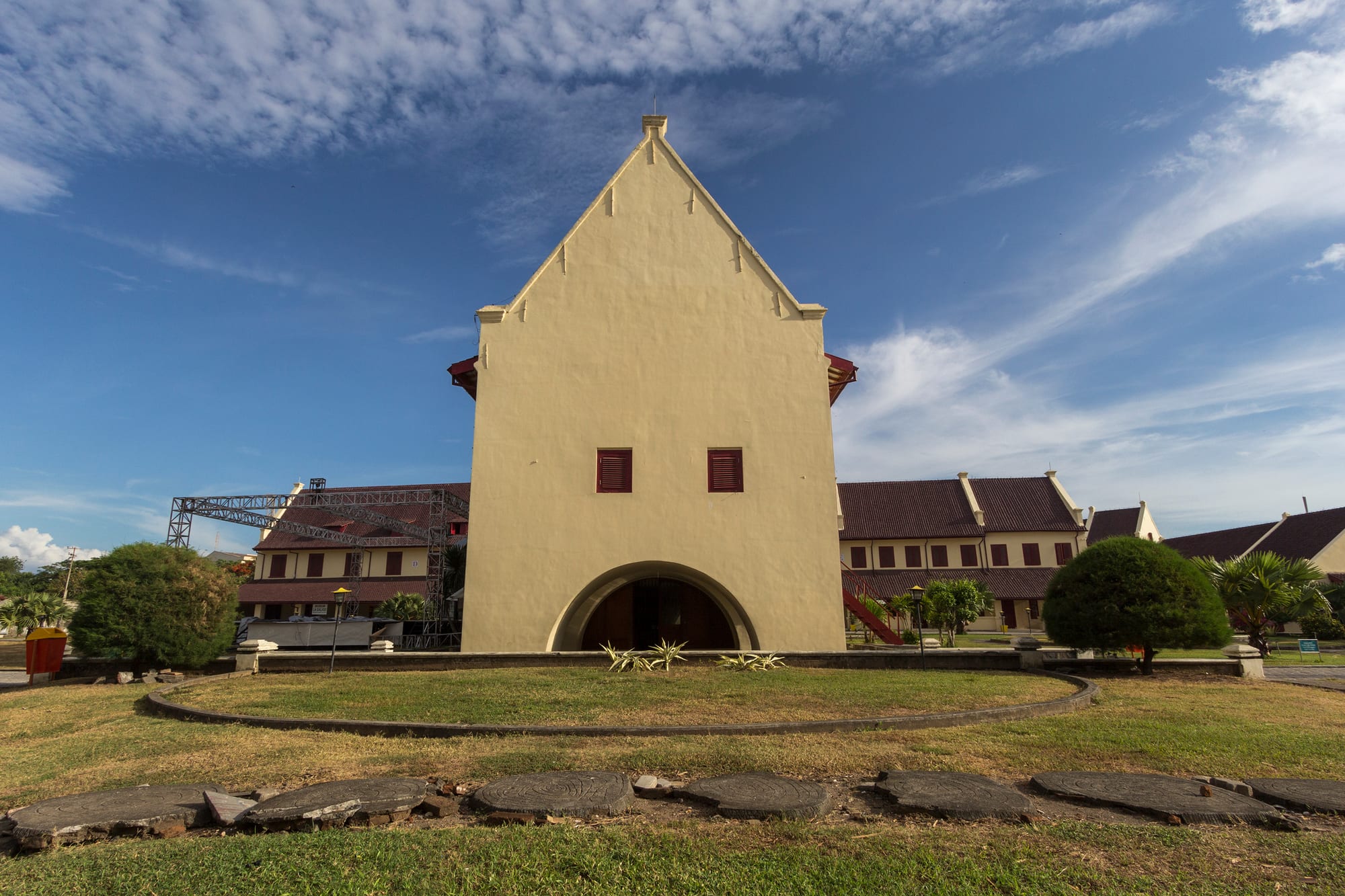
A tall cream-coloured gabled building with shuttered windows inside a walled fort, with lawns and red-roofed barracks alongside

Sulawesi, Indonesia

Makassar

The old church building inside Fort Rotterdam in central Makassar. (Herusutimbul / Wikimedia Commons · CC BY-SA 4.0)

The largest city in eastern Indonesia, on the south-west coast of Sulawesi facing the Makassar Strait. A great spice-trade port under the sultanate of Gowa, then a Dutch fortress town, and known as Ujung Pandang for part of the 20th century, it is now the region's main airport, university city and seafood capital, with a seafront promenade that fills every evening.

Neighbourhoods

  • Losari and the old centre
    • First-time visitors
    • Waterfront
    • Street food

    The heart of the city, where Fort Rotterdam stands a few streets back from the Losari promenade. Hotels, banks and offices are concentrated here, and the seafront platforms fill each evening with families, food carts and people watching the sun go down over the strait.

    Open in Maps
  • Jalan Somba Opu and the Chinese quarter
    • Shopping
    • Historic district
    • Best for food

    The old trading street behind Losari, lined with goldsmiths, souvenir shops selling silk and pearls, and Chinese-Indonesian restaurants and bakeries. Temples and shophouses mark a community that has traded here for centuries.

    Open in Maps
  • Ujung Tanah and Paotere
    • Harbour life
    • Local life

    The working port district north of the centre, where wooden pinisi schooners from across the archipelago tie up at Paotere to unload timber, cement and salt. Busy, hot and unpolished, with fish markets and boatyards along the shore.

    Open in Maps
  • Panakkukang
    • Shopping
    • Best for food
    • Close to public transport

    The modern commercial district inland from the centre, built around shopping centres, offices and long avenues of restaurants and cafés. It is where much of the city's middle class eats and shops, and where many newer hotels are.

    Open in Maps
  • Tanjung Bunga
    • Families
    • Waterfront

    Reclaimed land south of Losari, laid out with new housing, malls, a theme park and a long stretch of seafront. It is the newest face of the city, and the road out to the southern beaches begins here.

    Open in Maps
  • Tamalanrea
    • Students
    • Quiet and residential

    The northern suburbs around Hasanuddin University's main campus, with student housing, cheap eating places and the hospitals, some way from the centre but close to the airport road.

    Open in Maps

Things to do

Famous landmarks

  • Fort Rotterdamlandmark

    A fortress raised by the sultanate of Gowa in the 1630s, ceded to the Dutch under the Treaty of Bongaya in 1667 and rebuilt by them between 1673 and 1679, with thick walls, colonial barracks and lawns beside the sea.

    Open in Maps
  • Losari Beachattraction

    The seafront promenade of platforms and squares along the city's western edge, the gathering place for sunsets, street food and evening crowds.

    Open in Maps
  • Paotere Harbourattraction

    The old wooden-boat harbour north of the centre, where Bugis pinisi schooners still load and unload cargo along the quay.

    Open in Maps
  • Somba Opu Fortlandmark

    The ruined stronghold of the sultanate of Gowa south of the city, destroyed by the Dutch in 1669 and now an open site with reconstructed traditional houses from across South Sulawesi.

    Open in Maps

Museums

  • La Galigo Museummuseum

    The provincial museum, housed inside Fort Rotterdam, covering the archaeology, seafaring, textiles and court regalia of South Sulawesi and named after the great Bugis epic.

    Open in Maps
  • Balla Lompoa Museummuseum

    The palace of the kings of Gowa at Sungguminasa in Gowa Regency, just south of the city, built in 1936 on ironwood piles and now a museum of the Gowa court.

    Open in Maps

Waterfront, parks and markets

  • Pantai Akkarenabeach

    A sandy beach and pier at Tanjung Bunga on the southern edge of the city, used for swimming, sunsets and weekend picnics.

    Open in Maps
  • Great Mosque of Makassarlandmark

    The main mosque of South Sulawesi, built in 1948–49 and renovated in the early 2000s, with two minarets of about 67 m and room for some 10,000 worshippers.

    Open in Maps

Islands and short trips

  • Samalona Islandbeach

    A sand island of a couple of hectares about two kilometres offshore, reached in roughly half an hour by boat from the jetties near Losari, with clear water, a fringing reef and simple guest accommodation.

    Open in Maps
  • Bantimurung-Bulusaraung National Parkpark

    Limestone hills, caves and a waterfall famous for its butterflies, in the karst country inland from the city.

    Open in Maps
  • Maros-Pangkep karstattraction

    A landscape of tower karst about an hour north of Makassar, in Maros and Pangkep, holding some of the earliest known cave art, including red hand stencils and figurative paintings dated to at least 51,200 years ago.

    Open in Maps
  • Malinoattraction

    A hill town in Gowa about 70 km south-east of the city, some two hours by road, cool enough for pine forests, tea gardens and vegetable farms, with waterfalls nearby.

    Open in Maps
  • Sultan Hasanuddin International Airporttransit hub

    Eastern Indonesia's main air hub, in Maros north-east of the city, named after the 17th-century sultan of Gowa and a connecting point for flights across the east of the country.

    Open in Maps

Seasonal events

  • Independence Day17 August

    Flag ceremonies, decorated streets and neighbourhood games and races mark Indonesian independence, with crowds along the waterfront.

  • City anniversaryNovember

    Parades, exhibitions and cultural performances mark the city's anniversary, dated to the first Friday prayer held here in November 1607, with events along the waterfront.

  • Ramadan and Eid on the waterfrontduring Ramadan and the days after Eid al-Fitr, moving earlier each year

    Stalls selling snacks for the breaking of the fast line the seafront through the fasting month, and the promenade is packed for the holiday that follows.

Eat and drink

Long-standing places and food districts in Makassar. Hours, ratings and directions come from your maps app, always current.

Makassar classics

  • Coto Makassar warungsrestaurant

    The city's defining dish, a dark soup of beef and offal simmered for hours with ground peanuts and spices, eaten with pressed rice cakes called burasa or ketupat.

    Open in Maps
  • Konro and konro bakar housesrestaurant

    Beef ribs in a black broth darkened with keluak nut, or grilled and served with peanut sauce, a Makassar speciality found in restaurants across the city.

    Open in Maps
  • Seafood grillsrestaurant

    Fish, squid and prawns grilled over charcoal with a sweet soy or chilli baste, served with sambal and lime in large open restaurants near the waterfront.

    Open in Maps

Food streets and markets

  • Losari seafront stallsneighborhood

    Carts and stands along the promenade selling pisang epe, grilled bananas pressed flat and covered in palm-sugar syrup, alongside es pisang ijo and coffee.

    Open in Maps
  • Jalan Datuk Museng and the Losari back streetsneighborhood

    A concentration of seafood restaurants, coffee houses and late-night eating places a few minutes back from the sea.

    Open in Maps

Experience Makassar

History

The city grew from the twin kingdom of Gowa and Tallo, whose port at the mouth of the Jeneberang River became one of the great trading centres of the archipelago in the 16th century. Its rulers adopted Islam in the first years of the 1600s and kept the harbour open to everyone — Malays, Chinese, Portuguese, English, Danish and Indian merchants all traded here, and Makassar became the main outlet for spices from Maluku beyond Dutch control, a policy the sultans defended by arguing that God had made the sea free to all.

That brought war with the Dutch East India Company, which allied with the Bugis prince Arung Palakka of Bone. Sultan Hasanuddin was defeated, and the Treaty of Bongaya in 1667 forced Gowa to cede its fort, which the Dutch rebuilt as Fort Rotterdam; the great stronghold of Somba Opu fell two years later. Under colonial rule Makassar remained a busy port, and Makassan trepang fishers sailed as far as the coasts of northern Australia, where they traded with Aboriginal communities long before European settlement.

The 20th century brought occupation, revolution and unrest: Japanese rule from 1942, a violent counter-insurgency campaign by Dutch forces in 1946–47 during the struggle for independence, and the long Darul Islam rebellion in the surrounding countryside in the 1950s and 1960s. In 1971 the city was renamed Ujung Pandang, after the old fort, and it reverted to Makassar in 1999. Since then it has grown quickly as the administrative, university and transport capital of eastern Indonesia, with reclaimed land extending the shoreline south of Losari.

Culture & Customs

This is a Bugis and Makassarese city, and the sea is at the centre of its self-image. The pinisi, the two-masted wooden schooner built by hand on the beaches of Bulukumba to the south, is the emblem of that tradition, and the boatbuilding art of South Sulawesi was inscribed on UNESCO's list of intangible cultural heritage in 2017; working examples still tie up at Paotere. Siri', a code of honour and shame, underlies social behaviour, and people are direct in speech while careful not to cause public embarrassment.

Makassar is also a city of students. Hasanuddin University and several others bring tens of thousands of young people from across eastern Indonesia, giving the city a lively café and music scene and a tradition of political demonstration. Older traditions persist alongside: the Bugis epic La Galigo, a vast verse cycle whose surviving manuscripts were added to UNESCO's Memory of the World register in 2011, is a source of local pride, and the royal regalia of Gowa are kept in the museums.

Life is public and takes place after dark, when the heat eases. Families walk the Losari platforms, coffee houses fill, and food is eaten late. Islam shapes the week, with Friday prayers emptying offices, but the city's Chinese, Toraja and Christian communities keep their own calendars and their temples and churches stand openly among the mosques.

Daily Life

About 1.5 million people live in the city proper and some 2.8 million in the Mamminasata metropolitan area, which takes in Gowa, Maros and Takalar. The city is the administrative and commercial capital of eastern Indonesia: government offices, banks, hospitals and universities employ a large share of residents, the port handles cargo for Sulawesi and the islands beyond, and the airport connects the whole east of the country. Fishing, seafood processing, cement, nickel-related logistics and cocoa, shipped from the plantations inland, round out the economy.

Housing runs from the old low-rise kampung near the harbour to towers and gated estates in Panakkukang and Tanjung Bunga, built on land reclaimed from the sea. That reclamation, along with drainage, flooding in the rainy season and the condition of the fishing settlements squeezed between new developments, is a recurring source of argument in the city.

Daily rhythm starts before dawn with prayers and the fish market, runs through a hot and congested working day, and comes alive again in the evening along the water. Students, civil servants and traders dominate the streets; motorbikes dominate the roads. Traffic, flooding and the cost of housing are the standing complaints, along with the perennial question of whether the city's growth is reaching the neighbourhoods behind the seafront.

Food

Makassar's cooking is rich and beef-heavy, and its best-known dishes are eaten across Indonesia. Coto Makassar, the signature, is a dark soup of beef and offal simmered for hours with ground peanuts, cumin and coriander, ladled into small bowls and eaten with burasa, rice cooked in coconut milk and wrapped in banana leaf. Konro is a soup of beef ribs coloured almost black by keluak nut; konro bakar takes the same ribs, grills them and covers them in peanut sauce. Pallubasa is a close relative of coto, enriched with toasted grated coconut and sometimes a raw egg yolk stirred in.

Fish and shellfish come off the boats each morning. Whole fish, squid and prawns are grilled over charcoal and served with dabu-dabu, a raw sambal of chilli, shallot, tomato and lime, or with a fermented shrimp sauce. Mie titi, crisp fried noodles under a thick savoury gravy, is a local invention of the Chinese community, and jalangkote, a fried pastry filled with vegetables and vermicelli, is the standard snack.

Sweet things belong to the waterfront. Pisang epe — half-ripe bananas grilled, pressed flat and drenched in palm-sugar syrup — is sold along Losari every evening, and es pisang ijo wraps banana in a green pandan dough with syrup, milk and shaved ice. Barongko, mashed banana beaten with egg and coconut milk and steamed in banana leaf, is the classic Makassarese sweet. Coffee from Toraja and the Bugis highlands is drunk everywhere, strong and sweet.

Planning tools

Budget

Makassar is inexpensive for a large city. Warung meals, local transport and simple hotels cost little, and even the well-known seafood and coto restaurants are cheap by international standards. Costs rise with boat charters to the islands, cars with drivers for the karst country, and the domestic flights that most visitors take to reach the rest of Sulawesi.

Daily Budget Midrange
USD 50–120 (hotel near the seafront, restaurant meals, a car with driver, an island boat shared with others)
Daily Budget Shoestring
USD 18–35 (guesthouse, warung meals, pete-pete minibuses and ride-hailing motorbikes)

Ride-hailing apps work well here and are cheaper than hotel taxis; keep cash for markets, boats and small restaurants.

Best Time to Visit

The south-west of Sulawesi has a clear dry season from about June to October, which is the best time for the islands, the karst and travel onwards to Tana Toraja, where funeral ceremonies are concentrated after the harvest. From November to March heavy rain falls, boat crossings to the islands can be cancelled and parts of the city flood. Heat and humidity are constant.

Suggested Number of Days

Two days cover the centre, the harbour and the seafront. Four or five allow the islands offshore, the karst and caves inland and the hill country to the south. Many travellers use the city mainly as the gateway to the rest of Sulawesi, which shortens a stay.

First Visit
2 days
With Surroundings
4–5 days

Transportation

Ride-hailing cars and motorbikes are the standard way to move around and are inexpensive; blue pete-pete minibuses run fixed routes, and a bus rapid transit service links parts of the city. Traffic is heavy and slow along the main corridors. Boats to the offshore islands leave from the jetties near Losari and from Paotere, and long-distance buses and shared cars go north to Toraja and Palopo.

Allow extra time for the airport at the start and end of the working day, and agree island boat prices and the return time before setting out.

Airport & Station Connections

Sultan Hasanuddin International Airport, about 20 km north-east of the centre in Maros, is the main air hub of eastern Indonesia, with flights to Jakarta, Surabaya, Bali and across Sulawesi, Maluku and Papua; the drive into the city takes about 20 minutes by the toll road, longer in heavy traffic. Passenger ships of the national line call at the port on routes between Java, Kalimantan and the east, and buses leave for Toraja and the south.

Walkability

The Losari promenade is the one long, pleasant walk, busy and safe in the evening, and the old centre around Fort Rotterdam and Jalan Somba Opu can be covered on foot. Beyond that, heat, humidity, traffic and broken pavements make walking difficult, and the districts are far apart. Most short journeys are made by motorbike taxi.

Safety

Makassar is generally safe for visitors, with petty theft — phone and bag snatching from motorbikes — the most common problem, and traffic the main danger. The city has a long tradition of student protest, and during the nationwide demonstrations of 2025 and 2026 protesters blocked roads and clashed with police here, so marches are best avoided. Currents around the offshore islands can be strong, and small boats are sometimes overloaded. Sulawesi is seismically active.

Wear a helmet and only ride a scooter if experienced, avoid cheap cocktails and home-brewed spirits, dress modestly outside Bali and beach resorts, and heed volcano exclusion zones and tsunami warnings. Check current official travel advice before travelling.

Climate

Tropical monsoon: hot and humid all year, with a marked wet season from November to March, when the north-west monsoon brings downpours and flooding, and a dry season from June to October with clear skies and sea breezes.

Summer
the dry months, June–October: about 30–33°C by day, 23–24°C at night, with little rain
Winter
the wet months, November–March: about 29–31°C, very humid, with heavy rain, rough seas and street flooding

Local Customs

South Sulawesi is strongly Muslim and Makassar is a conservative city in dress and public behaviour, though a large student population and Chinese and Christian communities give it a mixed feel. Modest clothing is expected away from hotel pools, shoes are removed at mosques and in homes, and the right hand is used for eating and giving. Bugis and Makassarese culture sets great store by honour and courtesy, so disputes are handled politely and indirectly.

Tipping is not expected; alcohol is sold in hotels and some Chinese restaurants but is best kept out of sight elsewhere, and during Ramadan it is polite not to eat or smoke in the street in daylight.

Common Payment Methods

The currency is the Indonesian rupiah. Cards are accepted in hotels, malls and larger restaurants, and QR code payment is widely used, but markets, warungs, boats and minibuses take only cash. ATMs are common throughout the city and scarce on the islands.