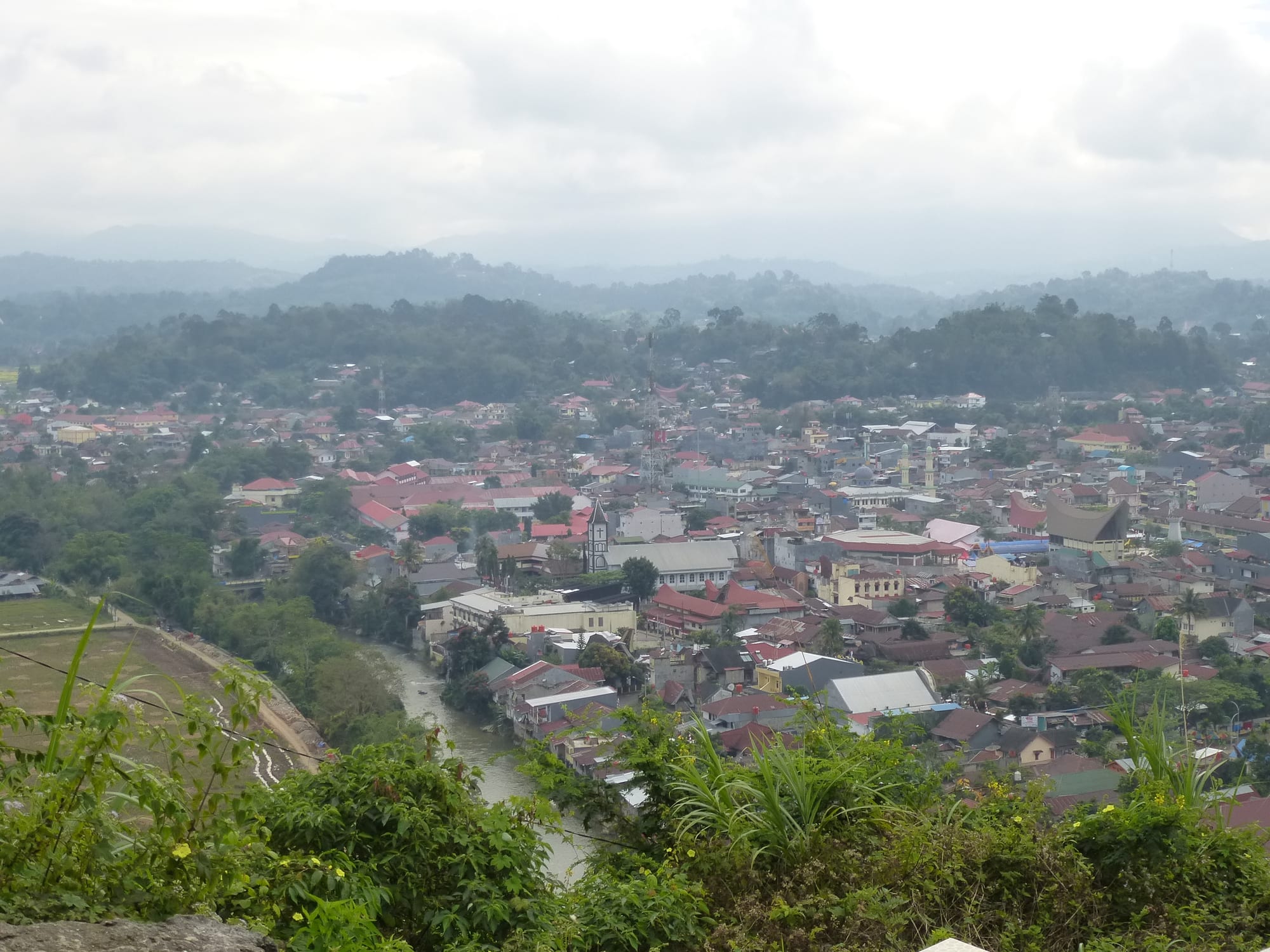
A small town of red and grey roofs in a green valley beside a river, with forested hills and mist behind

Sulawesi, Indonesia

Rantepao

Rantepao in the Toraja highlands, seen from the hills above the Sa'dan River. (Schwarzenfelder / Wikimedia Commons · CC BY-SA 4.0)

The main town of the Toraja highlands in the north of South Sulawesi, set at around 800 metres on the Sa'dan River among rice terraces and limestone hills. It is a market and transport centre rather than a sight in itself, and the base from which visitors reach the boat-roofed tongkonan houses, cliff tombs and ceremonies of the surrounding villages.

Neighbourhoods

  • Town centre
    • First-time visitors
    • Best for food
    • Close to transport

    A few busy streets of shops, guesthouses, coffee places and travel offices around the main crossroads and the bridge over the Sa'dan. Almost everything in the town is within a ten-minute walk, and buses and shared cars leave from here.

    Open in Maps
  • Bolu
    • Markets
    • Local life

    The district north-east of the centre built around Pasar Bolu, the regional market, where buffalo and pigs are traded alongside vegetables, palm wine and household goods. It is at its loudest on market days and quiet in between.

    Open in Maps
  • The riverside and the northern road
    • Quiet and residential
    • Views

    Hotels and homestays spread along the Sa'dan and the road running north towards the higher villages, with rice fields between them and mountain views from the upper terraces. Quieter than the centre and a short ride from it.

    Open in Maps
  • The surrounding villages
    • Traditional architecture
    • Walks

    Within a few kilometres in every direction are hamlets of tongkonan houses and rice barns with their sweeping roofs, family burial sites in rock and cave, and footpaths between them through terraces. Several have guesthouses of their own.

    Open in Maps

Things to do

Toraja villages and burial sites

  • Ke'te Kesu'landmark

    A village a few kilometres south of the town with five large tongkonan and a dozen rice barns, a cave of graves and carved coffins on the cliff behind, and a working ceremonial ground; the oldest house there is reputed to be 500 years old.

    Open in Maps
  • Londaattraction

    A burial cave in a limestone cliff south of the town, with carved wooden effigies, tau tau, standing on a balcony in the rock and coffins set in the chambers behind.

    Open in Maps
  • Lemoattraction

    A cliff face cut with square tombs, with rows of tau tau looking out over the rice fields, and coffins kept in the open air in the rock.

    Open in Maps
  • Bori Kalimbuangattraction

    A ceremonial field north of the town planted with tall standing stones, raised at funerals of high rank.

    Open in Maps
  • Palawalandmark

    A small traditional village north of Rantepao whose tongkonan face a row of rice barns, their gables hung with buffalo horns.

    Open in Maps

Landscape and walks

  • Batutumongaviewpoint

    A string of hamlets on the slopes of Mount Sesean north of the town, looking down over rice terraces and the whole Sa'dan valley, cool enough at night to need a blanket.

    Open in Maps
  • Sa'dan Riverattraction

    The river that runs through the town and the valley, with villages along its banks known for their weaving.

    Open in Maps

Markets

  • Pasar Bolumarket

    The regional market, held on a rotating cycle, where water buffalo and pigs are bought for ceremonies alongside vegetables, coffee, cloth and palm wine.

    Open in Maps

Short trips from the town

  • Makaleattraction

    The administrative seat of Tana Toraja Regency, south of Rantepao, with a very large statue of Christ blessing on Burake hill above the town.

    Open in Maps
  • Tana Toraja Regencyattraction

    The southern half of the Toraja highlands, with more villages, terraces and burial sites along the road towards Makassar.

    Open in Maps

Seasonal events

  • Rambu Solo' funeral ceremoniesmost often between July and September, after the rice harvest

    Toraja families hold long funeral ceremonies for their dead, with processions, guests from across the region and the ritual slaughter of buffalo and pigs; they are family occasions, and visitors attend only when invited or brought by a local guide, bringing a small gift.

  • Ma'nenearound August in some villages

    In certain communities the remains of relatives are taken from their tombs to be cleaned, re-wrapped and honoured before being returned, a rite of respect performed every few years rather than annually.

  • Harvest ceremoniesthe dry months, roughly May to September

    Rambu Tuka', the ceremonies of the rising sun, mark harvests, marriages and the completion of a tongkonan, with dancing, chanting and feasting.

Eat and drink

Long-standing places and food districts in Rantepao. Hours, ratings and directions come from your maps app, always current.

Toraja classics

  • Pa'piong kitchensrestaurant

    Pork, chicken or fish packed into bamboo tubes with coconut, spices and local greens and cooked slowly over a fire — the dish of every Toraja celebration, ordered in advance at restaurants in town.

    Open in Maps
  • Coffee housescafe

    Toraja arabica, grown on the surrounding slopes and sold worldwide, is roasted and drunk locally in small cafés around the centre.

    Open in Maps
  • Pasar Bolu food stallsmarket

    Market kitchens selling rice, grilled meat and vegetables, along with palm wine and sacks of coffee, on trading days.

    Open in Maps

Everyday eating

  • Warungs in the town centrerestaurant

    Simple places serving Indonesian standards — nasi goreng, soto, grilled fish — alongside Toraja dishes, with a few catering to visitors.

    Open in Maps

Experience Rantepao

History

Toraja means, roughly, people of the uplands, a name given by lowlanders to the communities living in these valleys. Before the 20th century there was no single Toraja state: society was organised around the tongkonan, the ancestral house, and around local nobles, and the highlands traded coffee, forest products and slaves with the Bugis and Makassarese kingdoms of the coast while resisting their control. Rantepao itself was a market place at a river crossing rather than a capital.

Dutch forces moved into the highlands in the first years of the 20th century, meeting armed resistance before imposing colonial administration; Rantepao became one of their administrative posts, and the colonial government abolished slavery and gave the highlanders the name Toraja in 1909. Missionaries of the Reformed Church began work in the 1920s, and over the 20th century most Torajans became Christian while keeping the funerary rites of the older religion, Aluk To Dolo. The Dutch encouraged coffee growing and built the road that still links the highlands to Makassar.

After independence the region was disturbed by the Darul Islam rebellion in South Sulawesi in the 1950s and 1960s. From the 1970s Toraja became one of Indonesia's best-known destinations, with foreign visitors arriving to see funerals and tongkonan villages, and tourism became a significant part of the local economy alongside coffee and remittances from Torajans working elsewhere in Indonesia and abroad. In 2008 the old Tana Toraja Regency was divided, and Rantepao became the seat of the new North Toraja Regency.

Culture & Customs

Toraja identity rests on the tongkonan, the ancestral house with its towering saddle-shaped roof, carved and painted in red, black and yellow with motifs of buffalo heads, roosters and spirals, facing a row of rice barns across a courtyard. A tongkonan belongs to a descent group rather than a person, and rebuilding one is itself an occasion for ceremony.

Ritual is divided between rites of the rising sun, Rambu Tuka', which celebrate harvests, marriages and houses, and rites of the setting sun, Rambu Solo', the funerals for which the region is known. A death is followed by months or years of preparation while the family gathers resources and relatives return home; the ceremony that follows lasts days, with processions, guests housed in temporary pavilions, chanting and dance, and the sacrifice of buffalo and pigs whose meat is distributed according to status. The dead are then placed in tombs cut into rock, in caves or in hanging coffins, and in some families a carved effigy, a tau tau, is set on a balcony at the site. These are acts of respect and obligation towards ancestors, and the expense involved is considerable.

Water buffalo, especially the pale spotted tedong bonga, are the measure of wealth and are traded at Pasar Bolu for very large sums. Alongside all this, Sunday churchgoing, choirs, school and coffee define ordinary life, and Torajans who have moved away return for ceremonies from across Indonesia.

Daily Life

Rantepao is a small town of a few tens of thousands of people and the seat of North Toraja Regency, which has about 270,000 in all, living in the valley bottoms and in hamlets scattered up the slopes. The rhythm is agricultural: rice in terraced fields worked by hand and buffalo, coffee on the higher ground, vegetables, pigs and chickens around the houses. Market days at Bolu, which fall on a rotating cycle rather than a fixed weekday, draw people in from the whole district.

The other economies are tourism — guesthouses, guides, drivers and carvers — and money sent home by Torajans working in Makassar, Papua, Kalimantan and abroad, much of it saved towards ceremonies and houses. Many families keep a foot in both worlds, with children at school or university in the city and grandparents in the village.

Days start early and cool, with mist on the terraces, church bells or roosters, and traffic of motorbikes into town. Afternoons bring rain for much of the year. Concern locally is over the price of coffee, the cost of ceremonies, young people leaving for work elsewhere, road conditions in the hills and how to keep tourism respectful and worthwhile now that it has become part of the economy.

Food

Toraja cooking is unusual in Indonesia in being neither Muslim nor coastal. The celebrated dish is pa'piong: meat — most often pork, sometimes chicken or fish — chopped with grated coconut, spices, lemongrass and local greens such as the leaves of cassava or mayana, packed into lengths of bamboo and cooked slowly over an open fire, so the bamboo flavours the contents. It is the centrepiece of ceremonies and ordered ahead in restaurants.

Pork is common, roasted or stewed, and buffalo meat appears after ceremonies, distributed among guests and often sold on in the market. Vegetables are highland ones — pakis fern tips, bamboo shoots, chayote, cassava leaves — usually cooked with chilli and coconut. Deppa tori, a fried sesame-topped rice cake sweetened with palm sugar, is the local snack, and black rice and sticky rice dishes appear at feasts.

Coffee is the highlands' other great product. Arabica has been grown on these slopes since colonial times, and Toraja beans are sold abroad as a premium origin; in the town they are drunk plain, strong and hot. Tuak, palm wine tapped from sugar palms, is drunk at gatherings, and ballo', its local name, is offered at ceremonies alongside sweet tea.

Planning tools

Budget

Rantepao is inexpensive. Guesthouses, warung meals and shared transport cost little, and the main expense is a car with a driver or a motorbike to reach the villages, plus the small entrance fees charged at the best-known burial sites. A local guide, which makes far more sense of what is being seen and is essential for attending a ceremony, is the other worthwhile cost.

Daily Budget Midrange
USD 45–100 (comfortable hotel, restaurant meals, a car with driver and a guide for the day)
Daily Budget Shoestring
USD 15–30 (guesthouse, warung meals, shared cars and a hired motorbike)

Carry cash: there are ATMs in the town but none in the villages, and guides, drivers and entrance fees are paid in rupiah.

Best Time to Visit

June to September is the driest stretch and also the season when most families hold funeral ceremonies, after the rice harvest, so it is the busiest time for visitors and the time when hotels fill. The highlands are green and cool throughout the year. From about November to March the rain is heavy, roads and footpaths turn slippery and mist often settles on the hills.

Suggested Number of Days

Two or three days are enough for the town and the villages nearest to it. Four or five allow the higher country to the north, walks between hamlets and the chance of being invited to a ceremony, which can take a whole day. The long road journey in and out should be counted separately.

First Visit
2–3 days
With Surroundings
4–5 days

Transportation

The town is small enough to cross on foot, and everything else is reached by hired motorbike, ojek motorbike taxi, or a car with a driver, which is the usual arrangement for a day among the villages. Roads to the nearest sites are surfaced; those climbing to the higher villages are steep, narrow and rough in places. Public bemo minibuses run on the main routes.

Ride-hailing apps barely function here, so arrange transport through a guesthouse or agree a price with a driver directly.

Airport & Station Connections

Most people arrive by road from Makassar, about 300 km to the south, a journey of most of a day by bus, with comfortable overnight services, or a similar time by car. Toraja Airport, which opened in 2020 about 11 km from Makale, south of Rantepao, has flights to Makassar. Buses also run north towards Central Sulawesi and east to Palopo on the coast.

Walkability

The centre is compact and easily walked, and walking between the villages on field paths and back lanes is one of the best things to do here — routes through the terraces between hamlets are well used and mostly gentle, though the climbs north of the town are steep. Pavements in town are patchy and traffic is light. Paths are muddy in the wet season.

Safety

The Toraja highlands are calm and crime against visitors is rare. The main risks are road accidents on winding mountain roads, particularly at night and on motorbikes, slippery paths and cliff edges at burial sites, and the long bus journey to and from the coast. Ceremonies involve the slaughter of animals at close quarters, which some visitors find distressing.

Wear a helmet and only ride a scooter if experienced, avoid cheap cocktails and home-brewed spirits, dress modestly outside Bali and beach resorts, and heed volcano exclusion zones and tsunami warnings. Check current official travel advice before travelling.

Climate

Highland tropical: warm days, cool nights and more rain than the coast, with mist in the valleys in the early morning. Temperatures change little across the year, but rainfall does.

Summer
the drier months, June–September: about 28–30°C by day, falling to 16–18°C at night, and cooler again at Batutumonga
Winter
the wet months, November–March: about 27–29°C by day with heavy afternoon and evening rain, mud on the paths and frequent cloud

Local Customs

Most Torajans are Christian, and churches are full on Sundays, but ancestral practice remains central to funerals and to the standing of families. A funeral is a private family occasion that outsiders may join only when invited or introduced by a local guide; the customary gesture is to bring a gift such as sugar, cigarettes or coffee, to dress soberly in dark clothes, to greet the family, and to ask before taking photographs. Burial sites are graves and are treated as such.

Tipping is not expected, though guides and drivers are usually given something; pork and palm wine are normal here in a way they are not in Muslim parts of Indonesia, so it is worth being clear about preferences when invited to eat.

Common Payment Methods

The currency is the Indonesian rupiah. There are ATMs and money changers in Rantepao, and cards are taken by some hotels, but the villages, markets, drivers and small restaurants are entirely cash. Draw enough before leaving the town for several days in the hills.