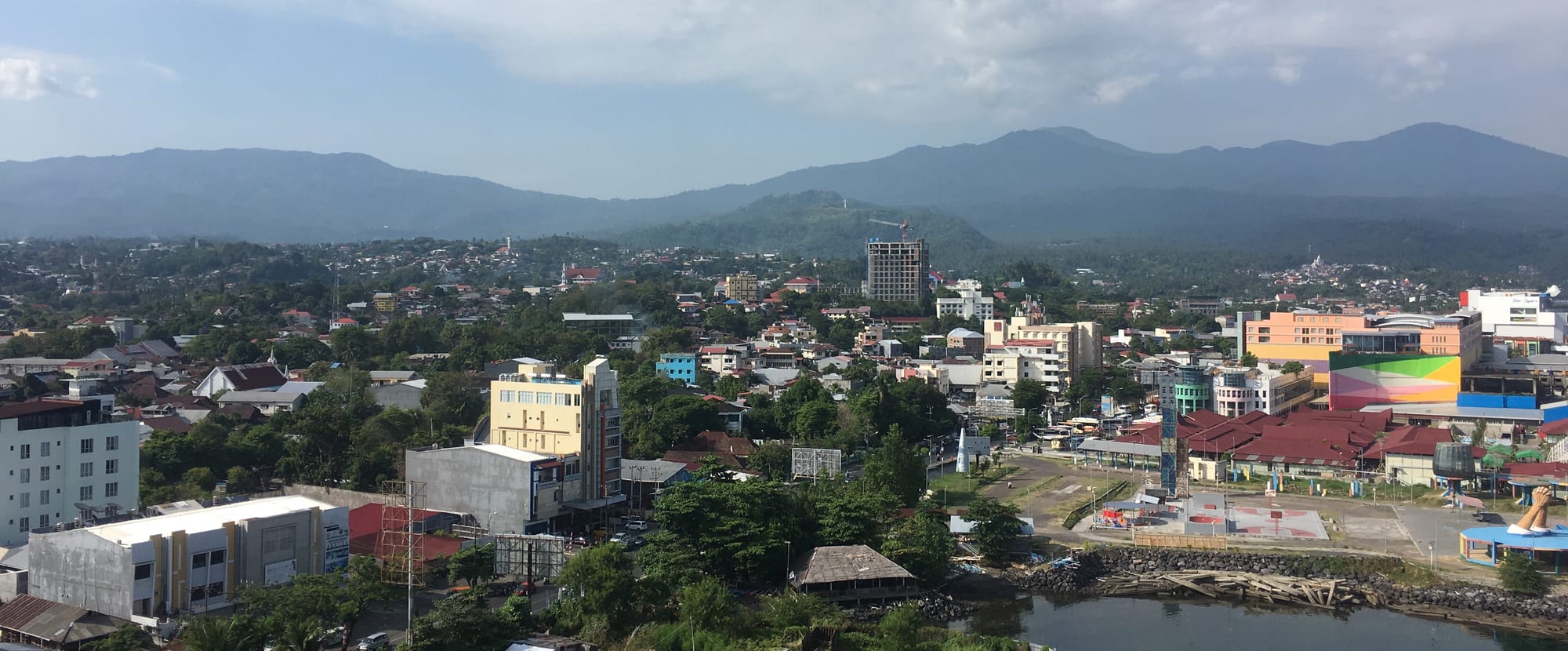
Low-rise city of red and white roofs seen from above, running back from the water to blue forested mountains

Sulawesi, Indonesia

Manado

Manado seen from a waterfront building, with the hills of Minahasa behind. (Juxlos / Wikimedia Commons · CC BY-SA 4.0)

The capital of North Sulawesi, at the head of a bay on the island's northern tip, and the main city of the largely Protestant Minahasa people. A Dutch fort town that grew into a provincial capital of churches, markets and a reclaimed waterfront strip, it is best known abroad as the gateway to the reefs of Bunaken and to the volcanoes and wildlife of the Minahasa highlands.

Neighbourhoods

  • Wenang and the old centre
    • First-time visitors
    • Markets
    • Historic district

    The original core beside the river mouth, where the Dutch fort once stood. Government offices, banks, churches, the Chinese temple and the sprawling central market sit within a few blocks, and the streets are busiest in the morning.

    Open in Maps
  • The Boulevard and Megamas
    • Waterfront
    • Best for food
    • Nightlife

    A strip of reclaimed land along the bay, built up from the 1990s with shopping malls, hotels, karaoke bars and rows of seafood and grilled-fish places. It is where the city goes in the evening, and where most sunset views over Manado Tua are had.

    Open in Maps
  • Sario and Titiwungen
    • Close to public transport
    • Quiet and residential

    The middle of the modern city between the old centre and the southern suburbs, with hotels, hospitals, schools and minibus routes running through. Handy rather than scenic, and an easy base for getting around.

    Open in Maps
  • Malalayang
    • Beaches
    • Local life

    The southern end of the city, where the coast road runs past black-sand beaches and warungs selling grilled fish. Boats leave from here for diving along the Malalayang shore, and the road continues south towards Tanawangko.

    Open in Maps
  • Winangun and the hill suburbs
    • Quiet and residential
    • Views

    The slopes rising inland from the bay, where newer housing estates look down over the city and out to the islands. Cooler and quieter than the centre, but dependent on a car or motorbike.

    Open in Maps
  • Bunaken and the islands
    • Beaches
    • Diving
    • Quiet and residential

    The islands across the bay, about an hour away by boat, where dive resorts and simple guesthouses line the shore of Bunaken and Siladen. Village life is slow, electricity can be limited, and the reef drop-offs are a few minutes from the beach.

    Open in Maps

Things to do

In the city

  • Ban Hin Kiong Templelandmark

    A Taoist temple in the old centre, established in 1819 and the oldest temple in the city, and the focus of its Chinese New Year processions.

    Open in Maps
  • Sam Ratulangi International Airporttransit hub

    The province's airport, named after the Minahasan nationalist Sam Ratulangi, and the way almost every visitor arrives.

    Open in Maps

Diving and the islands

  • Bunaken National Parkpark

    A marine park in the bay whose reef walls drop steeply into deep water; a permit fee applies to enter, and boats reach it from Manado in about an hour.

    Open in Maps
  • Manado Tuaviewpoint

    The old volcanic cone that closes the bay to the west, visible from most of the city and climbable from the village at its foot.

    Open in Maps
  • Bunakenbeach

    The main island of the marine park, with a fringing reef that drops away a short swim from the sand and a scattering of village guesthouses and resorts.

    Open in Maps

Short trips from the city

  • Tomohonattraction

    A cool highland town about 20 km inland, set below the volcanoes Lokon and Mahawu, known for its flower growing and for a wet market whose trade in dog and cat meat was banned in 2023.

    Open in Maps
  • Mount Lokonviewpoint

    An active volcano above Tomohon that erupts periodically; access depends on the exclusion zone in force at the time.

    Open in Maps
  • Mount Mahawuviewpoint

    A volcano near Tomohon with a short walk from a car park to a crater rim looking over the highlands to the sea.

    Open in Maps
  • Lake Tondanopark

    The largest lake in North Sulawesi, about 36 km from the city and 600 m above the sea, ringed by rice fields, fish farms and lakeside eating places.

    Open in Maps
  • Tangkoko Batuangus Nature Reservepark

    A coastal reserve beyond Bitung where spectral tarsiers and black crested macaques are seen at close range on guided walks.

    Open in Maps
  • Lembeh Straitattraction

    The channel off Bitung, about 45 km away, famous among divers for the small and strange animals of its black volcanic sand.

    Open in Maps
  • Mount Klabatviewpoint

    The highest volcano on Sulawesi, east of the city, with a shallow crater lake at the summit and no confirmed historical eruptions; walkers usually climb it through the night for sunrise.

    Open in Maps
  • Waruga at Sawanganlandmark

    Rows of carved stone Minahasan tombs gathered in a field north-east of the city, some 144 of them at Sawangan, the dead laid inside facing north until the Dutch banned the practice in 1828.

    Open in Maps

Seasonal events

  • Cap Go MehFebruary, fifteen days after Chinese New Year

    A long street procession from the Chinese temple through the centre, with drums, dragon dances and mediums, watched by the whole city.

  • Tomohon flower festivalonce a year

    A parade of floats decked with flowers through the highland town of Tomohon, run by the city each year and drawing visitors from across the province.

  • Pengucapan Syukurvariable, mostly June to September

    The Minahasan harvest thanksgiving, when villages take turns to hold church services and then open their houses to guests for a day of eating.

  • Christmas and New YearDecember

    The biggest season of the year in a largely Protestant province, with church services, decorated streets and family visits through to January.

Eat and drink

Long-standing places and food districts in Manado. Hours, ratings and directions come from your maps app, always current.

Manado classics

  • Tinutuanrestaurant

    The city's own breakfast — a thick porridge of rice, pumpkin, corn, cassava leaves and basil, eaten with salted fish, chilli sambal and fried snacks. Several places along Wakeke street in the centre cook little else.

    Open in Maps
  • Grilled fish on the Boulevardneighborhood

    Open-fronted places along the reclaimed waterfront grilling skipjack, snapper and squid, served with dabu-dabu, a raw relish of chilli, tomato, shallot and lime.

    Open in Maps
  • Klappertaartcafe

    A coconut custard tart left over from Dutch times, with young coconut, raisins and cinnamon, sold by bakeries across the city and taken home as a present.

    Open in Maps

Markets and food streets

  • Pasar 45market

    The big central market by the river mouth, selling fish, vegetables, spices and smoked cakalang tuna in tied bundles.

    Open in Maps
  • Tomohon marketmarket

    The highland market in Tomohon, known for its flowers and produce and for the wild-meat stalls at one end; the trade in dog and cat meat there was banned in 2023.

    Open in Maps
  • Malalayang beachfront warungsneighborhood

    Simple stalls along the southern shore serving fried and grilled fish with rice and sambal, with the sea a few steps away.

    Open in Maps

Experience Manado

History

The name Manado is thought to come from a Minahasan word for the island now called Manado Tua, which closes the bay to the west. Long before a town stood here, the Minahasa peoples of the surrounding hills lived in scattered villages bound by a council tradition, and Spanish and Portuguese ships called on the coast during the 16th century, leaving loanwords and Catholic converts behind them. The Dutch East India Company displaced them in the 17th century and built Fort Amsterdam at the river mouth in 1658; the settlement that grew around it became the seat of Dutch power in the north.

Minahasan leaders allied with the Dutch rather than resisting them, and the relationship shaped everything that followed. Protestant missionaries arrived in the early 19th century and converted most of the region within a few decades, schools spread early and in Dutch, and Minahasans went on to fill posts in the colonial army and administration across the Indies, which earned the area the nickname of the twelfth province of the Netherlands. Coffee, copra and cloves moved out through the port.

The 20th century brought harder times. Japanese forces landed in January 1942, taking the town in a landing supported by the first use of paratroops in Japanese military history. In 1958, during the Permesta rebellion against the central government, whose headquarters moved to the city that year, Manado was bombed in February and taken by government forces after an invasion in June. Since the 1990s the city has grown along the bay on reclaimed land, filling with malls, hotels and churches, while diving at Bunaken turned it into the tourism centre of eastern Sulawesi. Flash floods after sustained rain have repeatedly damaged low-lying districts, a reminder of how the rivers behave in the wet season.

Culture & Customs

Manado is the urban face of Minahasan culture: Protestant, outspoken, musical and fond of a party. Churches are everywhere and well attended, choirs are a serious business, and the calendar peaks at Christmas, when decorations go up early and the whole month is given over to services and family visits. The harvest thanksgiving, Pengucapan Syukur, is the other great occasion, with villages taking turns so that people can visit each other in succession.

Music runs through it. The kolintang, a set of tuned wooden bars played in ensembles, is the region's own instrument and is taught in schools; brass bands, choirs and karaoke all thrive, and North Sulawesi has sent a steady supply of singers to the national stage. The maengket dance, performed in rows by women in traditional dress, and the cakalele war dance of the coasts both survive as performance. The local language of daily life is Manado Malay, a relaxed dialect sprinkled with Portuguese, Dutch and Minahasan words, spoken loudly and with affection for nicknames.

The city has long had a mixed population: Minahasans from the hill districts, Sangirese from the islands to the north, Gorontalese and Bugis traders, and a Chinese community established for centuries around the Ban Hin Kiong temple, whose Cap Go Meh procession draws crowds of all faiths. Relations between Christians and Muslims are generally easy, and the phrase torang samua basudara — we are all family — is used so often that it functions as a civic motto.

Daily Life

About 460,000 people live in the city proper and some 1.4 million in the wider metropolitan area, which takes in Tomohon, Bitung and the Minahasa districts that the city effectively serves. It is the provincial capital, so government, education and health account for a great deal of employment, alongside trade, transport and a large informal economy of market stalls, drivers and food carts. Bitung, half an hour away, handles the heavy shipping and the tuna canneries; Manado keeps the offices, the malls and the university.

The day begins early. Markets open before dawn, tinutuan is eaten for breakfast standing up or sitting down, and the mikrolet minibuses fill with school children and office workers before the heat arrives. Traffic on the coast road and the few routes up the hills is slow at both ends of the day. Afternoons are quiet, and the city comes out again in the evening along the Boulevard, where families eat, teenagers gather and the malls stay busy until late.

Growth has come at a cost. Reclamation has walled off parts of the bay from the old town, the rivers that run through the city flood after sustained rain, and hillside building has made landslides more common. Tourism is now a significant employer, but it is concentrated on the islands and the dive boats rather than in the city, and many residents also work seasonally in Java or abroad as sailors, nurses and domestic staff — a Minahasan habit of travel that goes back generations.

Food

Minahasan cooking is among the spiciest in Indonesia, built on chilli, ginger, lemongrass, turmeric leaf and the scented lemon basil called kemangi. Rica-rica, meaning chilli, describes any dish cooked in a fierce paste of ground chillies and shallots; woku is its herb-heavy cousin, usually made with fish; and dabu-dabu, a raw relish of chopped chilli, tomato, shallot and lime, is spooned over everything grilled. The everyday fish is cakalang, skipjack tuna, eaten fresh or as cakalang fufu, split, cured and smoked over a fire until it keeps for days.

The city's signature is tinutuan, also called bubur Manado — a thick porridge of rice cooked down with pumpkin, sweet corn, cassava leaves and basil, served with salted fish, sambal, and a fritter of some kind on the side. It is breakfast, hangover cure and comfort food at once. Snacks are taken seriously: panada, pasties filled with spiced cakalang; lalampa, sticky rice with fish grilled in banana leaf; biapong, steamed buns of Chinese descent; and brenebon, a bean and pork soup whose name comes straight from the Dutch. Klappertaart, a soft coconut and custard tart, is the classic thing to carry home.

Drinking is open here in a way it is not in much of the country. Hot ginger with palm sugar is sold at roadside stalls; cap tikus, a spirit distilled from palm wine, is a Minahasan institution and, made at home and unregulated, the cause of many warnings about untested alcohol. Some Minahasan dishes use meats that outsiders find difficult — fruit bat, rats and snake are sold at the Tomohon market and eaten at feasts, and the sale of dog and cat meat there was banned in 2023 — and visitors are best advised simply to ask what they are being offered.

Planning tools

Budget

Everyday costs in the city are low: warung meals, minibuses and simple hotels cost little. Diving is what sets the budget — island resorts, day-boat trips, equipment hire and the marine-park entry fee add up quickly, and the flight in from Jakarta or Makassar is usually the single largest item. Guided trips to Tangkoko and the highlands are priced per car and guide, so sharing them helps.

Daily Budget Midrange
USD 50–120 (dive resort or good hotel, daily diving, guided visits, transfers)
Daily Budget Shoestring
USD 20–35 (guesthouse, warung meals, minibuses and public boats)

Island resorts are usually booked as full-board packages including boats, so compare the whole price rather than the room rate, and carry cash for the islands, where card payment is rare.

Best Time to Visit

Diving is possible all year, with the calmest seas and best visibility generally from about April to November, which is also when rain is lighter in the north. December to March brings heavier downpours, rougher crossings and occasional flooding in the city. The Tomohon flower parade and, in February, the Chinese New Year processions add to the calendar.

Suggested Number of Days

Two or three days cover the city and a day on the water. Divers usually stay a week or more, based on the islands. Add days for the highlands and for the wildlife reserve beyond Bitung, as each is a long half-day or more by road.

First Visit
2–3 days
With Surroundings
5–7 days

Transportation

Blue minibuses called mikrolet run fixed routes across the city from terminals near the central market, cheaply and without timetables. Motorcycle taxis and ride-hailing apps cover everything else, and hiring a car with a driver is the normal way to reach the highlands, Bitung or Tangkoko. Boats to Bunaken and Siladen leave from the city and from Malalayang, most of them in the morning.

Prices for motorbike rides and chartered boats are agreed before setting off rather than metered, and public crossings to the islands are infrequent and mostly run early in the day, so return times are worth checking locally.

Airport & Station Connections

Sam Ratulangi International Airport is about 13 km north-east of the centre, roughly half an hour by road, with frequent flights to Jakarta, Makassar and Surabaya and a smaller number of international services. Pelni passenger ships call at the port, and long-distance buses and shared cars run to Gorontalo and beyond, a journey of many hours.

Walkability

The old centre and the waterfront strip are flat and walkable, and the Boulevard is a pleasant walk in the evening. Beyond that the city spreads along the coast and up steep hills, pavements are broken or missing, traffic is heavy and the heat is constant, so most journeys are made by minibus or motorbike even when the distance is short.

Safety

Manado is a calm provincial city with little violence directed at visitors; petty theft in markets and on the waterfront is the usual problem. The real risks are natural and practical: North Sulawesi is seismically active and its volcanoes erupt periodically, heavy rain causes flooding and landslides in the city and on the hill roads, and boat trips and diving carry the usual hazards. Traffic is dense and motorbikes move unpredictably.

Use reputable dive operators, avoid overloaded boats, and check local conditions before travelling. Wear a helmet and only ride a scooter if experienced, avoid cheap cocktails and home-brewed spirits, dress modestly outside Bali and beach resorts, and heed volcano exclusion zones and tsunami warnings. Check current official travel advice before travelling.

Climate

Equatorial, hot and humid in every month, with days around 31–32°C and nights near 23°C. Rain falls all year but is heaviest from about November to March, when downpours can flood low-lying streets; the middle months are drier and the sea calmer. The highlands around Tomohon are several degrees cooler and often misty.

Summer
June–September: the drier, calmer half of the year, about 31–32°C by day and 23°C at night, with brief showers
Winter
November–March: the wet season, similar temperatures near 31°C but much heavier rain, rough crossings and a risk of flooding and landslides

Local Customs

This is a largely Protestant city in a mainly Muslim country, so churches rather than mosques set the Sunday rhythm, pork and alcohol are openly sold, and there is a sizeable Muslim minority as well as a long-settled Chinese community. People are sociable and direct, and hospitality tends to involve large amounts of food. Modest dress is still expected away from beaches and dive boats, and shoes come off indoors.

Tipping is not expected beyond rounding up or a small sum for a guide or boat crew. Ask before photographing people, and dress and behave quietly around churches on Sunday mornings and at funerals, which are large public occasions here.

Common Payment Methods

The currency is the Indonesian rupiah. Cards work in hotels, malls and larger restaurants in the city, and ATMs are easy to find in the centre and along the Boulevard, but warungs, markets, minibuses and boat crews are cash only. The islands have effectively no banking, so draw enough cash before crossing. Rupiah notes run into the hundreds of thousands, and small vendors rarely have change for large ones.