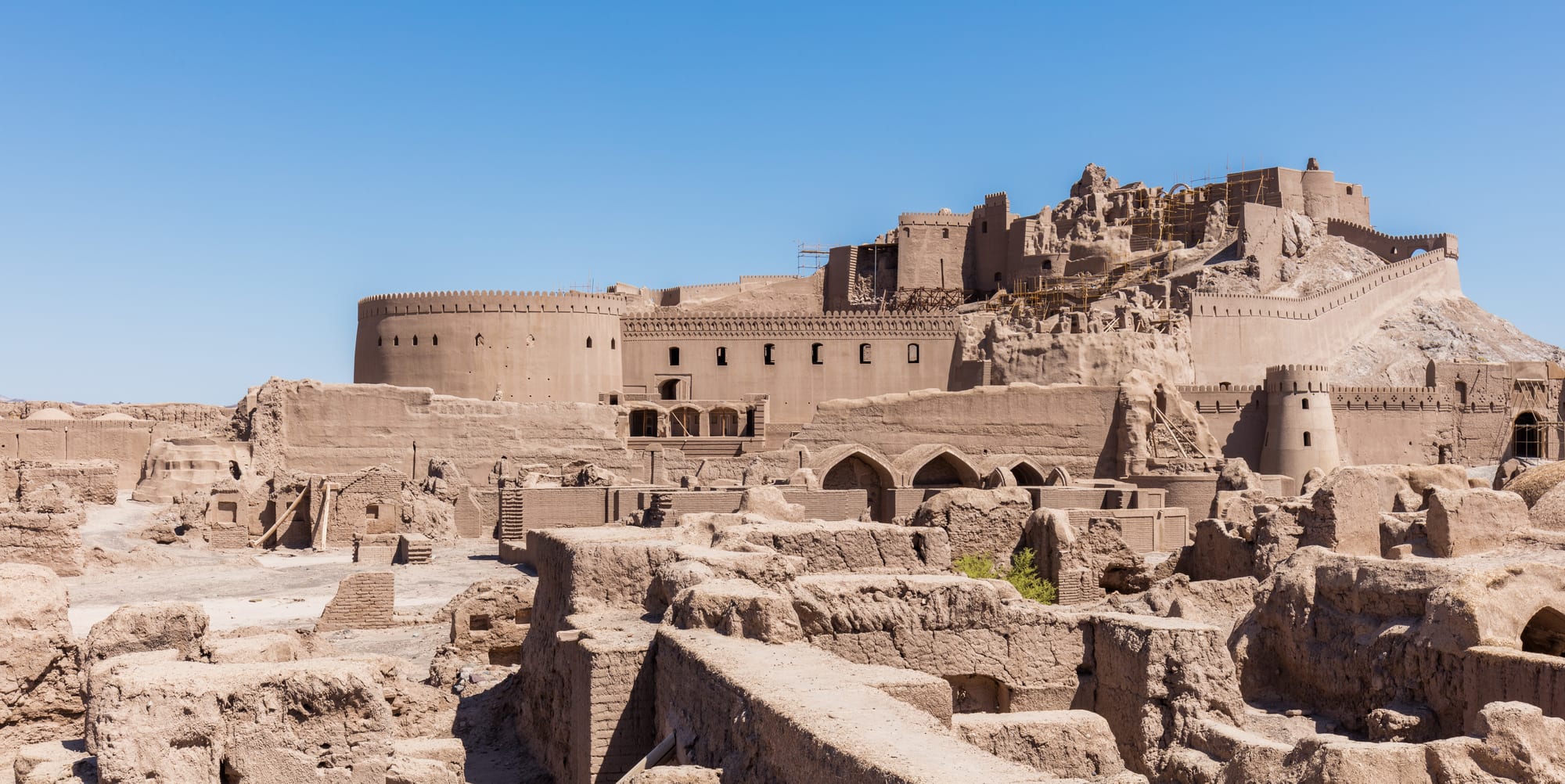
Mud-brick walls, towers and ruined houses of the citadel at Bam rising in tiers to a fortified summit under a clear blue sky

Mashhad, Yazd & the East, Iran

Bam

The mud-brick citadel of Arg-e Bam above the ruins of the walled town below it. (Diego Delso / Wikimedia Commons · CC BY-SA 4.0)

A date-palm oasis town in south-eastern Kerman province, watered by qanats on the desert edge and known above all for Arg-e Bam, an enormous mud-brick fortified town at its northern edge. An earthquake in December 2003 destroyed most of the modern town and much of the citadel, and both have been rebuilt since. This page is written to explain the town, not to encourage travel.

Neighbourhoods

  • The citadel and its edge
    • First-time visitors
    • Historic district

    The northern edge of the town, where the walls of Arg-e Bam rise straight out of the plain. The streets below hold the ticket entrance, a few shops and the approach road, and the citadel itself is a walled town rather than a single building.

    Open in Maps
  • The modern centre
    • Hotels and shops
    • Local life

    Almost everything here was rebuilt after the 2003 earthquake, in low-rise blocks along straight avenues. It holds the town's shops, bakeries, bus station and most of its small hotels and guesthouses.

    Open in Maps
  • The date groves
    • Quiet and residential
    • Walks

    Palm gardens surround the built-up area on all sides, fed by qanats and irrigation channels. Walled orchards, mud-brick field walls and citrus trees fill the ground between the scattered settlements.

    Open in Maps
  • Baravat
    • Quiet and residential
    • Historic district

    A neighbouring oasis city about seven kilometres east, with its own palm gardens and qanats, administratively separate from Bam but effectively continuous with it.

    Open in Maps

Things to do

The citadel and its landscape

  • Arg-e Bamlandmark

    One of the largest mud-brick structures in the world — a walled town of houses, stables, a bazaar, a mosque and a garrison, rising to a governor's citadel, badly damaged in 2003 and rebuilt over many years.

    Open in Maps
  • Bam and its Cultural Landscapeattraction

    The UNESCO World Heritage Site that covers not only the citadel but the qanats, gardens, fortresses and irrigated oasis that made settlement here possible.

    Open in Maps

The oasis

  • The palm groves and qanatspark

    Irrigated date gardens ring the town, watered by underground channels that run down from the mountains; tracks between the walled plots are quiet walking in the cooler months.

    Open in Maps

Short trips from the town

  • Rayen Castlelandmark

    A smaller mud-brick fortified town, intact where Bam's was damaged, standing on the plateau north-west of Bam beneath the mountains.

    Open in Maps
  • Kermanattraction

    The provincial capital, with a long covered bazaar and the Safavid Ganjali Khan complex, reached in around three hours by road.

    Open in Maps
  • Lut Desertattraction

    The great salt and sand desert north-east of the city of Kerman, inscribed as a UNESCO World Heritage Site in 2016, whose wind-carved kalut ridges include the hottest land surface ever measured on earth.

    Open in Maps

Seasonal events

  • The date harvestlate summer and autumn

    Picking and packing the Mazafati dates for which Bam is known dominate the oasis from about August, and the fresh crop is sold across Iran.

  • Nowruzlate March

    The Persian new year, marked with house visits and picnics in the palm gardens, and the main season for domestic visitors.

  • Ramadanvaries with the lunar calendar

    A month of daytime fasting, when eating and drinking in public are not acceptable and the town comes to life after sunset.

  • Muharram and Ashuravaries with the lunar calendar

    Days of mourning for Imam Husayn, marked with processions through the streets and food distributed to neighbours.

Eat and drink

Long-standing places and food districts in Bam. Hours, ratings and directions come from your maps app, always current.

Bam classics

  • The date and pastry shopsmarket

    Shops in the centre sell Mazafati dates fresh and packed, along with kolompeh, the date and cardamom pastry of Kerman province, and local citrus in winter.

    Open in Maps
  • The town centre's grill housesneighborhood

    Bam's eating places are plain kebab and rice restaurants, bakeries and juice bars along the main avenues of the rebuilt centre.

    Open in Maps

Experience Bam

History

Bam grew where qanats — underground channels cut back into the alluvial fan of the mountains — brought enough water to the desert edge to support date palms, citrus and a walled town. Settlement here is very old, and the citadel's origins are usually placed in the Achaemenid or Parthian period, with most of what stands today built and rebuilt from the Safavid era onwards. The town sat on the routes between the Persian Gulf, Kerman and the Indian frontier, and it grew rich on trade, above all on silk and cotton cloth.

Arg-e Bam was not a castle but a fortified town of about eighteen hectares, holding a residential quarter, a bazaar street, a congregational mosque, stables and army barracks, with the governor's quarters on a rocky hill behind a double fortification wall. An outer wall some 1,815 metres long, carrying thirty-eight watchtowers and four gates, and a moat ran around the whole. It was lived in until the 19th century, after which the population moved out to the modern town on the plain; a garrison stayed inside the walls until 1932, and the rest was left to the weather.

At 5.26 in the morning on 26 December 2003 an earthquake struck directly beneath the town. More than 26,000 people were killed, most of the modern town collapsed, and the citadel, built of unfired mud brick, largely fell. Relief came from many countries, and the rebuilding that followed was substantial: a new town of low-rise, earthquake-resistant buildings, and a long restoration of the citadel using traditional materials, carried out with international help. UNESCO inscribed Bam and its Cultural Landscape as a World Heritage Site soon afterwards.

Culture & Customs

Bam's culture is that of an oasis: shaped by water, dates and the long distances of the Kerman plain. The qanat system that sustains the gardens has needed cooperative management for centuries, and ownership of water shares, like ownership of palms, runs through families. Bam and Baravat keep the rhythm of rural Kerman province, with neighbourly obligation, large extended families and an emphatic hospitality in which refusing tea or dates is almost impossible.

The 2003 earthquake is the central fact of local memory. Few families were untouched, and the reconstruction — rapid, foreign-assisted and much debated — reshaped the town physically and socially. The restoration of the citadel became a matter of national feeling as well as heritage policy, with mud brick made and laid in the old way, and it turned the site into a symbol of recovery rather than only of loss.

Religious life follows the Shia calendar of the province, with Muharram processions and Ramadan evenings the main public occasions of the year, alongside Nowruz in spring, when families picnic in the palm gardens. Traditional crafts of the district include palm-frond weaving and, in the wider province, pateh embroidery and carpet weaving. Kerman Persian is spoken with a distinct southern accent, and Baluch families from further east are part of the town's population.

Daily Life

About 127,000 people lived in Bam at the 2016 census, with more in Baravat and the surrounding rural districts. Agriculture is the economy: dates above all, especially the soft dark Mazafati variety for which the district is known nationally, together with citrus and other irrigated crops. Packing, processing and transport follow the harvest, and the seasonal work draws labour from outside the district.

The town people live in is almost entirely post-2003. Low-rise housing on wide streets replaced the dense older quarters, with new schools, clinics and public buildings, and an emphasis on earthquake resistance. A special economic zone was established outside the town to bring industry and assembly work, with mixed results, and many younger people still leave for Kerman or further afield.

Water is the permanent worry. Qanats and wells are drawn on harder than the aquifer can bear, drought has cut yields, and the palm gardens depend on a supply that is not secure. The day follows the sun: early starts, a long pause through the afternoon in summer, and streets that refill in the evening. Bam's position on the road towards the Pakistani border also makes smuggling and policing a constant feature of provincial life. Like the rest of the country, the town has lived through years of sanctions, high inflation and, since February 2026, war.

Food

Dates are the foundation of everything. Bam's Mazafati dates are dark, soft and almost syrupy, eaten fresh in season and kept chilled the rest of the year, and they turn up with tea, in pastries, pressed into bread and cooked into sweets. The regional pastry is kolompeh, a pie-like case filled with minced dates and cardamom and often finished with pistachio or sesame, baked in Kerman and bought by the box.

Everyday cooking is that of southern Kerman: lamb or chicken kebab grilled over charcoal and served with saffron rice, grilled tomato and flatbread; abgusht, the lamb, chickpea and potato stew whose broth is soaked up with bread before the solids are pounded to a paste; and thick ash soups of pulses, noodles and herbs. Bread comes hot from the neighbourhood oven several times a day.

Drinking means tea, poured black and strong and taken with a date held in the mouth, and in the heat the cold drinks of the plateau: doogh, salted yoghurt thinned with water and mint, and sharbats of rosewater, sour cherry or sweet basil seeds. Citrus from the oasis gardens makes fresh juice in winter, and pistachios and walnuts from further north are sold alongside the dates. Alcohol is illegal.

Planning tools

Budget

Bam is a cheap place to stay, with a small number of guesthouses and modest hotels rather than any range to choose from. Food costs very little. The real expenses are getting here and getting around, since the citadel, the oasis and anything beyond the town need a taxi or a hired car. Cash is essential.

Daily Budget Midrange
USD 45–90 (a modest hotel, restaurant meals, a car and driver for the day)
Daily Budget Shoestring
USD 15–25 (guesthouse bed, bakery and kebab-house food, buses and shared taxis)

Bring enough cash from Kerman, as there is no way for visitors to draw money on a foreign card.

Best Time to Visit

November to March, when days on this southern plain are warm and clear and nights cool — the same season that suits the deserts to the north. Spring is pleasant but short. Summer is severe, with long spells above 40°C. That is the ordinary calendar, and it no longer describes the present. Since 28 February 2026 Iran has been at war with the United States and Israel, and there is at present no good time to go.

Suggested Number of Days

The citadel and the oasis fill a day for most visitors, and many people travel in and out from the provincial capital within that time. Staying longer suits anyone who wants an unhurried pace, the fortresses and gardens of the surrounding district, or a break in the long road journey.

First Visit
1 day
With Surroundings
2 days

Transportation

The town is small and its centre can be walked, but the citadel sits at the northern edge and the date groves spread for several kilometres, so shared taxis and private taxis do most of the work. There is no urban public transport of consequence. For Rayen, the desert or anywhere off the main road, visitors hire a car with a driver. That is the peacetime picture: the war that began in February 2026 has disrupted aviation across the region, and what is open at any given airport, road or border crossing has changed repeatedly.

Agree taxi fares before setting off, avoid travelling by road at night in this part of the province, and check what is running before relying on any route.

Airport & Station Connections

Bam lies about three hours south-east of Kerman by road, on the route that continues towards Zahedan and the Pakistani border, and long-distance buses and shared taxis are the normal way in. The railway south from Kerman also reaches the town, and there is a small airport with occasional domestic flights. Schedules on all of them have been unreliable since the war began.

Walkability

The rebuilt centre is flat, laid out on straight streets and easy enough on foot, though it is spread out and short of shade. The citadel is walked around and through, over uneven mud-brick surfaces and ramps that climb to the upper fortress, which takes a couple of hours and is hard going in heat. Tracks through the palm groves are level and quiet.

Safety

Several governments strongly advise against travel to Iran, and dual nationals face particular risks. Bam lies on the main road towards Sistan and Baluchestan, the part of the country that carries the strongest warnings, with armed insurgency, smuggling across the Afghan and Pakistani borders and a risk of kidnapping; roads south and east of here are the concern rather than the town itself. Heat and the long empty distances are the other real dangers.

Since 28 February 2026 Iran has been at war with the United States and Israel. Take the strongest advisories on Sistan and Baluchestan seriously, do not travel by road after dark, carry plenty of water, and dress conservatively. Check current official travel advice before travelling.

Climate

Hot desert climate, lower and warmer than Kerman, with about 60 mm of rain a year and very dry air. Winter days are mild and sunny with cold nights; the summer heat is extreme and the middle of the day is spent indoors.

Summer
very hot and dry, often above 40°C by day, with warm nights
Winter
mild and sunny, generally around 20°C by day, with chilly nights and occasional frost

Local Customs

This is a small, conservative town in a rural province, and dress is watched more closely than in the big cities. Women must cover their hair and wear loose clothing that covers the arms and legs; men wear long trousers. Greetings are formal and hospitality is insistent — visitors are routinely offered tea and dates and should expect an offer to be repeated after it is refused.

Ask before photographing people, especially women, and do not photograph military sites, checkpoints or government buildings. Alcohol is illegal. Accept tea when it is offered.

Common Payment Methods

The currency is the Iranian rial, though prices are quoted in tomans, each worth ten rials. Sanctions mean foreign bank cards and international cash machines do not work anywhere in the country, so visitors bring cash in euros or dollars to change in a larger city, or use a prepaid local tourist card. In a town this size, cash is what everyone uses.