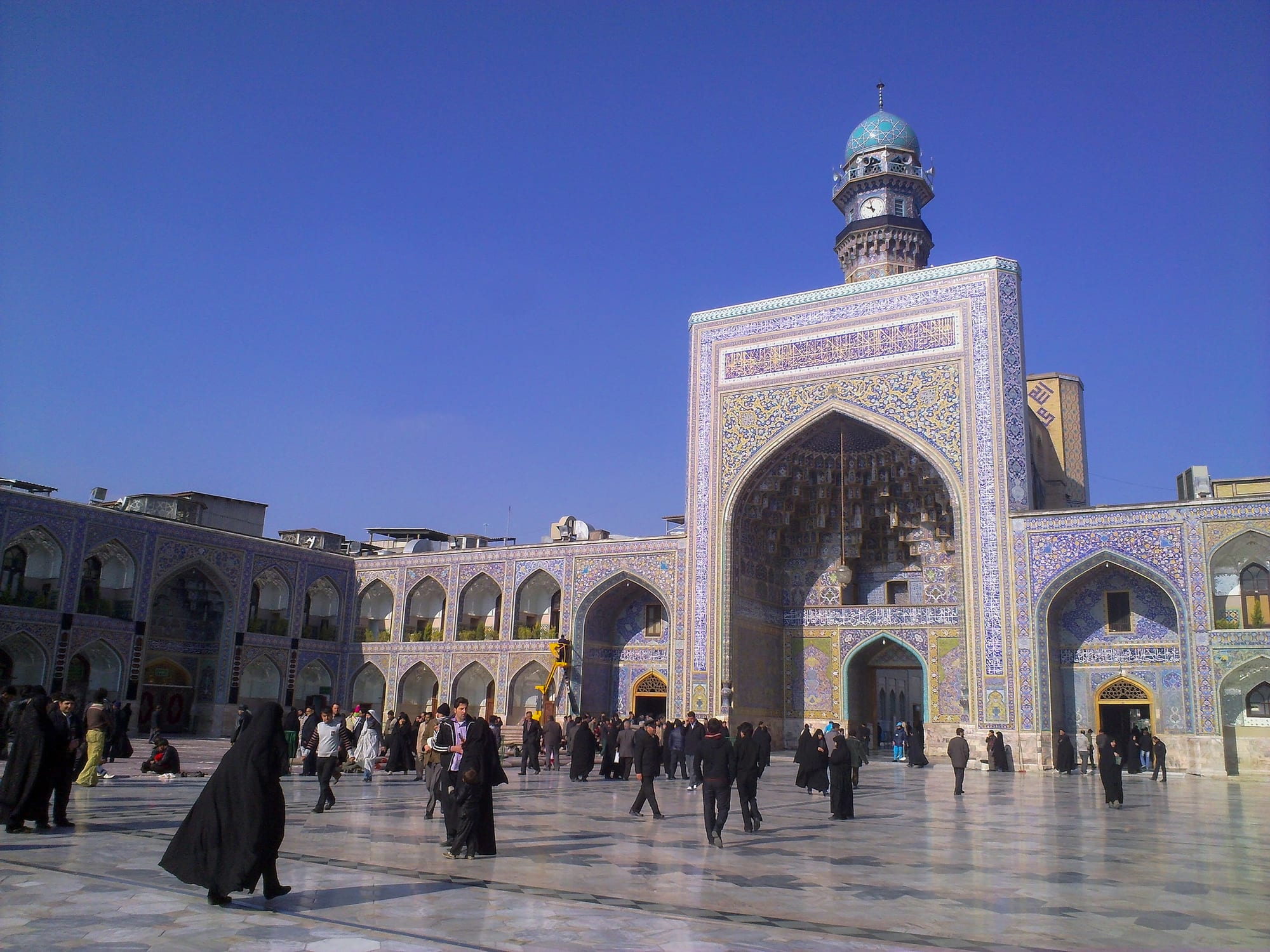
A tiled iwan portal and turquoise-domed minaret rising above a marble courtyard in the Imam Reza shrine at Mashhad

Mashhad, Yazd & the East, Iran

Mashhad

A courtyard of the Imam Reza shrine complex in Mashhad. (Mostafameraji / Wikimedia Commons · CC BY-SA 4.0)

Iran's second city, in the north-east near the Turkmen and Afghan borders, grown from a village into a metropolis of more than three million around the tomb of Imam Reza, the eighth Shia imam. The gold-domed shrine complex fills the centre and draws millions of pilgrims a year. This page is written to explain the city, not to encourage travel.

Neighbourhoods

  • Around the shrine
    • First-time visitors
    • Pilgrim hotels
    • Close to public transport

    The dense heart of the city, where wide pedestrian approaches, hotels, prayer-goods shops and eating houses press up against the walls of the shrine complex. It is busy day and night, at its most crowded during religious anniversaries, and dress and behaviour are watched closely here.

    Open in Maps
  • Ahmadabad
    • Restaurants and cafes
    • Quiet and residential

    A long boulevard running south-west of the centre, lined with clinics, offices, bookshops and cafes. It is one of the city's older middle-class districts and feels far calmer than the streets around the shrine.

    Open in Maps
  • Sajjad and the western boulevards
    • Modern hotels
    • Shopping

    The newer west of the city, built along broad avenues such as Sajjad and Vakilabad, with shopping centres, restaurants and much of Mashhad's modern housing. Distances here are long and most journeys are made by car or metro.

    Open in Maps
  • Kooh Sangi
    • Parks
    • Quiet and residential

    A southern district named after the rocky hill at its edge, where a large public park at the foot of the slope is a traditional place for families to walk in the evening.

    Open in Maps
  • Torqabeh and Shandiz
    • Best for food
    • Day out of the city

    Two small towns in the green valleys west of Mashhad, reached in well under an hour. They are the city's weekend escape and the home of its best-known kebab restaurants, set in gardens along the streams.

    Open in Maps

Things to do

The shrine complex

  • Imam Reza shrinelandmark

    The mausoleum of the eighth Shia imam and the reason the city exists — a walled complex of courtyards, gold domes, mirrored halls, mosques and museums, parts of it closed to non-Muslims.

    Open in Maps
  • Goharshad Mosquelandmark

    A Timurid congregational mosque inside the shrine complex, built in the early 15th century for Goharshad, wife of the ruler Shah Rukh, and known for its tilework.

    Open in Maps
  • Central Library of Astan Quds Razaviattraction

    The shrine's library and a centre for Islamic research, holding tens of thousands of manuscripts and lithographic books, and tracing its origins to a tenth-century endowment of a Quran.

    Open in Maps

Elsewhere in the city

  • Tomb of Nader Shahlandmark

    A mausoleum and garden holding the remains of Nader Shah, the 18th-century ruler who made Mashhad the capital of Iran, completed in 1963 to a design by Hooshang Seyhoun.

    Open in Maps
  • Ferdowsi University of Mashhadlandmark

    Iran's third oldest university, set in a large wooded campus in the west of the city that doubles as a public green space.

    Open in Maps
  • Mashhad Urban Railwaytransit hub

    The city's metro, whose lines cross Mashhad from the airport and the western boulevards to the area around the shrine.

    Open in Maps
  • Kooh Sangi Parkpark

    A public park below a rocky outcrop in the south of the city, with pools, paths and a view back over the built-up plain.

    Open in Maps

Short trips from the city

  • Tusattraction

    The ancient city north-west of Mashhad that Mashhad eventually replaced, with the remains of its walls and citadel still visible on the plain.

    Open in Maps
  • Tomb of Ferdowsilandmark

    The mausoleum at Tus of the poet Ferdowsi, author of the Shahnameh, rebuilt in the 1930s in a style drawn from ancient Persian architecture.

    Open in Maps
  • Nishapurattraction

    A historic city of Khorasan about 70 kilometres west, once one of the great centres of the medieval Islamic world and long known for its turquoise mines.

    Open in Maps
  • Tomb of Omar Khayyamlandmark

    The open lattice monument at Nishapur over the grave of the poet, astronomer and mathematician Omar Khayyam, completed in the 1960s.

    Open in Maps
  • Kangattraction

    A village in the mountains west of Mashhad, in the same green valleys as Torqabeh and Shandiz, reached by a road that climbs above the streams.

    Open in Maps

Seasonal events

  • Nowruzlate March

    The Persian new year, when Mashhad receives one of its heaviest influxes of domestic visitors and hotels fill for a fortnight.

  • Ramadanvaries with the lunar calendar

    A month of daytime fasting, when eating and drinking in public are not acceptable and much of the city's life shifts to the evening.

  • Muharram and Ashuravaries with the lunar calendar

    Days of mourning for Imam Husayn marked by processions, black drapes across the streets and free food distributed in the city.

  • The anniversaries of Imam Rezavaries with the lunar calendar

    The birth and death anniversaries of the imam bring vast crowds to the shrine and its approaches, and rooms across the city are booked far ahead.

Eat and drink

Long-standing places and food districts in Mashhad. Hours, ratings and directions come from your maps app, always current.

Food districts and markets

  • The bazaar and shops around the shrinemarket

    Covered arcades and shopfronts on the approaches to the shrine selling saffron, barberries, dried fruit, nuts and nabat crystallised sugar, alongside prayer goods and souvenirs.

    Open in Maps
  • Ahmadabadneighborhood

    A boulevard of cafes, juice bars, pastry shops and restaurants that serve the city rather than the pilgrim trade.

    Open in Maps

Out of town for kebab

  • Shandizneighborhood

    A small town west of Mashhad whose garden restaurants are known across Iran for shishlik, large pieces of lamb grilled over charcoal and served with rice and bread.

    Open in Maps
  • Torqabehneighborhood

    The neighbouring valley town, with more grills, teahouses and stalls selling dried fruit and nuts along the road.

    Open in Maps

Experience Mashhad

History

Mashhad began as the village of Sanabad, beside the much older city of Tus, where the Abbasid caliph Harun al-Rashid was buried in 808. Ten years later Ali al-Rida, the eighth imam of Twelver Shia Islam and known in Iran as Imam Reza, died there and was buried in the same place. The site took the name Mashhad, "the place of martyrdom", and a shrine grew over the grave. Pilgrims came, and a town gathered around them.

The shrine was sacked more than once — by the Ghaznavids and later during the Mongol invasions, which also destroyed Tus — and each time it was rebuilt larger. Under the Timurids the complex gained the Goharshad Mosque, completed in the 1420s for Goharshad, the wife of Shah Rukh, and finished around 1430. When the Safavids made Twelver Shia Islam the religion of the state in the 16th century, Mashhad became the country's supreme place of pilgrimage, and the shrine acquired the gilded dome and minarets that still define it. Shah Abbas I walked there from Isfahan.

In the 18th century Nader Shah, a Khorasani who seized the throne after the Safavids fell, made Mashhad his capital, and he is buried in the city. The following two centuries brought a long, steady growth on pilgrim traffic, and after the revolution of 1979 the shrine's foundation, Astan Quds Razavi, became one of the largest institutions in the country, with landholdings, factories and a construction programme that cleared and rebuilt much of the old centre around the complex. The city expanded west across the plain and is now second in size only to Tehran.

Culture & Customs

Mashhad's culture is inseparable from the shrine. The religious calendar sets the rhythm of the year, the flow of visitors and the trade of the streets; black drapes appear across whole boulevards during Muharram, and the anniversaries of the imam fill the courtyards to capacity. Free food is cooked and distributed on a very large scale, an old tradition of the shrine kitchens, and hospitality towards pilgrims is a point of civic pride. The city receives far more Iranian than foreign visitors, and many arrive as extended families making the journey together.

It is also the capital of Khorasan, a region with its own long literary and musical identity. Ferdowsi, whose Shahnameh preserved Persian epic and much of the language itself, was from Tus a few kilometres away, and Omar Khayyam and the poet Attar are buried at Nishapur; all three are national figures, and their tombs are visited almost as reverently as the shrine. Khorasan's bakhshi bards, who sing epic and love poetry to the two-stringed dotar, are recognised by UNESCO as intangible heritage, and the province's Kurdish and Turkmen communities keep their own music and dress.

Manners in the city are formal and conservative. Dress codes are enforced more firmly than in Tehran, quiet behaviour is expected near the shrine, and the elaborate courtesies of Persian taarof — repeated offers, polite refusals — are part of every transaction.

Daily Life

More than three million people live in Mashhad, making it Iran's second largest city, and many millions more pass through each year as pilgrims. That traffic is the economy: hotels and guesthouses at every price, transport, catering, prayer goods, souvenirs, saffron and nut shops, and the vast property and commercial interests of the shrine foundation. Around it sit food processing, textiles, car assembly and the trade of a regional capital serving the whole of Khorasan.

The city has grown outwards in rings. The old quarters around the shrine were largely demolished and rebuilt in the decades after 1979, replaced by hotels and pedestrian approaches, while the middle classes moved west along Ahmadabad, Sajjad and Vakilabad into apartment blocks and gated compounds. Poorer neighbourhoods lie to the south and east, and the city has absorbed large numbers of Afghan refugees and migrants, many working in construction and small workshops.

Days begin early and pause in the afternoon heat of summer. Families walk in the parks in the evening, weekends mean picnics in the Torqabeh and Shandiz valleys, and the metro and shared taxis carry the working population across long distances. Water is a constant concern in a dry province, as is air quality in winter. Like the rest of the country, the city has lived through years of sanctions, high inflation and, since February 2026, war.

Food

Mashhad's own dish is sholeh mashhadi, a thick, long-cooked porridge of meat, pulses, rice and herbs, dark and heavily spiced, sold from large pots and often prepared in quantity for religious occasions. The other local standby is dizi, or abgusht, a stew of lamb, chickpeas and potato served in a stone pot, its broth poured over torn bread and the solids then pounded to a paste at the table.

The great eating tradition of the region, though, is kebab in the valleys west of the city. Shandiz and Torqabeh are known across Iran for shishlik, large pieces of lamb grilled over charcoal, eaten in garden restaurants beside running water with saffron rice, grilled tomatoes, herbs and flatbread. Doogh, salted yoghurt thinned with water and flavoured with mint, is the usual drink alongside.

Khorasan is Iran's saffron province, and the shops around the shrine sell it by weight beside barberries, pistachios, walnuts and dried fruit. A large part of the trade is sweets — gaz and sohan among them — and the shops also sell nabat, crystallised sugar on a stick, often coloured with saffron and stirred into tea. Sweetened saffron rice puddings, rosewater pastries and endless small glasses of black tea complete the picture; alcohol is illegal, and teahouses and juice bars take its social place.

Planning tools

Budget

Mashhad is inexpensive by international standards and has an enormous stock of pilgrim hotels, from dormitories to large modern towers, which keeps prices low outside the religious high season. Rooms near the shrine cost more than those in the west of the city, and rates rise steeply during Nowruz and the major religious anniversaries. Cash is essential.

Daily Budget Midrange
USD 45–90 (mid-range hotel, restaurant meals, a car and driver for a day out to Tus or Nishapur)
Daily Budget Shoestring
USD 20–30 (pilgrim guesthouse or hostel bed, bazaar food, metro and shared taxis)

Book well ahead for Nowruz and the shrine's anniversaries, and expect to pay for everything in cash.

Best Time to Visit

Spring and autumn suit Mashhad best, when days are mild and the Binalud foothills are at their greenest or clearest. Summer is hot and dry and winter brings cold and occasional snow. The shrine is extremely crowded on major religious anniversaries and at Nowruz. That is the ordinary calendar, and it no longer describes the present. Since 28 February 2026 Iran has been at war with the United States and Israel, and there is at present no good time to go.

Suggested Number of Days

The shrine and the centre occupy a couple of days for most visitors. Add a day or two for the towns and monuments of the surrounding plain, which are spread over long distances and need a car. Religious crowds slow everything down and can add time.

First Visit
2 days
With Surroundings
3–4 days

Transportation

The city is large and spread out, and most journeys are made by taxi or by the Mashhad Urban Railway, whose lines cross the city and serve the area around the shrine. Buses cover the rest, and shared taxis running fixed routes along the main boulevards are the everyday way to move. The streets immediately around the shrine are largely pedestrian. That is the peacetime picture: the war that began in February 2026 has disrupted aviation across the region, and what is open at any given airport, road or border crossing has changed repeatedly.

Agree a taxi fare before setting off, and allow extra time on the approaches to the shrine, which close to traffic when crowds are heavy.

Airport & Station Connections

Mashhad has the country's second-busiest airport, a short drive south-east of the centre, with domestic flights and, in normal times, regional international services carrying pilgrims. Trains from Tehran run overnight across the desert, and long-distance buses connect the city with the rest of Khorasan and with the major cities to the west. Schedules on all of them have been unreliable since the war began.

Walkability

The area around the shrine is made for walking, with broad paved approaches, and the complex itself is crossed on foot. Beyond that ring Mashhad is a city of wide boulevards and long blocks where walking between districts is impractical, and summer heat and winter cold both discourage it. Crossing traffic takes care.

Safety

Since 28 February 2026 Iran has been at war with the United States and Israel; a ceasefire agreed in April collapsed in July and hostilities resumed in September. The east of the country has seen fewer strikes than the west. Several governments strongly advise against travel to Iran, and dual nationals face particular risks. Mashhad itself is an ordinary large city for everyday crime, with pickpocketing in the crowds around the shrine the main nuisance, and the Afghan border region to the east and south of the province is sensitive.

Dress conservatively in Mashhad and at the shrine, follow the instructions of shrine staff, avoid crowds and demonstrations, and check what is running before relying on any route. Check current official travel advice before travelling.

Climate

A semi-arid climate at around 1,000 m, drier and hotter than the mountains to the west but colder in winter than the deserts to the south. Rain falls mainly between late autumn and spring, and the air is dry for most of the year.

Summer
hot and dry, typically in the mid 30s °C by day with cooler nights
Winter
cold and dry, with daytime temperatures around 5–10°C, frosty nights and occasional snow

Local Customs

This is Iran's most religious city and standards of dress and behaviour are stricter than elsewhere. Women must cover their hair and wear loose clothing, and a chador is expected inside the shrine, where one can be borrowed; men wear long trousers and sleeved shirts. Some parts of the shrine complex are open only to Muslims. Greetings are warm and formal, and hospitality is insistent — an offer refused once is usually repeated.

Ask before photographing people, and do not photograph inside restricted parts of the shrine, military sites or government buildings. Alcohol is illegal. Shaking hands with someone of the opposite sex is often not expected — wait to see what is offered.

Common Payment Methods

The currency is the Iranian rial, though prices are usually quoted in tomans, each worth ten rials. Sanctions mean foreign bank cards and international cash machines do not work, so visitors bring cash in euros or dollars to change, or use a prepaid local tourist card loaded on arrival. Iranian debit cards are used everywhere by residents.