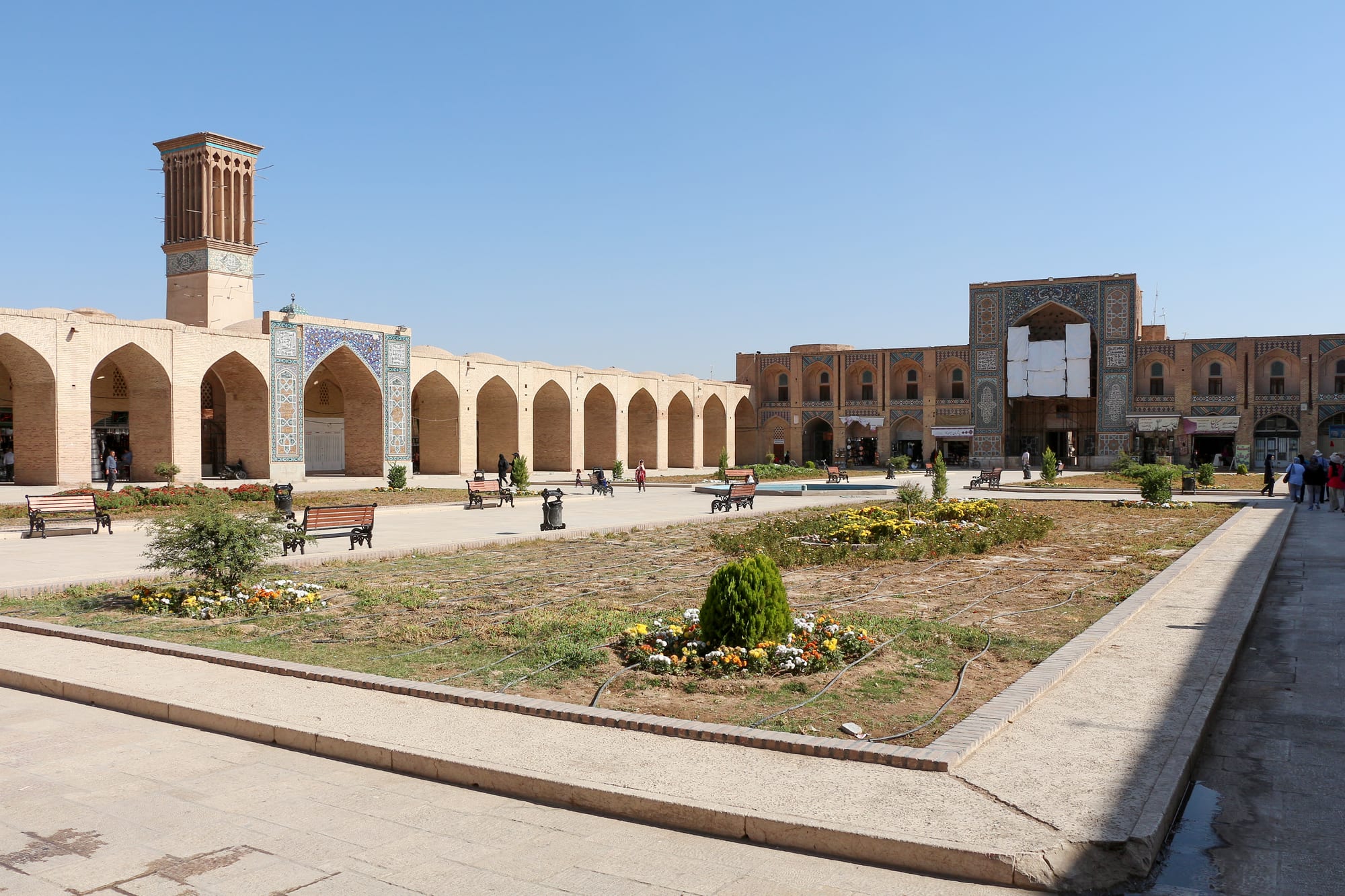
A long brick arcade and a tall windcatcher beside a tiled portal across a garden square in Kerman under a clear sky

Mashhad, Yazd & the East, Iran

Kerman

The Ganjali Khan square and its arcades in the centre of Kerman. (Bernard Gagnon / Wikimedia Commons · CC BY-SA 4.0)

The capital of Iran's largest province, set on a high desert plain at about 1,750 m between mountains and the Lut. A caravan city fed by qanats, it is known for its long covered bazaar, the Safavid Ganjali Khan complex, its carpets and the pistachio orchards of the surrounding province, and it is the usual base for the Lut desert. This page is written to explain the city, not to encourage travel.

Neighbourhoods

  • The bazaar quarter
    • First-time visitors
    • Historic district
    • Shopping

    The old commercial centre, where a covered bazaar runs for well over a kilometre east from Arg Square past caravanserais, a mint, a bathhouse and the Ganjali Khan square. Most of what visitors come for lies within a few minutes' walk of it.

    Open in Maps
  • Around the Friday Mosque
    • Historic district
    • Local life

    The streets at the eastern end of the bazaar, around the tiled portal of the Jameh Mosque, with workshops, tea houses and the everyday shops of an old residential quarter.

    Open in Maps
  • The northern boulevards
    • Modern hotels
    • Restaurants

    The newer city spreading north and west along wide avenues, with most of Kerman's hotels, larger restaurants, shopping centres and apartment blocks. Journeys here are made by taxi rather than on foot.

    Open in Maps
  • The university district
    • Students
    • Quiet and residential

    The area around Shahid Bahonar University in the south-west, quieter and greener than the centre, with cafes and cheap eating places used by students.

    Open in Maps

Things to do

The historic centre

  • Ganjali Khan Complexlandmark

    A Safavid square built around 1600 by the city's governor, combining a caravanserai, a mint, a school, a water cistern and a painted bathhouse now fitted out as a museum.

    Open in Maps
  • Jameh Mosque of Kermanlandmark

    The city's Friday mosque, entered through a tall tiled portal at the east end of the bazaar.

    Open in Maps
  • Jabalieh Domelandmark

    A domed 12th-century building of stone and brick on the eastern edge of the city, one of the finest pieces of stone masonry of its period in Iran and unusual in a region that builds in mud brick.

    Open in Maps
  • Malek Mosquelandmark

    The oldest and largest mosque in Kerman, built between 1077 and 1096 under the Seljuk rulers of the province and restored many times since.

    Open in Maps

Gardens and shrines at Mahan

  • Shah Nematollah Vali Shrinelandmark

    The tomb at Mahan of the Sufi poet and founder of the Nimatullahi order, who died in 1431, under a tiled dome and twin minarets added by Shah Abbas I in 1601.

    Open in Maps
  • Shazdeh Gardenpark

    A walled Qajar garden on a slope above Mahan, its stepped water channel and pavilion set against bare desert mountains; part of the UNESCO listing of Persian gardens.

    Open in Maps
  • Mahanattraction

    A small town about 35 kilometres south-east of Kerman at the foot of the mountains, the setting for both the shrine and the garden.

    Open in Maps

The desert and the mountains

  • Dasht-e Lutattraction

    A UNESCO World Heritage Site of dunes, salt flats and wind-carved kalut ridges east of the city, among the hottest surfaces measured on earth.

    Open in Maps
  • Shahdadattraction

    The desert town north-east of Kerman that is the usual gateway to the kaluts, with a major Bronze Age settlement site, found in 1968, nearby.

    Open in Maps
  • Rayen Castlelandmark

    A mud-brick fortified town about 100 kilometres south-east of Kerman, still standing where the similar citadel at Bam was destroyed by the earthquake of 2003, with walls, towers and a governor's quarter.

    Open in Maps

Seasonal events

  • Nowruzlate March

    The Persian new year, marked with house visits and picnics, and the busiest fortnight of the year for domestic travel.

  • Ramadanvaries with the lunar calendar

    A month of daytime fasting, when eating and drinking in public are not acceptable and the city's life moves to the evening.

  • Muharram and Ashuravaries with the lunar calendar

    Mourning processions for Imam Husayn fill the bazaar quarter, with black drapes across the streets and free food distributed.

  • The pistachio harvestSeptember and October

    Picking and processing around Rafsanjan and the surrounding districts dominate the province's autumn, and the new crop reaches the bazaar.

Eat and drink

Long-standing places and food districts in Kerman. Hours, ratings and directions come from your maps app, always current.

Kerman classics

  • The pastry shops of the bazaar quartermarket

    Kolompeh, a pastry filled with minced dates and cardamom, is the city's signature sweet, sold alongside dates, saffron and boxes of local pistachios.

    Open in Maps
  • Ganjali Khan and the bazaar tea housesneighborhood

    Tea rooms occupy some of the vaulted spaces off the bazaar, serving tea, doogh and simple food under brick domes.

    Open in Maps

Food districts

  • The northern boulevardsneighborhood

    Kerman's everyday restaurants, grill houses and cafes are strung along the wide avenues north and west of the old city.

    Open in Maps
  • Mahanneighborhood

    Eating places around the shrine and the garden serve kebab and rice to the pilgrims and day trippers who come out from the city.

    Open in Maps

Experience Kerman

History

Kerman is traditionally said to have been founded in the third century by Ardashir I, the first Sasanian king, and for much of its history it was known as a frontier city facing the deserts and the routes to India. Its life depended on qanats, the underground channels that brought water down from the mountains, and on the caravan trade that crossed the plateau between the Persian Gulf and Khorasan.

The city changed hands often. Arab armies took it in the seventh century; the Seljuks made it the seat of a long-lasting local dynasty, from which the Malek Mosque survives; and the Mongols and then Timur passed through. Under the Safavids it recovered strongly, and around 1600 the governor Ganjali Khan built the square, caravanserai, mint, school and bathhouse that still form the finest group of buildings in the city. Kerman's carpets and shawls were exported as far as Europe in this period, and the province's woven goods became its name abroad.

Prosperity ended violently. In 1794 Agha Mohammad Khan, founder of the Qajar dynasty, besieged Kerman because it had sheltered his rival Lotf Ali Khan Zand, and on taking the city he exacted a punishment remembered as one of the cruellest in Iranian history. The old city was largely abandoned and a new one grew alongside it. The 20th century brought roads, the railway from Tehran, a university and industry, above all the vast copper mine at Sarcheshmeh to the south-west and the pistachio orchards around Rafsanjan, and the modern city has spread out far beyond the walls of the old one.

Culture & Customs

Kerman's name travelled the world on its carpets. The city and its province have woven for centuries, and Kerman rugs — finely knotted, often with curving floral designs and pale grounds — are among the best known Persian types. Pateh, a Kermani needlework in which coloured thread, often silk, is stitched in paisley, cypress and sun patterns onto a broad piece of woollen cloth, is the other local craft, sold in the bazaar and made in villages across the province.

The city is closely associated with Sufism through the shrine at Mahan, where Shah Nematollah Vali, a poet and the founder of the Nimatullahi order, is buried; the order spread from here across Iran and beyond, and the shrine draws visitors of many kinds. Alongside it the ordinary Shia calendar is kept with the seriousness usual in provincial Iran, and the Muharram processions through the bazaar quarter are the largest public gatherings of the year.

Kermanis have a reputation in Iran for a dry sense of humour and for deliberateness of speech, and the local dialect of Persian is distinct enough to be noticed elsewhere. Daily sociability revolves around tea, the bazaar and, in a province of orchards, the exchange of nuts, dates and sweets as gifts. The zurkhaneh, the traditional gymnasium of clubs, drum and sung verse, survives here as it does across the plateau.

Daily Life

About 540,000 people live in Kerman, making it one of the larger cities of eastern Iran and the administrative centre of a province the size of a small country. The economy rests on three things: mining, above all the open-cast copper at Sarcheshmeh, among the largest deposits in the world, and others in the hills; agriculture, especially the pistachios of Rafsanjan and the dates of the low country; and the trade and government that any provincial capital carries, along with a large university.

Life has spread outward from the old centre. The bazaar quarter still works, but most people live in the newer districts to the north and west, in apartment blocks and walled houses along wide avenues, and travel by car or shared taxi. The city also holds a substantial Afghan community, and its position on the routes north from the Pakistani border has long made drug smuggling a serious policing problem for the province.

Water governs everything. The qanats that watered Kerman for centuries are failing, groundwater is over-pumped, and drought has cut the pistachio harvests that much of the province depends on, with land subsidence visible in some farming districts. Days begin early and pause through the strongest afternoon sun; evenings are cool at this altitude even in summer. Like the rest of the country, the city has lived through years of sanctions, high inflation and, since February 2026, war.

Food

Kerman's best-known thing to eat is kolompeh, a round pastry stamped with a pattern and filled with a paste of dates and cardamom, made across the province and bought by the box to take away. Behind it stands the province's agriculture: pistachios from Rafsanjan, eaten fresh and green in autumn and roasted and salted the rest of the year, and dates from the hot lowlands to the south and east, which appear in sweets, with tea and on their own.

Savoury cooking is that of the plateau — lamb kebab grilled over charcoal with saffron rice, grilled tomatoes and herbs; abgusht, the lamb, chickpea and potato stew pounded to a paste at the table and eaten with bread; and thick ash soups of noodles, pulses and herbs. Goat as well as lamb is eaten, and the province's dates and walnuts find their way into savoury cooking as well as sweets.

Drinks are tea above all, poured black and strong and taken with a date, a pistachio or a lump of sugar held between the teeth. Doogh, salted yoghurt thinned with water and mint, goes with grilled food, and chilled sharbats of rosewater and sweet basil seeds help through the heat of the day. Alcohol is illegal.

Planning tools

Budget

Kerman is inexpensive, with a modest range of hotels including a few restored courtyard houses in the old city and plain modern places on the northern boulevards. Food costs little. The main expense is transport: the desert, Mahan and Rayen all need a car, and a trip into the Lut means paying for a guide and a vehicle. Cash is essential.

Daily Budget Midrange
USD 45–90 (traditional-house or mid-range hotel, restaurant meals, a guided desert trip)
Daily Budget Shoestring
USD 20–30 (guesthouse or hostel bed, bazaar food, buses and shared taxis)

Share the cost of a Lut desert tour with other travellers, and expect to pay for everything in cash.

Best Time to Visit

October to April, when the plateau is warm by day and cold at night; the Lut is only sensible from late autumn to early spring. Spring brings colour to the gardens at Mahan. Summer is fierce on the desert side of the province. That is the ordinary calendar, and it no longer describes the present. Since 28 February 2026 Iran has been at war with the United States and Israel, and there is at present no good time to go.

Suggested Number of Days

The bazaar and the historic centre take about two days at an unhurried pace. Longer stays are usually about what lies outside the city, which is spread over long distances and needs a car or a hired driver.

First Visit
2 days
With Surroundings
3–4 days

Transportation

The old city and the bazaar are covered on foot; everything else is reached by taxi, which is cheap and the normal way to cross a spread-out city, or by local buses along the main avenues. There is no metro. Mahan, Rayen and Shahdad are served by infrequent buses and shared taxis, so most visitors hire a car and driver for the day. That is the peacetime picture: the war that began in February 2026 has disrupted aviation across the region, and what is open at any given airport, road or border crossing has changed repeatedly.

Go into the Lut only with an experienced local driver and plenty of water, agree taxi fares before setting off, and check what is running before relying on any route.

Airport & Station Connections

Kerman lies at the southern end of the railway from Tehran through Qom, Kashan and Yazd, and overnight trains and long-distance buses both serve it; Yazd is about four to five hours away by road and Bam roughly three. The city has an airport a short distance from the centre with domestic flights. Schedules on all of them have been unreliable since the war began.

Walkability

The bazaar quarter is easily walked, and the covered market itself gives more than a kilometre of shade in a hot, dry climate. Beyond it Kerman is a modern city of long blocks and wide avenues where walking between districts is impractical, and the altitude, strong sun and dry air tire people faster than they expect.

Safety

Several governments strongly advise against travel to Iran, and dual nationals face particular risks. Kerman itself is an ordinary provincial city for everyday crime, but it lies close to the routes north from the Pakistani and Afghan borders, and the roads towards Sistan and Baluchestan to the south-east carry the strongest warnings in the country. In the deserts, heat and breakdowns are real dangers.

Since 28 February 2026 Iran has been at war with the United States and Israel. Take the strongest advisories on Sistan and Baluchestan seriously, avoid travelling by road at night, never enter the desert without a guide, and dress conservatively. Check current official travel advice before travelling.

Climate

A high desert climate, dry in every month, with strong sun, cool nights and a wide daily temperature range. The surrounding mountains hold snow into spring while the plain below stays dry.

Summer
hot and very dry, typically in the mid to high 30s °C by day, with much cooler nights than the low desert
Winter
cool days around 10–15°C, hard frosts at night and occasional snow

Local Customs

Kerman is a conservative provincial capital. Women must cover their hair and wear loose clothing, and men wear long trousers and sleeved shirts. Shoes are removed at mosque and shrine entrances, and the shrine at Mahan is an active place of worship rather than a monument. Hospitality is pressed on visitors and refusals are expected to be repeated before they are believed.

Ask before photographing people, and do not photograph military sites, government buildings or the interiors of shrines where it is restricted. Alcohol is illegal. Bargaining is normal in the bazaar, particularly for carpets.

Common Payment Methods

The currency is the Iranian rial, though prices are quoted in tomans, each worth ten rials. Sanctions mean foreign bank cards and international cash machines do not work, so visitors bring cash in euros or dollars to change, or use a prepaid local tourist card loaded on arrival. Bazaar traders and small hotels deal in cash.