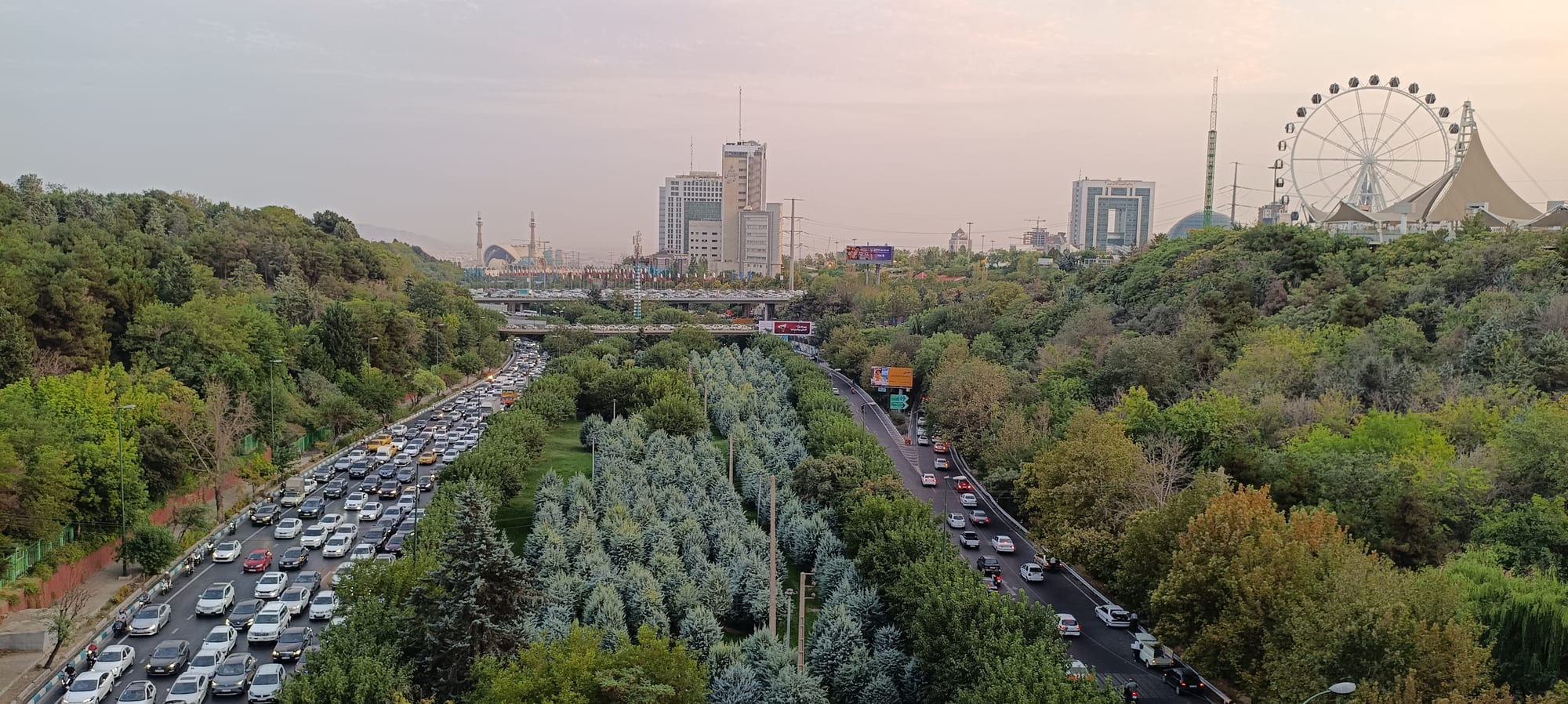
View from a bridge over a tree-lined highway in Tehran, with traffic below, towers and a ferris wheel on the skyline

Tehran & the Caspian North, Iran

Tehran

The Modares Expressway and the Abbas Abad parks seen from the Tabiat Bridge in northern Tehran. (IRANforeever / Wikimedia Commons · CC0)

Iran's capital, spread across a long slope below the Alborz mountains, from the crowded bazaar quarter in the south to the cooler, wealthier hills in the north. A modest town until the Qajars made it their capital in 1786, it is now a metropolis of some nine million, holding the country's government, universities, museums and crown jewels. This page is written to explain the city, not to encourage travel.

Neighbourhoods

  • The bazaar quarter and the old city
    • First-time visitors
    • Historic district
    • Markets

    The dense southern centre around the Grand Bazaar, Arg Square and Golestan Palace, where Tehran began. Lanes of wholesalers, porters, carpet halls, tea houses and mosques run for kilometres under brick vaults, and several metro lines meet nearby.

    Open in Maps
  • Enghelab and the university quarter
    • Bookshops
    • Close to public transport
    • Local life

    The band along Enghelab Street around the University of Tehran, lined with bookshops, publishers, print works and cheap eating places. It has long been the city's student and intellectual district, busy in term time and well served by the metro.

    Open in Maps
  • Vali-asr and Vanak
    • Cafés
    • Shopping
    • Walks

    The central stretch of the long plane-lined avenue that climbs the city, with offices, cinemas, cafés and shopping centres around Vanak Square. It is the ordinary meeting ground of middle-class Tehran and a useful spine for finding a way north or south.

    Open in Maps
  • Tajrish and Shemiran
    • Markets
    • Cooler air
    • Mountain access

    The old villages at the northern top of the city, now absorbed into it but still noticeably cooler. Tajrish has a covered bazaar and the Imamzadeh Saleh shrine beside the square, and the trailheads at Darband and the Tochal cable car are a short ride above.

    Open in Maps
  • Niavaran and northern Tehran
    • Quiet and residential
    • Palaces and museums
    • Gardens

    Leafy, expensive hillside districts of apartment towers, walled gardens and embassies. The Niavaran and Sa'dabad palace complexes, both former royal residences now open as museums, stand among the plane trees here, and the air is clearer than on the plain below.

    Open in Maps
  • Rey
    • Historic district
    • Pilgrimage
    • Local life

    The ancient city of Rhages at Tehran's southern edge, absorbed by the capital's growth but far older than it. The shrine of Shah Abdol-Azim, with its gilded dome, draws pilgrims, and the surrounding streets are working-class and traditional.

    Open in Maps

Things to do

Famous landmarks

  • Golestan Palacelandmark

    The Qajar royal citadel of mirrored halls, painted tilework and garden courtyards, a UNESCO World Heritage Site; in March 2026 shockwaves from an air strike on the nearby Arg Square damaged windows, doors and mirrors in the complex.

    Open in Maps
  • Azadi Towerlandmark

    The white marble arch of 1971 on the western approach to the city, designed by Hossein Amanat, with a museum beneath it.

    Open in Maps
  • Milad Towerlandmark

    A telecommunications tower over 400 metres tall in the west of the city, with observation decks that take in the whole plain and the Alborz.

    Open in Maps
  • Tabiat Bridgelandmark

    A curving three-level pedestrian bridge of 2014 linking two parks across a motorway, designed by Leila Araghian and used as a place to sit rather than simply to cross.

    Open in Maps
  • Shah Abdol-Azim Shrinelandmark

    A large Shia shrine complex in Rey, south of the city, holding the tomb of a descendant of the second Shia imam.

    Open in Maps

Palaces and museums

  • National Museum of Iranmuseum

    The country's principal archaeological museum, with finds from prehistory through the Achaemenid, Parthian and Sasanian periods, next to an Islamic-era collection.

    Open in Maps
  • Treasury of National Jewelsmuseum

    The royal jewel collection held in the vault of the central bank on Ferdowsi Street, including the Darya-ye Noor diamond and the Peacock Throne.

    Open in Maps
  • Sa'dabad Complexmuseum

    A hillside park of former royal palaces in Shemiran, now separate museums; several of them were damaged by shockwaves from air strikes in March 2026.

    Open in Maps
  • Niavaran Palace Complexmuseum

    The last shah's family residence in northern Tehran, with its 1960s main palace, the Qajar-era Sahebqaranieh pavilion and a garden of tall trees.

    Open in Maps
  • Tehran Museum of Contemporary Artmuseum

    A 1977 building beside Laleh Park holding a celebrated collection of Western modern art alongside Iranian work.

    Open in Maps
  • Carpet Museum of Iranmuseum

    Persian carpets from many regions and centuries, shown in a museum beside Laleh Park established in 1976.

    Open in Maps
  • Reza Abbasi Museummuseum

    A museum of Iranian art from the pre-Islamic period to the Qajars, strong on miniature painting, metalwork and calligraphy.

    Open in Maps

Bazaars and streets

  • Grand Bazaarmarket

    Kilometres of covered lanes in the south of the city, divided by trade into carpets, gold, spices, fabric and household goods, and still central to Iranian commerce.

    Open in Maps
  • Tajrish Bazaarmarket

    A smaller, brighter covered market at the top of the city, good for fruit, nuts, pickles and herbs, beside the Imamzadeh Saleh shrine.

    Open in Maps
  • Vali-asr Streetattraction

    The longest street in the Middle East, running from the railway station in the south of the city to Tajrish Square in the north under rows of plane trees.

    Open in Maps

Parks and the mountains

  • Darbandtrail

    A stepped path up a stream gorge above Tajrish, lined with tea houses and grills, and the usual way Tehranis walk into the Alborz.

    Open in Maps
  • Tochalviewpoint

    The peak above the city, reached by a long gondola from Velenjak, with walking in summer and skiing near the top in winter.

    Open in Maps
  • Laleh Parkpark

    A central park between the university and the museums, with lawns, plane trees and a Japanese garden.

    Open in Maps
  • Mellat Parkpark

    A large park in northern Tehran with a lake, sports grounds and busy evening crowds in summer.

    Open in Maps

Short trips from the city

  • Mount Damavandviewpoint

    Iran's highest mountain, a snow-capped volcanic cone of about 5,610 metres, visible from the city on clear days and climbed in summer from the village of Polur.

    Open in Maps
  • Dizinattraction

    A ski resort high in the Alborz about 70 kilometres north of the city, the first in Iran recognised by the International Ski Federation, reached over the Chalus road.

    Open in Maps
  • Shemshakattraction

    A smaller and steeper ski area in the mountains north-east of Tehran, popular with weekend skiers from the capital.

    Open in Maps

Seasonal events

  • Nowruzaround 21 March

    The Persian new year at the spring equinox, when the city empties as families travel and the streets fill with sabzeh and haft-sin displays beforehand.

  • Chaharshanbe Surithe last Tuesday evening before Nowruz, March

    The fire festival on the eve of the last Wednesday of the year, marked with bonfires and fireworks in streets and parks.

  • Muharram and Ashuravaries with the lunar calendar

    Ten days of Shia mourning processions, black banners and street kitchens giving out food, observed across the city.

  • Fajr Film FestivalFebruary

    Iran's main film festival, held in Tehran cinemas each winter.

  • Tehran International Book Fairspring

    A very large book fair drawing publishers and enormous crowds of readers.

  • Yalda Nightaround 21 December

    The longest night of the year, spent with family over watermelon, pomegranates, nuts and poetry.

Eat and drink

Long-standing places and food districts in Tehran. Hours, ratings and directions come from your maps app, always current.

Tehran classics

  • Dizi and abgoosht housesrestaurant

    Lunchtime kitchens serving abgoosht, a lamb, chickpea and potato broth strained into a bowl and the solids pounded to a paste, eaten with flatbread, onion and pickles.

    Open in Maps
  • Kalleh pacheh kitchensrestaurant

    Dawn places serving sheep's head and trotters, an old Tehran breakfast eaten before work and usually sold out by mid-morning.

    Open in Maps
  • Jigar and kebab stallsrestaurant

    Evening grills where skewers of liver, heart and lamb are cooked over charcoal on the pavement and handed over in bread.

    Open in Maps

Food districts and markets

  • Grand Bazaar food lanesmarket

    Traditional restaurants, tea houses and sweet shops tucked between the trading halls, serving the bazaar's own workers.

    Open in Maps
  • Tajrish Bazaarmarket

    Fruit, nuts, saffron, dried limes and pickles at the top of the city, with juice counters and grills around the edges.

    Open in Maps
  • Darband's stream-side grillsneighborhood

    Terraces stacked up a gorge above Tajrish selling kebabs, corn, sour plums and tea to walkers on the mountain path.

    Open in Maps

Cafés and sweet shops

  • Vali-asr and Enghelab caféscafe

    Coffee houses around the central avenue and the university quarter, where much of the city's social life happens over tea, coffee and long conversations.

    Open in Maps
  • Confectioners and nut shopsmarket

    Shops selling gaz nougat, sohan, baklava and roasted nuts, the customary gift when visiting an Iranian home.

    Open in Maps

Experience Tehran

History

Tehran was a walled village of gardens and underground houses north of the great city of Rey when the Mongols destroyed Rey in the 13th century, and it grew slowly on its ruins as a market town on the road between the plateau and the Caspian. The Safavids gave it a bazaar and a wall in the 16th century, and Karim Khan Zand briefly used it as a base, but the decisive moment came in 1786, when Agha Mohammad Khan, founder of the Qajar dynasty, chose it as his capital for its position between the tribal north-west and the heart of the country.

Under the Qajars the town became a city. The Golestan Palace grew into a royal complex of mirrored halls and tiled courtyards, new gates and squares were laid out, and in the 1870s Naser al-Din Shah pulled down the old wall and replaced it with a far larger octagonal moat and rampart. Tehran was the stage of the constitutional revolution of 1906, when merchants and clergy took sanctuary and forced the shah to accept a parliament.

Reza Shah's government cut wide avenues through the old fabric in the 1930s, removed the walls and built ministries, a railway station and a university. The city then spread north up the slope and swallowed the old hill villages of Shemiran. Allied troops occupied it in 1941, and in 1943 it hosted the Tehran Conference. It was the centre of the 1953 coup and of the revolution of 1979, and during the Iran-Iraq war it was hit by missiles. Growth since has been relentless, north over the foothills and west towards Karaj.

Culture & Customs

Tehran is a city of migrants from every province, and its manner — fast, crowded, status-conscious, quick with a joke — is its own rather than any region's. The divide people talk about most is between north and south: the cooler, wealthier hillside districts with their cafés and galleries, and the older working-class quarters on the plain around the bazaar, more traditional and more religious. Much of what visitors notice about the city is negotiated between those poles and within the limits of the law.

It is the centre of Iranian cultural production. Publishers and bookshops line Enghelab Street, the Fajr festivals fill cinemas and concert halls each winter, and Iranian cinema, which has won prizes around the world, is largely made here. Galleries cluster in the northern districts, and the Museum of Contemporary Art holds one of the most remarkable collections of modern Western art outside Europe and North America. Poetry is quoted in ordinary conversation, and Hafez and Ferdowsi are household names.

Football divides the city: the Tehran derby between Persepolis and Esteghlal is followed with intensity across the country. The weekend, which falls on Friday, sends families to the mountain paths at Darband and Darakeh, to the parks, or north over the Alborz to the Caspian. Hospitality is taken seriously, taarof governs offers and refusals, and guests are pressed to eat far more than they intended.

Daily Life

Around nine million people live in the city and more than twelve million in Tehran province, with another large population in neighbouring Karaj; a great many commute daily between them. The city is the seat of government, of banking, of the universities and of much of Iran's industry, and jobs in ministries, state companies, hospitals and the bazaar sustain much of it, alongside a large informal economy of drivers, traders and small workshops.

The day starts early and runs late. Traffic dominates it, and millions use the metro and the shared taxis that ply fixed routes, calling their destination through the window. Shops open in the morning, many close in the early afternoon and reopen until late evening, and social life happens after dark, in parks, on the mountain paths and in cafés. Apartment living is the norm, in towers that have replaced most of the old courtyard houses.

The concerns people discuss are consistent: inflation and the cost of housing, which pushes families further west and south, air pollution that closes schools on the worst winter days, water shortages, land subsidence beneath the southern plain, and the strain of sanctions on incomes and medicine. Earthquake risk is a constant in the background, since major faults run along the foot of the Alborz. The war that began in February 2026 has added its own disruptions to travel, aviation and daily routine.

Food

Tehran eats from the whole country, since every province has sent migrants to it, but it has staples of its own. Chelow kabab — rice with grilled meat, a knob of butter, grilled tomato and sumac — is the standard restaurant meal, whether the meat is minced koobideh, lamb chops or saffron chicken. Dizi, also called abgoosht, is the lunchtime dish of the old city: lamb, chickpeas and potatoes cooked in a stone pot, the broth poured off and drunk while the rest is pounded to a paste and eaten with bread, onion and herbs.

Breakfast can be halim, a wheat and meat porridge, or the older kalleh pacheh of sheep's head and trotters, sold before dawn. Street food means liver kebabs grilled on the pavement, beetroot and steamed broad beans in winter, corn and sour plums on the mountain paths in summer. Stews are the home cooking: ghormeh sabzi of herbs, kidney beans and dried lime; gheymeh with split peas; and fesenjan of walnuts and pomegranate.

Bread is bought fresh from bakeries several times a week — sangak baked on hot stones, barbari, taftoon and lavash. Tea is drunk black from small glasses, often with a sugar lump held in the teeth, and the shops sell gaz nougat, sohan and baklava in boxes as gifts. Ice cream flavoured with saffron and rosewater, and faloodeh of frozen noodles with lime, are summer fixtures.

Planning tools

Budget

Tehran is the most expensive city in Iran for rooms and restaurants, though costs remain low in dollar terms because of the weak rial. Hotels in the north and centre cost several times what a guesthouse in the bazaar quarter does, while metro fares, bazaar meals and museum entry are inexpensive. Sanctions mean foreign cards do not work, so every cost has to be covered with cash brought in.

Daily Budget Midrange
USD 55–100 (mid-range Tehran hotel, restaurant meals, a driver for the Alborz)
Daily Budget Shoestring
USD 25–40 (guesthouse or simple hotel, bazaar food, metro and shared taxis)

Bring all money in euros or US dollars and change it at official exchange offices; agree a price before taking an unmetered taxi.

Best Time to Visit

April to June and September to October are the mild months, with clear mountain views after rain. Summer is hot and dry, winter cold with snow on the Alborz, and smog is often heavy from late autumn to winter. That is the ordinary calendar: since 28 February 2026 Iran has been at war with the United States and Israel, and there is at present no good time to go.

Suggested Number of Days

The palaces, museums and bazaar of the centre fill three or four days. Traffic and the city's size slow everything down, so allow more than the map suggests, and add days for the mountains north of the city.

First Visit
3–4 days
With Surroundings
5–7 days

Transportation

A large metro with several lines crosses the city and is the fastest way to move at peak times, with carriages reserved for women at each end of the train. Buses, including bus rapid transit lanes, shared taxis running fixed routes and ride-hailing apps cover the rest, and traffic is heavy for much of the day. That is the peacetime picture: the war that began in February 2026 has disrupted aviation across the region, and a strike in April 2026 brought down a major bridge on the road between Tehran and Karaj.

Keep small notes for shared taxis, expect long journey times across the city, and check what is open before relying on any route.

Airport & Station Connections

Imam Khomeini International Airport handles international flights and lies about 35 kilometres south-west of the city, roughly an hour by road; Mehrabad, inside the city in the west, handles domestic flights. Trains and long-distance buses run from several terminals to the Caspian, Tabriz, Isfahan and Mashhad, and three roads cross the Alborz to the coast.

Walkability

Individual districts walk well — the bazaar lanes, Enghelab's bookshops, the Tajrish streets, the parks and the Tabiat Bridge — but the city as a whole is far too large and too steep to cross on foot, and it climbs several hundred metres from south to north. Pavements are crowded and often blocked, wide roads are hard to cross, and motorcycles use the pavement. Most visits combine the metro with short walks.

Safety

Tehran is the seat of government and the place where protests and security operations are most likely, and it has been struck repeatedly since the war began in February 2026. Street crime is low by the standards of large cities, and the ordinary dangers are traffic, which is chaotic and gives pedestrians little room, and winter air pollution. Photographing government, military or police buildings is treated seriously.

Several governments strongly advise against travel to Iran, citing the risk of arbitrary arrest and detention of foreigners and dual nationals. Avoid all gatherings, do not photograph government or military buildings, carry identification, and avoid political discussion. Check current official travel advice before travelling.

Climate

A semi-arid climate at about 1,200 metres, with a marked difference between the hot, low southern districts and the cooler northern slopes, which can be several degrees colder. Rain falls mainly between November and April, and snow settles in the north of the city most winters.

Summer
hot and dry, often 35–40°C by day in the south of the city, cooler in the northern districts and dropping at night
Winter
cold, around 0–10°C, with snow in the northern districts and on the Alborz above

Local Customs

Iran has a legal dress code: women must cover their hair and wear a loose coat or tunic over trousers, and men avoid shorts. Greetings are formal and warm, and taarof, the elaborate ritual of offering and refusing, shapes everyday exchanges, including the taxi driver who waves away the fare. Alcohol is illegal. Shoes come off indoors, and photography of people, especially women, needs permission.

Dress modestly and carry a scarf, accept tea when offered, refuse the first offer or two before accepting, and do not photograph inside shrines without asking.

Common Payment Methods

The currency is the Iranian rial, though prices are usually quoted in toman, one toman being ten rials. Foreign bank cards and international payment apps do not work because of sanctions, so visitors bring cash in euros or US dollars and change it at exchange offices, or load a prepaid local tourist card. Cash is needed almost everywhere.