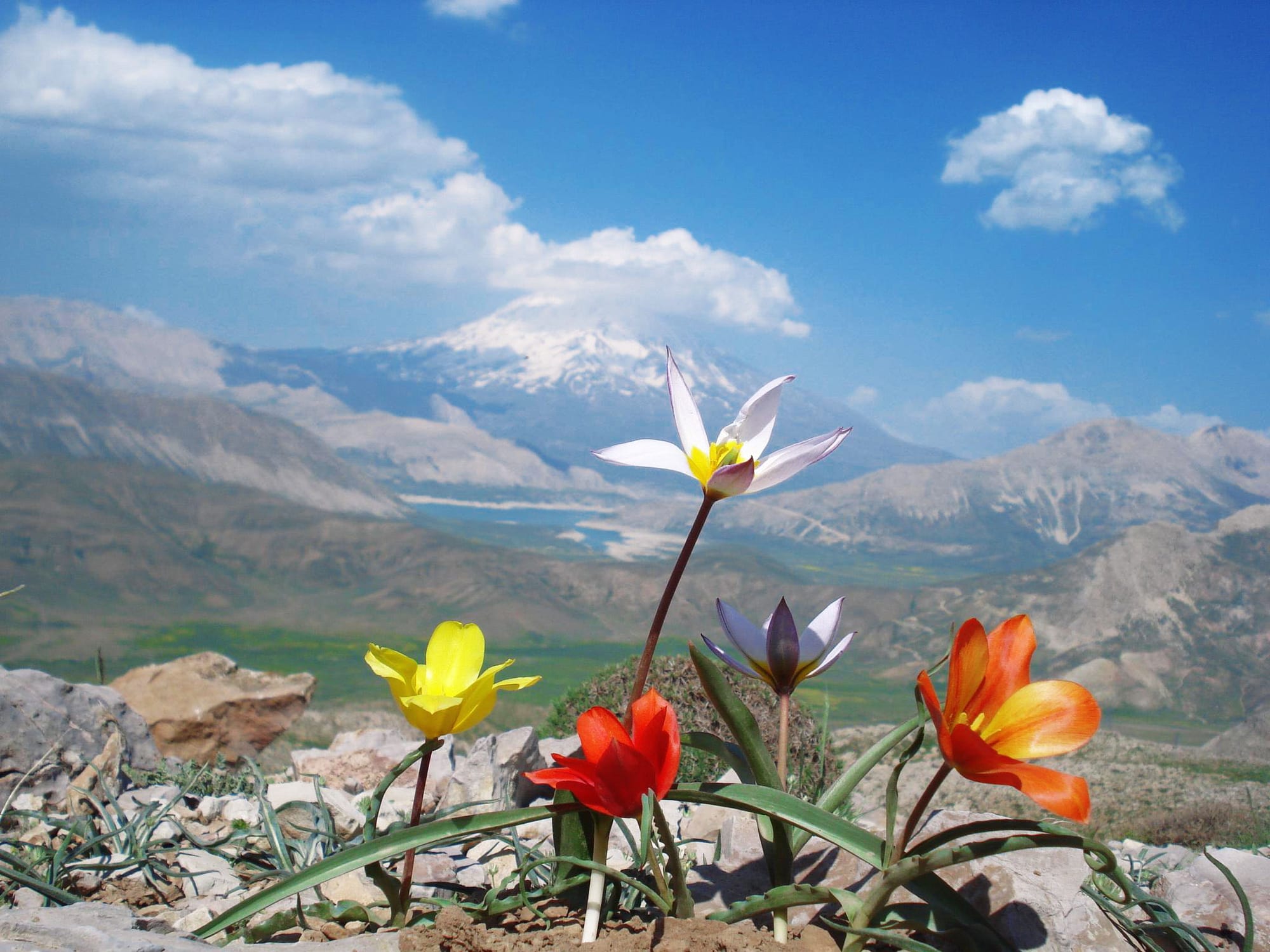
Wild tulips on a rocky slope in the foreground, with Lar Lake in a valley and snow-capped Mount Damavand behind

Iran

Tehran & the Caspian North

Mount Damavand above Lar Lake, seen from Mount Siah Palas in Mazandaran province. (Mahdi Kalhor / Wikimedia Commons · CC BY 3.0)

Iran's northern band, from the capital on the southern slopes of the Alborz over the mountains to the humid, forested Caspian shore and east to the Turkmen steppe of Golestan — the country's political centre and its green, rice-growing coast. This page is written to explain the region, not to encourage travel.

Explore Tehran & the Caspian North

History

Long before Tehran existed, the plain at the foot of the Alborz was dominated by Rey, ancient Rhages, a major city of Parthian and early Islamic Iran and the birthplace of the physician al-Razi, until the Mongols sacked it in the 13th century. North of the mountains, the Caspian provinces of Tabaristan and Gilan resisted the Arab conquest for generations behind their forests and passes; local dynasties ruled there long after the plateau had become Muslim, and the Daylamites of the Gilan highlands produced the Buyids, who took Baghdad in the 10th century.

In the Alborz north of Qazvin, Hassan-i Sabbah seized the castle of Alamut in 1090, making it the base of the Nizari Ismaili state, the "Assassins" of Western legend, until the Mongols took it in 1256. Qazvin became the Safavid capital under Shah Tahmasp in the mid-16th century, before Shah Abbas moved the court to Isfahan. Tehran was a modest town until Agha Mohammad Khan, founder of the Qajar dynasty, made it his capital in 1786.

Under the Qajars and Pahlavis Tehran grew into the country's political and economic centre, and it was the stage for the constitutional revolution of 1906, the 1953 coup and the revolution of 1979. The north had its own upheavals: Russian troops occupied Gilan in the early 20th century, and Mirza Kuchik Khan's Jangali forest movement briefly declared a Soviet-backed republic there in 1920–21. Since the mid-20th century the capital's growth has spilled west into Karaj and north over the mountains, turning the Caspian shore into Tehran's holiday coast.

Culture & Customs

Tehran is a city of migrants from every province, and its style — fast, crowded, status-conscious and more openly cosmopolitan in its northern neighbourhoods than in the working-class south — is its own. The capital's football derby between Persepolis and Esteghlal divides families, and the cafés, galleries and mountain-walking paths of northern Tehran are where much of its young social life happens, within the limits of the law.

Over the Alborz the identity changes. Gilan and Mazandaran speak Gilaki and Mazandarani, Caspian languages related to Persian, and the Talysh live in the western hills of Gilan. Caspian people are known for their green, rain-soaked villages, wooden houses with wide verandas and a reputation, among other Iranians, for independent-minded women who work in the paddies, tea gardens and markets. In Golestan the Turkmen, Sunni Muslims unlike the Shia majority, keep their own language, felt and carpet traditions and horse-breeding culture on the steppe around Gonbad-e Kavus.

The calendar follows the national one — Nowruz, Muharram mourning processions, Ramadan — with local colour: Mazandaran's rice-planting and harvest seasons, the tea harvest around Lahijan, and Tirgan, an old midsummer festival still marked in parts of Mazandaran.

Daily Life

Tehran province holds more than 12 million people, with around 9 million in the city itself, and Karaj, capital of Alborz province, has more than 1.5 million. Rasht in Gilan, with around 700,000, is the largest Caspian city; Sari, Amol and Babol in Mazandaran, Gorgan in Golestan, and Qazvin and Semnan on the plateau are the other main centres.

Tehran is the seat of government, banking, universities, media and much of Iran's industry, and its economy draws commuters from Karaj and beyond. The Caspian lives on rice, tea, citrus, fishing, dairy and domestic tourism, with second homes spreading along the coast and into the forest. Qazvin has industrial estates on the Tehran road, Golestan farms wheat and cotton on its plain, and Semnan is a desert-edge province of small towns along the old road to Khorasan.

The capital's day is dominated by traffic, with the metro and shared taxis carrying millions, and by the weekend on Thursday afternoon and Friday, when families head for the mountain trails at Darband and Darakeh or drive north to the sea. Air pollution, water shortages, land subsidence around Tehran, high inflation and the cost of housing are constant topics of conversation.

Food

The Caspian has its own cuisine, the most distinctive in Iran: sour, garlicky and herb-heavy, built on local rice. Gilan's dishes include mirza ghasemi, smoked aubergine mashed with garlic, tomato and egg; baghali ghatogh, broad beans cooked with dill, garlic and egg; kal kabab, an aubergine dish with walnuts and pomegranate; and sir torshi, whole garlic pickled for years until black. Smoked and fried Caspian fish, especially white fish (mahi sefid), are eaten with rice at Nowruz, and wild greens and forest herbs appear in omelettes and stews. Rasht is a UNESCO Creative City of Gastronomy.

Rice from the paddies of Gilan and Mazandaran, varieties such as Hashemi, is prized across Iran, as is tea from the gardens around Lahijan, where Iranian tea-growing began. Fuman is known for kuluche, soft round cookies filled with walnut, and the coast sells oranges and other citrus by the roadside in winter.

Qazvin has its own specialities: gheimeh nesar, rice studded with slivered almonds and pistachios, barberries and saffron-scented meat, and a local style of baklava. Tehran eats everything from everywhere, but its working-class staples are dizi at lunchtime and kalleh pacheh, sheep's head and trotters, at dawn, with liver kebabs (jigar) grilled at street stalls in the evening.

Attractions & Natural Wonders

Tehran's sights are its museums and palaces: the Golestan Palace, a UNESCO World Heritage Site of Qajar tilework and mirrored halls; the Grand Bazaar beside it; the National Museum's Achaemenid and Sasanian collections; the crown jewels in the vault of the central bank; the Sa'dabad and Niavaran palace complexes in the north; and the modern landmarks of the Azadi Tower, Milad Tower and the Tabiat footbridge. Rey, at the city's southern edge, keeps the shrine of Shah Abdol-Azim.

Above the city the Alborz mountains offer the Tochal cable car, walking trails from Darband, and the ski slopes of Dizin and Shemshak. Mount Damavand, the highest peak in Iran and a dormant volcano, is climbed in summer from the village of Polur on its southern side, and Lar Lake lies in a protected valley at its foot.

North of the mountains the Caspian coast runs from Astara and the Anzali lagoon in Gilan through Ramsar and Chalus to Babolsar in Mazandaran, backed by the Hyrcanian forests, a UNESCO World Heritage Site. In Gilan's hills, Masuleh stacks its ochre houses up a slope so steeply that roofs serve as paths. In Golestan the forests reach Golestan National Park, and on the steppe stands the Gonbad-e Qabus, an 11th-century brick tomb tower and a UNESCO World Heritage Site.

Qazvin has Safavid monuments, a Friday Mosque and an old caravanserai quarter, and is the base for the Alamut valley and its castle ruins. Semnan province's Damghan holds the Tarikhaneh, one of the oldest mosques in Iran.

Cities in Tehran & the Caspian North

Planning basics

Budget

Costs follow the national pattern of a weak rial and cash-only travel, but Tehran is the most expensive city in the country for rooms and restaurants, and Caspian beach towns raise their prices during Nowruz and the summer holidays, when Tehranis drive north in large numbers. Qazvin, Rasht, Gorgan and the smaller Caspian towns cost noticeably less.

Daily Budget Midrange
USD 55–100 (mid-range Tehran hotel, restaurant meals, a driver for the Caspian or Alborz)
Daily Budget Shoestring
USD 25–40 (guesthouse or simple hotel, bazaar food, metro, buses and shared taxis)

Bring all cash in euros or US dollars and change it at official exchange offices in Tehran; small Caspian towns have few places to change money.

Safety

The national warnings apply in full here. Several governments strongly advise against travel to Iran, citing the risk of arbitrary arrest and detention of foreigners and dual nationals, and Tehran, as the seat of government, is where protests and security operations are most likely. Street crime is low, but traffic, air pollution, mountain weather on the Alborz and Damavand, and swimming off the Caspian beaches bring their own risks.

Avoid all gatherings and do not photograph government or military buildings; climb Damavand with a licensed guide. Check current official travel advice before travelling.

Climate

Two different worlds either side of the Alborz. Tehran is semi-arid, with hot, dry summers, cold winters and occasional snow, and the high valleys and ski resorts above it are snowbound in winter. North of the mountains the Caspian coast is humid and green, with mild winters and heavy rain, especially in autumn in Gilan. Semnan to the south-east is dry and faces the Dasht-e Kavir desert.

Summer
hot and dry in Tehran and Semnan, often 35–40°C; humid and around 30°C on the Caspian coast
Winter
cold in Tehran, around 0–10°C with some snow; mild and wet on the coast; deep snow in the Alborz

Transportation

Tehran is the national hub: Imam Khomeini airport for international flights, Mehrabad for domestic ones, a large metro, and buses and trains in every direction. Three roads cross the Alborz to the Caspian — the scenic Chalus road, the Haraz road past Damavand, and the Firuzkuh road — taking roughly three to five hours. The Trans-Iranian Railway runs to Sari through the mountains, and a newer line reaches Rasht via Qazvin.

Avoid the Caspian roads at the start and end of holidays; a hired car with driver is the practical way to reach Masuleh and Alamut.

Best Time to Visit

April to June and September to October suit Tehran and Qazvin. The Caspian is at its greenest in late spring and busiest in summer and at Nowruz, when the mountain roads jam. Damavand's climbing season runs roughly from June to September, and the Alborz ski resorts operate in winter. Winter smog can be heavy in Tehran.