History
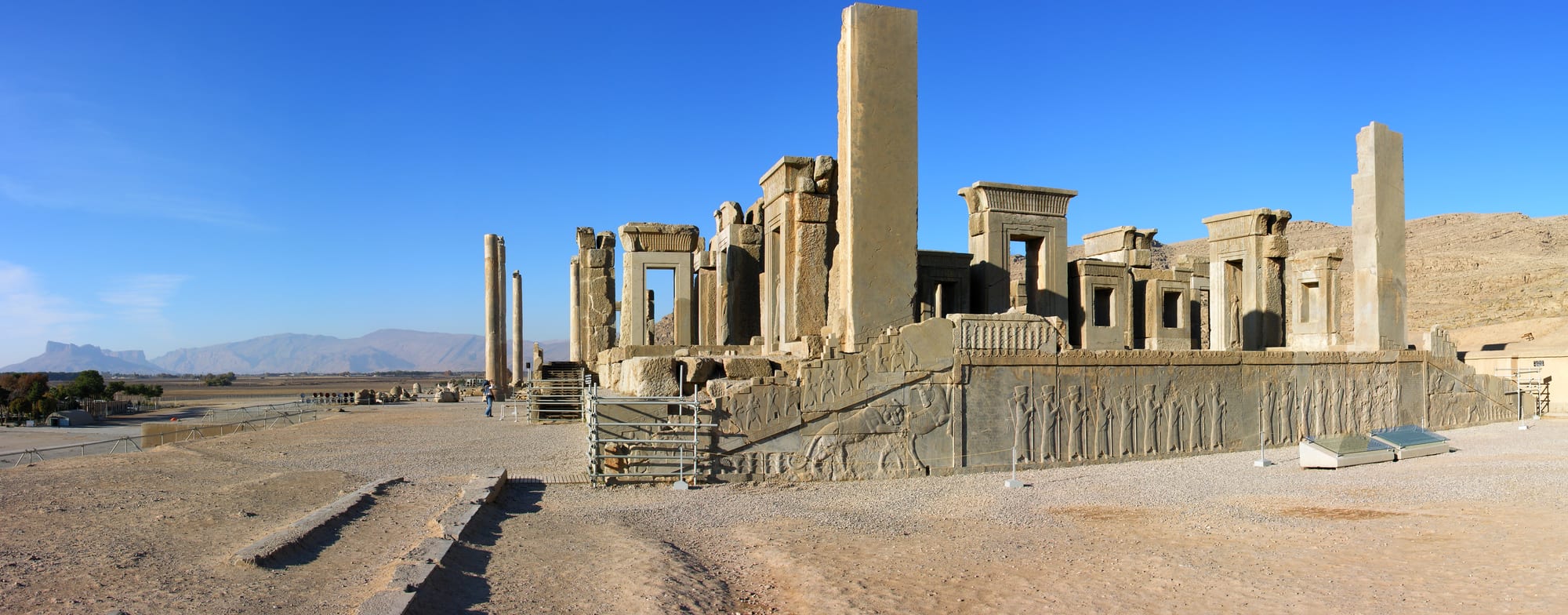
The south-west was the home of Elam, one of the world's earliest civilisations, whose capital Susa and religious centre at Chogha Zanbil flourished on the Khuzestan plain in the second millennium BC. To the east, in Fars — the Greeks' Persis, which gave Persia its name — Cyrus the Great founded the Achaemenid Empire in the 6th century BC and built Pasargadae, where his tomb still stands. Darius I began Persepolis around 518 BC, and Alexander burned it in 330 BC. Fars was again the cradle of empire under the Sasanians, who rose there in the 3rd century AD and left rock reliefs at Naqsh-e Rostam and cities at Firuzabad and Bishapur.
Shiraz grew under Islamic rule and was spared by the Mongols, and its poets Saadi, of the 13th century, and Hafez, of the 14th, made it Iran's literary capital. Karim Khan Zand made it the capital of Iran from the 1760s until his death in 1779 and gave it its bazaar, mosque, baths and citadel. On the coast, the Portuguese seized Hormuz in 1507 and held its trade until a Safavid force, helped by English ships, expelled them in 1622, after which Bandar Abbas took over as the port.
In 1908 oil was struck at Masjed Soleyman in Khuzestan, the first commercial find in the Middle East, and the Abadan refinery made the province the base of the British-run oil industry. When Iraq invaded in 1980, Khuzestan bore the worst of the war: Khorramshahr fell and was retaken in 1982, and Abadan was besieged.