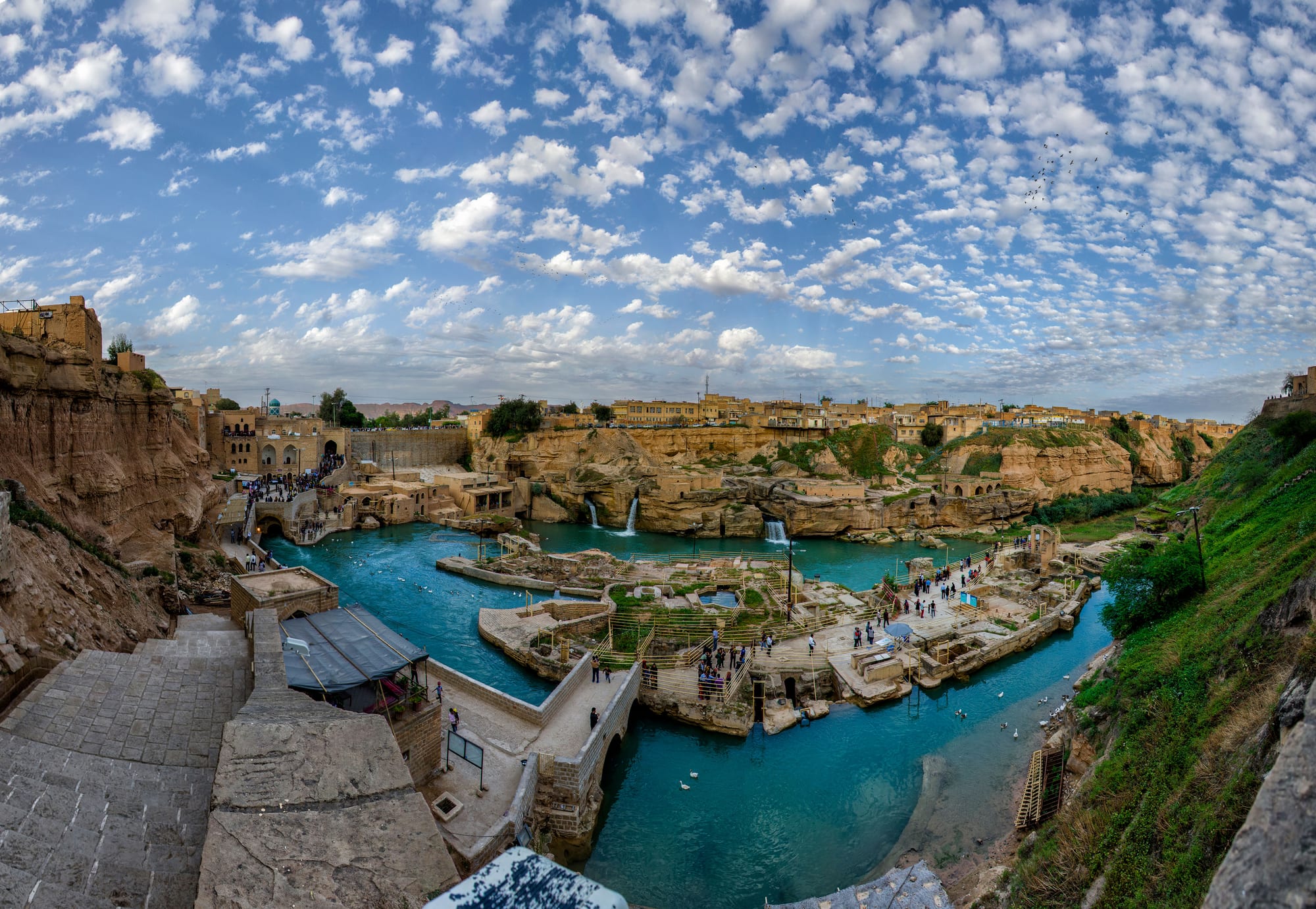
Turquoise water falling through channels cut in rock below a stone-built town, with bridges, ruined mills and terraces around the pools

Shiraz & the South, Iran

Shushtar

The waterfalls, channels and mill ruins of the historical hydraulic system below the old town of Shushtar. (Iman Yari / Wikimedia Commons · CC BY-SA 4.0)

A town in northern Khuzestan built where the Karun river leaves the Zagros foothills, and shaped for two thousand years by the dams, canals, tunnels and watermills that split the river around it. The waterworks are a UNESCO World Heritage Site. This page is written to explain the town, not to encourage travel.

Neighbourhoods

  • The old town above the waterfalls
    • First-time visitors
    • Historic district
    • Photography

    The core of Shushtar stands on a rock terrace directly above the mills and cascades, a grid of brick lanes, courtyard houses and small mosques. Almost everything a visitor comes for is within a short walk of the viewing terraces here.

    Open in Maps
  • The bazaar and central streets
    • Markets
    • Best for food
    • Local life

    The commercial heart of the town below the old quarter, where shops, bakeries, tea houses and the covered market run along a few busy streets. The town's modest hotels and shared-taxi stands are close by.

    Open in Maps
  • The Gargar side
    • Walks and viewpoints
    • Quiet and residential

    The eastern edge along the Gargar canal, the artificial channel that turned the town into an island. The banks give the long views back to the cliffs and the mill ruins, and the district is residential and quiet.

    Open in Maps
  • The newer western districts
    • Quiet and residential
    • Close to public transport

    Low modern housing spreading west towards the road to Dezful and Ahvaz, built as the town grew in the later twentieth century. Little here is historic, but it is where most Shushtaris live.

    Open in Maps

Things to do

The waterworks

  • Shushtar Historical Hydraulic Systemlandmark

    The complex of dams, weirs, tunnels, canals and watermills that divides the Karun around the town, begun in antiquity and inscribed by UNESCO as a World Heritage Site in 2009.

    Open in Maps
  • Band-e Kaisarlandmark

    The Caesar's dam, a Sasanian bridge-weir across the Karun traditionally said to have been built with Roman prisoners after the defeat of the emperor Valerian.

    Open in Maps

Ancient sites and short trips

  • Chogha Zanbillandmark

    The mud-brick ziggurat of the Elamite city of Dur-Untash, built around 1250 BC about 30 kilometres to the west and the first Iranian site inscribed by UNESCO as a World Heritage Site, in 1979.

    Open in Maps
  • Susalandmark

    One of the oldest cities in the world, an Elamite, Achaemenid and later capital whose mounds, palace remains and French excavation castle lie about 60 kilometres north-west; a UNESCO World Heritage Site.

    Open in Maps
  • Haft Tepelandmark

    An Elamite site of mounds, tombs and temple remains on the road towards Susa, identified with the city of Kabnak and the funerary complex of the fifteenth-century BC king Tepti-Ahar.

    Open in Maps
  • Dezfulattraction

    A larger town about 55 kilometres north-west on the Dez river, named after the Sasanian bridge whose stone foundations still carry its brick arches, with an old quarter of brick lanes.

    Open in Maps

Seasonal events

  • Nowruzlate March

    The Persian new year falls in the pleasant season here, when Iranian visitors come to the waterfalls and families picnic along the canals.

  • Mourning of Muharramvaries with the lunar calendar

    Processions and nightly mourning gatherings fill the old quarter, the town's most important religious occasion.

  • Ramadanvaries with the lunar calendar

    A month of daytime fasting when the bazaar works in the evening and the streets come alive after sunset.

Eat and drink

Long-standing places and food districts in Shushtar. Hours, ratings and directions come from your maps app, always current.

Khuzestani food

  • Restaurants around the bazaarneighborhood

    Kababs, rice and the stews of southern Iran, including ghalyeh mahi, the province's best-known dish, a dark stew of fish with onion, fresh coriander and heavy spice.

    Open in Maps
  • Shushtar bazaarmarket

    Dates, citrus, herbs, dried limes and flatbread from the ovens, along with the sugar and molasses that the region's cane fields have produced since antiquity.

    Open in Maps
  • Street food stallsneighborhood

    Falafel and sambuseh, fried pastries filled with spiced meat or lentils, are the standard evening street food across Khuzestan.

    Open in Maps

Experience Shushtar

History

Shushtar exists because of the river. The Karun leaves the Zagros here and runs across the Khuzestan plain, and a channel, the Gargar, was cut through rock to the east of the town, turning the site into an island between two arms of water; parts of the system are traditionally traced back to Darius the Great. Under the Sasanians the island city was chosen as a summer capital. Dams, weirs, tunnels and mill races were added over centuries until the town sat at the centre of a machine for lifting, dividing and using water, driving mills and irrigating the plain below.

The most famous piece of it is Sasanian. Shapur I, who defeated and captured the Roman emperor Valerian in the third century AD, is said to have used Roman prisoners to build the great bridge-weir across the Karun known ever since as the Band-e Kaisar, Caesar's dam. The work combined Roman bridge building with Iranian irrigation engineering, and the system it anchored supported sugarcane plantations and mills that made the district wealthy in the early Islamic centuries, when Shushtar was one of the notable towns of Khuzestan.

Decline followed the silting and damage of later centuries, and the town shrank into a provincial place of brick houses and orchards. Khuzestan's oil century brought Ahvaz and Abadan to prominence rather than Shushtar, and the Iran–Iraq War of 1980–88 turned the province into a battlefield, with the frontier only a short distance west. The waterworks were restored and studied through the twentieth century, and their inscription as a UNESCO World Heritage Site in 2009 confirmed the town's standing as a monument to ancient engineering.

Culture & Customs

Khuzestan is the most mixed province in Iran, and Shushtar sits at the meeting point of its communities: Persian-speaking townspeople with their own Shushtari dialect, Arabic-speaking families whose kin live across the plain and over the border, and Bakhtiari Lurs from the mountains just to the east who still bring flocks down to the lowlands for the winter. Arabic, Persian and Luri are all heard, and marriages, music and cooking cross between them.

The town's architecture is a response to heat. Houses were built of brick around shaded courtyards, with wind catchers above them and cool rooms cut into the soft rock below, where families could escape the worst of the summer. Rooftops and the terraces above the water were the evening living rooms. Water itself is a matter of local pride: the falls and mills are where people take visitors, and the engineering is taught as the town's inheritance.

Religious life follows the Shia calendar, with Muharram the most intense period of the year, when processions move through the old quarter and neighbourhood groups provide food to all comers. Hospitality is unforced and insistent, shaped by taarof; guests are fed, given tea, and pressed to stay. Music at weddings tends to the Arab and Bakhtiari styles of the region, with drums and the sorna oboe, and dancing in lines with sticks or scarves.

Daily Life

About 100,000 people live in Shushtar, in a district of irrigated farmland that is among the most productive in Iran. Sugarcane, planted here since antiquity and revived on a large scale in the modern era, dominates the plain, along with wheat, citrus, dates and vegetables, and the mills and processing plants attached to them employ many townspeople. Government offices, schools, the hospital and the small tourism economy around the World Heritage Site make up much of the rest, and Ahvaz and Dezful draw commuters.

The town's rhythm is dictated by heat for half the year. In summer work begins at dawn, the streets empty by late morning, and life restarts at dusk; in winter the days are mild and the surrounding countryside is green. Water supply, pollution from industry and dust storms blowing in from the dried marshlands to the west are the region's recurring problems, and the state of the Karun — its flow reduced by dams upstream — is a constant local subject.

Khuzestan is oil-rich and has long felt poorly served by the wealth it produces, a grievance that surfaces in protests over water, jobs and services. The national economic crisis of recent years, with its high inflation and collapsing currency, weighs on households here as elsewhere, and young people leave for Ahvaz, Tehran or abroad. Older residents still remember the war years, when the province was the front line and much of its population was displaced.

Food

Shushtar eats like Khuzestan, which means food with more chilli, tamarind and sourness than the Iranian plateau and a strong Arab influence. The regional signature is ghalyeh mahi, a dark stew of fish cooked with onion, heavy spice and a mass of fresh coriander, served with rice; made with shrimp from the Gulf it becomes ghalyeh meygu. Shushtar's own speciality is halim, a breakfast of wheatmeal cooked with shredded lamb. River fish from the Karun, grilled or fried, is common, and rice is often cooked with dill and broad beans or with fish stock.

Street food here is closer to Iraq and the Gulf than to Tehran: falafel in flatbread with pickles and hot sauce, and sambuseh, fried triangular pastries of spiced meat or lentils, are sold from small counters in the evening. Bread is baked flat and thin in clay ovens, and breakfast is bread with fresh cheese, dates and sweet tea. Yoghurt soups and herb stews such as ghormeh sabzi appear at home as they do nationally.

The plain's own produce fills the market: dates from the groves, citrus, cucumbers and melons, and the sugar of the cane fields, which reaches the table as syrup and in the very sweet tea drunk all day. Dried limes, tamarind and hot spice mixes are the store-cupboard staples. Alcohol is illegal in Iran; the cold drinks are doogh, salted yoghurt thinned with water, fresh lime and mint sharbats, and fruit juice, all of which matter a great deal in a place this hot.

Planning tools

Budget

Shushtar is a small provincial town with few hotels and low prices; most visitors come on a day trip from Ahvaz or Dezful, or stay in one traditional-house guesthouse. Costs are dominated by transport, since a car and driver is the practical way to link the town with Chogha Zanbil and Susa. Cash is essential.

Daily Budget Midrange
USD 50–95 (traditional-house hotel or a room in Dezful, restaurants, a driver for Chogha Zanbil and Susa)
Daily Budget Shoestring
USD 20–35 (simple guesthouse, bazaar food, buses and shared taxis)

Arrange a driver in Ahvaz or Dezful to cover the ancient sites in one day, and bring cash, as exchange outside the big cities is limited.

Best Time to Visit

November to March. Khuzestan is a winter destination: the cool months are mild and green, and the waterworks run strongly after the winter rains. From May to September the heat on the plain is extreme and dangerous, with temperatures approaching 50°C, and dust storms are common. That is the ordinary calendar: since 28 February 2026 Iran has been at war with the United States and Israel, and there is at present no good time to go.

Suggested Number of Days

A day is enough for the town itself, and many people stop here while travelling between the larger cities of the province. Two or three days suits anyone taking in the ancient sites of the plain at an unhurried pace; the heat, rather than the number of sights, decides how much fits into a day.

First Visit
1 day
With Surroundings
2–3 days

Transportation

The town is small and served by shared taxis and minibuses, with buses linking it to Ahvaz, Dezful and Masjed Soleyman. Within Shushtar most things are walkable or a short taxi ride. Chogha Zanbil, Susa and Haft Tepe have little public transport and are normally reached with a hired car and driver from here, Ahvaz or Dezful. That is the peacetime picture: the war that began in February 2026 has disrupted aviation and travel across the region, and what is running has changed repeatedly.

Agree a price for a driver covering several sites before setting off, and start early to avoid the afternoon heat. Check what is running before relying on any route.

Airport & Station Connections

There is no airport in the town: visitors fly to Ahvaz, about 90 kilometres south, or to Dezful, about 55 kilometres north-west, both with domestic flights in normal times, and continue by road in roughly an hour or two. The main line from Tehran to the Gulf serves Ahvaz and passes a short way from Dezful, and long-distance buses stop in the town.

Walkability

The old town is compact and best seen on foot: the terraces above the waterfalls, the bridge-weir and the lanes of the historic quarter sit within a kilometre or so, with steps and uneven stone underfoot around the mills. The newer districts are spread out and plain. Walking is comfortable only in the cool months; from late spring the heat makes midday walking unwise.

Safety

Since 28 February 2026 Iran has been at war with the United States and Israel, and this region has been at the centre of it, with strikes on installations along the Gulf coast and in Khuzestan. Khuzestan has a history of separatist unrest among parts of its Arab population, and the Iraqi border zone west of the province was a front line of the Iran–Iraq War, leaving unexploded ordnance in places. Street crime is low; the everyday hazards are extreme summer heat, dust storms and slippery stone around the watercourses.

Several governments strongly advise against travel to Iran. Stay away from the Iraqi border, never photograph military sites or infrastructure, avoid travel here in high summer, and carry water. Check current official travel advice before travelling.

Climate

One of the hottest inhabited parts of the world in summer, with a long dry season and a short wet winter. Rain falls almost entirely between November and April, and dust storms blow in from the west in the warm months; humidity rises closer to the Gulf.

Summer
extremely hot and dry, regularly above 45°C and sometimes near 50°C
Winter
mild and the pleasant season, generally 15–20°C by day with cool nights and most of the year's rain

Local Customs

A headscarf and loose clothing covering the arms and legs are compulsory for women in public, and men do not wear shorts. Khuzestan is mixed — Persian, Arab and Bakhtiari Lur communities live side by side, and Arabic is widely spoken in the province — and hospitality is pressed on visitors in the usual Iranian way, with taarof shaping every offer and refusal. Shoes come off at the door of a mosque or a house.

Ask before photographing people, dress conservatively at shrines and during Muharram, and note that alcohol is illegal throughout the country.

Common Payment Methods

The currency is the Iranian rial, with prices usually quoted in toman, worth ten rials. Foreign bank and credit cards do not work anywhere in Iran because of sanctions, and money cannot be withdrawn inside the country, so visitors bring euros or US dollars in cash and change them in a large city. Small notes are needed in a town this size.