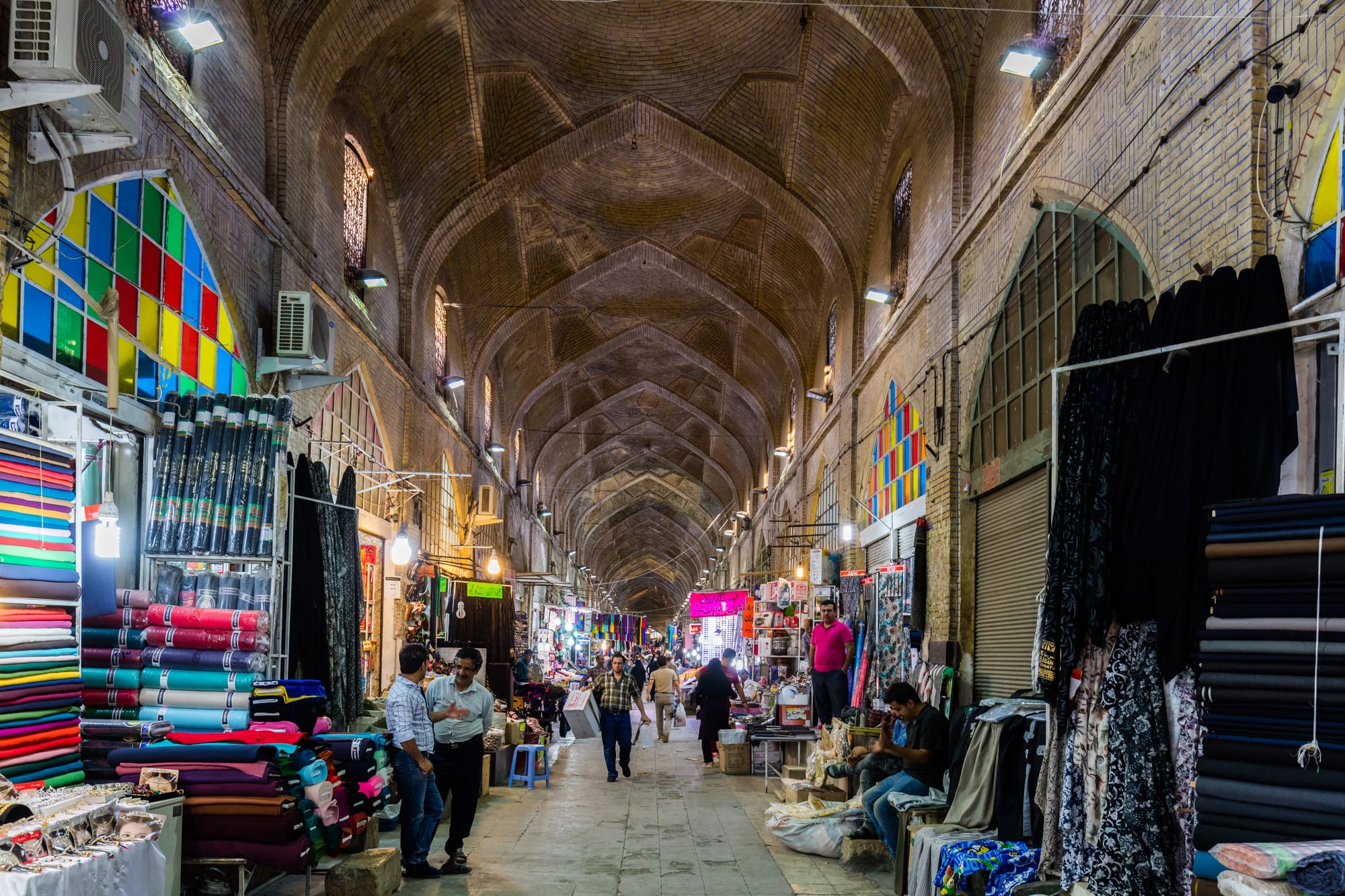
A long brick-vaulted bazaar arcade lined with fabric and clothing stalls, shoppers walking down the stone-paved aisle

Shiraz & the South, Iran

Shiraz

The brick vaults of the Vakil Bazaar in central Shiraz, built in the eighteenth century under Karim Khan Zand. (Diego Delso / Wikimedia Commons · CC BY-SA 4.0)

The capital of Fars province, set in a valley of the Zagros at about 1,500 metres and long known in Persian culture as the city of gardens, wine and poetry. It holds the tombs of Hafez and Saadi, the Zand dynasty's bazaar and citadel, and the road to Persepolis. This page is written to explain the city, not to encourage travel.

Neighbourhoods

  • The Zand centre
    • First-time visitors
    • Historic district
    • Close to public transport

    The heart of the city along Karim Khan Zand Boulevard, where the citadel, the Vakil mosque, bathhouse and bazaar stand within a few minutes of each other. Hotels, banks and bus and metro connections are concentrated here, and the streets stay busy into the evening.

    Open in Maps
  • The old quarters and Shah Cheragh
    • Historic district
    • Markets
    • Pilgrimage

    South and east of the bazaar, a dense grid of lanes, courtyard houses and small mosques around the pilgrimage shrine of Shah Cheragh. Many of the restored traditional houses that now take guests are in these streets, and the mosque with the famous stained glass is at their southern edge.

    Open in Maps
  • Hafeziyeh and Saadiyeh
    • Gardens and tombs
    • Quiet and residential

    The north-eastern districts below the mountains, where the tombs of the two poets stand in walled gardens a few kilometres apart. Cypress trees, teahouses and the Quran Gate at the mouth of the pass give this side of the city its reputation.

    Open in Maps
  • Eram and the university quarter
    • Gardens
    • Students and cafés

    North-west of the centre, built around the botanical garden of Eram and the campuses of Shiraz University. The avenues are wide and green, with bookshops, cafés and newer flats, and other walled garden estates within reach.

    Open in Maps
  • Qasr-e Dasht
    • Quiet and residential
    • Orchards

    A western district of walled orchards and garden plots that gave Shiraz much of its fruit, now part suburb and part farmland. Families drive out here in spring, when the citrus and almond trees are in blossom.

    Open in Maps

Things to do

Mosques and shrines

  • Nasir al-Mulk Mosquelandmark

    A Qajar mosque built between 1876 and 1888, its prayer hall glazed with stained glass that throws coloured light across the carpets at sunrise.

    Open in Maps
  • Shah Cheraghlandmark

    The mirrored funerary mosque and pilgrimage shrine of two brothers of the eighth Shia imam, the most important religious site in the city.

    Open in Maps
  • Vakil Mosquelandmark

    The congregational mosque built under Karim Khan Zand between 1751 and 1773, with a forest of spiral stone columns in its winter prayer hall and pink-flowered tilework.

    Open in Maps

The Zand city

  • Arg of Karim Khanlandmark

    The brick citadel of the Zand dynasty in the centre of the city, with round corner towers, one of them leaning, around a walled residential courtyard.

    Open in Maps
  • Vakil Bazaarmarket

    The eighteenth-century covered market, its long brick vaults holding carpet, spice, fabric and copper sellers and a series of old caravanserai courtyards.

    Open in Maps
  • Vakil Bathmuseum

    A Zand-period public bathhouse beside the bazaar, its domed chambers now used for displays on bathing and daily life.

    Open in Maps
  • Quran Gatelandmark

    The gateway at the north-eastern entrance of the city, where travellers once passed beneath a Quran kept in a chamber above the arch for a safe journey.

    Open in Maps

Gardens and poets' tombs

  • Tomb of Hafezlandmark

    The domed pavilion over the grave of the fourteenth-century poet Hafez, set in a garden of cypresses and orange trees where Iranians come to read his verses aloud.

    Open in Maps
  • Tomb of Saadilandmark

    The resting place of Saadi, the thirteenth-century poet of the Gulistan and Bustan, in a garden with a spring-fed fish pond a few kilometres north-east of the centre.

    Open in Maps
  • Eram Gardenpark

    A Qajar garden of cypresses, watercourses and a tiled pavilion, now a botanical garden of Shiraz University and part of the UNESCO listing of the Persian Garden.

    Open in Maps
  • Qavam Houselandmark

    The Naranjestan, a nineteenth-century mansion and orange-tree garden with painted ceilings and mirrored reception rooms.

    Open in Maps
  • Afif-Abad Gardenpark

    A walled garden and Qajar mansion in the west of the city, with a pool, tall cypresses and a collection of historic arms.

    Open in Maps
  • Delgosha Gardenpark

    One of the oldest garden sites in the city, near the tomb of Saadi, laid out with orange trees around a pavilion.

    Open in Maps

Short trips from the city

  • Persepolislandmark

    The ceremonial capital of the Achaemenid empire, about 50 kilometres north-east, with its staircases of tribute-bearing reliefs, column halls and royal gateway; a UNESCO World Heritage Site.

    Open in Maps
  • Naqsh-e Rostamlandmark

    A cliff face near Persepolis cut with the rock-hewn tombs of Achaemenid kings above later Sasanian reliefs of royal victories.

    Open in Maps
  • Pasargadaelandmark

    The first Achaemenid capital, built by Cyrus the Great, whose plain stepped tomb stands alone on the plain about 90 kilometres north-east of the city; a UNESCO World Heritage Site.

    Open in Maps

Seasonal events

  • Nowruzlate March

    The Persian new year fills the gardens and the poets' tombs with visitors from across Iran, and coincides with the orange blossom for which the city is known.

  • Mourning of Muharramvaries with the lunar calendar

    Processions and nightly gatherings centred on Shah Cheragh and the old quarters, the most intense religious period of the year.

  • Yalda Night21 December

    The longest night of the year, spent with watermelon, pomegranates, nuts and readings from the poems of Hafez.

  • Commemoration of Hafez12 October

    An annual day marking the poet, observed with readings and music at his tomb.

Eat and drink

Long-standing places and food districts in Shiraz. Hours, ratings and directions come from your maps app, always current.

Shiraz classics

  • Faloodeh shopsneighborhood

    Faloodeh-ye Shirazi is the city's signature sweet — thin frozen starch noodles in a rosewater and lime syrup, sold near the poets' tombs and in the bazaar quarter.

    Open in Maps
  • Vakil Bazaarmarket

    Spice stalls, dried limes, rosewater, dates and nuts under the brick vaults, with tea served in the courtyards of the old caravanserais.

    Open in Maps

Restaurants and teahouses

  • Restaurants around Karim Khan Zand Boulevardneighborhood

    The central strip for kababi grills and traditional restaurants serving kalam polo, the Shirazi rice with cabbage and small meatballs.

    Open in Maps
  • Courtyard teahouses of the old cityneighborhood

    Several restored courtyard houses near the bazaar serve tea, sherbets and stews under orange trees, in the manner the city is known for.

    Open in Maps

Experience Shiraz

History

Shiraz is an Islamic-era city on a much older site, its name recorded as Tiraziš on Elamite tablets: the modern city was founded or restored in 693, after the Arab conquest, by a kinsman of the Umayyad governor of the east. Its first golden age came under the Buyids in the tenth century, when it was one of the leading cities of the Islamic world for learning, and it gained a reputation for gardens, wine and poets that it never lost. The local Salghurid rulers submitted to the Mongols in the thirteenth century, which spared the city the destruction suffered elsewhere; Saadi lived and wrote here then, and Hafez a century later.

The city's second peak was the Zand period. Karim Khan, who took power over much of Iran after the fall of Nader Shah, made Shiraz his capital in the 1760s and built the citadel that carries his name, the Vakil mosque, bathhouse and bazaar, and a ring of walls and moats. He called himself the regent, vakil, rather than shah. After his death in 1779 the Zands lost a civil war to the Qajars, who moved the capital to Tehran, destroyed the fortifications and left Shiraz a provincial town. Earthquakes and the long nineteenth-century decline reduced it further.

Modern growth came with the twentieth century: roads and a rail link, the founding of what is now Shiraz University, oil-era money, and a large university and hospital sector that made the city a regional centre. An international festival of arts ran in the city and at Persepolis from 1967 to 1977, and the Shah's celebration of 2,500 years of monarchy was staged at Persepolis in 1971. The revolution of 1979 ended that era, and the city has since grown into the largest in southern Iran.

Culture & Customs

No Iranian city is more bound up with poetry. Hafez and Saadi are buried here, and their tombs are not museums but places of use: people come in the evening to read a ghazal aloud, to take a fal-e Hafez, a fortune drawn at random from the poet's collected works, and to sit under the cypresses with tea. Lines from both poets turn up in everyday speech and on carpets, tilework and gravestones across the country.

The garden is the other Shirazi art. The classic walled Persian garden, with its straight watercourse, cypress avenues and pavilion at the cross-axis, reached one of its finest forms here, and Eram Garden is part of the UNESCO listing that covers the type. Orange trees line the city's older streets, and their blossom in spring is treated as a public event. Wine made from Shiraz grapes was famous for centuries and written about by the poets; alcohol has been illegal since 1979, and the connection survives only in literature and in the name used abroad for an unrelated grape variety.

Religion in the city centres on Shah Cheragh, a pilgrimage shrine whose mirrored interior draws visitors from across Iran, and Muharram brings processions through the old quarters. Fars province is also the homeland of the Qashqai, a Turkic confederation of pastoralists whose weaving and seasonal migrations remain part of the region's identity, and whose carpets and gabbehs are sold in the bazaar. Shirazis have a national reputation for being easy-going, talkative and devoted to picnics, and the city's own humour turns on that image.

Daily Life

About two million people live in Shiraz, making it Iran's fifth largest city and the main centre of the south. It is a university city above all — Shiraz University, a large medical school and several other institutions draw students from across the country — and a medical centre whose hospitals serve the whole province. Electronics and petrochemical industries, food processing and the farming of the Fars plains, with its citrus, grapes and cereals, round out the economy, alongside the tourism that in ordinary times brings most of Iran's foreign visitors here.

The city is laid out on long boulevards running north-west to south-east along the valley, with the first metro line following the same axis. Newer housing has climbed the slopes and spread into the orchard land of Qasr-e Dasht, while the old quarters south of the bazaar have seen courtyard houses restored as hotels and restaurants alongside blocks that are still crowded and poor. Water is a constant worry: the region's rainfall has been low for years, the lake south-east of the city dries out, and supply restrictions are part of life.

Days begin early and pause in the afternoon heat of summer, when shops close and reopen towards evening. The national economic crisis — high inflation and a currency that has lost most of its value — bears on households here as elsewhere, and young graduates leave for Tehran or abroad. Fridays are for family visits and picnics in the gardens, on the slopes above the Quran Gate, or out among the orchards.

Food

The dish most associated with the city is kalam polo Shirazi, rice steamed with cabbage, herbs and small meatballs scented with cinnamon and a little rosewater. Beside it sit the national staples cooked in local versions: kababs of lamb and minced meat with grilled tomatoes, and thick stews such as ghormeh sabzi of herbs and dried lime. Shirazi salad — cucumber, tomato and onion diced small and dressed with lime juice — is named after the city and eaten with everything.

Sweets and cold things are the real speciality. Faloodeh-ye Shirazi is thin frozen noodles of starch in a syrup of rose water and sugar, eaten with lime juice squeezed over it and often with ice cream; masghati, a soft, fragrant starch-based sweet studded with almonds or pistachios, is the other local confection, along with candied orange peel and rosewater-scented pastries. Both are sold near the poets' tombs and in the bazaar, and the city's reputation for them reaches every province.

The bazaar is the place to see what the countryside produces: dates, dried limes, citrus, pistachios, rosewater distilled in the villages, and herbs sold by the armful. Bread comes flat and hot from the oven — sangak baked on stones, barbari, taftoon — and is eaten at breakfast with cheese, walnuts and herbs. Tea is constant and dark, drunk through a lump of sugar. Alcohol is illegal; the drinks on offer are doogh, salted yoghurt thinned with water, and sharbats made with rose, quince or lime.

Planning tools

Budget

Shiraz is one of Iran's main tourist cities, and prices reflect it: restored courtyard-house hotels in the old quarters and restaurants near the bazaar cost more than the national average, while guesthouses, bazaar food and the metro are cheap. A car and driver for Persepolis, Naqsh-e Rostam and Pasargadae is the other main expense. Cash is essential.

Daily Budget Midrange
USD 50–95 (boutique hotel in a traditional house, restaurants, a driver for Persepolis)
Daily Budget Shoestring
USD 20–35 (guesthouse or hostel bed, bazaar and street food, metro and shared taxis)

Rooms in the traditional-house hotels are few and fill at Nowruz, so arrange them well ahead, and bring enough cash for the whole stay.

Best Time to Visit

March to May, when the orange trees blossom and the gardens are at their best, and October and November, which are clear and mild. Summer days are hot and dry, though the altitude keeps the nights bearable, and winter brings cold nights, rain and the low sun that lights the stained glass of the Nasir al-Mulk mosque. That is the ordinary calendar: since 28 February 2026 Iran has been at war with the United States and Israel, and there is at present no good time to go.

Suggested Number of Days

The gardens, tombs, shrines and the Zand centre take two or three days at an unhurried pace. Allow four or five to add the Achaemenid sites on the plain to the north-east and the Zagros valleys; travellers combining Shiraz with Yazd or Isfahan often stay longer.

First Visit
2–3 days
With Surroundings
4–5 days

Transportation

Shiraz has two metro lines, the first running north-west to south-east across the city, a large bus network and plentiful cheap taxis, both private and shared. Most of the historic sights are in or near the centre, and the tombs and gardens are short taxi rides from it. Persepolis, Naqsh-e Rostam and Pasargadae are reached by hired car with driver, since public transport to them is awkward. That is the peacetime picture: the war that began in February 2026 has disrupted aviation across the region, and what is open at any given airport or road has changed repeatedly.

Shared taxis run set routes along the main boulevards and are flagged down at the kerb. Check what is running before relying on any route.

Airport & Station Connections

Shahid Dastghaib International Airport sits a few kilometres south-east of the centre and is the largest airport in southern Iran, with domestic flights and some international ones in normal times. By road Shiraz is roughly six hours from Isfahan and twelve or more from Tehran; VIP buses run overnight, and a railway line links the city to the national network.

Walkability

The Zand centre is comfortable on foot: the citadel, the Vakil complex and the bazaar form one continuous walk, and the lanes of the old quarters south of them are best seen slowly. Beyond that the city is large and laid out on wide boulevards, so the poets' tombs, Eram Garden and the university quarter are reached by taxi or metro. Summer afternoons are too hot for long walks.

Safety

Since 28 February 2026 Iran has been at war with the United States and Israel, and strikes have hit targets across the country; in this region the Gulf coast has been at the centre of it. Mass anti-government protests that began in December 2025 have been met with lethal force and near-total internet blackouts. Street crime is low and Shirazis are hospitable, but military and nuclear sites must never be approached or photographed, and dual nationals and journalists face a particular risk of arbitrary arrest.

Several governments strongly advise against travel to Iran. Avoid all demonstrations, never photograph security forces or military sites, dress conservatively at Shah Cheragh and other shrines, and do not discuss politics with strangers. Check current official travel advice before travelling.

Climate

A semi-arid climate tempered by an altitude of about 1,500 metres, with long dry summers and a short wet season between December and April. Days are sunny for most of the year and the air is dry.

Summer
hot and dry, with highs around 35–38°C and much cooler nights
Winter
cool and changeable, with daytime temperatures around 10–15°C, frosty nights and most of the year's rain

Local Customs

A headscarf and loose clothing covering the arms and legs are compulsory for women in public, and modest dress is expected of men; shrines require stricter cover, and a chador is lent at the entrance to Shah Cheragh. Shoes come off at mosque doors and in homes. Taarof, the ritual of offering and refusing, governs invitations and payments, and visitors are often invited to sit, drink tea or share a picnic. Poetry is quoted in ordinary conversation here more than anywhere else in Iran.

Ask before photographing people, keep photography discreet inside shrines, and note that alcohol is illegal in Iran despite the city's old association with wine.

Common Payment Methods

The currency is the Iranian rial, with prices usually quoted in toman, worth ten rials each. Foreign bank and credit cards do not work because of sanctions and there is no way to withdraw money inside the country, so visitors bring euros or US dollars in cash and change them locally; some agencies issue a prepaid local card for visitors. Keep small notes for taxis and the bazaar.