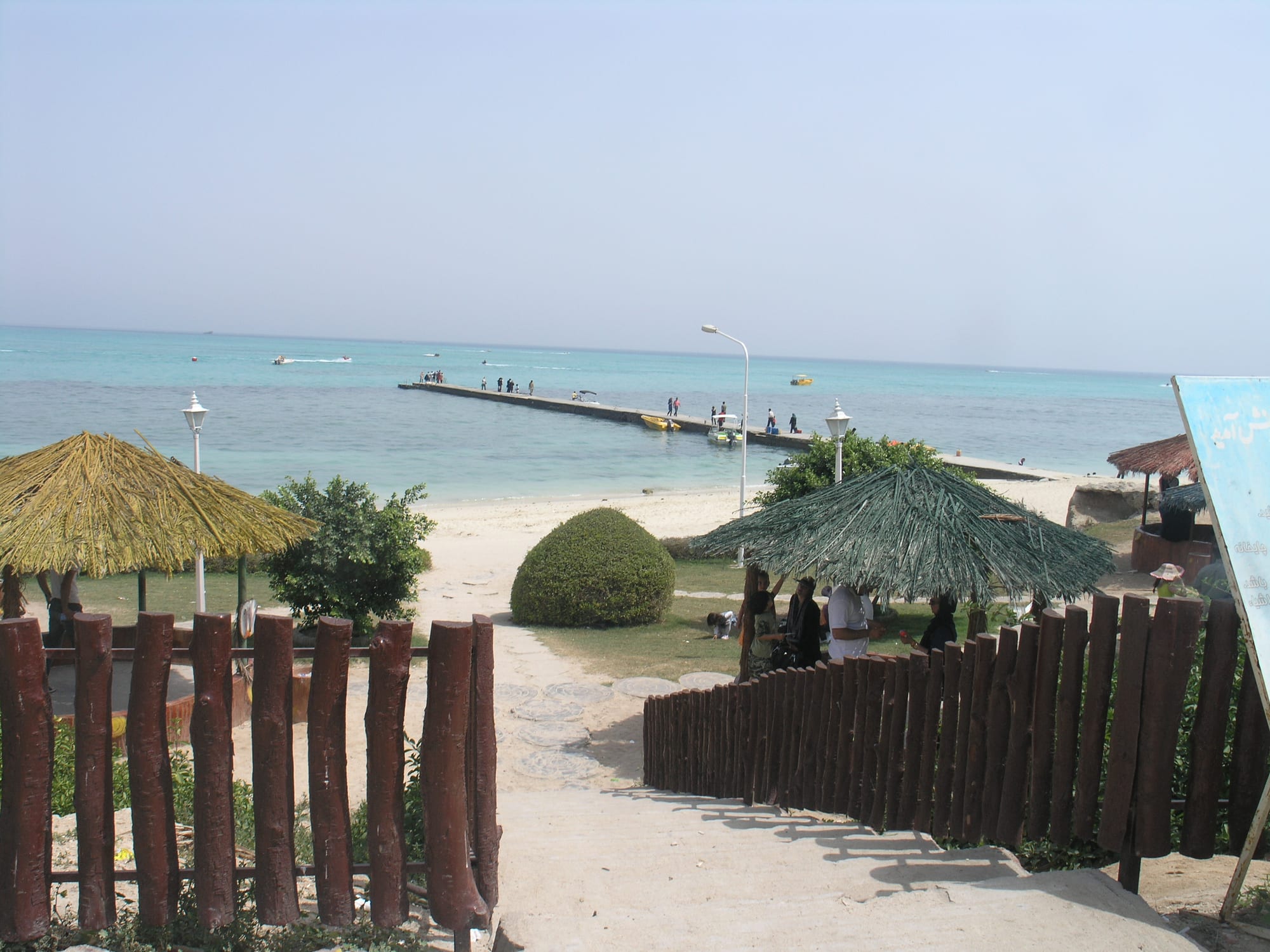
Thatched umbrellas and a sandy beach above turquoise water, with a low stone jetty running out into the Gulf

Shiraz & the South, Iran

Kish Island

The beach and jetty on the coral coast of Kish Island in the Persian Gulf. (mohsen barazandeh ah… / Wikimedia Commons · CC BY-SA 3.0)

A flat coral island in the Persian Gulf, some 20 kilometres off the Iranian coast, that was a rich medieval trading port and is now a free-trade zone and the country's main domestic beach resort, with shopping centres, hotels, clear water and the ruins of the old town of Harireh. This page is written to explain the island, not to encourage travel.

Neighbourhoods

  • The northern town and shopping centres
    • First-time visitors
    • Shopping
    • Close to public transport

    The built-up north of the island, where most hotels, restaurants and the large air-conditioned malls of the free-trade zone stand along a grid of wide avenues. This is where the island's residents live and work, and where arriving flights land nearby.

    Open in Maps
  • The eastern coral coast
    • Beaches
    • Snorkelling and boat trips

    A low shoreline of white coral rubble and shallow turquoise water on the eastern side, with jetties, beach clubs and the departure points for glass-bottomed boats and diving trips.

    Open in Maps
  • The southern shore
    • Quiet and residential
    • Sunsets

    A more open coast of rock ledges and sand backed by resort hotels and stretches of scrub. The rusting hull of a cargo ship aground offshore is the landmark most photographed here, especially at sunset.

    Open in Maps
  • Harireh and the western end
    • Historic district
    • Quiet and residential

    The thinly built western half of the island, and, on the northern coast, the excavated remains of the old town of Harireh among dust and palms. Little is built here beyond scattered gardens and greenhouses that supply the island.

    Open in Maps

Things to do

History on the island

  • Harirehattraction

    The excavated remains of an eighth-century town at the centre of the northern coast, long abandoned, its site covering about three square kilometres.

    Open in Maps
  • The Greek ship wrecklandmark

    A cargo ship that ran aground off the south-western shore in 1966 and has rusted in place ever since; known locally as the Greek ship, it is the island's best-known sight.

    Open in Maps

Beaches and the sea

  • Coral beaches of the east coastbeach

    Shallow, clear water over living and broken coral, with marked bathing areas separated for women and men as elsewhere in Iran.

    Open in Maps
  • The underground karizattraction

    An ancient underground water channel cut into the coral bedrock beneath the island, part of it now open as a walk-through gallery of tunnels and wells.

    Open in Maps

Short trips by sea and air

  • Hendorabiattraction

    A small, much quieter island about 35 kilometres west, reached by boat, with sand beaches and little development.

    Open in Maps
  • Bandar Lengehattraction

    The port on the mainland coast about 90 kilometres east, a historic Gulf trading town and the county town to which Kish belongs.

    Open in Maps
  • Kish International Airporttransit hub

    The island's airport, near the centre of the island and the arrival point for most visitors, with domestic flights to mainland cities in normal times.

    Open in Maps

Seasonal events

  • Nowruzlate March

    The Persian new year is the island's busiest fortnight, when Iranian families fill the hotels and the beaches at the end of the cool season.

  • Ramadanvaries with the lunar calendar

    Daytime eating and drinking in public stops during the fasting month, and the island's restaurants and markets work in the evening instead.

  • Winter holiday seasonNovember to March

    The cool months are the island's high season, with conferences, trade fairs and a steady flow of domestic holidaymakers.

Eat and drink

Long-standing places and food districts in Kish Island. Hours, ratings and directions come from your maps app, always current.

Island food

  • Fish and shrimp restaurantsneighborhood

    Southern Iranian cooking centres on the Gulf catch — fish grilled or fried with turmeric and garlic, shrimp with rice, and ghalyeh mahi, a dark fish stew with tamarind, coriander and chilli.

    Open in Maps
  • Malls and food courts of the free-trade zoneneighborhood

    The island's commercial centres hold food courts, cafés and ice-cream counters, busy in the evening when the heat drops.

    Open in Maps
  • Dates, dried fish and spicesmarket

    Shops sell the produce of the Gulf coast — dates from the mainland groves, dried and salted fish, tamarind, dried limes and the hot spice mixes used in Bandari cooking.

    Open in Maps

Experience Kish Island

History

Kish was a trading island long before it was a resort. Under the name Qais it appears in medieval Arabic and Persian geographies as a port at the centre of the Gulf, whose merchants dealt in pearls fished from the banks nearby, in horses shipped to India and in goods moving between Basra, Oman and the Indian coast. From the eleventh century its rulers competed with, and eventually eclipsed, the older mainland port of Siraf, and for roughly two centuries the island was one of the wealthiest places in the Gulf. Marco Polo's account of the region mentions the island's pearls, and the ruins at Harireh, spread over about three square kilometres of the northern coast, date from those centuries.

The rise of Hormuz, at the mouth of the Gulf, took the trade away, and Kish sank into obscurity as a poor fishing and pearling island. Pearl diving remained its main livelihood into the twentieth century, until Japanese cultured pearls destroyed the market in the 1930s.

The modern island dates from the 1970s, when the government of the day developed it as an international resort with an airport, hotels and a road network. That project ended with the revolution of 1979, and the Iran–Iraq War of the 1980s left the Gulf a dangerous place. Kish was designated a trade zone in 1989, which reopened it as a duty-free shopping and holiday destination for Iranians; hotels, malls and apartment blocks were built through the 1990s and 2000s, and the island's population and visitor numbers have grown steadily since.

Culture & Customs

Kish is Iran's holiday island, and its culture is largely the culture of Iranian tourism: families and young couples from Tehran, Isfahan and Shiraz come for the sea, the malls and the mild winter, and the island trades on being a little more relaxed and better supplied than the mainland. Shopping is the main activity — electronics, clothing and cosmetics brought in duty free — and trade fairs and conferences fill the hotels outside the holiday peaks.

The permanent population is a different island. Alongside the workers who have come from all over Iran for jobs in hotels, construction and the free zone, there are long-settled families of the Gulf coast whose culture is Bandari: a southern Iranian mix with strong Arab and East African influence, heard in the drums, the neyanban bagpipe and the fast six-eight rhythms of Bandari music, and seen in the loose, bright clothing and, among some older women, the stiff burqa-style face covering worn along this coast. Many coastal families are Sunni Muslims, unlike most of Iran.

National rules hold here as everywhere in the country: headscarves and covered arms and legs in public, separate enclosed beaches for women and men, and no alcohol. Sea customs shape the calendar too — fishing, boat building and, in memory if no longer in practice, the pearl diving that once sent crews out for weeks at a time and left behind its own songs.

Daily Life

Roughly 55,000 people live on the island, a number that swells with holidaymakers in the cool season and with short-term workers. Almost everyone depends on the free-trade zone in some way: hotels, restaurants and beach concessions, the shopping centres, construction, the airport and port, and the administration that runs the zone. There is little farming on the thin coral soil, though gardens and greenhouses supply some vegetables, and fishing continues from small harbours.

Life is organised around the heat. From late spring the working day starts early and the afternoons are spent indoors, with the malls acting as air-conditioned public space; evenings bring people out to the seafront, the parks and the food courts, and summer nights are lived late. Fresh water is the island's permanent constraint, supplied by desalination, and electricity for cooling is the largest running cost of almost every building.

The island is comfortable by Iranian standards but not detached from the country's problems: inflation and the collapse of the currency have pushed up the cost of imported goods and of the flights that bring visitors, and the fortunes of the hotels follow the national economy closely. Residents live mainly in the city of Kish in the north of the island and in apartment blocks built for zone employees, well away from the resort strips, and many keep families on the mainland.

Food

Kish eats what the Gulf coast eats. The staples are fish and shrimp: whole fish rubbed with turmeric, garlic and lime and grilled or fried, shrimp cooked with rice and spices, and ghalyeh mahi, a dark, sour stew of fish with tamarind, fresh coriander, garlic and chilli that is the signature dish of southern Iran. Ghalyeh meygu is the same sauce made with shrimp. The southern spice palette — hot, sour and much heavier on chilli and tamarind than the food of the plateau — is the clearest difference between this coast and the rest of the country.

Bread is the flat, thin local kind baked in a clay oven, and rice is eaten with almost everything, often coloured with turmeric or mixed with dill and broad beans. Falafel and small stuffed pastries, brought from across the Gulf, are common street food along this coast, as is a hot spiced sandwich sold from counters in the evening. Dates from the mainland groves, dried limes, tamarind and salted fish fill the shops, and fresh mango and other imported fruit are easy to find because of the island's trading status.

Drinks follow the national pattern: strong dark tea all day, doogh, which is salted yoghurt thinned with water, and fruit juices and sharbats scented with rose or lime. Alcohol is illegal throughout Iran. The one local indulgence is ice cream and faloodeh, eaten late in the evening when families walk on the seafront.

Planning tools

Budget

As a free-trade zone popular with Iranian holidaymakers, Kish charges more for hotels than the mainland, especially in the cool season and at Nowruz, and it has few budget beds. Food is cheaper than the rooms, and the island's duty-free status makes it a shopping destination for Iranians rather than a bargain for foreign visitors. Cash is essential.

Daily Budget Midrange
USD 55–100 (resort or mid-range hotel, restaurants, boat trips and taxis)
Daily Budget Shoestring
USD 25–45 (simple guesthouse or shared apartment, bakery and fish-restaurant meals, local buses)

Bring enough cash for the whole stay, as exchange on the island is limited, and book well ahead for the winter season and Nowruz.

Best Time to Visit

November to March, when the air is warm and dry, around 20–25°C, and the sea is comfortable; this is when Iranians come. From May to September the combination of 40°C heat and heavy humidity makes the middle of the day difficult and outdoor sightseeing unpleasant. That is the ordinary calendar: since 28 February 2026 Iran has been at war with the United States and Israel, and there is at present no good time to go.

Suggested Number of Days

The island covers about 91 square kilometres and its sights are few, so one or two days cover them. People who come to swim, dive or use the island as a base for boat trips stay longer, and the season, the heat and the ferry timetable matter more than the list of things to see.

First Visit
1–2 days
With Surroundings
3–4 days

Transportation

Kish is small and flat, with a ring road around the coast. Taxis are the usual way to get about, and hire cars, motorcycles, bicycles and electric buggies are widely rented; a limited bus service links the hotels and the malls. Bicycles work well in the cool months. That is the peacetime picture: the war that began in February 2026 has disrupted aviation across the region, and what is open at any given airport, port or route has changed repeatedly.

Agree a taxi fare before setting off, and avoid cycling in the middle of the day in summer. Check what is running before relying on any route.

Airport & Station Connections

Most visitors fly: Kish International Airport is at the centre of the island, a short drive from the hotels, with domestic flights from cities on the mainland in normal times. Passenger boats and a car ferry cross from ports on the mainland coast, a trip of roughly an hour depending on the boat and the sea. The island has historically had its own, easier entry arrangements separate from the mainland, but Iranian entry rules change often and should be checked before any journey.

Walkability

Distances inside the hotel and shopping districts are walkable, and the seafront paths on the eastern coast make easy level walking in the cool months. The island as a whole is spread out and built for vehicles, with long stretches of empty road between the town, the beaches and Harireh, and there is very little shade; from May to September walking outside in the daytime is uncomfortable.

Safety

Since 28 February 2026 Iran has been at war with the United States and Israel, and this coast has been at the centre of it: Iran blocked the Strait of Hormuz in March 2026 and shipping in the Gulf has repeatedly been attacked, while aviation across the region has been disrupted. Street crime on the island is very low. The ordinary risks are heat and dehydration in summer, sharp coral and currents in the water, and the rule that ports, naval sites and ships must never be photographed.

Several governments strongly advise against travel to Iran. Never photograph ports, ships or military sites, avoid the island in high summer, and swim only in the marked areas, which are separated for women and men. Check current official travel advice before travelling.

Climate

Hot desert climate with sea humidity all year. Rain is rare and falls mostly in winter; the sea is warm enough for swimming through the cool months, and dust and haze are common.

Summer
very hot and humid, with highs above 40°C and nights staying near 30°C
Winter
warm and dry, generally 20–25°C by day, the comfortable season

Local Customs

Iranian rules apply on Kish despite its resort character: a headscarf and loose clothing covering the arms and legs are compulsory for women in public, and beaches are divided into separate enclosed areas for women and men, with swimwear worn only inside them. Alcohol is illegal. Taarof, the exchange of polite offers and refusals, governs invitations and payments, and most people met here are Iranian holidaymakers rather than residents.

Dress modestly away from the enclosed beaches, ask before photographing people, and keep cameras away from ports and boats.

Common Payment Methods

The currency is the Iranian rial, with prices usually quoted in toman, worth ten rials. Foreign bank and credit cards do not work anywhere in Iran because of sanctions, and money cannot be withdrawn once inside the country, so visitors bring euros or US dollars in cash; exchange on the island is limited, so changing money in Shiraz or Bandar Abbas first is wise. Shops in the free-trade zone take Iranian bank cards.