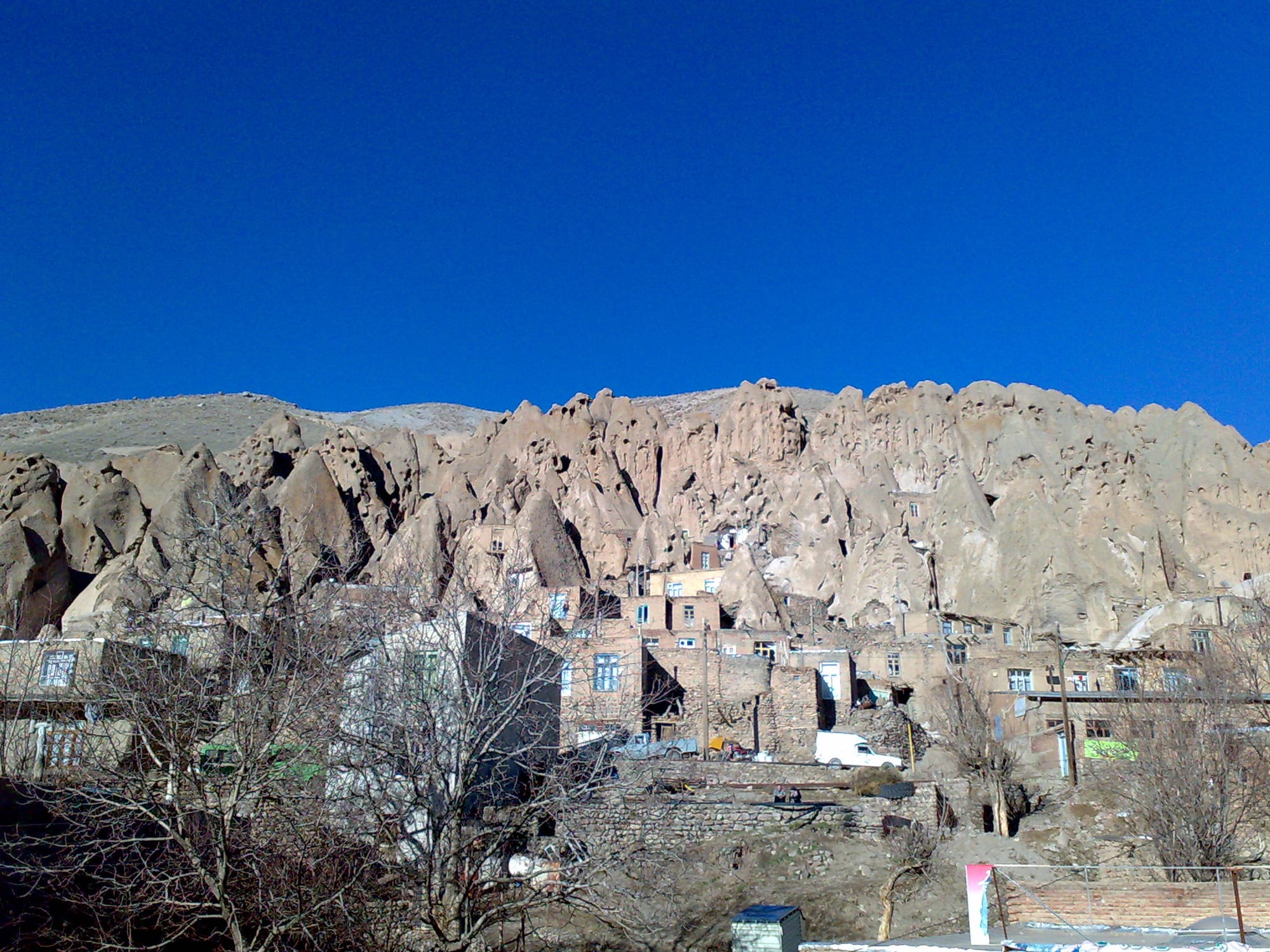
Cone-shaped rock formations with doors and windows cut into them above a village of brick houses under a clear blue sky

Iran

Tabriz & the Northwest

The cave houses of Kandovan, carved into volcanic rock cones on the slopes of Mount Sahand south of Tabriz. (aliarji / Wikimedia Commons · CC BY-SA 3.0)

Iran's high, cold north-west, bordering Turkey, Iraq, Armenia and Azerbaijan — an Azerbaijani-speaking heartland around Tabriz and Ardabil, with Kurdish mountains to the south-west and Armenian monasteries in the north, and Lake Urmia at its centre. This page is written to explain the region, not to encourage travel.

Explore Tabriz & the Northwest

History

The north-west has been a crossroads of empires since antiquity. The Mannaeans and then the Medes ruled the lands around Lake Urmia in antiquity, and under the Sasanians the region, known as Atropatene, held Adur Gushnasp, one of the three great fire temples of Zoroastrianism, at the site now called Takht-e Soleyman. Christianity took root early among Armenians and Assyrians, whose churches still dot the north and the Urmia plain.

From the 11th century Turkic peoples settled the region, and over time its language became Azerbaijani Turkish. Tabriz rose to become a capital of the Mongol Ilkhanids, whose ruler Öljeitü built a new capital at Soltaniyeh, and then of the Turkmen Qara Qoyunlu and Aq Qoyunlu. In Ardabil the Sufi order of Sheikh Safi al-Din grew into a militant movement, and in 1501 its young leader Ismail took Tabriz and proclaimed the Safavid dynasty. The Ottomans repeatedly seized the city, and the Safavids moved their capital inland.

Under the Qajars Tabriz was the seat of the crown prince and Iran's gateway to Russia and Europe. After wars with Russia, the Treaty of Turkmenchay in 1828 fixed the border on the Aras river. Tabriz was a centre of the constitutional revolution of 1905–11. After the Second World War, Soviet-backed governments briefly ruled from Tabriz and, among the Kurds, from Mahabad in 1945–46 before Iranian forces returned. Since then Tabriz has grown into a large industrial city, while Kurdistan's relations with the state have remained tense.

Culture & Customs

Most people in East and West Azerbaijan, Ardabil and Zanjan speak Azerbaijani Turkish at home and Persian at school and work, and Iranian Azerbaijanis, mostly Shia, are deeply woven into national life, from the bazaar to the clergy and government. Tabrizis take pride in their city's role in the constitutional revolution, its commerce and its football club, Tractor, whose matches draw huge crowds. The ashiq, a bard who sings epics to the long-necked saz, carries the region's oral tradition.

In Kurdistan province and the south-west of West Azerbaijan, the population is Kurdish and largely Sunni, with Kurdish dress and circle dances at weddings. The Hawraman valleys keep a distinct dialect and village life on terraced slopes. Armenian and Assyrian Christian communities, smaller than they once were, live around Urmia, Salmas and Tabriz, and the Armenian monastery of St Thaddeus remains a place of pilgrimage.

Tabriz carpets, with dense knots and elaborate medallion designs, are among the most famous in Iran, and Zanjan is known for its knives and filigree silver.

Daily Life

Tabriz, with over 1.7 million people, is the largest city of north-western Iran. Urmia, Ardabil, Zanjan and Sanandaj each have a few hundred thousand, and the smaller towns include Maragheh, Marand, Khoy, Mahabad and Saqqez.

Tabriz is an industrial and trading city of machinery, vehicles, food processing and carpets, and its bazaar still handles serious wholesale trade. Around Lake Urmia and on the Aras valley farmers grow wheat, sugar beet, apples and grapes, and the Kurdish highlands raise sheep and goats. Cross-border trade with Turkey, Iraq and the Caucasus, formal and informal, is a large part of the economy, especially for Kurdish border communities, where porters, known as kolbar, carry goods over the mountains at great risk.

Winter shapes the year: long, cold months indoors, then summer evenings in the parks of Tabriz and at El Goli pool. The shrinking of Lake Urmia, with its dust and salt storms and the loss of lakeside farming and tourism, has been one of the region's defining concerns, alongside unemployment and water shortages.

Food

Tabriz has its own cuisine, and its signature is koofteh tabrizi, a large meatball of minced meat, rice, split peas and herbs wrapped around a boiled egg, walnuts and dried apricot, and braised with tomato and barberries. Ash-e doogh, a yoghurt soup with herbs and chickpeas, is linked with Ardabil and the north-west, and dolma of vine leaves and vegetables is eaten across the region.

The dairy is excellent. Lighvan cheese, a brined sheep's-milk cheese from the village of Lighvan on the slopes of Sahand, is prized nationwide, and Sabalan's pastures produce honey sold at roadside stalls. Kurdish kitchens make kalaneh, flatbread stuffed with wild herbs, and serve lamb and rice with local buttermilk.

Tabriz is Iran's sweets capital for many: qurabiyeh almond cookies, nougat and other local confections fill the shops of the bazaar, and gifts of boxed sweets are part of every visit. Urmia is known for grapes and apples, and tea, drunk strong from small glasses, accompanies everything.

Attractions & Natural Wonders

Tabriz's centrepiece is its bazaar, a UNESCO World Heritage Site: kilometres of brick-vaulted lanes, domed halls and caravanserais. The city also has the 15th-century Blue Mosque, restored after earthquake damage, the massive brick walls of the Arg, and the El Goli park. South of Tabriz, Kandovan's cave houses are cut into rock cones on Sahand's slopes, and Maragheh keeps the remains of the Ilkhanid observatory.

Lake Urmia lies west of Tabriz, now much reduced, with the Urmia plain and its churches on its western side. In the far north, near the Aras river, the Armenian monastic ensembles of St Thaddeus (Qara Kelisa) and St Stephanos form a UNESCO World Heritage Site. Ardabil has the Sheikh Safi al-Din shrine, also UNESCO listed, with its tiled courtyards and porcelain house, and the inactive volcano Sabalan, around 4,800 metres high, rises west of the city above the hot springs of Sareyn and Meshgin Shahr.

In West Azerbaijan's south-east corner, Takht-e Soleyman surrounds its turquoise crater lake with Sasanian walls and later Ilkhanid palace remains, a UNESCO World Heritage Site. Zanjan province has Soltaniyeh's vast dome, another UNESCO site. Kurdistan's capital Sanandaj has Qajar mansions and a lively bazaar, and the stepped village of Palangan and the Hawraman valleys lie in the mountains to its south-west.

Cities in Tabriz & the Northwest

Planning basics

Budget

The north-west is cheaper than Tehran, Isfahan or Shiraz, and Tabriz in particular has good-value hotels and a huge choice of simple places to eat. Kandovan's rock-hotel is the main splurge. Cash rules as everywhere in Iran, and exchange offices are concentrated in Tabriz and Urmia.

Daily Budget Midrange
USD 45–85 (mid-range hotel, restaurants, a driver for Kandovan, Takht-e Soleyman or Soltaniyeh)
Daily Budget Shoestring
USD 20–35 (guesthouse, bazaar lunches, buses and shared taxis)

Change enough money in Tabriz before heading to Kurdistan or the Armenian monasteries, where exchange options are scarce.

Safety

The national warnings apply, and several governments strongly advise against travel to Iran. The Kurdish areas of Kurdistan and West Azerbaijan have a heavy security presence, a history of armed conflict between Kurdish groups and the state, and sensitive border zones with Iraq and Turkey, where some governments warn against all travel. The region is also prone to earthquakes, and winter roads can be dangerous.

Stay away from the Iraqi and Turkish border areas, carry identification at checkpoints, and avoid any political discussion or gatherings. Check current official travel advice before travelling.

Climate

A high, cold part of Iran. Tabriz, Ardabil and Zanjan sit high on the plateau, with warm, dry summers, snowy winters and temperatures well below freezing in January; Ardabil and the Sabalan slopes are colder still. The Kurdish mountains are wetter and greener in spring, and the valleys along the Aras river on the northern border are milder.

Summer
warm and dry, 25–33°C in Tabriz; cooler at altitude around Sabalan and Kandovan
Winter
cold and snowy, often -10 to 5°C, with passes and mountain roads blocked at times

Transportation

Tabriz is the hub, with an airport, an overnight train from Tehran and frequent buses to Urmia, Ardabil, Zanjan and Sanandaj. The Tehran–Tabriz highway and railway pass Zanjan. Overland crossings lead to Turkey at Bazargan and to Armenia at Norduz. Takht-e Soleyman, Soltaniyeh and the Armenian monasteries are easiest with a hired car and driver.

Tabriz to Kandovan is under an hour by road; Takht-e Soleyman is a long day trip, best from Zanjan or Takab.

Best Time to Visit

May to October. Late spring brings green hills and wildflowers in Kurdistan and around Takht-e Soleyman; high summer is pleasant here while the rest of Iran bakes; September and October are clear and cool. Winter is harsh, and some rural sites are hard to reach in snow.