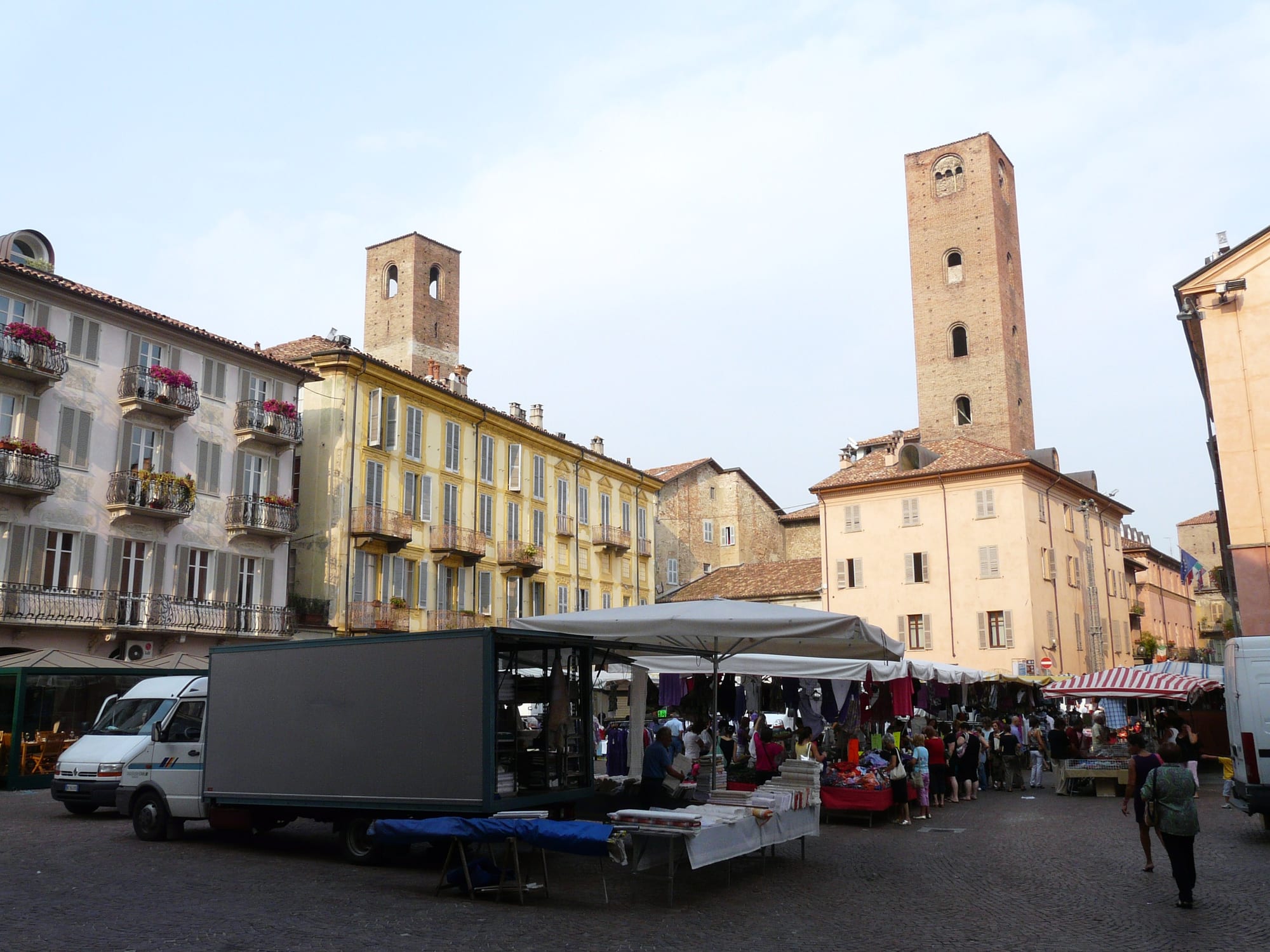
Market stalls in a cobbled square below pastel palazzi and two tall medieval brick towers

Piedmont, Italy

Alba

Market day in Piazza Risorgimento, the historic heart of Alba, with two of the town's medieval towers. (Davide Papalini / Wikimedia Commons · CC BY-SA 3.0)

A market town on the River Tanaro at the foot of the Langhe hills, once the Roman Alba Pompeia and later a medieval commune of many towers. It is the trading centre of the white truffle and of the Barolo and Barbaresco wine country, home of the confectioner Ferrero, and a compact old town of brick towers, churches and food shops.

Neighbourhoods

  • Centro storico
    • First-time visitors
    • Historic district
    • Best for food

    The old town on the right bank of the Tanaro, built over the Roman street plan. Via Vittorio Emanuele, which locals call Via Maestra, runs from Piazza Risorgimento through the centre past churches, wine and food shops, and the surviving medieval towers rise above the rooftops.

    Open in Maps
  • The Langhe wine villages
    • Wine
    • Countryside
    • Quiet stays

    The vineyard hills around the town, where villages such as Barolo, La Morra and Barbaresco sit among the vines. Staying out here means wine estates, farm stays and village restaurants, and a car is all but essential.

    Open in Maps

Things to do

The old town

  • Alba Cathedrallandmark

    The cathedral of San Lorenzo, a Romanesque building probably raised over Roman-era sacred buildings, known for its wood-carved choir stalls of 1512; the three portals and the crypt survive from the original church.

    Open in Maps
  • Piazza Risorgimento and the towerslandmark

    The historic heart of town, with the 13th-century Palazzo Comunale and the best preserved of the 14th- and 15th-century towers that once earned Alba the name of the 'city of a hundred towers'.

    Open in Maps
  • San Domenicolandmark

    A Gothic church of the 13th and 14th centuries with a triple-arched portal and traces of Renaissance frescoes, used as a stable during the Napoleonic Wars.

    Open in Maps
  • Via Vittorio Emanueleneighborhood

    Alba's main street since the beginning, the 'Via Maestra', crossing the old centre from Piazza Risorgimento past the churches of Santa Maria Maddalena and Santi Cosma e Damiano.

    Open in Maps

Short trips into the Langhe

  • Grinzane Cavour Castlelandmark

    A castle on a hill among the vineyards at Grinzane Cavour, inscribed as part of the UNESCO World Heritage Site in 2014.

    Open in Maps
  • Baroloattraction

    The village that gives its name to Barolo wine, made from the Nebbiolo grape and often described as one of Italy's greatest wines.

    Open in Maps
  • La Morraviewpoint

    A long-established wine village of the Barolo country, where it was once illegal to cut down a Nebbiolo vine.

    Open in Maps
  • Barbarescoattraction

    The small village north-east of Alba known for its medieval tower and the wine that bears its name.

    Open in Maps
  • Bra and Pollenzoattraction

    Bra, birthplace of the Slow Food founder Carlo Petrini and host of the biennial Cheese festival, and nearby Pollenzo, campus of the University of Gastronomic Sciences that he established.

    Open in Maps

Seasonal events

  • Vinumspring

    Alba's spring wine event.

  • Alba Music Festivallate May to early June

    A classical music festival of vocal, choral, chamber and orchestral works performed in the town's medieval churches.

  • Palio degli Asinifirst Sunday in October

    A donkey race through the town, held together with the Giostra delle Cento Torri.

  • International White Truffle FairOctober to November

    The fair that grew out of a grape harvest festival in 1928 into a national event, held when Alba's white truffle market is at its busiest.

Eat and drink

Long-standing places and food districts in Alba. Hours, ratings and directions come from your maps app, always current.

Alba classics

  • Truffle season dishesneighborhood

    In autumn the town's restaurants and osterie serve white truffle over tajarin, the thin local egg pasta.

    Open in Maps
  • Osterie of the old townrestaurant

    Informal osterie serving local wine and Langhe specialities are scattered through the centro storico.

    Open in Maps

Food shops and markets

  • Weekend marketmarket

    A large open-air market held at weekends around Piazza Guglielmo Marconi.

    Open in Maps
  • Wine shops on Via Maestraneighborhood

    Small shops in the old centre sell the wines of the surrounding hills, from Barolo and Barbaresco to Dolcetto d'Alba and Barbera d'Alba.

    Open in Maps

Experience Alba

History

People lived here as early as the Neolithic, and the town took its Latin name, Alba Pompeia, when it was recognised as a town by the consul Gnaeus Pompeius Strabo, who was building a road from Acqui to Turin. Parts of a fortified gate and remains of buildings with marble and mosaics survive from the Roman city, which had a polygonal plan. Alba was the birthplace of Pertinax, briefly Roman emperor in 193.

After the fall of the Western Empire the town was sacked again and again, by Ostrogoths, Byzantines, Lombards, Franks, Hungarians and Saracens among others. In the 11th century it became a free commune and joined the Lombard League, and its towers, built in the 14th and 15th centuries, earned it the name of the city of a hundred towers. Montferrat and the Visconti fought over it, and it later passed to the Gonzaga, until the Treaty of Cherasco in 1631 assigned it to Savoy. Under Napoleon it was briefly the Republic of Alba and then part of the French Empire, before returning to the Kingdom of Sardinia in 1814.

The Second World War gave Alba its most famous modern episode. On 10 October 1944 partisans liberated the town and declared a Republic of Alba, which held out until 2 November; the writer Beppe Fenoglio, born here, fought in it. The town received the Gold Medal for Military Valour for its resistance. In 2017 Alba joined the UNESCO Creative Cities Network.

Culture & Customs

Alba is one of the main towns of the Langhe-Roero and Monferrato vineyard landscapes, a UNESCO World Heritage Site, and its identity is bound up with what the hills produce. The white truffle fair, begun in 1928 as a sideshow to the grape harvest festival, has grown into a national event; guests of the fair over the years have included Alfred Hitchcock, Marilyn Monroe and Joe DiMaggio.

Autumn is also the season of the Palio degli Asini, a donkey race through the town on the first Sunday of October. In late spring the Alba Music Festival fills medieval churches with choral and chamber music, and the Vinum fair celebrates the local wines. The Gothic church of San Domenico holds much of the town's finest sacred art, and the Palazzo Comunale and the church of San Giovanni Battista have paintings by Macrino d'Alba, the Renaissance painter believed to have been born here.

Much of the town's life is tied to the land and its products, from the vineyards to the truffle grounds, and the town has its own name, Ârba, in the dialect of the Langhe.

Daily Life

Alba has about 31,000 inhabitants. It is a prosperous town with a broad economy: Ferrero, maker of Nutella, is based here, as are the publishing house Società San Paolo, the textile firm Miroglio and the Banca d'Alba, Italy's largest cooperative credit bank by number of members.

The countryside lives on wine. Around 290 wineries in the Alba area cultivate about 700 hectares of vines, producing Barolo, Barbaresco and Moscato among the top-rank DOCG wines and Barbera, Dolcetto and Nebbiolo among the DOC ones. Truffles, hazelnuts and food tourism add to the local economy, and the town is the shopping and service centre for the villages of the Langhe and Roero.

The rhythm of the year follows the vineyards: harvest in early autumn, then the truffle fair, when visitors fill the streets and restaurants, followed by a quieter winter. A large open-air market fills the area around Piazza Guglielmo Marconi at weekends.

Food

The white truffle, tartufo bianco d'Alba, is the town's great product, found mainly in the Langhe and Monferrato and above all in the countryside around Alba and Asti. The truffle market is busiest in October and November, when the fair takes place. In season it is shaved raw over dishes such as tajarin, the thin Piedmontese egg pasta.

Local sweets include pesche ripiene, stuffed peaches; the hazelnut cake of the Langhe; paste di meliga, biscuits; and bunèt, a custard dessert made with cocoa and amaretto. Hazelnuts and chocolate also underpin the town's best-known industry, the Ferrero confectionery company.

Wine is everywhere. The hills around Alba produce Barolo and Barbaresco from the Nebbiolo grape, along with Barbera d'Alba, Dolcetto d'Alba and sweet Moscato, and the old town's wine shops and osterie are the easiest places to try them. With about 290 wineries in the Alba area alone, the choice runs from famous estates to small family producers.

Planning tools

Budget

Alba itself is moderately priced most of the year, but rooms and restaurant bills rise sharply in October and November, when the truffle fair is on and white truffle dishes command high prices. Wine-estate stays in the surrounding hills cost more than rooms in town, and a hire car or driver adds to the bill.

Daily Budget Midrange
USD 150–290 (mid-range hotel or agriturismo, trattoria dinners, a winery tasting, a hire car)
Daily Budget Shoestring
USD 70–110 (simple B&B, market picnics and osteria lunches, regional trains)

Book rooms early for truffle-fair weekends; winery visits in the hills usually need to be arranged in advance.

Best Time to Visit

October and November are the classic season, with the truffle fair, the end of the grape harvest and the vineyards turning gold, though fog can settle in the valley. Late spring brings the wine fair and the music festival in mild weather. Summers are hot, and winters are quiet.

Suggested Number of Days

The old town needs a day or two. Allow three or four to take in the wine villages of the Langhe as well; the number grows with every winery visit, and a car or a driver makes the hills much easier.

First Visit
1–2 days
With Surroundings
3–4 days

Transportation

The old town is compact enough to walk everywhere, and some locals get about by bicycle. The surrounding Langhe and Roero are poorly served by public transport, so a hire car, a driver or an organised tour is the usual way to reach the wine villages.

Arrange a designated driver or a tour on tasting days, and allow extra time on the winding hill roads.

Airport & Station Connections

Alba lies about 50 km south-east of Turin, and hourly trains from Turin's main stations take about an hour. The nearest large airports are in the Turin area; most visitors arrive by train from Turin or by car.

Walkability

The centro storico is small and flat, and the main sights, squares and shops are a few minutes apart on foot along Via Maestra. The vineyard villages are on hilltops several kilometres away and are not a walk from town.

Safety

Italy is generally safe, with low levels of violent crime against visitors. Alba is a quiet provincial town; the main hazards are the winding hill roads of the Langhe and thick fog in late autumn.

Drive slowly in fog and never drink and drive after tastings. Check current official travel advice before travelling.

Climate

A humid subtropical climate moderated by the nearness of the Mediterranean, drier than the lands north of the Po. Rain falls mostly in spring and autumn, and fog is common in November and December.

Summer
hot, with temperatures that can reach 35°C; July and August are among the drier months
Winter
relatively mild — January is usually around 5°C — with fog in November and December

Local Customs

Food and wine are taken seriously here, and meals are long and unhurried. Greetings matter on entering shops, and friends greet each other with two light kisses on the cheek. Restaurants often add a cover charge, the coperto, and tipping is not expected.

Cover shoulders and knees in churches, and treat a winery visit as a guest would: arrive on time and ask before photographing cellars.

Common Payment Methods

Italy uses the euro. Cards are widely accepted in shops and restaurants; carry some cash for market stalls, small bars and rural wineries.