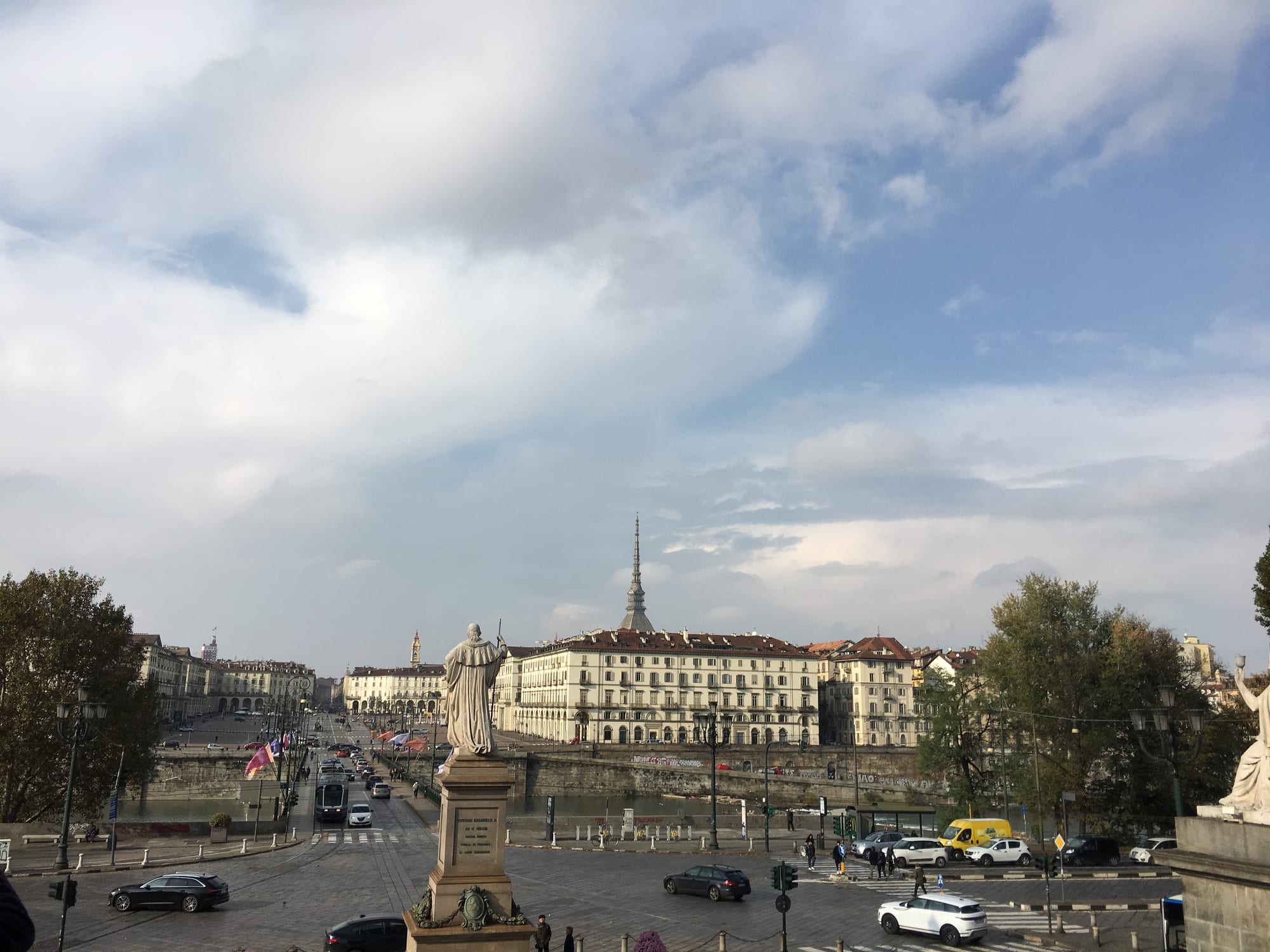
A statue above a wide square and a river bridge, with arcaded palazzi and the tall spire of the Mole Antonelliana beyond

Piedmont, Italy

Turin

Piazza Vittorio Veneto and the Mole Antonelliana seen across the Po from the church of the Gran Madre di Dio. (Torukmato / Wikimedia Commons · CC BY-SA 4.0)

Piedmont's capital on the River Po, with the Alps on the skyline — the Roman Augusta Taurinorum, rebuilt by the House of Savoy as a Baroque royal capital and briefly the first capital of united Italy. Fiat made it the country's car city; today it is a city of arcaded streets, historic cafés, major museums and two rival football clubs.

Neighbourhoods

  • Centro
    • First-time visitors
    • Historic district
    • Close to public transport

    The Baroque core between Porta Nuova station and the Po, laid out on a straight grid of arcaded streets. Via Roma runs through Piazza San Carlo to Piazza Castello and the Royal Palace, Via Po leads to the river at Piazza Vittorio Veneto, and the historic cafés, the cathedral and most of the big museums are a short walk apart.

    Open in Maps
  • Quadrilatero Romano
    • Historic district
    • Best for food
    • Nightlife

    The old district west of the Porte Palatine, on the footprint of the Roman town, renewed in recent decades. Its narrow streets around Piazza Emanuele Filiberto are full of bars and restaurants, and Via Garibaldi, a long pedestrian shopping street, runs along its southern edge.

    Open in Maps
  • San Salvario
    • Nightlife
    • Best for food
    • Parks

    A grid of streets south-east of the centre, between the railway and the Po, crossed by Via Nizza and Via Madama Cristina. Its bars and restaurants make it one of the busiest districts after dark, and Parco del Valentino, the city's central park, runs along its river side.

    Open in Maps
  • Vanchiglia
    • Local life
    • Students and nightlife

    A small triangle of streets between Corso San Maurizio, Corso Regina Margherita and the Po, just beyond the centre, with the neo-Gothic church of Santa Giulia at its heart and a mix of old workshops, flats and bars.

    Open in Maps
  • Crocetta
    • Quiet and residential
    • Markets

    South of the centre, one of the city's most exclusive residential districts, built along wide avenues such as Corso Duca degli Abruzzi and Corso Galileo Ferraris. Corso De Gasperi holds the Mercato della Crocetta, a fashionable open-air market, and the Gallery of Modern Art stands at its northern edge.

    Open in Maps
  • Aurora and Borgo Dora
    • Markets
    • Multicultural

    One of the oldest districts outside the medieval walls, just north of the centre. Borgo Dora, beside the great Porta Palazzo market, is home to a large immigrant community, and the area is mixed, busy and less polished than the centre.

    Open in Maps
  • Lingotto
    • Museums
    • Shopping
    • Close to public transport

    The southern district named after the former Fiat factory, a long building with a test track on its roof, now converted into a shopping, exhibition and hotel complex. The metro runs here from the centre, and the car museum and the Eataly food hall are nearby.

    Open in Maps

Things to do

Famous landmarks

  • Mole Antonellianalandmark

    The tall spire that dominates the skyline, built in the 19th century; a lift climbs inside to the cupola at the top.

    Open in Maps
  • Royal Palace of Turinlandmark

    The 17th-century palace of the House of Savoy on Piazza Castello, with the Royal Armoury in the same complex.

    Open in Maps
  • Palazzo Madamamuseum

    A medieval castle with a Baroque façade in the middle of Piazza Castello, now the Museo Civico d'Arte Antica.

    Open in Maps
  • Turin Cathedrallandmark

    The cathedral of Saint John the Baptist, beside which the Chapel of the Holy Shroud keeps the Shroud of Turin.

    Open in Maps
  • Piazza San Carlolandmark

    The arcaded Baroque square midway along Via Roma, laid out in the 17th century as Piazza Reale, with twin churches at its southern end.

    Open in Maps
  • Porta Palatinalandmark

    A gateway of the Roman town of Augusta Taurinorum with two towers, one of the world's best-preserved 1st-century AD Roman gateways.

    Open in Maps
  • Gran Madre di Diolandmark

    A church modelled on the Pantheon in Rome, across the Po from Piazza Vittorio Veneto, built in the 19th century to celebrate the return of the Savoy king.

    Open in Maps

Museums

  • Egyptian Museummuseum

    One of the largest collections of Egyptian antiquities, on Via Accademia delle Scienze near Piazza San Carlo.

    Open in Maps
  • National Museum of Cinemamuseum

    A museum of film history spread up the inside of the Mole Antonelliana.

    Open in Maps
  • National Automobile Museummuseum

    The national car museum, near Lingotto, telling the story of the industry that made modern Turin.

    Open in Maps
  • Museum of Oriental Artmuseum

    One of the most important collections of Asian art in Italy, housed in a palazzo near the Quadrilatero.

    Open in Maps
  • Sabauda Gallerymuseum

    The royal art collections amassed by the House of Savoy over the centuries.

    Open in Maps
  • Gallery of Modern and Contemporary Artmuseum

    The GAM, the city's modern art museum, on the edge of Crocetta.

    Open in Maps

Parks and the river

  • Parco del Valentinopark

    A popular public park on the west bank of the Po, in San Salvario.

    Open in Maps
  • Castello del Valentinolandmark

    A Savoy residence in the park, one of the UNESCO-listed Savoy residences, now the seat of the Polytechnic University's architecture faculty.

    Open in Maps
  • Borgo Medioevaleattraction

    A replica medieval village and castle on the riverbank in Parco del Valentino.

    Open in Maps
  • Basilica of Supergalandmark

    The Baroque basilica built on the hill east of the city as a thanks-offering for the end of the siege of 1706, a royal mausoleum since 1772 with a view over the city to the Alps; the Superga Rack Railway climbs to it from Sassi.

    Open in Maps

Markets

  • Porta Palazzo marketmarket

    The great open market on Piazza della Repubblica, spread over more than 50,000 square metres, with food, clothing and covered market halls.

    Open in Maps

Music, sport and nights out

  • Teatro Regioattraction

    The city's opera house, where Puccini's La bohème had its premiere in 1896; fire destroyed all but its façade in 1936, and the rebuilt theatre reopened in 1973.

    Open in Maps
  • Juventus Stadiumattraction

    The home ground of Juventus, one of the two clubs whose rivalry, the Derby della Mole, divides the city.

    Open in Maps

Short trips from the city

  • Palace of Venarialandmark

    The vast Baroque hunting palace of the Savoy kings at Venaria Reale, with formal gardens, part of the UNESCO-listed Savoy residences.

    Open in Maps
  • Stupinigi Palacelandmark

    A Savoy hunting lodge designed by Filippo Juvarra for Victor Amadeus II, outside the city.

    Open in Maps
  • Castle of Rivolimuseum

    A former Savoy royal castle west of the city, home to the larger of the two modern art museums of the Turin area.

    Open in Maps
  • Sacra di San Michelelandmark

    An abbey on Mount Pirchiriano, on the south side of the Susa valley, west of Turin.

    Open in Maps

Seasonal events

  • Turin International Book Fairmid-May

    Italy's largest trade fair for books, held at Lingotto Fiere.

  • Kappa FuturFestivalJuly

    A techno music festival in Parco Dora.

  • Terra Madre Salone del Gustoautumn

    An international food fair organised by Slow Food, held every two years.

  • Torino Film FestivalNovember

    An international film festival held over a week, the second largest in Italy after Venice.

Eat and drink

Long-standing places and food districts in Turin. Hours, ratings and directions come from your maps app, always current.

Turin classics

  • Caffè Al Bicerincafe

    A small historic café on Piazza della Consolata, home of the bicerin, the layered drink of espresso, drinking chocolate and milk.

    Open in Maps
  • Caffè Mulassanocafe

    A historic café on Piazza Castello where tramezzini, crustless sandwiches, were first served in 1925 as an alternative to English tea sandwiches.

    Open in Maps
  • Baratti & Milanocafe

    A historic café and confectioner on Piazza Castello, next door to Mulassano.

    Open in Maps
  • Caffè San Carlocafe

    One of the historic cafés under the arcades of Piazza San Carlo.

    Open in Maps

Food districts and markets

  • Porta Palazzomarket

    The city's great open market on Piazza della Repubblica, the biggest open market in Europe.

    Open in Maps
  • Eataly Lingottomarket

    A vast food hall near Lingotto, the original store of what became an international chain of Italian food halls.

    Open in Maps
  • Quadrilatero Romanoneighborhood

    The old Roman quarter's lanes, full of bars and restaurants and busy at aperitivo time.

    Open in Maps

Experience Turin

History

The Taurini, a Celto-Ligurian people, gave the city its name. In the 1st century BC the Romans founded Augusta Taurinorum, a walled colony on a grid plan whose outline still shapes the Quadrilatero, and the Porta Palatina survives from its walls. After Rome it passed to the Ostrogoths, the Lombards and the Franks, and through the marriage of Adelaide of Susa it came under the House of Savoy. By the end of the 13th century, when it was annexed to the Savoy state, it had about 20,000 inhabitants, and the University of Turin was founded in the 15th century.

Turin's great age began in 1563, when Duke Emmanuel Philibert made it his capital. The Savoys enlarged it in planned stages — Piazza San Carlo and Via Roma, the Royal Palace, the arcaded Via Po — and in 1706 the city withstood a French siege of 117 days. The dukes became kings, and in the 19th century, as capital of the Kingdom of Sardinia, Turin led the unification of Italy, becoming the first capital of the new kingdom in 1861 until the move to Florence in 1865.

Industry replaced the court. Fiat was founded here in 1899 and Lancia in 1906, and the 1902 exposition made the city a showcase of Art Nouveau. Allied bombing in the Second World War heavily damaged the city, and partisans freed the city in April 1945. Hundreds of thousands of migrants from the south arrived during the post-war boom, and the population peaked at almost 1.2 million in 1971 before the crises of the 1970s and 1980s cut it by more than a quarter. The 2006 Winter Olympics marked a city remaking itself.

Culture & Customs

Turin wears its royal past openly: the Savoy residences in and around the city form a UNESCO World Heritage Site, and the palaces, squares and arcades of the centre give it a formal, orderly feel unusual in Italy. It is also a city of museums, from the Egyptian Museum to the cinema museum in the Mole, and UNESCO has named it a City of Design. Literature runs deep — the publisher Giulio Einaudi brought out Cesare Pavese, Italo Calvino, Primo Levi and Natalia Ginzburg — and in the 1960s and 1970s the city was a centre of Arte Povera.

Music has its stage at the Teatro Regio, where Puccini's La bohème was first performed in 1896, and newer scenes gather around techno festivals in summer. Football divides households between Juventus and Torino, whose rivalry is the Derby della Mole. The Shroud of Turin, kept in the cathedral, makes the city a destination for pilgrims on the rare occasions it is shown.

Café culture is a point of civic pride: the arcades of Piazza San Carlo hold the city's oldest cafés, Caffè Fiorio on Via Po was the favourite café of 19th-century politicians, and the evening aperitivo, linked to the vermouth first produced in Turin in the 18th century, remains a daily ritual.

Daily Life

About 856,000 people lived in the city proper in 2026, the urban area holds about 1.7 million, and the wider metropolitan area about 2.2 million. Immigrants made up 18.7 per cent of the population in 2025, with large communities in districts such as Borgo Dora and San Salvario, and the city's population has long been shaped by migration from southern Italy.

The car industry is still a pillar — Fiat, now part of Stellantis, keeps a sizeable factory here, and design houses and suppliers surround it — but the economy has broadened. Aerospace firms built modules of the International Space Station in Turin, the University of Turin and the Polytechnic draw large numbers of students, and banking, food companies such as Ferrero, Lavazza and Martini & Rossi, and tourism add to the mix.

Daily rhythms run on coffee at the bar, a working lunch and an evening aperitivo, with the riverside and Parco del Valentino filling on warm evenings. Many families leave for the sea or the mountains in August. A second metro line, linking Mirafiori in the south-west with Barriera di Milano in the north, is planned.

Food

Turin is above all a chocolate city. Gianduiotto, the ingot-shaped chocolate made with hazelnuts, is named after Gianduja, a local commedia dell'arte mask, and gianduja itself is the hazelnut chocolate the city is known for. The bicerin is the signature drink: espresso, drinking chocolate and whole milk served in layers in a small rounded glass. Torrone, nougat, and grissini, thin breadsticks, are among the city's traditional products, and tramezzini, the crustless sandwiches found in bars across Italy, were first served at Caffè Mulassano in 1925.

The wider Piedmontese table is rich and meaty: vitello tonnato, thinly sliced cold veal under a creamy tuna sauce; agnolotti del plin, small pinched stuffed pasta; tajarin, thin egg pasta; and bollito misto, mixed boiled meats with green sauce. Turin also has its own pizza al padellino, a small, thick-crust, deep-dish pizza served in many of the city's pizzerias.

The modern versions of vermouth were first produced in Turin in the 18th century, and it is still served as an aperitif. Porta Palazzo, the great open market on Piazza della Repubblica, hosts the biggest open market in Europe, and the Eataly food hall near Lingotto began here before spreading worldwide.

Planning tools

Budget

Turin is noticeably cheaper than Milan for rooms and restaurants, and the evening aperitivo, where a drink comes with a buffet of snacks, can stand in for a cheap supper. Prices rise for big fairs and events at Lingotto. Many of the major museums charge entry.

Daily Budget Midrange
USD 150–270 (central hotel, trattoria dinners, museum tickets, the odd taxi)
Daily Budget Shoestring
USD 70–110 (hostel or simple B&B, aperitivo suppers, trams and the metro)

The squares, arcades, riverside and parks cost nothing to explore; the Torino+Piemonte Card covers the museums and most other city attractions.

Best Time to Visit

Spring and autumn are the most comfortable seasons, with mild days and the Alps often clear on the horizon; autumn also brings the film festival and the food fairs. Summers are hot and humid, and the city is quieter in August, when many locals leave. Winters are cold but generally dry, with snow possible.

Suggested Number of Days

Two or three days cover the centre and the main museums. Four or five leave time for the royal residences around the city and the hills outside it; a visit planned around a fair or a football match needs a little extra.

First Visit
2–3 days
With Surroundings
4–5 days

Transportation

The centre is walkable, and trams and buses cover the city; tram lines 3, 4 and 9 run as light rail. The automatic metro line runs from the western suburbs through Porta Susa and Porta Nuova stations to Lingotto, and the metropolitan railway serves the suburbs. Driving in the centre is best avoided because of restricted traffic zones.

Buy tram and bus tickets before boarding and validate them on the vehicle.

Airport & Station Connections

Turin Airport, Caselle International Airport Sandro Pertini, is in Caselle Torinese, about 13 km from the centre, linked to the city by rail from Dora station and by bus from Porta Nuova and Porta Susa. High-speed trains reach Milan in under an hour and continue to the rest of Italy; most travellers arrive at Porta Nuova or Porta Susa.

Walkability

The centre is flat and laid out on a regular grid, and its kilometres of arcades keep walkers dry in rain and shaded in summer. Piazza Castello, Piazza San Carlo, the Egyptian Museum, the Mole and the river are all within a short walk of each other. Superga, Lingotto and the outer residences need public transport.

Safety

Italy is generally safe, with low levels of violent crime against visitors. Turin is calmer than Italy's biggest tourist cities; the main concern is pickpockets in busy places, and the streets between Porta Palazzo and the Dora can be unsafe at night.

Keep bags closed and in front on crowded trams and around the stations. Check current official travel advice before travelling.

Climate

A humid subtropical climate with four distinct seasons. Winters are moderately cold and dry, with fog banks on the surrounding plains that rarely reach the city itself; summers are hot on the plain and milder in the hills, and summer rain often comes as heavy thunderstorms.

Summer
quite hot on the plain and milder in the hills, with frequent heavy thunderstorms; the record high is 37.1°C, set in August 2003
Winter
moderately cold and dry — snowfalls are not uncommon, though deep snow is unusual; the record low is −21.8°C, set in February 1956

Local Customs

Polite greetings matter in shops and cafés; friends and family greet each other with two light kisses on the cheek. Coffee is usually taken standing at the bar, and the early-evening aperitivo is a fixed ritual. Restaurants often add a cover charge, the coperto, and tipping is not expected.

Cover shoulders and knees in churches, and keep quiet near the Chapel of the Holy Shroud; football loyalties run deep, so tread lightly with Juventus and Torino jokes.

Common Payment Methods

Italy uses the euro. Cards and contactless payments are accepted almost everywhere, including most cafés; keep a little cash for market stalls and small bars. ATMs are easy to find in the centre and at the stations.