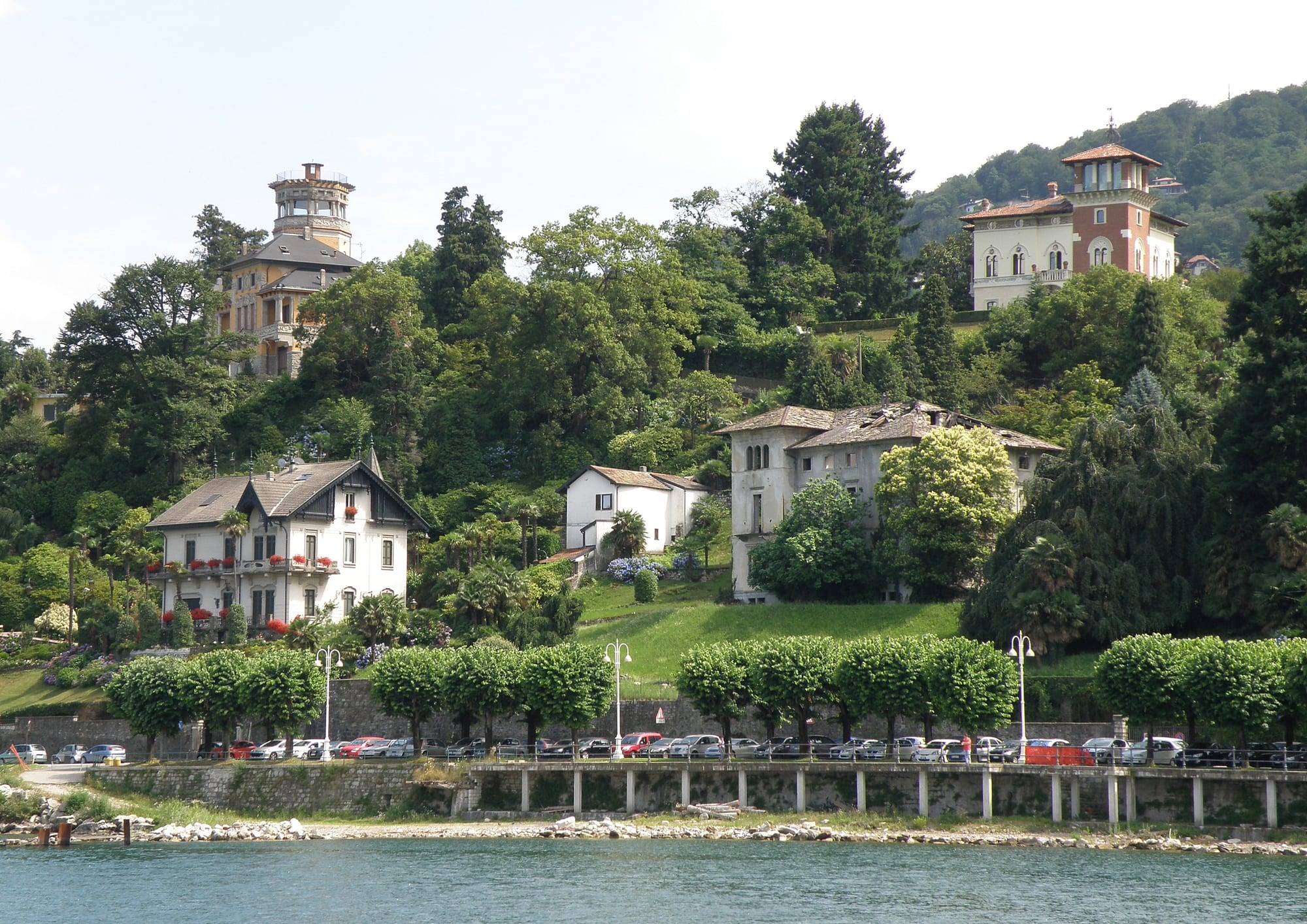
Lakeside villas with towers and red roofs among dense trees above a stone lakefront wall and the blue water of Lake Maggiore

Piedmont, Italy

Stresa

Villas above the lakefront promenade of Stresa on Lake Maggiore. (Torsade de Pointes / Wikimedia Commons · CC0)

A small resort town on the western shore of Lake Maggiore, facing the Borromean Islands across the Borromean Gulf. A fishing village under the Visconti and then the Borromeo family, it grew into a lake resort of villas and grand lakefront hotels on the road and railway to the Simplon Pass, and today lives largely from visitors.

Neighbourhoods

  • Stresa centre and the lungolago
    • First-time visitors
    • Close to public transport
    • Lake views

    The historic core at the south-eastern end of town, with the main ferry dock, the central square and the railway station close by. The lakefront promenade runs past villas, gardens and grand hotels, with Isola Bella in view across the water.

    Open in Maps
  • Carciano
    • Lake access
    • Quieter stays

    The north-western end of town, with a lido, a second ferry landing and the lower station of the cable car to the Mottarone. Isola Bella lies just offshore.

    Open in Maps
  • Isola dei Pescatori
    • Village atmosphere
    • Best for food

    The only one of the Borromean Islands inhabited all year round, a fishing village of narrow lanes and old houses that belongs to the municipality of Stresa. Day visitors come for its fish restaurants; after the last ferries it falls quiet.

    Open in Maps

Things to do

The Borromean Islands

  • Isola Bellalandmark

    An island 400 metres from Stresa, until 1632 a rocky crag with a tiny fishing village, when the Borromeo family began a palace and an Italianate garden on it.

    Open in Maps
  • Isola Madrepark

    The largest of the Borromean Islands, known for its gardens, laid out in the English style from the late 18th century, around a 16th-century Borromeo palace.

    Open in Maps
  • Isola dei Pescatoriattraction

    Fishermen's Island, the one island never owned by the Borromeo family, with a small fishing village and the church of San Vittore.

    Open in Maps

The lakefront and villas

  • Lungolagotrail

    The lakefront promenade lined with historic villas, gardens and grand hotels, looking across the Borromean Gulf.

    Open in Maps
  • Parco della Villa Pallavicinopark

    Gardens and a zoological park of 20 hectares between Stresa and Belgirate, with magnolias, camellias and a great cedar of Lebanon.

    Open in Maps
  • Villa Ducalelandmark

    A villa of about 1770 that passed in 1848 to the philosopher Antonio Rosmini and now houses the International Centre for Rosminian Studies.

    Open in Maps

Short trips from the town

  • Mottaroneviewpoint

    A 1,492-metre mountain rising behind Stresa between Lake Maggiore and Lake Orta, with wide views over the lakes.

    Open in Maps
  • Giardino Botanico Alpiniapark

    A four-hectare garden of alpine plants at 800 metres above Stresa, founded in 1934, with about 1,000 species from the Alps and beyond.

    Open in Maps
  • Villa Taranto Botanical Gardenspark

    Botanical gardens at Verbania, across the Borromean Gulf, reached by ferry.

    Open in Maps
  • Santa Caterina del Sassolandmark

    A 14th-century monastery perched on a rocky ridge above the lake on the Lombard shore, best seen from the ferry.

    Open in Maps
  • Aronaattraction

    A lakeside town at the southern end of the Piedmontese shore, reached by ferry or along the lake road.

    Open in Maps

Seasonal events

  • Stresa Festivalsummer

    An international classical music festival first held in 1962 as the Settimane Musicali di Stresa, with concerts in Stresa, on Isola Bella and Isola Madre and at other venues around the lake.

  • Stresa, un aperitivo con...June

    A literary festival of talks and meetings with authors.

Eat and drink

Long-standing places and food districts in Stresa. Hours, ratings and directions come from your maps app, always current.

Stresa classics

  • Fish restaurants on Isola dei Pescatorineighborhood

    About a dozen restaurants on the fishermen's island specialise in fish dishes, open for lunch and dinner.

    Open in Maps
  • Margheritinecafe

    The town's own biscuits, created in 1857 by the pastry cook Piero Antonio Bolongaro in honour of Princess Margherita of Savoy, the future queen.

    Open in Maps

Food districts and markets

  • Restaurants of the town centreneighborhood

    Restaurants and an ice cream shop stand on and around the central square.

    Open in Maps
  • Outdoor marketmarket

    An outdoor market on Piazza Capucci.

    Open in Maps

Experience Stresa

History

The town's name first appears in a document of 998 as Strixsya. In 1014 the Emperor Henry II gave Stresa to the Benedictine nuns of San Felice in Pavia, and in the 15th century it grew into a fishing community owing allegiance to the Visconti of Milan, before passing to the Borromeo family, who were building their palaces and gardens on the islands offshore from the 16th and 17th centuries.

The modern resort grew on its position on the road and rail routes to the Simplon Pass. Villas went up along the shore, among them the Villa Ducale of about 1770, which passed to the philosopher Antonio Rosmini in 1848, and in 1857 a local pastry cook created the Margheritine biscuits in honour of Princess Margherita of Savoy, who was living there. Ernest Hemingway set part of A Farewell to Arms, published in 1929, in a Stresa grand hotel, and visited the town in 1948. Stresa also gave its name to the Stresa Front of 1935, when the United Kingdom, Italy and France met here and agreed to contain Nazi Germany, and in 1958 to the conference that laid the foundations of the European Community's Common Agricultural Policy.

In September 1943 four of the 57 victims of the massacre of Jews around Lake Maggiore were rounded up in Stresa. More recently, on 23 May 2021, a cabin of the cable car from Stresa to the Mottarone fell, killing fourteen people.

Culture & Customs

Stresa's culture is that of an old lake resort. Its elegant lakefront of grand hotels and historic villas has made it one of the most visited places in Piedmont, and the Borromeo palaces and gardens on Isola Bella and Isola Madre are its great showpieces. Villas and hotels on the shore have served as film locations for Italian comedies and thrillers since the 1940s.

Music has been a central part of the town's identity since 1962, when the Settimane Musicali di Stresa were inaugurated with a concert by the orchestra of La Scala. Now the Stresa Festival, it brings concerts to the Palazzo dei Congressi, the tapestry hall of the palace on Isola Bella and the gardens of Isola Madre, and to churches and hermitages around the lake. In June the town also holds a literary festival.

Isola dei Pescatori, Fishermen's Island, keeps something of the older lake culture: it is the only one of the islands lived on all year round, and unlike its neighbours it never belonged to the Borromeo family.

Daily Life

Stresa has about 4,600 residents. The municipality includes the shore around the historic centre and Carciano, three of the four Borromean Islands, and a string of hill villages above the lake, while Isola dei Pescatori had only about 25 residents in 2018.

Tourism is the economy. The hotels, restaurants, ferries and island palaces employ much of the town, and the season runs from spring, when the gardens flower, to autumn, after which the town is very quiet. Stresa is also the seat of the Capitaneria di Porto, the harbour authority for the whole of Lake Maggiore, and one of the main landing points of the lake's tourist boats.

Daily life follows the timetable of the ferries across the gulf and the trains on the line between Milan and Domodossola, and in the hill villages above the lake life is quieter and more residential than on the busy shore. Until the 2021 crash, the cable car from Carciano linked the town with the Alpinia garden and the ski area of the Mottarone.

Food

Lake Maggiore supplies the town's traditional food. The lake holds two kinds of whitefish, the less widespread of them the lavarello, as well as perch, pike, chub and eel, and fish dishes are the speciality of the restaurants on Isola dei Pescatori and many in town.

The Margheritine are Stresa's own sweet: small biscuits created in 1857 by the pastry cook Piero Antonio Bolongaro for Princess Margherita of Savoy, later the first queen of Italy, who was then living at the Villa Ducale. Ice cream is sold on the central square, close to the lakefront.

Beyond the lake, menus draw on the cooking of Piedmont: risotto, the blue cheese Gorgonzola and Piedmontese wines such as Barbera and Dolcetto. A meal on Isola dei Pescatori, reached by ferry or, after the last boat, by water taxi, is a long-standing part of a stay, and the island's dozen or so restaurants serve both lunch and dinner.

Planning tools

Budget

Stresa is a resort town, and rooms on the lakefront are expensive in summer, when the islands are at their busiest. Ferry tickets and the palace and garden entries on Isola Bella and Isola Madre are the main extra costs. Rooms in the hills or away from the lake, and visits in spring or autumn, are cheaper.

Daily Budget Midrange
USD 160–300 (lake-view hotel, restaurant dinners, island ferries and palace and garden tickets)
Daily Budget Shoestring
USD 80–120 (simple guesthouse or B&B, picnics and pizzerias, trains and ferries)

A combined ticket covers both Isola Bella and Isola Madre; the lakefront promenade costs nothing.

Best Time to Visit

Spring is a favourite season, when the island and villa gardens are in flower. Summer is warm and busy, with the music festival and lake swimming; September and October are quieter, and winter is very quiet.

Suggested Number of Days

One or two days cover the town and the three islands. Allow three or four to add the gardens and towns around the lake and the mountain behind; ferry timetables, which thin out outside summer, decide how much fits.

First Visit
1–2 days
With Surroundings
3–4 days

Transportation

Navigazione Laghi ferries link the main dock, the three Borromean Islands and Carciano, and continue around the Borromean Gulf to Baveno and Verbania and along the lake from Arona to Locarno in Switzerland. Water taxis run from the main dock and the lido, useful after the last ferry. Bicycles can be hired, and there are taxi ranks at the station and the ferry terminal.

Check the last ferry back from the islands, especially outside high summer.

Airport & Station Connections

Stresa station is on the Milan–Domodossola railway, with regular direct trains from Milan Centrale taking around an hour and EuroCity trains to Bern and Basel. The nearest airport is Milan Malpensa, about 43 km away, linked in season by the Alibus coach. By road, the A26 motorway has exits at Carpugnino and Baveno-Stresa.

Walkability

The town is small and easy on foot: the station, the centre and the main ferry dock are close together, and the lakefront promenade leads to Carciano and to the Villa Pallavicino park. The islands are reached by boat, and their lanes and gardens involve steps and slopes.

Safety

Italy is generally safe, with low levels of violent crime against visitors. Stresa is a quiet resort; the main cautions are busy lakefront traffic and the speed of weather changes on the lake and the mountain.

Use licensed ferries and water taxis only. Check current official travel advice before travelling.

Climate

The lake softens the climate, and the area is among the rainiest in Italy. Summers are warm rather than hot, and winters are cold but tempered on the shore, with snow in most winters.

Summer
warm — in nearby Verbania, July averages about 21°C and highs rarely pass 32°C
Winter
cold but mild by the water — in nearby Verbania, January averages about 1.5°C, and snow falls every winter

Local Customs

Stresa has received visitors for well over a century and is used to them, but it keeps an unhurried, slightly formal style. Greetings matter on entering shops, and friends greet each other with two light kisses on the cheek. Restaurants often add a cover charge, the coperto, and tipping is not expected.

Cover shoulders in churches and in the island palace interiors, and keep swimwear for the lido and the beaches.

Common Payment Methods

Italy uses the euro. Cards are widely accepted in hotels, restaurants and shops; keep some cash for small purchases, the market and some transport, such as the seasonal airport coach.