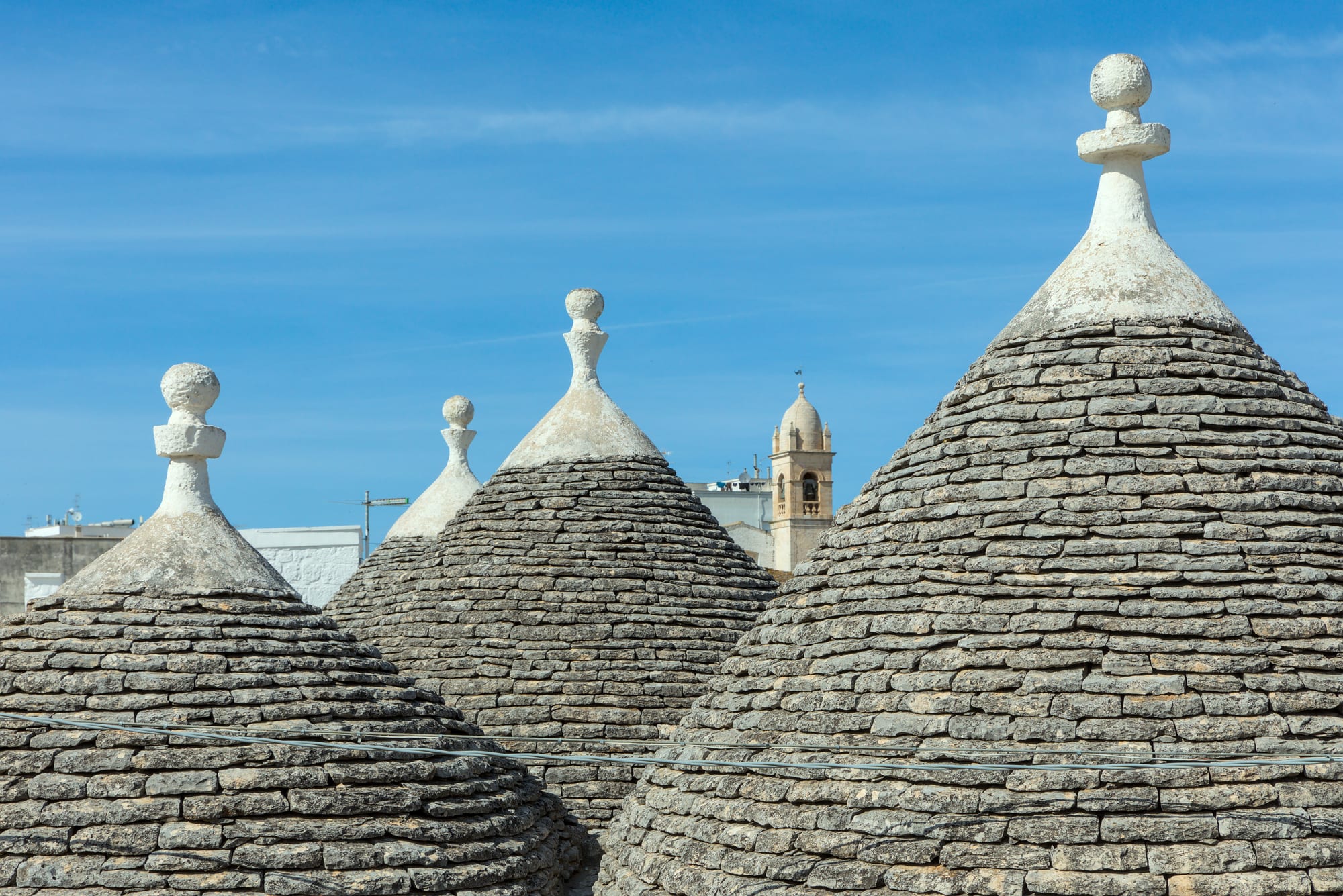
Conical stone roofs of trulli topped with pinnacles in the Rione Monti district

Puglia, Italy

Alberobello

Trulli roofs and their pinnacles in the Rione Monti district of Alberobello. (Benjamin Smith / Wikimedia Commons · CC BY-SA 4.0)

A small town on the low Murge south-east of Bari, famous for its trulli — dry-stone houses with conical stone roofs, packed together in whole districts and listed as a UNESCO World Heritage Site since 1996. Founded by peasant families in the 16th century and freed from feudal rule in 1797, it now lives largely from visitors.

Neighbourhoods

  • Rione Monti
    • First-time visitors
    • Historic district
    • Shopping

    The hillside district densely packed with trulli, where many of the conical houses now hold souvenir shops, restaurants and rooms, while others are still lived in. Linen and other textiles made locally are sold in small shops among the trulli, and the lanes are busiest in the middle of the day.

    Open in Maps
  • Town centre
    • Local life
    • Close to public transport

    The newer part of town on the other side of the main street, Largo Martellotta, which follows the course of the old Cana stream. It holds the basilica of Saints Cosmas and Damian, the Trullo Sovrano and everyday shops and bars, and the railway station is about fifteen minutes' walk away.

    Open in Maps

Things to do

Trulli and landmarks

  • Trullo Sovranomuseum

    One of the largest trulli in the town, 14 metres high, on Piazza Sacramento; originally a simple country trullo, it hosts small plays, concerts and other cultural events in summer.

    Open in Maps
  • Trullo Siameselandmark

    One of the best-known trulli in the town, among its main sights.

    Open in Maps
  • Museo del Territorio Casa Pezzollamuseum

    The largest group of linked trulli open to visitors in Alberobello — fifteen of them, dating from the 18th century — used as the town's museum.

    Open in Maps
  • Basilica of Saints Cosmas and Damianlandmark

    The mother church, dedicated to the town's patron saints and holding their relics, recognised as a sanctuary in 1938 and made a minor basilica in 2000.

    Open in Maps

Short trips in the Itria Valley

  • Locorotondoneighborhood

    A whitewashed town between Alberobello and Martina Franca, listed among the most beautiful villages of Italy, whose old town is easy to explore on foot.

    Open in Maps
  • Martina Francaneighborhood

    The second most populous town in the province of Taranto, host since 1975 of an annual summer opera festival.

    Open in Maps
  • Nocineighborhood

    The neighbouring town from which about forty peasant families came to settle Alberobello in the early 16th century.

    Open in Maps
  • Castellana Cavesattraction

    A karst cave system in the municipality of Castellana Grotte.

    Open in Maps

Seasonal events

  • Feast of Saints Cosmas and Damian25–28 September

    The town's patron saints are celebrated over four days, drawing pilgrims to the basilica that holds their relics.

  • Summer festivalssummer

    Folk, classical, jazz and popular music, theatre and street performances, most of them free and open-air, and religious feasts with music and fireworks.

Eat and drink

Long-standing places and food districts in Alberobello. Hours, ratings and directions come from your maps app, always current.

Food districts

  • Restaurants of Rione Montineighborhood

    Restaurants and wine shops among the trulli, some in the conical houses themselves, selling local cheese, sausages, biscuits and wine.

    Open in Maps
  • Restaurants of the town centreneighborhood

    Trattorias and pizzerias around the main street and the basilica, more used by residents than those in the trulli district.

    Open in Maps

Experience Alberobello

History

Alberobello's name means "beautiful tree", and old records call the area simply a selva, a forest. The land was first settled only in the early 16th century, when Andrea Matteo III Acquaviva d'Aragona, Count of Conversano, allowed about forty peasant families from Noci to farm it in return for a tenth of their crops. In 1635 his successor, Count Giangirolamo II, built an inn with a tavern and an oratory and began turning the forest into a village of small houses.

The count required the houses to be built of dry stone, with no mortar. A 15th-century edict of the Kingdom of Naples, the Prammatica de Baronibus, taxed every new settlement, and buildings without mortar could be passed off as temporary and pulled down quickly, so he avoided paying the Spanish viceroy. With limestone abundant in the surrounding karst, peasants found that a round plan with a self-supporting domed roof was the simplest way to build, and the trullo became the town's form.

Alberobello remained a fief of the Acquaviva family until 27 May 1797, when King Ferdinand IV of Bourbon made it a royal city and freed it from feudal servitude; its first mayor was elected on 22 June. The surviving urban trulli date from the 18th to the 20th centuries. Many families emigrated, a large number of them to Utica in New York State. During the Second World War a farm outside the town, the Casa Rossa, was used by the Fascist government as a transit and internment camp. The trulli were listed as a UNESCO World Heritage Site in 1996.

Culture & Customs

Alberobello is the only inhabited town with an entire district of trulli and is regarded as the cultural capital of the trulli of the Itria Valley. A trullo usually has one room under each cone, with extra living space in arched alcoves. On top of each cone sits a hand-worked pinnacle — a disc, ball, cone or other shape — said to be the signature of the master builder, the trullaro. Some cones carry painted symbols, many of them Christian, such as a cross or a heart pierced by an arrow; the row of symbols on Via Monte Pertica was painted only in the late 20th and early 21st centuries.

The town is a place of pilgrimage as well as tourism: its patron saints, the physician martyrs Cosmas and Damian, are celebrated from 25 to 28 September at the basilica that holds their relics. In summer the town stages folk, classical and jazz music, theatre and street performances, mostly free and in the open air.

Local people have long been known for textiles, and linen is still sold in shops among the trulli. Alberobello has twinned itself with the Japanese villages of Shirakawa-gō and Gokayama, also famous for their traditional houses, and the Giro d'Italia has visited twice, finishing a stage here in 2017 and starting one in 2025.

Daily Life

About 10,200 people lived in the municipality in 2022, in the town and its only outlying village, Coreggia. The centre was built along the old Cana stream, whose course is now followed by Largo Martellotta, the main street. Some trulli are still homes, while many have become shops, restaurants and holiday rooms.

Tourism is now central to the economy. Most visitors are Italian, and the trulli lanes fill in the middle of the day with coach groups and day-trippers from Bari and the coast, then quieten again in the evening. Trulli settlements began to be deserted in the second half of the 20th century, and today many of those in the centre serve visitors.

Life follows the southern rhythm of a long lunch and a quiet afternoon. In summer the passeggiata, the evening stroll, continues past midnight, and the town's festivals and feasts fill the squares. The railway, opened in the first years of the 20th century, links the town with Bari and with the neighbouring towns of Noci and Locorotondo.

Food

Alberobello eats as the Itria Valley and the province of Bari do. Orecchiette, the "little ears" of Puglia, are made from durum wheat semolina, water and salt, rarely with egg: each small piece of dough is pressed and dragged across the board with a knife, then turned over the thumb to give its hollow shape. In the Bari dialect they are often called strasc'nat, from the dragging. They have been documented around Bari since at least the 12th and 13th centuries.

The meat of the valley is the bombetta, "little bomb": a slice of pork capocollo stuffed with Apulian canestrato cheese, salt and pepper, sometimes with parsley, rolled into a bundle and cooked on the grill or in the oven. Butchers guard their own recipes, and variants come wrapped in bacon, filled with ham or spiced.

Shops in the trulli district sell local cheeses, sausages, biscuits, spreads, wine and grappa. Taralli, rings of dough shortened with olive oil or lard, are a snack common across southern Italy.

Planning tools

Budget

Alberobello is moderately priced. Sleeping in a restored trullo costs more than an ordinary B&B, and restaurants in the trulli district charge more than those a short walk away. Many people visit for the day from Bari, Polignano a Mare or other towns of the Itria Valley.

Daily Budget Midrange
USD 140–260 (night in a trullo or masseria, restaurant dinners, museum tickets, a hire car)
Daily Budget Shoestring
USD 60–100 (B&B room, pizza or a trattoria lunch, regional train)

Walking the trulli districts costs nothing; a car makes it easy to combine the town with the other towns of the valley.

Best Time to Visit

Spring and autumn are pleasant for walking. Summer is hot and brings most visitors as well as the festivals and long evening strolls; late September brings the patron saints' feast. Winter is quiet.

Suggested Number of Days

The town itself can be seen in a day, though a night in a trullo lets the lanes empty in the evening. Allow three or four days to use it as a base for the rest of the Itria Valley and the nearby coast.

First Visit
1 day
With Surroundings
3–4 days

Transportation

Everything in town is within walking distance. Alberobello station is on the Bari–Martina Franca–Taranto railway, run by FS Sud Est (until 2026 Ferrovie del Sud Est) rather than Trenitalia, and trains from Bari take about an hour and a half. Most visitors to the wider valley drive.

The regional trains are not run by Trenitalia, so check whether a rail pass is valid before boarding.

Airport & Station Connections

The airports of Bari and Brindisi are each under an hour away by car. Trains run from Bari Centrale, where the Sud Est platforms are inside the main station, and the walk from Alberobello station to the trulli takes about fifteen minutes.

Walkability

A very walkable town: all its sights are within walking distance, and the trulli lanes are short, though some climb steeply. Pavements are narrow and stone surfaces can be slippery after rain.

Safety

Italy is generally safe, with low levels of violent crime against visitors. Alberobello is a quiet town; the main concerns are crowds in the trulli lanes at midday, break-ins to parked cars, and summer heat.

Leave nothing visible in parked cars and carry water in summer. Check current official travel advice before travelling.

Climate

A Mediterranean climate, with hot, dry summers and mild winters; the town stands inland on the low plateau of the Murge.

Summer
hot and dry — on the coast at Bari Palese, August averaged about 24°C in 1971–2000
Winter
mild — January averaged about 9°C at Bari Palese in 1971–2000

Local Customs

Many trulli are private homes: residents are friendly to visitors, but doors, gardens and steps should be treated as private property. Churches expect covered shoulders and knees, and in summer the evening stroll goes on late.

Ask before photographing residents, and do not climb on trulli roofs or walls.

Common Payment Methods

Italy uses the euro. Cards are accepted widely; keep a little cash for small bars, market stalls and rural spots.