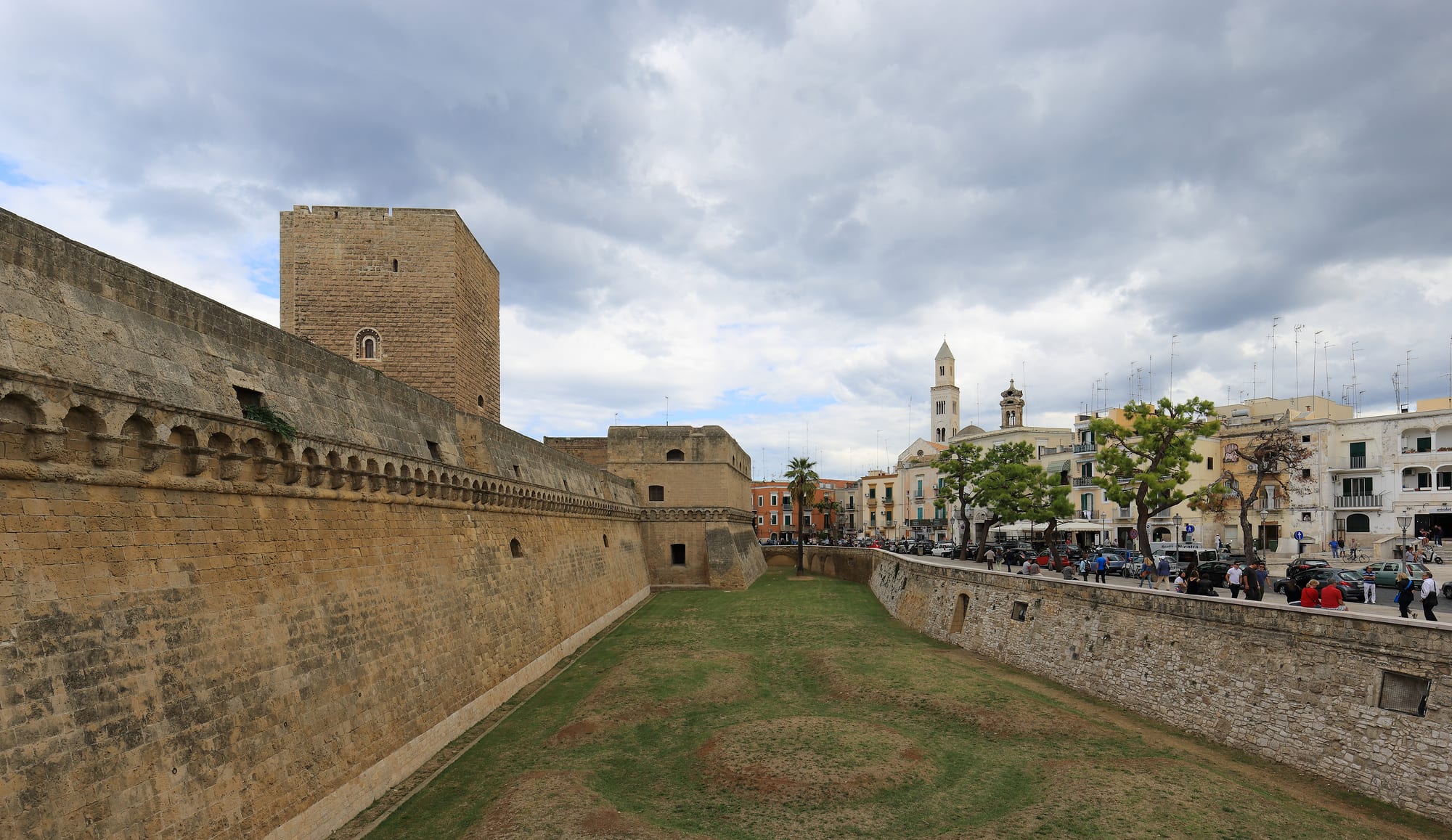
The stone walls and square tower of Bari's castle above a grassy moat, with the cathedral bell tower and old town houses beyond

Puglia, Italy

Bari

The Norman-Swabian castle and its moat, with the old town of Bari and the cathedral bell tower behind. (Martin Falbisoner / Wikimedia Commons · CC BY-SA 4.0)

The capital of Puglia and the largest city on the Adriatic, a port and university city built around a walled old town on a peninsula between two harbours. The relics of Saint Nicholas, landed here in 1087, made it a pilgrimage centre for Catholic and Orthodox Christians alike; today ferries leave for Greece and the Balkans from the edge of the medieval lanes.

Neighbourhoods

  • Bari Vecchia
    • First-time visitors
    • Historic district
    • Nightlife

    The closely built old town on the peninsula between the two harbours, with the Basilica of Saint Nicholas, the cathedral and the castle within a few minutes of one another. Its medieval street plan survives, and the lanes and squares that were once avoided after dark now fill with bars and restaurants at night.

    Open in Maps
  • Murat
    • Shopping
    • Close to public transport
    • Theatre

    The modern heart of the city, laid out from 1813 under Joachim Murat on a rectangular grid south of the old town. Via Sparano and Via Argiro are the main shopping streets, Corso Cavour holds the Teatro Petruzzelli, and the grid runs from Bari Centrale station down to the seafront.

    Open in Maps
  • The Lungomare
    • Walks
    • Sea views

    The long seafront promenade completed in the Fascist era, running along much of the city's coast past the Teatro Margherita and the public buildings of the Fascist era. It is where the city walks in the evening.

    Open in Maps
  • Southern seafront and Torre Quetta
    • Beaches
    • Summer evenings

    Beyond the centre, the coast towards San Giorgio has the city's places to swim and sit by the sea, with Torre Quetta reached by local train. Locals and visitors come here on summer evenings, and some of Bari's clubs stand along this stretch.

    Open in Maps

Things to do

Famous landmarks

  • Basilica of Saint Nicholaslandmark

    Built between 1087 and 1197 to hold the relics of Saint Nicholas, a pilgrimage church for Catholics and Orthodox Christians whose crypt has 26 columns and whose bishop's throne is a major work of Romanesque sculpture.

    Open in Maps
  • Bari Cathedrallandmark

    The cathedral of Saint Sabinus, built mostly in the late 12th century on the ruins of a Byzantine cathedral destroyed in 1156.

    Open in Maps
  • Castello Normanno-Svevolandmark

    The castle built around 1132 under Roger II, destroyed in 1156 and rebuilt by Frederick II in 1233, later home to Bona Sforza; surrounded by a moat and now used for exhibitions.

    Open in Maps
  • Teatro Petruzzelliattraction

    The city's largest theatre, opened in 1903, destroyed by arson in 1991 and returned to the city in 2009 after rebuilding; it stages opera, ballet, plays and concerts.

    Open in Maps

Museums

  • Pinacoteca metropolitana di Barimuseum

    The public picture gallery, also called the Pinacoteca Corrado Giaquinto, showing art connected with Puglia.

    Open in Maps
  • Teatro Margheritamuseum

    A theatre built over the sea on pillars in the old port in 1912–14, used as a theatre and cinema until 1979 and now a museum.

    Open in Maps

Walks and the waterfront

  • Via dell'Arco Bassoneighborhood

    A lane in Bari Vecchia where women have traditionally made orecchiette by hand and sold them from tables outside their homes.

    Open in Maps
  • Bari Vecchia sea wallsviewpoint

    The walk along the top of the old walls on the waterfront, past the Fortino di Sant'Antonio, an old fort now used as a gallery, and the former monastery of Santa Scolastica, which holds an archaeological museum.

    Open in Maps

Sport

  • Stadio San Nicolaattraction

    Renzo Piano's flower-shaped stadium of 26 'petals', built for the 1990 World Cup and home to SSC Bari, holding about 58,000.

    Open in Maps

Short trips from the city

  • Bitonto Cathedrallandmark

    The Romanesque cathedral of the neighbouring city of Bitonto, in the Bari hinterland.

    Open in Maps
  • Polignano a Mareattraction

    A cliff-top town south along the coast, above the Lama Monachile cove.

    Open in Maps
  • Castellana Cavesattraction

    A karst cave system in the municipality of Castellana Grotte, in the Bari hinterland.

    Open in Maps
  • Alberobelloattraction

    The town of trulli, the dry-stone houses with conical roofs that have been a UNESCO World Heritage Site since 1996.

    Open in Maps
  • Trani Cathedrallandmark

    A pale stone cathedral consecrated in 1143 beside the sea in Trani, one of the main examples of Apulian Romanesque.

    Open in Maps
  • Castel del Montelandmark

    Frederick II's octagonal hilltop castle of the 1240s, a UNESCO World Heritage Site that appears on the Italian one-cent coin.

    Open in Maps
  • Materaattraction

    The cave city of the Sassi across the border in Basilicata, linked to Bari by the Ferrovie Appulo Lucane railway.

    Open in Maps

Seasonal events

  • Festa di San NicolaMay, with a second feast on 6 December

    The patron saint's feast marks the arrival of his relics in May 1087 with historical re-enactments, music, a fireworks contest and a procession of the saint's statue; on 6 December masses begin early in the morning and crowds fill the old town through the night.

  • Fiera del LevanteSeptember

    A trade fair held since 1930, with stands from many countries, conferences and musical events.

Eat and drink

Long-standing places and food districts in Bari. Hours, ratings and directions come from your maps app, always current.

Bari classics

  • Orecchiette in Bari Vecchianeighborhood

    Hand-made orecchiette, the 'little ears' of pasta called strasc'nat in dialect, are made and sold in the old town's lanes; the classic dressing is cime di rapa with garlic, anchovies and chilli.

    Open in Maps
  • Panzerotti and focaccianeighborhood

    Fried turnovers usually filled with tomato and mozzarella, and Puglian focaccia topped with tomatoes and olives — the city's everyday street food.

    Open in Maps

Food districts

  • Old town restaurantsneighborhood

    Trattorias, pizzerias and late bars around Piazza Mercantile, Piazza del Ferrarese and the lanes near the basilica.

    Open in Maps
  • Murat and Corso Vittorio Emanuele IIneighborhood

    Pubs, cafés and restaurants on the broad avenue between the old town and the Murat grid, and in the streets around the Teatro Petruzzelli.

    Open in Maps

Experience Bari

History

Bari was a harbour of the Iapygian Peuceti before Rome absorbed it in the 3rd century BC, and its value lay where the coast road met the Via Traiana, with a port for trade to the east. After Rome fell it passed between Ostrogoths, Byzantines and Lombards, served as one of the Mediterranean's major slave depots, and from 847 to 871 was the seat of an emirate before Louis II and a Byzantine fleet took it. It then became the capital of Byzantine rule in southern Italy, until Robert Guiscard captured it in 1071 after a three-year siege.

In 1087 Bari's sailors brought the relics of Saint Nicholas from Myra, and the basilica raised over them was consecrated in 1197. Peter the Hermit preached the First Crusade here in 1095, and Pope Urban II held a council here in 1098 to try to reconcile the Eastern and Western churches. William I of Sicily destroyed much of the city in 1156. A long decline under the kings of Naples was broken by the Sforza dukes and above all by Bona Sforza, Queen of Poland, who settled here in 1556 in the principality she had inherited, and died in the city the next year.

Joachim Murat began the new grid-plan town in 1813, the Apulian Aqueduct brought running water in 1915, and the seafront was built in the 1930s. Bari surrendered without resistance in September 1943; on 2 December a German air raid hit the harbour, and the American ship John Harvey released a secret cargo of mustard gas, a disaster kept secret for years. In August 1991 the ship Vlora docked carrying more than 20,000 Albanians, and that October the Teatro Petruzzelli burned; it reopened in 2009.

Culture & Customs

Saint Nicholas defines the city. His basilica draws Catholic and Orthodox pilgrims from across Europe, and his feast is held twice: in May, marking the landing of the relics in 1087, with re-enactments, music, a fireworks contest and a procession that returns the statue to the basilica, and on 6 December, when masses begin early in the morning and the old town stays crowded all night. The Barese dialect, part of the upper-southern Italo-Romance family, is spoken beside Italian in daily life.

The theatre is a point of civic pride. The Petruzzelli, the fourth-largest theatre in Italy, opened in 1903 with Meyerbeer's Les Huguenots, and its destruction by arson in 1991 and long rebuilding were followed closely; it stages opera, ballet and concerts again. The Bari International Film Festival has run since 2010, Gianrico Carofiglio's crime novels and the television series Lolita Lobosco are set in the city, and the Fiera del Levante has made it a trade-fair city.

Football follows SSC Bari, founded in 1908, at Renzo Piano's Stadio San Nicola, built for the 1990 World Cup and host of the 1991 European Cup final. Bari Vecchia, once avoided at night, has become one of the city's main places to go out, with bars and restaurants around its squares open late.

Daily Life

Bari has about 316,000 residents (2026), the urban area about 750,000, and the Metropolitan City of Bari about 1.2 million. Immigrants make up about 6 per cent, with Georgia, Bangladesh, Albania, Romania and Pakistan the largest countries of birth.

It is one of the main economic centres of mainland southern Italy. Its economy rests on industry, commerce, services and administration, with services employing the largest share of workers, and the port is a cargo hub for south-east Europe as well as a ferry port for Greece and the Balkans. The University of Bari, the Polytechnic University, an academy of fine arts and a conservatory bring a large student population, and the airport handled more than six million passengers in 2023.

The city is divided into 17 neighbourhoods. Most people live not in the old town or the Murat grid but in the residential districts built around the centre in the 1960s and 1970s and the outer suburbs that grew in the 1990s. A third line of the metropolitan railway, to Bitritto, opened in January 2024. Evenings belong to the seafront and to Via Sparano's shops.

Food

Bari's cooking rests on wheat, olive oil and wine. Orecchiette, called strasc'nat in the Bari dialect for the way the dough is dragged across the board, have been documented around the city since the 12th or 13th century, and along Via dell'Arco Basso women have traditionally shaped them by hand and sold them from tables outside their doors. The classic dressing is cime di rapa — turnip tops — with garlic, anchovies, chilli and olive oil, finished with cacioricotta.

Bari is also the home of spaghetti all'assassina, the "assassin's spaghetti": instead of being boiled, the pasta is cooked in a pan, traditionally cast iron, with diluted tomato sauce added a little at a time until it browns and crisps. It most probably reached restaurant menus in the late 1960s or early 1970s, and some trace it to a restaurant in the city centre. Tiella bakes potatoes, rice, onion and mussels together in the round earthenware dish that gives it its name.

Street food is fried and baked dough. Panzerotti, fried turnovers that look like small calzoni, are usually filled with tomato and mozzarella; focaccia pugliese has potato in the dough and is topped with tomatoes, olives and oregano. Pasta al forno, baked pasta with small meatballs and hard-boiled eggs, was the traditional Sunday dish, and taralli and sgagliozze, slices of fried polenta, are eaten in the old town.

Planning tools

Budget

Bari is cheaper than Rome, Florence or the Amalfi Coast, and food is good value, from street snacks to seafood dinners. Cheap beds are scarce in the centre, so budget travellers often pay more for a room than they expect. Rooms cost more around the May feast of Saint Nicholas and in August.

Daily Budget Midrange
USD 130–260 (central B&B or hotel, restaurant dinners, a theatre ticket or a day trip by train)
Daily Budget Shoestring
USD 55–100 (hostel bed or simple B&B, panzerotti and focaccia, city buses and regional trains)

The cathedral is free to enter, and walking the old town and the seafront costs nothing.

Best Time to Visit

Late spring and early autumn are the most comfortable seasons for the city and for trips into Puglia. Early May brings the feast of Saint Nicholas and large crowds of pilgrims. July and August are hot, though the seafront and the old town are busy into the night; winter is mild and quiet, with the 6 December feast as its high point.

Suggested Number of Days

The city itself takes one to two days. As a base for day trips along the coast and inland, four to six days work well. A hire car makes more of the countryside reachable in less time.

First Visit
1–2 days
With Surroundings
4–6 days

Transportation

The old town is walked, not driven. AMTAB city buses cover the rest of Bari, and suburban trains run along the southern seafront. Bari Centrale is the hub for Trenitalia and for the regional railways: Ferrovie del Sud Est to Alberobello and the Valle d'Itria, and Ferrovie Appulo Lucane to Matera, from a separate station beside the main one. A car is easiest for the countryside.

Use the park-and-ride car parks on the edge of the centre rather than driving into the old town.

Airport & Station Connections

Bari Karol Wojtyła Airport, also called Palese, is about 8 km north-west of the centre and linked to Bari Centrale by train, as well as by shuttle and city buses. Bari Centrale is on the Adriatic railway, with trains to Rome, Milan, Bologna and Naples. Ferries sail to Igoumenitsa and Patras in Greece, and to Albania, Montenegro and Dubrovnik.

Walkability

The centre is flat and compact. Bari Centrale to the old town is a walk through the Murat grid, and the old town's lanes are a pedestrian maze. The seafront promenade makes a long, easy walk. The stadium, the outer districts and the southern beaches need a bus or train.

Safety

Italy is generally safe, with low levels of violent crime against visitors. In Bari pickpockets work the narrow, crowded lanes of the old town, and at night there can be drunk people in the nightlife area. The old town is now busy with bars and restaurants at night.

Keep bags closed in the lanes of Bari Vecchia and on crowded buses, and leave nothing visible in a parked car. Check current official travel advice before travelling.

Climate

A hot-summer Mediterranean climate bordering on semi-arid, with mild winters and hot, dry summers. Northerly winds can bring sudden storms and sharp drops in temperature even in summer.

Summer
hot and dry, with heatwaves — the airport station recorded 45.6°C in July 2007
Winter
mild on this coast, though the record low is -5.9°C, in January 1993; snow is uncommon, though it fell in several winters including 2017 and 2018

Local Customs

Bari is the city of Saint Nicholas, and the basilica is visited by Catholic and Orthodox pilgrims; shoulders and knees should be covered inside churches. Most of the old town's other churches are closed to visitors. The evening passeggiata along the seafront and through the Murat streets is a daily habit, and the Barese dialect is widely spoken alongside Italian.

Keep voices down and avoid photography during services, especially in the crypt of the basilica.

Common Payment Methods

Italy uses the euro. Cards are accepted widely in shops, hotels and restaurants; keep a little cash for small bars, street food in the old town and bus tickets.