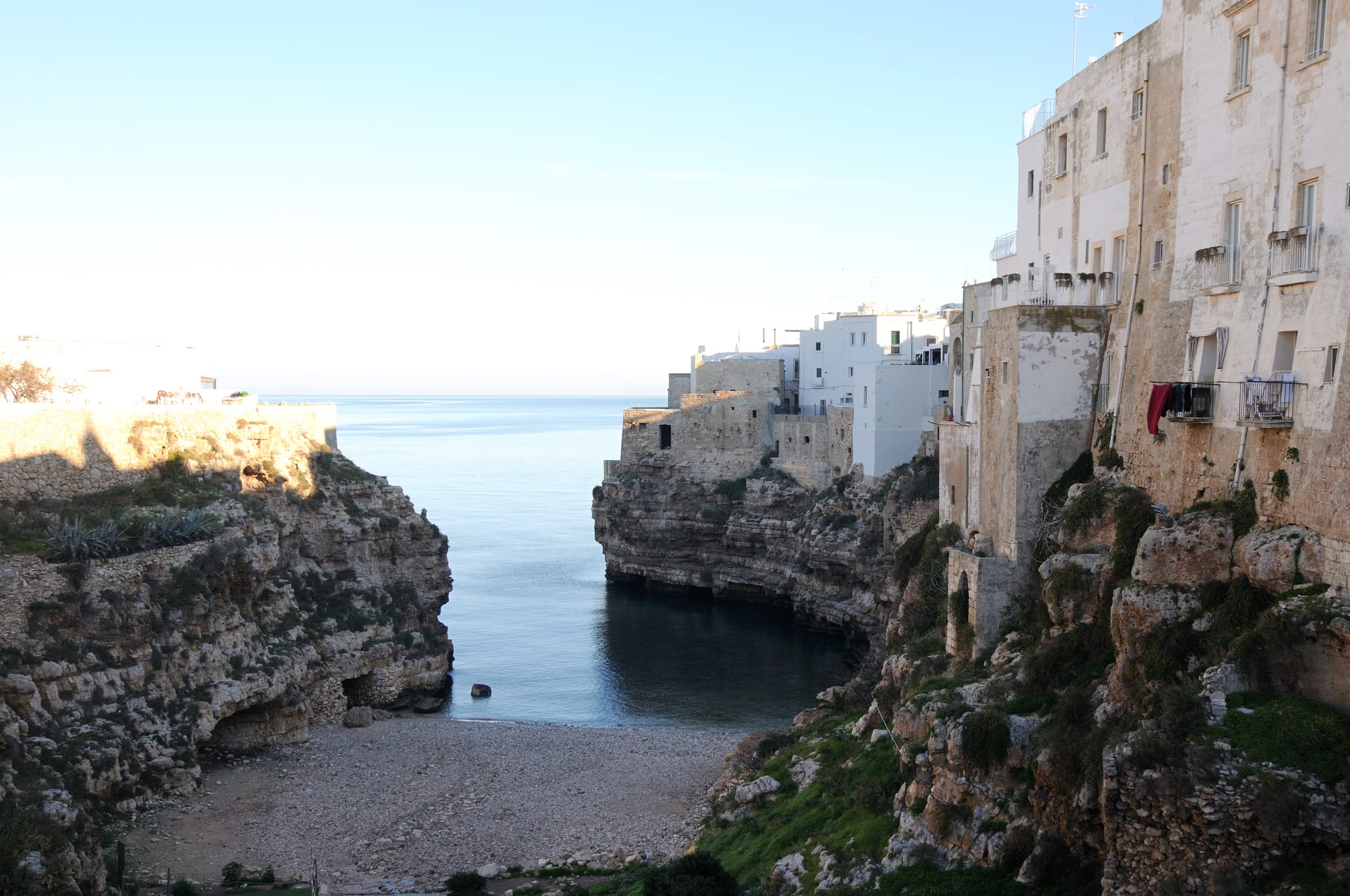
A pebble cove between limestone cliffs, with pale stone houses built on the cliff edge above calm sea

Italy

Puglia

The Lama Monachile cove below the old town of Polignano a Mare, on the Adriatic south of Bari. (Josep M. Gracia / Wikimedia Commons · CC BY-SA 4.0)

The heel of Italy's boot, a long, mostly flat region between the Adriatic and the Gulf of Taranto — a land of olive groves, white hill towns, the conical trulli of the Valle d'Itria, the baroque city of Lecce, the port of Bari and the wooded Gargano promontory in the north.

Explore Puglia

History

Before Rome, Puglia belonged to the Iapygian peoples — Daunians in the north, Peucetians around Bari and Messapians in the Salento — while Spartan colonists founded Taras, later Taranto, around 700 BC, the most powerful Greek city in the region. Rome conquered the area in the 3rd century BC, and the Via Appia ran to Brindisi, the empire's port for Greece and the East.

After Rome the region was fought over by Goths, Lombards, Byzantines and Arab raiders; Bari was briefly the seat of an emirate in the 9th century and then the capital of Byzantine rule in southern Italy. The Normans took Bari in 1071, and in 1087 its sailors carried off the relics of St Nicholas from Myra, building the basilica that made the city a pilgrimage centre. Under Frederick II in the 13th century Puglia was a favoured seat of the Holy Roman Emperor, who built castles such as Castel del Monte. In 1480 an Ottoman force captured Otranto and killed hundreds of its inhabitants, remembered as the Martyrs of Otranto.

Spanish viceroys and then the Bourbons ruled Puglia as part of the Kingdom of Naples, and Lecce flowered in the 17th century with the baroque churches that define it. After unification in 1861 the region was a land of large estates and landless labourers, and land reform after the Second World War broke many of them up. The Taranto steelworks, built in the 1960s, brought jobs and pollution, and in 1991 some 20,000 Albanians arrived in Bari on the ship Vlora, an early sign of Puglia's role as a gateway across the Adriatic.

Culture & Customs

Puglia's identity is split between north and south. The Salento, south of Brindisi and Taranto, feels almost like a separate land, with its own dialects and, in the villages of the Grecìa Salentina, a Greek dialect called Griko still spoken by older people. The Salento's music is the pizzica, a fast tambourine dance descended from rituals once used to "cure" women believed bitten by the tarantula, and it draws huge crowds to the Notte della Taranta festival in Melpignano each August.

Religion is public and processional. Bari's feast of San Nicola in May brings a procession by sea, Taranto's Holy Week rites send hooded brotherhoods through the streets at a slow sway for hours, and Monte Sant'Angelo and San Giovanni Rotondo, where Padre Pio lived, draw pilgrims to the Gargano. Summer village feasts light streets with elaborate wooden illuminations, the luminarie.

Crafts include Lecce's papier-mâché saints, the ceramics of Grottaglie and the dry-stone walling of the trulli country. Pugliesi are known for hospitality and a strong attachment to family land, and emigrants who left for the north, Germany or Argentina return every August for the holidays.

Daily Life

About 3.9 million people live in Puglia. Bari, with about 315,000, is the regional capital, a port, university and trade-fair city; Taranto, Foggia, Andria, Lecce and Brindisi are the other main centres. The population lives in large towns rather than scattered villages, a legacy of estates worked by labourers who walked out daily to the fields.

Farming remains central: Puglia produces more olive oil than any other Italian region, along with wine, durum wheat on the Tavoliere and table grapes, and it is one of the country's main vegetable gardens. Industry includes the ex-Ilva steelworks at Taranto, a long-running health and employment crisis, and aerospace and mechanics around Bari and Brindisi. Since the 2000s tourism has grown fast, and restored masserie and trulli now house visitors.

The olive disease Xylella fastidiosa, which has killed millions of trees in the Salento since 2013, has changed the look of the southern landscape. Daily life follows the southern rhythm of a long lunch, a quiet afternoon and a late evening passeggiata along the seafront.

Food

Puglian cooking rests on bread, durum wheat, vegetables, olive oil and seafood. Orecchiette, "little ears" of pasta, are the regional shape, served classically with cime di rapa, turnip tops, garlic, chilli and anchovy. Fave e cicoria, a purée of dried broad beans with bitter chicory, is the classic peasant dish, and Bari's tiella layers rice, potatoes and mussels in one baked pan. Raw seafood — sea urchins, mussels, octopus — is eaten at the harbour in Bari.

Bread is serious: the pane di Altamura, from durum-wheat flour, has protected status, and Bari's focaccia is topped with tomatoes and olives. Street food includes panzerotti, fried pastries filled with tomato and mozzarella, and bombette, small rolls of pork stuffed with cheese, grilled in the butcher-grills of the Valle d'Itria. Burrata, a pouch of mozzarella filled with cream and shreds of curd, comes from Andria, and taralli, crunchy ring-shaped crackers, accompany every drink. The sweet of Lecce is the pasticciotto, a shortcrust pastry filled with custard.

Puglia's wines are big reds and rosés: Primitivo di Manduria, Negroamaro and the Salice Salentino made from it, and Nero di Troia in the north.

Attractions & Natural Wonders

In the centre of the region, Bari's old town holds the Basilica of San Nicola and the Norman-Swabian castle, and the coast to the south runs past Polignano a Mare, whose white houses stand on cliffs above the Lama Monachile cove, and Monopoli's harbour. Inland lies the Valle d'Itria, where Alberobello's Rione Monti is packed with conical trulli, alongside the white towns of Locorotondo, Cisternino and Martina Franca and the Grotte di Castellana caves. Ostuni, the "white city", rises on its hill above the olive groves, and the Roman ruins of Egnazia lie near Fasano. To the west, on the Murge plateau, stands Castel del Monte, and on the coast the cathedral of Trani faces the sea.

The Salento has Lecce's baroque, above all the Basilica of Santa Croce, and its Roman amphitheatre; Otranto's cathedral with its vast 12th-century floor mosaic; Gallipoli's island old town; and the long coasts down to Santa Maria di Leuca at the tip of the heel. Taranto's MArTA museum holds Greek gold and sculpture.

In the north, the Gargano national park covers a limestone promontory with the beech woods of the Foresta Umbra, sea caves and the resorts of Vieste and Peschici, the cave sanctuary of St Michael at Monte Sant'Angelo, and ferries to the small Tremiti Islands offshore.

Cities in Puglia

Planning basics

Budget

Puglia is cheaper than Tuscany or the Amalfi Coast and good value for food, but prices have risen with its popularity. Restored masserie (fortified farmhouses) and trullo rentals can be expensive, and beach clubs in the Salento charge high rates in August, while Bari, Lecce and the inland towns remain reasonable.

Daily Budget Midrange
USD 140–290 (masseria or boutique B&B, restaurant dinners, a hire car)
Daily Budget Shoestring
USD 55–100 (B&B or hostel in Bari or Lecce, focaccia and panzerotti, regional trains and buses)

A hire car pays for itself in the Valle d'Itria and the Salento; avoid the August peak, when prices and crowds jump.

Safety

Puglia is generally safe for visitors. Petty theft happens around Bari's station and on busy beaches, cars are occasionally broken into, and some country roads are fast and poorly lit. Summer heat, strong sun and wildfire risk in dry scrubland are the main natural hazards.

Leave nothing visible in parked cars, carry water in summer and respect fire bans. Check current official travel advice before travelling.

Climate

Puglia is one of Italy's sunniest and driest regions. Summers are long and hot, with the Salento and the Tavoliere plain around Foggia among the hottest places in the country, and winters are mild on the coast. The Gargano and the Murge plateau are cooler and occasionally see snow, and strong winds blow across the flat peninsula.

Summer
hot and dry, 30–36°C inland and on the Tavoliere; slightly cooler on the breezy coast
Winter
mild on the coast, 7–14°C; cold snaps and occasional snow on the Murge and Gargano

Transportation

Bari and Brindisi have the region's main airports. High-speed trains link Bari with Rome and fast trains run along the Adriatic to Lecce, while local railways and buses reach Alberobello, the Valle d'Itria and the Salento villages, less often on Sundays. Ferries sail from Bari and Brindisi to Greece, Albania and the Balkans. A car is the simplest way to tour the countryside, the Gargano and the Salento coast.

Book cars early for summer; park outside historic centres, which are mostly camera-enforced ZTL zones.

Best Time to Visit

May, June and September are ideal: warm sea, open beach clubs and fewer people. July and August are hot and crowded, especially around Gallipoli and Polignano, though they bring village festivals and the Notte della Taranta concert. April and October suit the towns and walking; in winter many coastal hotels close.