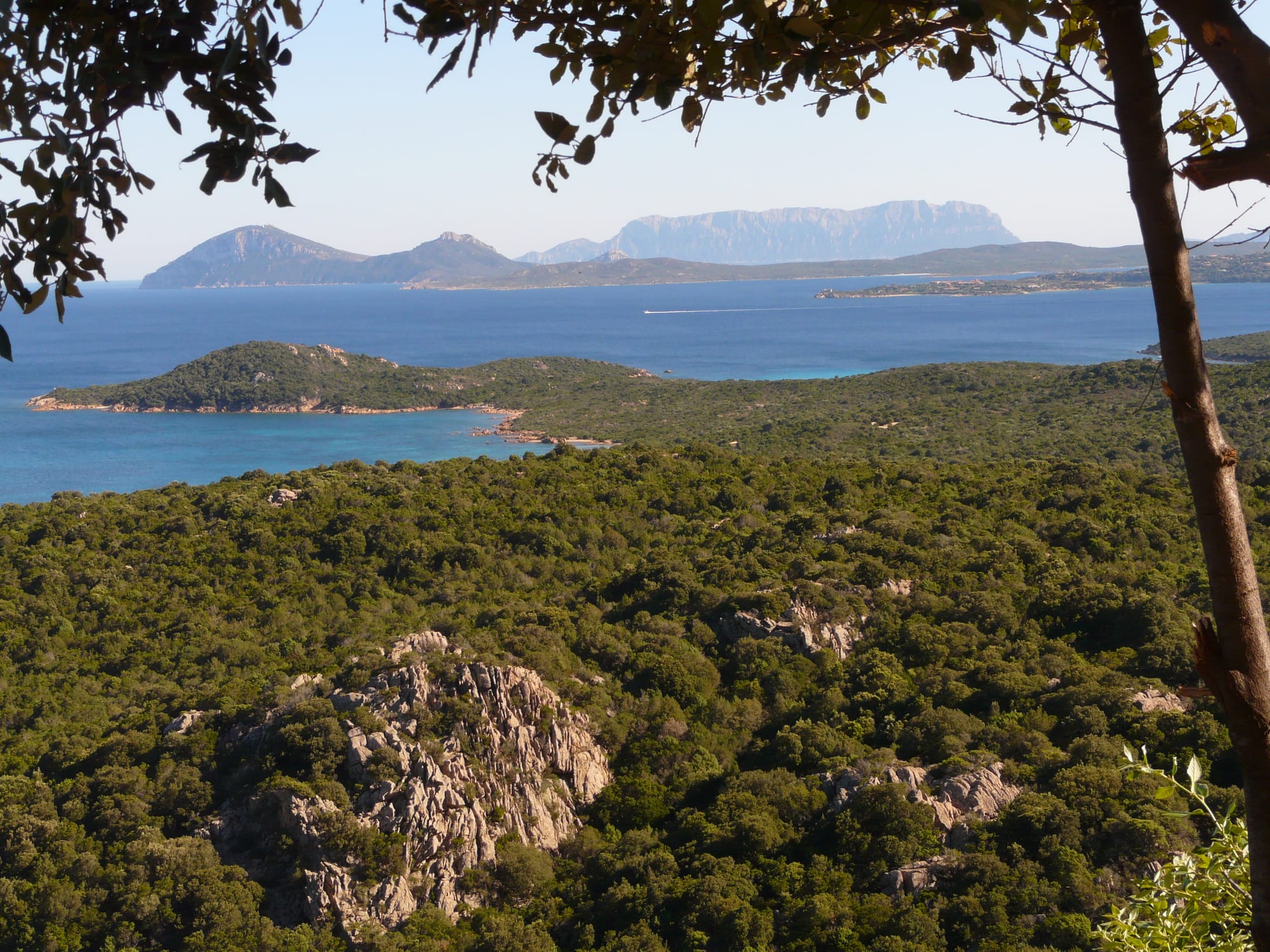
Green scrub-covered granite hills sloping to a blue bay, with a headland and the sheer island of Tavolara beyond

Italy

Sardinia

The coast of the Costa Smeralda near Arzachena, looking south-east towards the island of Tavolara. (Ökologix / Wikimedia Commons · CC0)

The second-largest island in the Mediterranean, lying west of the Italian mainland and south of Corsica — an autonomous region with its own language, thousands of Bronze Age nuraghe towers, the capital Cagliari, Catalan-flavoured Alghero, and a long coast running from the Costa Smeralda and the La Maddalena archipelago to the cliffs of the Gulf of Orosei.

Explore Sardinia

History

Sardinia's defining ancient culture is the Nuragic civilisation, which from about 1800 BC built thousands of nuraghi, cone-shaped stone towers, along with "giants' tombs" and sacred wells. Phoenicians founded ports such as Nora, Tharros and Karalis, today's Cagliari; Carthage then took control, and Rome seized the island in 238 BC, although the mountain peoples of the interior, which Romans called Barbaria, were never fully subdued.

After Vandal and Byzantine rule, Sardinia developed four independent kingdoms, the giudicati, by the 10th century. Pisa and Genoa gradually took over, until the Crown of Aragon conquered the island from 1323. The last giudicato, Arborea, resisted for decades, and its ruler Eleanor of Arborea updated the Carta de Logu, a law code that remained in force for centuries. The Aragonese repopulated Alghero with Catalans in the 14th century, and Spain ruled the island until the early 18th century.

In 1720 Sardinia passed to the House of Savoy, whose Kingdom of Sardinia, centred on Piedmont, unified Italy in 1861. The island remained poor, with malaria endemic on the coasts until a campaign eradicated it after the Second World War. Sardinia became an autonomous region in 1948, and in the 1960s the Aga Khan developed the Costa Smeralda. Kidnappings by bandits in the interior were a notorious problem until the 1990s.

Culture & Customs

Sardinian, or sardu, is recognised as a language in its own right, with two main varieties, Logudorese and Campidanese. Alghero speaks a form of Catalan, the island of San Pietro speaks the Ligurian dialect of Carloforte, and Sassarese and Gallurese in the north are close to Corsican.

Music is distinctive: the canto a tenore, a four-part guttural singing from the Barbagia, is on UNESCO's intangible heritage list, and the launeddas, a triple reed pipe, is played with circular breathing. Festivals are ancient and costumed: at carnival in Mamoiada the mamuthones walk in black wooden masks and sheepskins hung with cowbells; in Oristano's Sartiglia masked riders spear a star at the gallop; Cagliari's procession of Sant'Efisio on 1 May fills the streets with traditional dress; and Sassari's Cavalcata Sarda and Candelieri draw huge crowds.

The interior, especially the Barbagia, keeps a strong pastoral culture of sheep, hospitality and honour, and murals in Orgosolo record its politics. The novelist Grazia Deledda from Nuoro won the Nobel Prize in Literature in 1926. Crafts include woven carpets, gold filigree jewellery, Pattada knives and Alghero coral.

Daily Life

Just over 1.5 million people live on the island, making it one of Italy's least densely populated regions. Cagliari, with about 150,000 people and over 400,000 in its metropolitan area, is the capital; Sassari is the second city, and Olbia, Nuoro, Oristano and Alghero are the other main towns. The inland villages are ageing and shrinking.

The economy relies on tourism, public services, farming and sheep-rearing — the island has millions of sheep, and much of Italy's pecorino romano is made here. Mining in the south-west has largely ended, leaving industrial heritage, and military bases and training ranges cover large areas and are a political issue. Unemployment is high, especially among young people.

The mountainous province of Nuoro is known for the unusual number of people who live to 100, and the rhythm of life there remains slow and family-centred. Current debates include depopulation, ferry costs, wind and solar projects, and overtourism on the most famous beaches.

Food

Sardinian cooking comes from shepherds as much as from fishermen. The centrepiece of a feast is porceddu, suckling pig roasted slowly over a wood fire and served on myrtle leaves. Pane carasau, a thin crisp flatbread made to keep for weeks on shepherds' journeys, is also used in pane frattau, layered with tomato, pecorino and a poached egg.

Pasta includes malloreddus, small ridged semolina shells often served with sausage and tomato; culurgiones, from the Ogliastra, pleated dumplings filled with potato, pecorino and mint; and fregola, toasted semolina pearls often cooked with clams. Bottarga, dried and pressed mullet roe from the lagoons of Cabras, is grated over pasta. Cheeses include pecorino sardo and fiore sardo, and casu marzu is a sheep's cheese deliberately fermented by insect larvae. Seadas are fried pastries filled with fresh cheese and drizzled with honey.

Wines include Cannonau, the island's red, Vermentino di Gallura, a white from the granite north-east, and Vernaccia di Oristano. Mirto, a liqueur made from myrtle berries, is the traditional end to a meal.

Attractions & Natural Wonders

In the south, Cagliari's Castello quarter overlooks the port from its medieval walls and the Bastione di Saint Remy, with the cathedral and an archaeological museum holding some of the Mont'e Prama giant stone statues; the Poetto beach and the flamingos of the Molentargius salt pans lie close by. The Phoenician and Roman site of Nora, the beaches of Villasimius and the island of San Pietro complete the area. Inland, Su Nuraxi at Barumini, a UNESCO World Heritage Site, is the most famous of the Bronze Age nuraghi, and others include Santu Antine near Torralba and the Nuraghe Losa.

On the west coast lie the ruins of Tharros on the Sinis peninsula and the beach of Is Arutas. Further north, Alghero's walled Catalan old town looks out towards Capo Caccia, where the Neptune's Grotto sea cave can be reached by boat or a long cliff staircase; La Pelosa beach at Stintino and the Asinara national park lie further north.

In the north-east, the Costa Smeralda runs past Porto Cervo's marina and granite coves, with the Coddu Vecchiu giants' tomb near Arzachena. Off Palau, the La Maddalena archipelago national park includes La Maddalena town and Caprera with Garibaldi's house. On the east coast, the Gulf of Orosei has Cala Luna and Cala Goloritzè, with the Gorropu canyon and the cave village of Tiscali in the Supramonte above.

Cities in Sardinia

Planning basics

Budget

Costs vary greatly. The Costa Smeralda is one of the most expensive places in Italy in summer, and August prices rise everywhere on the coast, while the interior, Cagliari and the south-west offer good value in B&Bs and agriturismi. Ferries with a car and hire cars are major costs, especially in high season.

Daily Budget Midrange
USD 150–320 (hotel or agriturismo, restaurant dinners, a hire car, boat trips)
Daily Budget Shoestring
USD 65–100 (B&B or campsite, bakery and trattoria meals, buses)

Book ferries and hire cars months ahead for July and August, or travel in June or September for far lower prices.

Safety

Sardinia is one of Italy's safest regions. The main risks are natural: strong winds and rough seas, rip currents on exposed beaches, summer heat and wildfires, and remote hiking trails in the Supramonte with little water or signal.

Check wind and sea conditions before swimming or boating, carry water on hikes, and follow fire bans. Check current official travel advice before travelling.

Climate

Sardinia has a Mediterranean climate, with hot dry summers and mild wet winters on the coasts. The mountainous interior around the Gennargentu is cooler, with snow on the highest ground in winter. The island is windy: the maestrale, or mistral, blows from the north-west, cooling summer days and whipping up the sea.

Summer
hot and dry, 28–35°C inland; breezy and a little cooler on the coasts
Winter
mild on the coasts, 8–15°C; cold in the mountains, with snow on the Gennargentu

Transportation

Cagliari, Olbia and Alghero have the main airports, and ferries sail from Genoa, Livorno and Civitavecchia to Olbia, Golfo Aranci, Porto Torres and Cagliari. The island's railways are limited and slow, and buses cover most towns but thinly. A car is essential for the coasts and the interior, and roads are good but slow in the mountains. Frequent ferries cross from Palau to La Maddalena.

Hire a car for the whole trip; allow more time than the map suggests for mountain roads.

Best Time to Visit

May, June and September are the best months for beaches and walking. July and August are hot and crowded, with high prices and busy ferries. Spring and autumn suit the interior and the hiking of the Supramonte, and festivals include Cagliari's procession of Sant'Efisio on 1 May and the carnival masks of Mamoiada in winter.